


Antennas, Antenna Cables, Wireless Products: Technical Articles
N-Type Connector Guide: Specs, N vs SMA & How to Choose the Right One
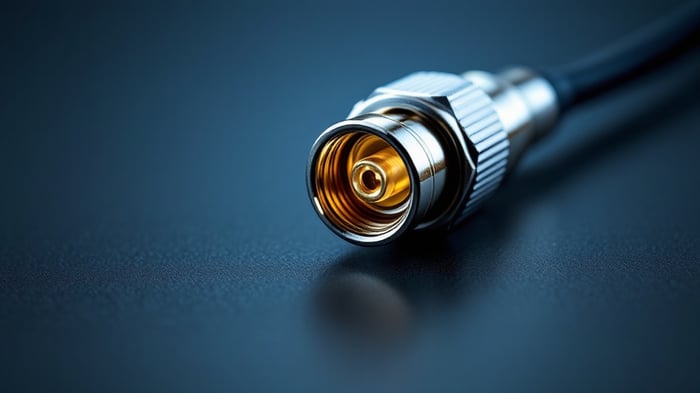
An N-type connector is a rugged, weatherproof 50-ohm threaded RF coaxial connector rated to roughly 11 GHz, used wherever a larger, durable connection is needed on outdoor WiFi, cellular, GPS and long-range antenna systems. If you are terminating thicker low-loss coax such as LMR-400 or RG-213, or building a connection that has to survive the weather on a tower or rooftop, the N-type connector (also written "type N connector" or just "N connector") is usually the right choice. This guide explains the key N-type specs, how it compares to SMA, the difference between male and female, and how to match an N connector to your coax and radio.
What is an N-type connector?
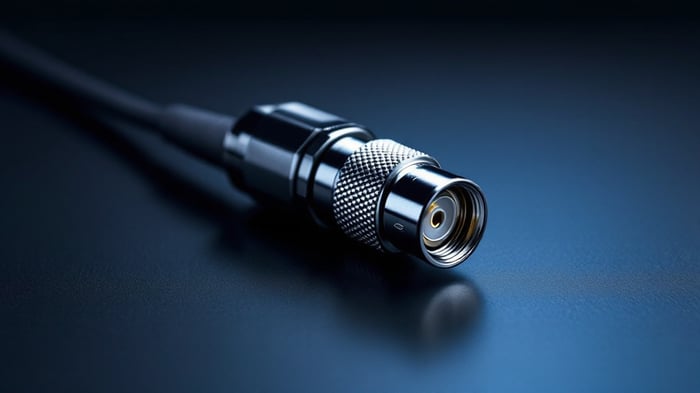
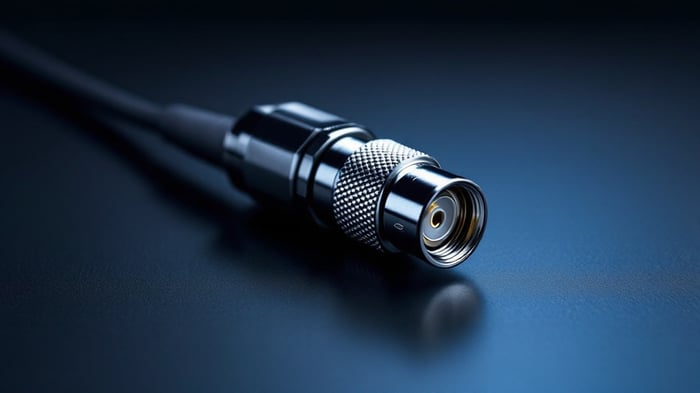
The N-type connector is a medium-sized threaded RF connector developed in the 1940s and named after its inventor, Paul Neill. It uses a threaded coupling nut to create a secure, vibration-resistant mate and an air or dielectric gap that supports higher power and higher frequencies than many compact connectors. The most common variant is 50-ohm, which is what you want for WiFi, cellular, LoRa and virtually all two-way RF systems; a 75-ohm N variant also exists for some video/broadcast work, and the two are not safely intermateable without risking damage to the center pin. Because the N-type connector is physically larger and weatherproof-capable, it is the default on outdoor base-station antennas, LMR-400 feedlines and bulkhead pass-throughs.
N-type connector specifications to verify
Do not assume every N connector is identical — plating, body style and the coax it is designed to terminate all vary. The figures below are typical industry values; always confirm the exact rating against the specific part's datasheet before you design a link budget or specify a build.
| Spec | Typical N-type value | Why it matters |
|---|---|---|
| Impedance | 50 ohm (75 ohm variant exists) | Must match the coax and radio or VSWR rises |
| Frequency range | DC to ~11 GHz (precision N to ~18 GHz) | Sets the ceiling for mmWave / high-band use |
| Coupling | Threaded (5/8"-24 TPI) | Vibration-resistant, repeatable torque |
| Weatherproofing | Available weatherproof / gasket-sealed | Critical for outdoor tower and rooftop runs |
| Typical coax terminated | LMR-400, RG-213, LMR-240, RG-58 | Body is sized to the cable's outer diameter |
| Mating cycles | Several hundred (confirm per part) | Matters for test/lab vs set-and-forget installs |
If you are building a long feedline, connector choice is only part of the loss story — the coax type and run length dominate. For the loss-per-foot figures that drive those decisions, see our antenna cable selection guide, and for the construction differences between thinner coax families, our comparison of RG-58 vs LMR-200 and LMR-100 coax shielding and signal loss.
N-type connector vs SMA: which should you use?
The most common cross-shopping question is N-type vs SMA. Both are 50-ohm threaded connectors, but they target different use cases. SMA is small, rated to 18 GHz, and dominates compact indoor gear, IoT boards and short pigtails. The N-type connector is larger, typically rated to ~11 GHz, handles more power, and is built for thicker low-loss coax and outdoor durability. Use the quick reference below.
| Attribute | N-type connector | SMA connector |
|---|---|---|
| Size | Medium / large | Small |
| Frequency ceiling | ~11 GHz (precision higher) | ~18 GHz |
| Typical coax | LMR-400, RG-213 | RG-174, LMR-100/240, pigtails |
| Power handling | Higher | Lower |
| Best for | Outdoor antennas, feedlines, bulkheads | Compact indoor radios, IoT, pigtails |
| Weatherproofing | Readily available | Less common |
For a full breakdown of SMA versus its reverse-polarity cousin, see our SMA connector guide. If you are weighing several connector families against each other — N, SMA, TNC and BNC — our deeper comparison of SMA vs N-type vs TNC vs BNC RF connectors walks through the trade-offs side by side, and the broader antenna connector types overview maps every common connector to its frequency limit and use case.
N-type male vs female and reverse polarity (RP-N)
As with other RF connectors, "male" and "female" refer to the center-contact gender, not the outer shell. A standard N-male plug has a center pin and the threads on the inside of a coupling nut; a standard N-female jack has a center socket. On most antenna builds the antenna presents an N-female jack (often as a bulkhead pass-through) and the cable terminates in an N-male. A reverse-polarity N (RP-N) swaps the center contacts to meet certain regulatory or vendor keying requirements — verify which convention your radio and antenna use before ordering, because RP and standard will thread together but will not make electrical contact.
How to choose the right N-type connector
Match the connector to four things: your operating frequency, the coax you are terminating, the polarity convention your gear expects, and the environment. The decision flow below summarizes the path technical buyers typically follow.
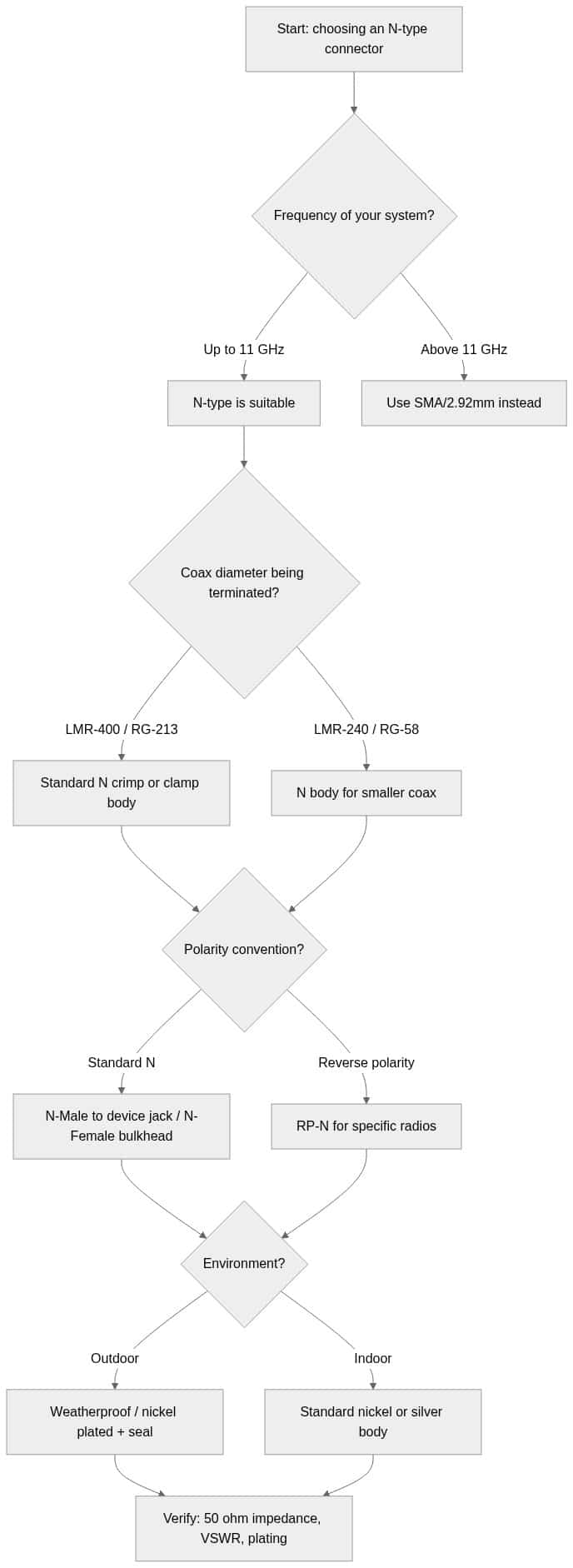
1. Confirm your frequency band
If your system runs at or below ~11 GHz — which covers WiFi, cellular/LTE, LoRa and most point-to-point links — a standard N-type connector is appropriate. Above that, move to SMA or a precision connector series.
2. Match the body to your coax
N connectors are sized to a specific cable outer diameter. An N body built for LMR-400 will not terminate RG-58 correctly, and vice versa. Pick the body that matches your exact coax, and prefer crimp or clamp styles appropriate to your tooling.
3. Verify polarity and gender
Confirm standard N vs RP-N, and that the genders on both ends complement each other (cable N-male to antenna N-female, for example).
4. Specify weatherproofing for outdoor runs
For tower, rooftop and mast installs, choose weatherproof N connectors and still weatherproof the mated joint. Good connectors do not save a run that lets water into the coax.
Shop N-type connectors and custom cable assemblies
Data Alliance manufactures custom antenna cable assemblies terminated with N-type connectors to your exact coax, length and gender — same-day shipping on orders placed before 4pm MST. Browse our antenna cables and adapters to configure a build, or contact technical support or request a custom quote if you need a non-standard assembly. Not sure how the pattern of your antenna affects coverage once it is connected? Our guide to antenna radiation patterns explains how to aim and place it.
Frequently asked questions about N-type connectors
Is an N-type connector 50 ohm or 75 ohm?
Most N-type connectors used in wireless and RF work are 50 ohm, which matches WiFi, cellular, LoRa and two-way radio systems. A 75-ohm N variant exists for some broadcast/video applications. The two are not safely intermateable — a 75-ohm pin into a 50-ohm socket can damage the contact — so always confirm the impedance of both halves.
What is the maximum frequency of an N-type connector?
Standard commercial N connectors are typically rated to around 11 GHz. Precision N series are specified higher (toward 18 GHz). Always check the specific part's datasheet rather than assuming, because body design and build quality affect the usable ceiling.
What is the difference between N-type and SMA?
Both are 50-ohm threaded connectors. SMA is small and rated to ~18 GHz, suited to compact indoor gear and pigtails. The N-type connector is larger, typically rated to ~11 GHz, handles more power, and is built for thicker low-loss coax like LMR-400 and for weatherproof outdoor use.
What coax does an N connector use?
N-type connectors are commonly supplied for LMR-400 and RG-213, with bodies also available for LMR-240 and RG-58. The connector body must match your cable's outer diameter, so choose the N connector that is specified for your exact coax.
What is a reverse-polarity N (RP-N) connector?
An RP-N swaps the center contacts relative to a standard N connector to meet certain regulatory or vendor keying rules. RP-N and standard N will thread together but will not make electrical contact, so match the convention your radio and antenna require.