


Antennas, Antenna Cables, Wireless Products: Technical Articles
Antenna Connector Types Explained: SMA, RP-SMA, N-Type, TNC, BNC, U.FL, MHF4 & More
Table of Contents
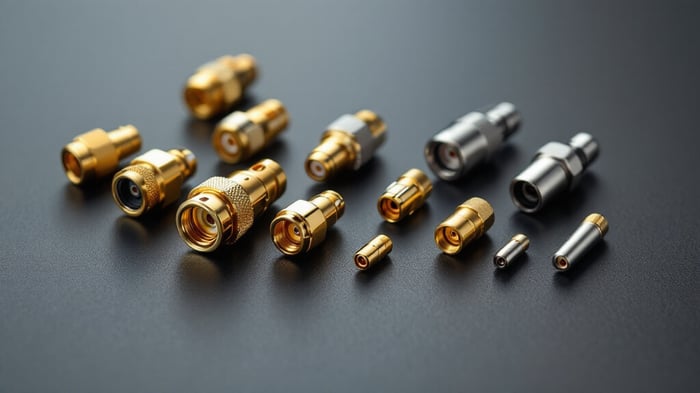
Choosing among antenna connector types comes down to four things: the frequency your system runs at, the coax diameter you are terminating, whether the interface lives indoors or outdoors, and mechanical fit. Get any of those wrong and you introduce insertion loss, VSWR problems, or a physical mismatch that simply will not mate. This guide maps the most common RF antenna connectors — SMA, RP-SMA, N-type, TNC, BNC, U.FL/IPEX, MHF4, MMCX and FAKRA — to their real-world specs and applications so you can specify the right interface the first time.
Nearly every antenna connector discussed here is 50-ohm and used in wireless data, cellular, GPS, LoRa/IoT and Wi-Fi systems. BNC is the notable exception: it is common in both 50-ohm and 75-ohm variants, and the two are not interchangeable. Always confirm impedance, gender, and polarity before ordering — an SMA jack and an RP-SMA jack look nearly identical but will not connect.
Antenna connector types at a glance
The table below summarizes the most widely deployed antenna connector types. Treat the frequency figures as typical usable ranges for standard commercial-grade parts; premium and precision-grade versions of several of these (notably SMA and N-type) are rated higher. Verify the exact rating on the datasheet for the specific part you are buying.
| Connector | Impedance | Typical usable frequency | Coupling | Common coax | Typical use |
|---|---|---|---|---|---|
| SMA | 50 Ω | DC–18 GHz | Threaded | RG174, RG316, LMR-100/200 | WiFi, GPS, cellular, IoT antennas & pigtails |
| RP-SMA | 50 Ω | DC–~12 GHz | Threaded (reverse polarity) | RG174, RG316, LMR-100/200 | Consumer/enterprise WiFi routers & APs |
| N-type | 50 Ω (75 Ω exists) | DC–11 GHz | Threaded | LMR-240/400, RG213 | Outdoor & base-station antennas, long runs |
| TNC | 50 Ω | DC–11 GHz | Threaded | RG58, RG174, LMR-200 | Vibration-prone mobile/GPS installs |
| BNC | 50 Ω or 75 Ω | DC–4 GHz | Bayonet (quick-lock) | RG58 (50 Ω), RG59 (75 Ω) | Test gear, video/CCTV, legacy RF |
| U.FL / IPEX MHF1 | 50 Ω | DC–6 GHz | Snap-on | 1.13 mm, 1.37 mm micro-coax | PCB-to-antenna inside compact devices |
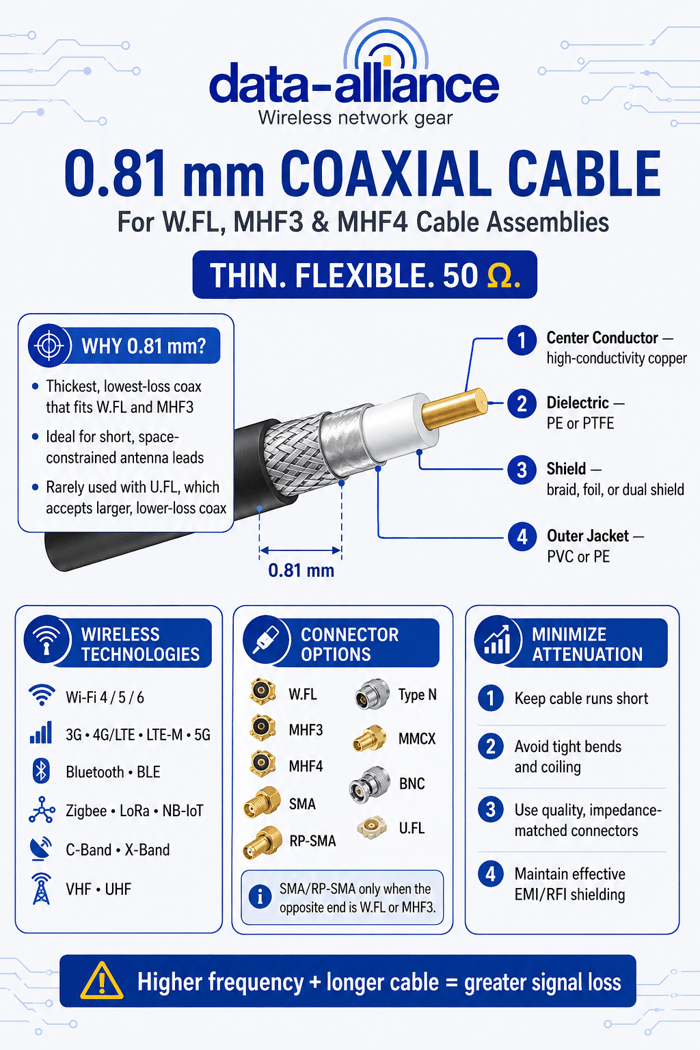
| MHF4 / IPEX MHF4 | 50 Ω | DC–6 GHz | Snap-on (smaller than U.FL) | 0.81 mm, 1.13 mm micro-coax | Ultra-compact modules, M.2/mini-PCIe cards |
| MMCX | 50 Ω | DC–6 GHz | Snap-on (rotatable) | RG174, RG178, 1.37 mm | GPS, FPV, mini-PCIe, wireless audio |
| FAKRA | 50 Ω | DC–6 GHz | Keyed snap-lock | RG174, RG316 | Automotive GNSS, cellular, V2X |
The threaded, board-level, and quick-connect families of antenna connector types
It helps to group antenna connector types by how they mate. Threaded connectors trade speed for repeatability and RF stability under vibration. Snap-on micro connectors save board space but are fragile and rated for limited mating cycles. Bayonet connectors are fast to service but top out at lower frequencies.
Threaded connectors: SMA, RP-SMA, N-type, TNC
SMA is the workhorse of the industry — compact, threaded, and usable to 18 GHz on quality parts. Standard SMA-male has a center pin; SMA-female has a socket. If you are unsure of gender orientation or want the full mechanical breakdown, our SMA connector specifications and characteristics guide covers composition, plating, and frequency handling in detail.
RP-SMA (reverse polarity SMA) swaps the center contact: an RP-SMA "male" body houses a socket, and the "female" body houses a pin. This exists largely so that consumer WiFi equipment complies with FCC rules that discourage easy antenna swaps. Mechanically it threads onto an SMA the same way, which is exactly why so many installers order the wrong one. Before you buy, read our breakdown of RP-SMA connector specifications and how RP-SMA differs from SMA.
N-type is larger and built for outdoor and higher-power work. Its weatherable versions and low-loss behavior on thick coax (LMR-240/400, RG213) make it the default for rooftop and base-station antennas and long cable runs. TNC is essentially a threaded BNC: it keeps a locking thread that survives vibration, which is why it is favored in mobile, vehicular, and GPS installations. For a side-by-side of the four most common outdoor/indoor 50-ohm threaded and bayonet options, see our comparison of SMA vs. N-type vs. TNC vs. BNC connectors.
Board-level micro connectors: U.FL / IPEX and MHF4
U.FL (Hirose's trademark; also sold as IPEX MHF1 and various generic equivalents) is the snap-on micro connector you find soldered to WiFi/Bluetooth modules, mini-PCIe cards, and IoT boards. It is tiny, inexpensive, and rated for only a handful of mating cycles — treat it as semi-permanent. MHF4 is smaller still and dominates modern M.2 modules and 5G/LTE cards where board real estate is scarce. Micro-coax choice matters as much as the connector: thinner cable means more loss per foot. Our guide comparing U.FL cable coax types — 1.13 mm, 1.32 mm, 1.37 mm, RG174 and RG178 lays out the loss-versus-flexibility tradeoffs so you can size the pigtail correctly.
Quick-connect and keyed connectors: BNC, MMCX, FAKRA
BNC uses a bayonet quarter-turn lock for fast connect/disconnect on test benches and video systems. Remember the impedance split: 50-ohm BNC for RF/data, 75-ohm BNC for video and CCTV. MMCX is a snap-on that can rotate while mated — handy in tight, articulated assemblies like FPV drones and GPS pucks. FAKRA is the automotive standard: color-coded and mechanically keyed so a GNSS lead cannot be accidentally plugged into a cellular port.
How to choose the right antenna connector type
Work through these in order and the connector usually selects itself:
- Match what is already on your equipment. The device-side interface (the antenna port or the module's board connector) is fixed. Your job is to specify a cable or adapter that mates to it without an impedance or polarity mismatch.
- Check the frequency ceiling. Running 6 GHz Wi-Fi 6E or higher? Avoid BNC and marginal parts; SMA and N-type have the headroom.
- Size the connector to the coax. Thick low-loss coax (LMR-400) pairs with N-type; thin flexible coax (RG174/RG316) pairs with SMA; micro-coax pairs with U.FL/MHF4.
- Account for the environment. Outdoors, choose weatherized N-type or properly sealed SMA/TNC and confirm plating (nickel or gold-plated brass) against corrosion.
- Consider service life. Micro snap-on connectors are for build-once assemblies; threaded connectors tolerate repeated mating.
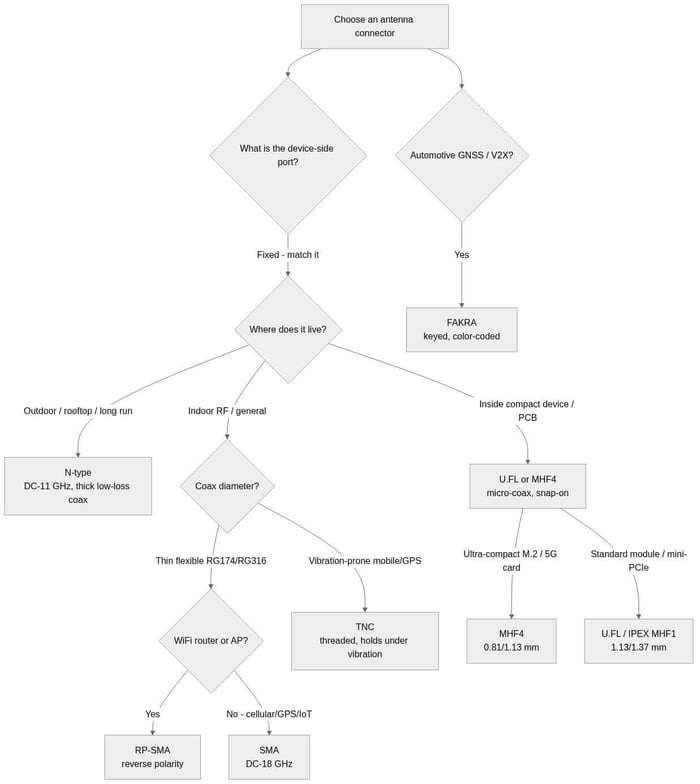
The decision tree below condenses those rules into a quick visual path from your requirements to the right connector family.
Data Alliance custom-manufactures antenna cables and adapters in nearly every connector combination and gender listed above, with same-day shipping on orders placed before 4 pm MST. Browse the full range on the antenna cables & adapters page, or if you need a specific interface, impedance, or length we do not stock, request a custom quote. Building out a wireless link and need the antenna too? See our SMA antennas selection.
Frequently asked questions about antenna connector types
What is the difference between SMA and RP-SMA?
They share identical threading but swapped center contacts. A standard SMA-male has a center pin; an RP-SMA-male has a socket instead. This means an SMA-male will not connect to an RP-SMA-male even though they thread together at the shell. RP-SMA is standard on consumer and enterprise WiFi routers and access points, while SMA is more common on cellular, GPS, and general RF antennas.
Are all antenna connectors 50 ohm?
Most RF/data antenna connectors are 50-ohm, including SMA, RP-SMA, N-type, TNC, U.FL, MHF4, MMCX, and FAKRA. BNC is the main exception because it is widely sold in both 50-ohm and 75-ohm versions. Mixing 50-ohm and 75-ohm parts in the same path causes impedance mismatch and reflected signal, so confirm impedance before ordering.
Which antenna connector is best for outdoor use?
N-type is the usual choice for outdoor and rooftop antennas because weatherized versions are robust and perform well on thick low-loss coax over long runs. Where a smaller interface is required outdoors, a properly sealed SMA or TNC connection can be used — verify the plating and weatherproofing rating for the specific part, since sealing quality varies between manufacturers.
What connector do WiFi routers use?
Most consumer and enterprise WiFi routers and access points with external antennas use RP-SMA. If you are adding or replacing an antenna, match the router's port polarity exactly — order an RP-SMA antenna or an RP-SMA cable, not a standard SMA one.
What is the smallest antenna connector?
Among common types, MHF4 (IPEX MHF4) is smaller than U.FL/MHF1 and is used where board space is extremely limited, such as M.2 and modern LTE/5G modules. Both are snap-on micro connectors rated for only a few mating cycles, so they are intended for semi-permanent internal assemblies rather than frequent connect/disconnect.
Can I use an adapter between different connector types?
Yes — adapters and hybrid cables (for example SMA-to-N or U.FL-to-RP-SMA) are common and let you bridge device-side and antenna-side interfaces. Every additional interface adds a small amount of insertion loss and one more potential failure point, so for permanent installs a single custom cable terminated with the exact connectors you need is usually the cleaner, lower-loss solution.