




Dual-Band WiFi Antennas: 2.4 & 5.8 GHz - WiFi 5/6
Dual-Band WiFi Antennas: 2.4 & 5 GHz — WiFi 5, WiFi 6 & WiFi 7 Compatibility
Dual-band WiFi antennas operating at 2.4 GHz and 5 GHz remain essential components of modern wireless networks, including networks using WiFi 5 (802.11ac), WiFi 6 (802.11ax), and WiFi 7 (802.11be) equipment. These antennas provide wireless signal transmission and reception across the established 2.4 GHz and 5 GHz WiFi frequency bands, supporting a wide variety of routers, access points, wireless adapters, industrial gateways, and other networking devices.
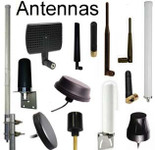
Data Alliance offers an extensive selection of 2.4 GHz / 5 GHz dual-band WiFi antennas, including omnidirectional and directional models, with various gain ratings, mounting configurations, and RF connector options.
Although many of these antennas were originally developed during the WiFi 4 and WiFi 5 eras, their usefulness extends well beyond those wireless generations.
Are WiFi 5 Antennas Compatible with WiFi 6 and WiFi 7?
Yes. An antenna originally developed for WiFi 5 can work perfectly well with a WiFi 6 router, provided its frequency coverage, connector, impedance, and RF performance are suitable.
Even a WiFi 7 router can use an older dual-band antenna for its 2.4 GHz and 5 GHz radios, provided the router's antenna-port arrangement supports that configuration. The antenna simply cannot serve the 6 GHz radio unless its specifications explicitly include the required 6 GHz frequency range.
This is because WiFi generations describe wireless communication technologies, not fundamentally different types of passive antennas.
WiFi 5, WiFi 6, and WiFi 7 differ in their modulation techniques, channel capabilities, data rates, and other features implemented by their radio hardware. An antenna's compatibility, however, depends primarily on its electrical and mechanical characteristics, including:
-
Supported operating frequencies
-
Antenna gain and radiation pattern
-
50-ohm impedance matching
-
VSWR and return-loss performance
-
RF connector type and gender
-
Antenna efficiency and installation conditions
An antenna manufactured before WiFi 6 was introduced does not become obsolete simply because newer wireless standards have been developed.
WiFi Frequency Bands and Antenna Compatibility
| WiFi Standard | Operating Frequencies | Dual-Band Antenna Compatibility |
|---|---|---|
| WiFi 4 (802.11n) | 2.4 and 5 GHz | Yes |
| WiFi 5 (802.11ac) | 5 GHz | Yes |
| WiFi 6 (802.11ax) | 2.4 and 5 GHz | Yes |
| WiFi 6E (802.11ax) | Adds 6 GHz | 2.4/5 GHz radios only |
| WiFi 7 (802.11be) | 2.4, 5 and optionally 6 GHz | 2.4/5 GHz radios only unless antenna also supports 6 GHz |
Compatibility assumes that the antenna covers the specific operating frequencies and satisfies the connected equipment's RF and connector requirements.
Importantly, WiFi 5 itself operates at 5 GHz, although many WiFi 5-era routers also support 2.4 GHz through earlier WiFi standards.
Advantages of 2.4 GHz and 5 GHz Dual-Band Antennas
Dual-band antennas offer flexibility by supporting two established wireless frequency bands within a single antenna assembly.
2.4 GHz WiFi — Coverage and Penetration
The 2.4 GHz band generally provides greater propagation distance and better penetration through walls and other obstructions than higher WiFi frequencies. It is widely used for general wireless networking, IoT devices, industrial wireless equipment, and applications requiring broad coverage.
5 GHz WiFi — Capacity and Higher Throughput
The 5 GHz band provides substantially more channel capacity than 2.4 GHz and supports high-throughput wireless connections. It is widely used in enterprise networking, wireless access points, video streaming, commercial installations, and other bandwidth-intensive applications.
A properly designed dual-band antenna allows compatible equipment to use either band without requiring separate antennas for each frequency range.
Dual-Band Antennas vs. WiFi 6E and WiFi 7 Tri-Band Antennas
Traditional 2.4/5 GHz dual-band antennas should be distinguished from newer antennas designed to cover the additional 6 GHz WiFi spectrum.
Many earlier dual-band antennas were designed for frequencies extending to approximately 5.8 GHz or 5.9 GHz. They can remain excellent choices for equipment operating within their specified frequency ranges, but they should not automatically be considered 6 GHz compatible.
For equipment requiring the additional 6 GHz spectrum, select an antenna specifically rated for those frequencies. In the United States, the complete 6 GHz WiFi allocation extends from 5.925 to 7.125 GHz.
For these applications, explore Data Alliance's WiFi 6 / 6E Antennas and WiFi 7 Antennas.
Types of Dual-Band WiFi Antennas
Data Alliance offers dual-band WiFi antennas in several configurations to accommodate different installations:
-
Omnidirectional antennas: Provide coverage around the antenna and are commonly used with routers, access points, and wireless gateways.
-
Directional antennas: Concentrate RF energy toward a particular area or direction, making them useful for targeted wireless coverage and point-to-point links.
-
Dipole and hinged antennas: Compact external antennas frequently used with WiFi routers, adapters, and industrial networking equipment.
-
Embedded antennas: Designed for integration into electronic devices, enclosures, and custom wireless systems.
-
Outdoor antennas: Weather-resistant designs suitable for compatible outdoor wireless installations.
Available connector options vary by antenna model and may include RP-SMA, SMA, U.FL, N-type, and other RF interfaces.
How to Select the Right Dual-Band WiFi Antenna
When choosing a 2.4 GHz / 5 GHz WiFi antenna, begin by confirming the operating frequency specifications of your equipment.
Next, verify the antenna's gain, radiation pattern, impedance, connector compatibility, and installation requirements. For equipment with multiple antenna ports supporting MIMO, ensure that the antenna configuration meets the radio manufacturer's requirements.
An antenna's nominal gain alone does not determine overall wireless performance. Correct antenna positioning, cable losses, interference, and the surrounding installation environment also affect results.
Data Alliance's 2.4 GHz and 5 GHz dual-band antennas provide a cost-effective, versatile solution for both existing and modern wireless networks, offering dependable RF frequency compatibility without requiring replacement simply because a newer WiFi generation has become available.