Wi-Fi 7 antennas support the newest generation of high-performance wireless networking across the 2.4 GHz, 5 GHz, and 6 GHz frequency bands. Designed for Wi-Fi 7 routers, access points, computers, industrial gateways, embedded devices, and other wireless equipment, these antennas help provide the RF performance needed for faster data rates, reduced latency, greater network capacity, and more dependable connections.

Wi-Fi 7 is the commercial name for IEEE 802.11be, also known as Extremely High Throughput, or EHT. It builds on the efficiency improvements introduced with Wi-Fi 6 and the expanded 6 GHz spectrum introduced with Wi-Fi 6E. Major Wi-Fi 7 capabilities include channels as wide as 320 MHz, Multi-Link Operation, 4096-QAM modulation, multiple resource units, and improved use of partially congested channels. Together, these technologies are designed to support demanding applications such as ultra-high-definition video, cloud computing, augmented and virtual reality, industrial automation, real-time collaboration, high-performance gaming, and dense enterprise networks.

Wi-Fi 7 Frequency Bands

Wi-Fi 7 can operate in three principal frequency bands. Selecting an antenna with the appropriate frequency coverage is essential because an antenna that performs well at 2.4 GHz may not provide acceptable performance at 5 GHz or 6 GHz.

2.4 GHz Wi-Fi

The 2.4 GHz band generally provides the greatest range and better penetration through walls, furniture, and other obstructions. It remains important for smart-home equipment, IoT devices, warehouse systems, mobile devices, and applications in which coverage is more important than maximum speed.

However, the 2.4 GHz band has limited channel capacity and is shared with Bluetooth, Zigbee, cordless devices, and many other wireless systems. It is therefore more susceptible to congestion and interference than the higher-frequency Wi-Fi bands.

Wi-Fi 7 continues to improve operation in the 2.4 GHz band, but its highest data rates will normally be achieved through wider channels in the 5 GHz and 6 GHz bands.

5 GHz Wi-Fi

The 5 GHz band offers a useful balance of speed, capacity, and coverage. It has substantially more usable spectrum than 2.4 GHz and supports wider channels, making it well suited for video streaming, office networks, wireless backhaul, gaming, and other high-throughput applications.

Propagation range at 5 GHz is generally shorter than at 2.4 GHz, particularly when signals must pass through walls or dense building materials. Proper antenna placement, gain, polarization, and cable selection can therefore have a significant effect on 5 GHz network performance.

The 5 GHz band is widely supported by existing Wi-Fi devices, allowing Wi-Fi 7 access points to serve both new Wi-Fi 7 clients and equipment based on earlier standards.

6 GHz Wi-Fi

The 6 GHz band provides the additional spectrum needed to realize the full performance potential of Wi-Fi 7. In the United States, the FCC has made 1,200 MHz of spectrum from 5.925 to 7.125 GHz available for unlicensed operation. Permitted frequencies and operating rules vary by country, so equipment and antennas should always be selected for the regulations of the intended installation location.

The 6 GHz band provides access to large blocks of spectrum without traffic from older Wi-Fi devices that operate only at 2.4 or 5 GHz. This makes it possible to establish wider channels with less legacy-device congestion. Wi-Fi 7 can use channels as wide as 320 MHz in the 6 GHz band, doubling the maximum 160 MHz channel width used by Wi-Fi 6 and Wi-Fi 6E.

Because 6 GHz signals experience greater free-space and obstruction loss than lower-frequency signals, antenna efficiency and placement become increasingly important. Cable loss also increases with frequency, making short cable runs and low-loss coaxial cable especially valuable for 6 GHz installations.
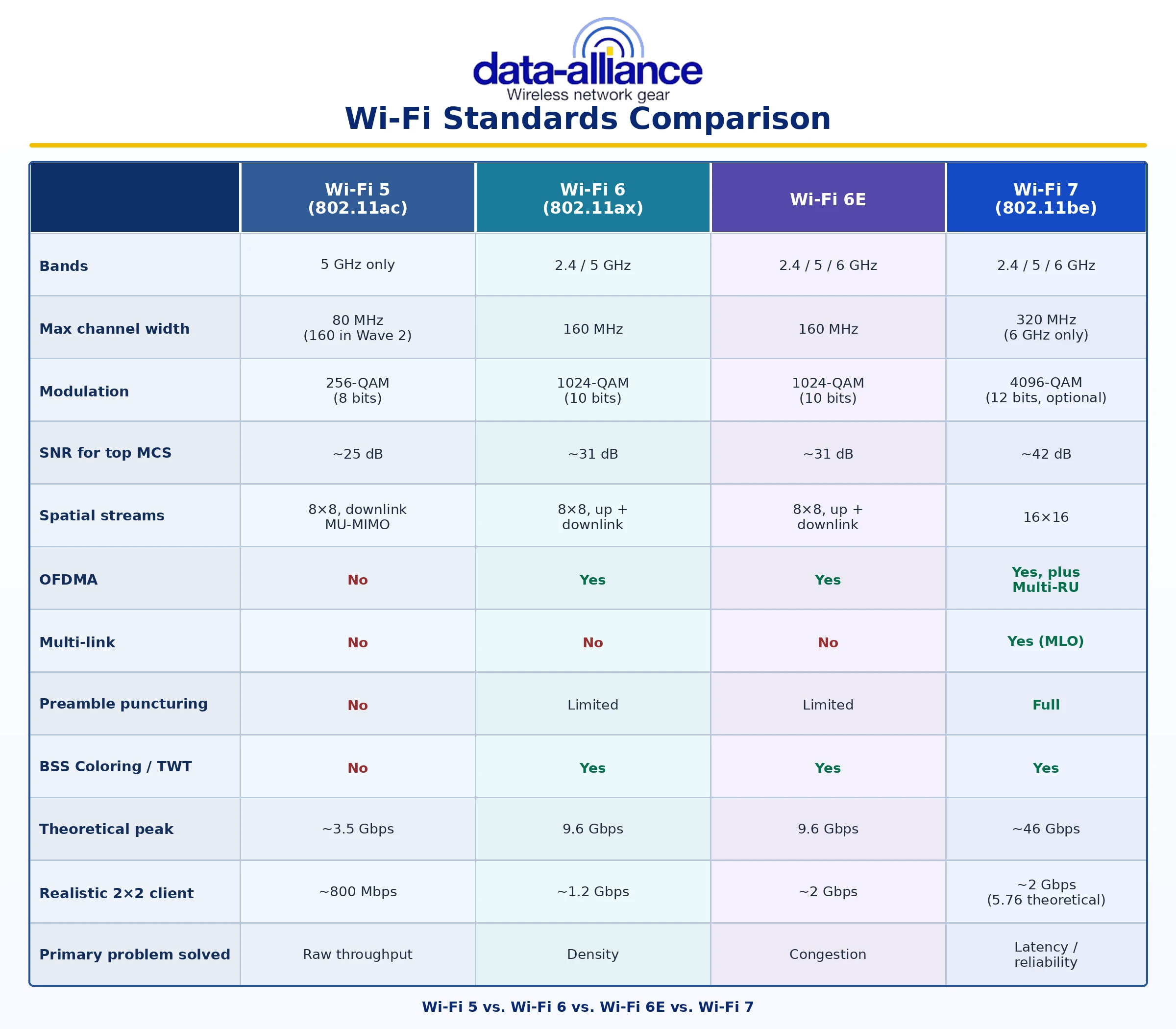
How Wi-Fi 7 Improves on Wi-Fi 6 and Wi-Fi 6E

Wi-Fi 6 introduced important improvements such as OFDMA, enhanced multi-user MIMO, improved network efficiency, and better performance in areas containing large numbers of connected devices. Wi-Fi 6 normally operates at 2.4 and 5 GHz, while Wi-Fi 6E extends Wi-Fi 6 technology into the 6 GHz band.

Wi-Fi 7 continues to use all three bands but introduces additional technologies that use the available spectrum more effectively.

320 MHz Channels

Wi-Fi 6 and Wi-Fi 6E support channels up to 160 MHz wide. Wi-Fi 7 increases the maximum channel width to 320 MHz where sufficient 6 GHz spectrum is available. A wider channel can carry more data during each transmission, helping compatible devices achieve multi-gigabit wireless speeds.

Actual performance depends on the access point, client device, number of spatial streams, signal quality, interference, network traffic, and antenna system. A 320 MHz-capable radio cannot deliver its intended performance if the antenna does not maintain suitable impedance matching and radiation efficiency across the required portion of the 6 GHz band.

Multi-Link Operation

Earlier Wi-Fi clients generally connected through one band or channel at a time. Multi-Link Operation, commonly abbreviated as MLO, allows compatible Wi-Fi 7 devices to establish and coordinate multiple wireless links across different channels or frequency bands.

Depending on the equipment and operating mode, data can be distributed across multiple links, or the system can select the link that offers the best combination of speed, reliability, and latency. For example, a Wi-Fi 7 device may use 5 GHz and 6 GHz links for additional throughput or retain a 2.4 GHz link for improved range and resilience.

MLO can improve throughput, reduce delays caused by channel congestion, and help maintain connectivity if one link encounters interference. The antenna configuration must support the frequency bands and RF chains used by the radio for these benefits to be realized.

4096-QAM Modulation

Wi-Fi 7 introduces 4096-QAM, also called 4K QAM. Wi-Fi 6 uses modulation up to 1024-QAM. Under sufficiently strong and clean signal conditions, 4096-QAM can provide approximately 20 percent higher transmission rates than 1024-QAM without requiring additional bandwidth or antennas.

Higher-order modulation requires an excellent signal-to-noise ratio. Antenna quality, impedance matching, isolation between MIMO elements, cable loss, connector condition, and installation location can all affect whether a radio can maintain the most advanced modulation rates.

Improved Spectrum Efficiency

Wi-Fi 7 can assign multiple resource units to a single client and make more flexible use of available channel capacity. It also supports puncturing techniques that allow a device to avoid an interfered portion of a wide channel while continuing to use the remaining available spectrum. This is more efficient than abandoning an entire wide channel because one section is occupied or experiencing interference.

These improvements are particularly valuable in offices, apartments, campuses, factories, convention facilities, and other locations with multiple overlapping wireless networks.

Antennas for Wi-Fi 7

An antenna does not generate Wi-Fi 7 features by itself. Technologies such as MLO, OFDMA, 4096-QAM, and 320 MHz channels are implemented by the access point and client radios. The antenna provides the physical RF interface through which those technologies operate.

A Wi-Fi 7 antenna should cover every frequency band required by the connected radio. For a tri-band device, this normally means coverage of:

  • 2.4 GHz Wi-Fi frequencies
  • Applicable 5 GHz Wi-Fi frequencies
  • Applicable 6 GHz Wi-Fi frequencies, potentially extending to 7.125 GHz

Many properly designed tri-band antennas originally marketed for Wi-Fi 6E can also be used with Wi-Fi 7 equipment because antenna compatibility is determined primarily by frequency range, impedance, radiation characteristics, and connector compatibility rather than by the Wi-Fi generation printed on the label. The antenna must nevertheless provide adequate performance across the entire frequency range used by the Wi-Fi 7 radio.

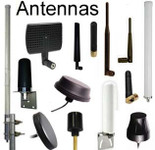
Data Alliance offers antennas covering the 2.4, 5, and 6 GHz Wi-Fi bands, including tri-band directional and omnidirectional configurations with RF connector options for routers, access points, adapters, gateways, and custom wireless equipment.

Wi-Fi 7 MIMO Antennas and Antenna Arrays

Wi-Fi 7 equipment commonly uses multiple-input, multiple-output technology, or MIMO. A MIMO radio has multiple RF chains and antenna ports that can transmit or receive multiple spatial streams. The number of antennas required depends on the radio architecture. A 2x2 radio generally requires two appropriate antenna elements, while a 4x4 configuration generally requires four.

For best performance, MIMO antenna elements should provide adequate isolation and should be positioned to reduce unwanted coupling. Polarization diversity, spatial separation, and radiation-pattern diversity can help the radio distinguish between spatial streams.

When replacing antennas on a Wi-Fi 7 router or access point, all active antenna ports should normally be connected to compatible antennas. Installing one high-gain antenna on only one port does not necessarily improve the overall performance of a multi-antenna radio and may create an unbalanced system.

For embedded designs, antenna positioning must be considered early in the enclosure-development process. Batteries, circuit boards, displays, heatsinks, metal housings, and cables can detune an antenna or obstruct its radiation pattern. Testing the completed device is more meaningful than evaluating the antenna in free space alone.

Omnidirectional and Directional Wi-Fi 7 Antennas

Omnidirectional Wi-Fi 7 antennas distribute RF energy around the antenna and are commonly used for indoor access points, routers, gateways, client devices, and general-area coverage. They are appropriate when wireless clients are located in multiple directions.

Directional Wi-Fi 7 antennas focus RF energy toward a defined area. They can improve signal strength and reduce reception of interference from directions outside the antenna’s main beam. Directional antennas are useful for connecting buildings, serving a specific room or aisle, covering part of a warehouse, or establishing point-to-point and point-to-multipoint wireless links.

Higher antenna gain does not automatically produce better results in every application. A high-gain omnidirectional antenna usually compresses the vertical radiation pattern, extending coverage horizontally while reducing signal above and below the antenna. The most appropriate gain and radiation pattern depend on the building, mounting height, client locations, required coverage area, and intended network design.

Selecting a Wi-Fi 7 Antenna

Important factors when selecting an antenna for Wi-Fi 7 equipment include:

  • Frequency coverage across the required 2.4, 5, and 6 GHz bands
  • Omnidirectional or directional radiation pattern
  • Antenna gain and beamwidth
  • Number of antenna ports and MIMO configuration
  • Linear, dual, or diverse polarization
  • Indoor, outdoor, or weatherproof construction
  • Direct-connect, adhesive, magnetic, through-hole, wall, or pole mounting
  • Connector type and gender
  • Coaxial cable type and cable length
  • Available space and surrounding materials
  • Regional 6 GHz frequency regulations

Common connectors include RP-SMA, SMA, Type-N, U.FL, MHF4, and other miniature RF connector systems. Connector gender and polarity must be checked carefully because SMA and RP-SMA connectors are not interchangeable despite their similar appearance.

Cable loss should be minimized, especially at 5 and 6 GHz. A long run of small-diameter coaxial cable can offset much of the advantage provided by a higher-gain antenna. Where longer cable runs are unavoidable, a lower-loss cable assembly may provide substantially better results.

Applications for Wi-Fi 7 Antennas

Wi-Fi 7 antennas can be used with compatible equipment in applications such as:

  • Home and enterprise Wi-Fi routers
  • Tri-band wireless access points
  • Mesh Wi-Fi systems
  • Industrial gateways and controllers
  • Computers and embedded computing systems
  • High-resolution video and media systems
  • Augmented, virtual, and extended-reality equipment
  • Wireless gaming systems
  • Warehouses and distribution facilities
  • Medical and educational networks
  • Smart buildings and IoT deployments
  • Point-to-point and point-to-multipoint wireless links
  • High-density public and commercial networks

The transition to Wi-Fi 7 increases the importance of broadband antenna performance. Wider channels, higher modulation rates, multiple simultaneous links, and advanced MIMO operation all depend on a strong and efficiently radiated RF signal.

Choose a Wi-Fi 7 antenna that matches the radio’s frequency bands, connector, MIMO configuration, mounting requirements, and intended coverage pattern. Data Alliance provides Wi-Fi antennas, coaxial cable assemblies, RF adapters, connectors, and technical support for integrating antennas with commercial, industrial, and embedded wireless equipment.

WiFi 7 Antennas

There are no products listed under this category.

Wi-Fi 7 antennas support the newest generation of high-performance wireless networking across the 2.4 GHz, 5 GHz, and 6 GHz frequency bands. Designed for Wi-Fi 7 routers, access points, computers, industrial gateways, embedded devices, and other wireless equipment, these antennas help provide the RF performance needed for faster data rates, reduced latency, greater network capacity, and more dependable connections.

Wi-Fi 7 is the commercial name for IEEE 802.11be, also known as Extremely High Throughput, or EHT. It builds on the efficiency improvements introduced with Wi-Fi 6 and the expanded 6 GHz spectrum introduced with Wi-Fi 6E. Major Wi-Fi 7 capabilities include channels as wide as 320 MHz, Multi-Link Operation, 4096-QAM modulation, multiple resource units, and improved use of partially congested channels. Together, these technologies are designed to support demanding applications such as ultra-high-definition video, cloud computing, augmented and virtual reality, industrial automation, real-time collaboration, high-performance gaming, and dense enterprise networks.

Wi-Fi 7 Frequency Bands

Wi-Fi 7 can operate in three principal frequency bands. Selecting an antenna with the appropriate frequency coverage is essential because an antenna that performs well at 2.4 GHz may not provide acceptable performance at 5 GHz or 6 GHz.

2.4 GHz Wi-Fi

The 2.4 GHz band generally provides the greatest range and better penetration through walls, furniture, and other obstructions. It remains important for smart-home equipment, IoT devices, warehouse systems, mobile devices, and applications in which coverage is more important than maximum speed.

However, the 2.4 GHz band has limited channel capacity and is shared with Bluetooth, Zigbee, cordless devices, and many other wireless systems. It is therefore more susceptible to congestion and interference than the higher-frequency Wi-Fi bands.

Wi-Fi 7 continues to improve operation in the 2.4 GHz band, but its highest data rates will normally be achieved through wider channels in the 5 GHz and 6 GHz bands.

5 GHz Wi-Fi

The 5 GHz band offers a useful balance of speed, capacity, and coverage. It has substantially more usable spectrum than 2.4 GHz and supports wider channels, making it well suited for video streaming, office networks, wireless backhaul, gaming, and other high-throughput applications.

Propagation range at 5 GHz is generally shorter than at 2.4 GHz, particularly when signals must pass through walls or dense building materials. Proper antenna placement, gain, polarization, and cable selection can therefore have a significant effect on 5 GHz network performance.

The 5 GHz band is widely supported by existing Wi-Fi devices, allowing Wi-Fi 7 access points to serve both new Wi-Fi 7 clients and equipment based on earlier standards.

6 GHz Wi-Fi

The 6 GHz band provides the additional spectrum needed to realize the full performance potential of Wi-Fi 7. In the United States, the FCC has made 1,200 MHz of spectrum from 5.925 to 7.125 GHz available for unlicensed operation. Permitted frequencies and operating rules vary by country, so equipment and antennas should always be selected for the regulations of the intended installation location.

The 6 GHz band provides access to large blocks of spectrum without traffic from older Wi-Fi devices that operate only at 2.4 or 5 GHz. This makes it possible to establish wider channels with less legacy-device congestion. Wi-Fi 7 can use channels as wide as 320 MHz in the 6 GHz band, doubling the maximum 160 MHz channel width used by Wi-Fi 6 and Wi-Fi 6E.

Because 6 GHz signals experience greater free-space and obstruction loss than lower-frequency signals, antenna efficiency and placement become increasingly important. Cable loss also increases with frequency, making short cable runs and low-loss coaxial cable especially valuable for 6 GHz installations.

How Wi-Fi 7 Improves on Wi-Fi 6 and Wi-Fi 6E

Wi-Fi 6 introduced important improvements such as OFDMA, enhanced multi-user MIMO, improved network efficiency, and better performance in areas containing large numbers of connected devices. Wi-Fi 6 normally operates at 2.4 and 5 GHz, while Wi-Fi 6E extends Wi-Fi 6 technology into the 6 GHz band.

Wi-Fi 7 continues to use all three bands but introduces additional technologies that use the available spectrum more effectively.

320 MHz Channels

Wi-Fi 6 and Wi-Fi 6E support channels up to 160 MHz wide. Wi-Fi 7 increases the maximum channel width to 320 MHz where sufficient 6 GHz spectrum is available. A wider channel can carry more data during each transmission, helping compatible devices achieve multi-gigabit wireless speeds.

Actual performance depends on the access point, client device, number of spatial streams, signal quality, interference, network traffic, and antenna system. A 320 MHz-capable radio cannot deliver its intended performance if the antenna does not maintain suitable impedance matching and radiation efficiency across the required portion of the 6 GHz band.

Multi-Link Operation

Earlier Wi-Fi clients generally connected through one band or channel at a time. Multi-Link Operation, commonly abbreviated as MLO, allows compatible Wi-Fi 7 devices to establish and coordinate multiple wireless links across different channels or frequency bands.

Depending on the equipment and operating mode, data can be distributed across multiple links, or the system can select the link that offers the best combination of speed, reliability, and latency. For example, a Wi-Fi 7 device may use 5 GHz and 6 GHz links for additional throughput or retain a 2.4 GHz link for improved range and resilience.

MLO can improve throughput, reduce delays caused by channel congestion, and help maintain connectivity if one link encounters interference. The antenna configuration must support the frequency bands and RF chains used by the radio for these benefits to be realized.

4096-QAM Modulation

Wi-Fi 7 introduces 4096-QAM, also called 4K QAM. Wi-Fi 6 uses modulation up to 1024-QAM. Under sufficiently strong and clean signal conditions, 4096-QAM can provide approximately 20 percent higher transmission rates than 1024-QAM without requiring additional bandwidth or antennas.

Higher-order modulation requires an excellent signal-to-noise ratio. Antenna quality, impedance matching, isolation between MIMO elements, cable loss, connector condition, and installation location can all affect whether a radio can maintain the most advanced modulation rates.

Improved Spectrum Efficiency

Wi-Fi 7 can assign multiple resource units to a single client and make more flexible use of available channel capacity. It also supports puncturing techniques that allow a device to avoid an interfered portion of a wide channel while continuing to use the remaining available spectrum. This is more efficient than abandoning an entire wide channel because one section is occupied or experiencing interference.

These improvements are particularly valuable in offices, apartments, campuses, factories, convention facilities, and other locations with multiple overlapping wireless networks.

Antennas for Wi-Fi 7

An antenna does not generate Wi-Fi 7 features by itself. Technologies such as MLO, OFDMA, 4096-QAM, and 320 MHz channels are implemented by the access point and client radios. The antenna provides the physical RF interface through which those technologies operate.

A Wi-Fi 7 antenna should cover every frequency band required by the connected radio. For a tri-band device, this normally means coverage of:

  • 2.4 GHz Wi-Fi frequencies
  • Applicable 5 GHz Wi-Fi frequencies
  • Applicable 6 GHz Wi-Fi frequencies, potentially extending to 7.125 GHz

Many properly designed tri-band antennas originally marketed for Wi-Fi 6E can also be used with Wi-Fi 7 equipment because antenna compatibility is determined primarily by frequency range, impedance, radiation characteristics, and connector compatibility rather than by the Wi-Fi generation printed on the label. The antenna must nevertheless provide adequate performance across the entire frequency range used by the Wi-Fi 7 radio.

Data Alliance offers antennas covering the 2.4, 5, and 6 GHz Wi-Fi bands, including tri-band directional and omnidirectional configurations with RF connector options for routers, access points, adapters, gateways, and custom wireless equipment.

Wi-Fi 7 MIMO Antennas and Antenna Arrays

Wi-Fi 7 equipment commonly uses multiple-input, multiple-output technology, or MIMO. A MIMO radio has multiple RF chains and antenna ports that can transmit or receive multiple spatial streams. The number of antennas required depends on the radio architecture. A 2x2 radio generally requires two appropriate antenna elements, while a 4x4 configuration generally requires four.

For best performance, MIMO antenna elements should provide adequate isolation and should be positioned to reduce unwanted coupling. Polarization diversity, spatial separation, and radiation-pattern diversity can help the radio distinguish between spatial streams.

When replacing antennas on a Wi-Fi 7 router or access point, all active antenna ports should normally be connected to compatible antennas. Installing one high-gain antenna on only one port does not necessarily improve the overall performance of a multi-antenna radio and may create an unbalanced system.

For embedded designs, antenna positioning must be considered early in the enclosure-development process. Batteries, circuit boards, displays, heatsinks, metal housings, and cables can detune an antenna or obstruct its radiation pattern. Testing the completed device is more meaningful than evaluating the antenna in free space alone.

Omnidirectional and Directional Wi-Fi 7 Antennas

Omnidirectional Wi-Fi 7 antennas distribute RF energy around the antenna and are commonly used for indoor access points, routers, gateways, client devices, and general-area coverage. They are appropriate when wireless clients are located in multiple directions.

Directional Wi-Fi 7 antennas focus RF energy toward a defined area. They can improve signal strength and reduce reception of interference from directions outside the antenna’s main beam. Directional antennas are useful for connecting buildings, serving a specific room or aisle, covering part of a warehouse, or establishing point-to-point and point-to-multipoint wireless links.

Higher antenna gain does not automatically produce better results in every application. A high-gain omnidirectional antenna usually compresses the vertical radiation pattern, extending coverage horizontally while reducing signal above and below the antenna. The most appropriate gain and radiation pattern depend on the building, mounting height, client locations, required coverage area, and intended network design.

Selecting a Wi-Fi 7 Antenna

Important factors when selecting an antenna for Wi-Fi 7 equipment include:

  • Frequency coverage across the required 2.4, 5, and 6 GHz bands
  • Omnidirectional or directional radiation pattern
  • Antenna gain and beamwidth
  • Number of antenna ports and MIMO configuration
  • Linear, dual, or diverse polarization
  • Indoor, outdoor, or weatherproof construction
  • Direct-connect, adhesive, magnetic, through-hole, wall, or pole mounting
  • Connector type and gender
  • Coaxial cable type and cable length
  • Available space and surrounding materials
  • Regional 6 GHz frequency regulations

Common connectors include RP-SMA, SMA, Type-N, U.FL, MHF4, and other miniature RF connector systems. Connector gender and polarity must be checked carefully because SMA and RP-SMA connectors are not interchangeable despite their similar appearance.

Cable loss should be minimized, especially at 5 and 6 GHz. A long run of small-diameter coaxial cable can offset much of the advantage provided by a higher-gain antenna. Where longer cable runs are unavoidable, a lower-loss cable assembly may provide substantially better results.

Applications for Wi-Fi 7 Antennas

Wi-Fi 7 antennas can be used with compatible equipment in applications such as:

  • Home and enterprise Wi-Fi routers
  • Tri-band wireless access points
  • Mesh Wi-Fi systems
  • Industrial gateways and controllers
  • Computers and embedded computing systems
  • High-resolution video and media systems
  • Augmented, virtual, and extended-reality equipment
  • Wireless gaming systems
  • Warehouses and distribution facilities
  • Medical and educational networks
  • Smart buildings and IoT deployments
  • Point-to-point and point-to-multipoint wireless links
  • High-density public and commercial networks

The transition to Wi-Fi 7 increases the importance of broadband antenna performance. Wider channels, higher modulation rates, multiple simultaneous links, and advanced MIMO operation all depend on a strong and efficiently radiated RF signal.

Choose a Wi-Fi 7 antenna that matches the radio’s frequency bands, connector, MIMO configuration, mounting requirements, and intended coverage pattern. Data Alliance provides Wi-Fi antennas, coaxial cable assemblies, RF adapters, connectors, and technical support for integrating antennas with commercial, industrial, and embedded wireless equipment.