




Antennas, Antenna Cables, Wireless Products: Technical Articles
Antenna Polarization: Vertical, Linear: Key Factor in Selection of an Antenna
Table of Contents
Antenna Polarization:
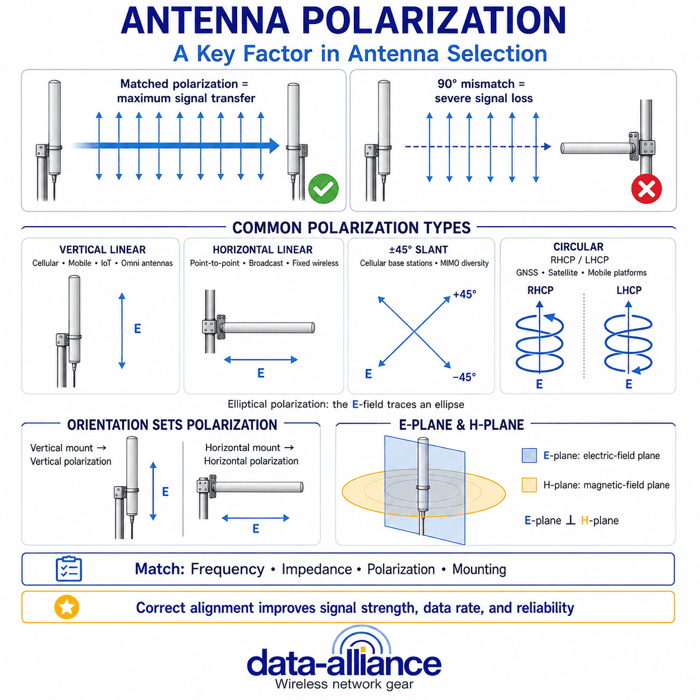
Antenna polarization is a key electrical characteristic that must be considered when selecting an antenna for any RF system. Proper polarization matching between antennas directly impacts signal strength, system efficiency, and overall wireless performance. Like-matched antennas in an RF setup will provide optimal power transfer and signal integrity, especially in point-to-point and point-to-multipoint applications.
Polarization is just as important as antenna gain, radiation pattern, and VSWR when selecting an antenna. While gain determines how much energy is focused, and radiation pattern defines where that energy is directed, polarization determines how that energy is oriented in space. If polarization is mismatched between transmitting and receiving antennas, significant signal loss can occur—even when all other parameters are optimized.
Our article on antenna radiation patterns is closely related to polarization and is highly recommended for a more complete understanding of antenna behavior in real-world installations.
Understanding Antenna Polarization
In transmitting antennas, polarization refers to the orientation of the electromagnetic (EM) fields produced by the antenna as energy radiates away from it. Specifically, polarization is defined by the direction of the electric field (E-field) component of the electromagnetic wave. This orientation determines the plane in which energy propagates and how it can be received by another antenna.
Transmitting and receiving antennas are designed with a specific polarization as an intrinsic characteristic. For maximum signal transfer, both antennas must share the same polarization orientation. If they are misaligned, signal degradation occurs due to polarization mismatch losses.
For example, a vertically polarized transmitting antenna will radiate energy with its electric field aligned vertically. A receiving antenna must also be vertically polarized to efficiently capture that energy.
Types of Polarization:
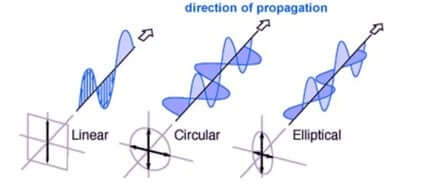
The most common forms of antenna polarization include linear, slant, circular, and elliptical polarization.
Linear (Horizontal or Vertical) Polarization
Linear polarization refers to the oscillation of the antenna’s electric field in a single plane. This plane may be either horizontal or vertical relative to the Earth’s surface.
- Vertical polarization is commonly used in mobile, cellular, IoT, and omnidirectional applications.
- Horizontal polarization is often used in point-to-point microwave links, broadcast systems, and some fixed wireless installations.
Linear polarization is determined by the physical orientation of the antenna’s radiating element. A vertically mounted dipole produces vertical polarization, while a horizontally mounted dipole produces horizontal polarization.
Slant Polarization
Slant polarization describes an electromagnetic field that oscillates at a fixed angle—typically 45 degrees—relative to the horizontal or vertical plane. Slant polarization is commonly used in cellular base stations and MIMO systems to reduce interference and improve channel diversity.
Circular Polarization (CP)
Circular polarization occurs when the electric field rotates as the signal propagates through space. This rotation can be:
- Right-Hand Circular Polarization (RHCP), or
- Left-Hand Circular Polarization (LHCP)
Circular polarization is especially useful in environments where antenna orientation cannot be guaranteed or where reflections cause signal distortion. Circularly polarized antennas are less sensitive to orientation mismatch and multipath interference, making them ideal for mobile, satellite, GNSS (GPS), and certain IoT applications.
Elliptical Polarization
Elliptical polarization is a generalized form of circular polarization in which the electric field traces an elliptical path rather than a perfect circle. In practice, many real-world antennas exhibit elliptical polarization due to imperfections or environmental effects.
Polarization and Receiving Antennas
Receiving antennas can only effectively capture electromagnetic energy that matches their polarization. A horizontally polarized antenna cannot efficiently receive a vertically polarized signal, and vice versa. In theory, a 90-degree polarization mismatch results in near-total signal loss.
This makes polarization alignment critical in system design. Even partial misalignment can result in signal degradation, reduced data rates, and increased error rates.
The orientation, physical structure and mounting of antennas also determine their polarization. Alignment of the orientation and polarization of transmitting and receiving antennas will improve signal strength and the optimal transfer of power. Linear polarization of antennas is geometrically determined, typically in the direction of the antenna's current.
Antenna Orientation and Mounting Effects
The orientation, physical structure, and mounting method of an antenna all directly influence its polarization. Linear polarization is geometrically determined and typically follows the direction of current flow within the antenna element.
Effect of Mounting on Polarization
Mounting location plays a significant role in antenna performance:
- A straight dipole antenna mounted vertically produces vertical polarization.
- The same antenna mounted horizontally produces horizontal polarization.
Environmental proximity also affects performance. Practically speaking:
- Horizontally polarized antennas often experience less signal loss when mounted near a ceiling.
- Vertically polarized antennas generally perform better when mounted near a wall or vertical surface.
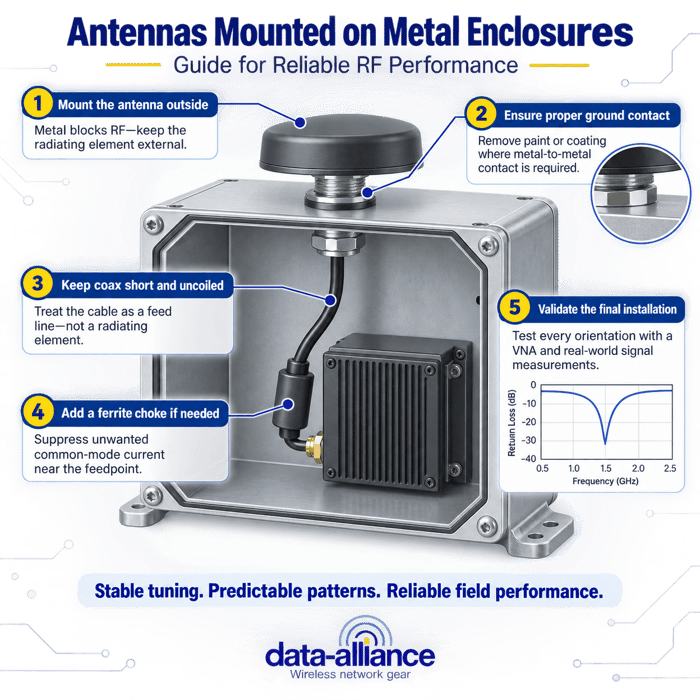
Nearby conductive surfaces can alter the effective polarization and radiation pattern, so careful placement is essential for consistent performance.
Omni-Directional Antennas and Polarization
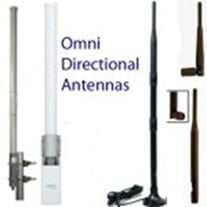
Omni-directional antennas have different polarization and performance compared to linear or directional antennas. These antennas radiate RF energy in all directions perpendicular to the antenna's axis in a characteristic ‘doughnut’-shaped radiation pattern. Omni-directional antennas are usually vertically polarized, though they can be circularly polarized or dual polarized. The omni-directional nature of these antennas can cause reflections, which are mitigated by circular polarization.
Circular and Dual Polarization in Omni Antennas
Omni-directional antennas can be susceptible to reflections and multipath interference, especially in indoor or urban environments. Circular polarization helps mitigate these effects by reducing sensitivity to wave orientation and reflections.
A circularly polarized omni-directional antenna is relatively insensitive to antenna alignment, providing more stable performance in dynamic environments. In receiving applications, a dual-polarized circularly polarized omni-directional antenna can capture energy regardless of signal orientation, offering optimal energy transfer.
For this reason, circularly polarized and dual-polarized omni-directional antennas are often preferred for wireless networking, mobile systems, and IoT deployments.
Antennas as RF Interfaces
Within any radio frequency setup, an antenna serves as the electrical interface between the transmitter or receiver and free space. It converts conducted electrical current into radiated electromagnetic energy—and vice versa.
Selecting the correct antenna is critical to creating an optimally functioning RF system. Antennas must be precisely matched not only in frequency range and impedance, but also in polarization, mechanical construction, environmental durability, and mounting configuration.
Wireless Antenna Polarization
Polarization of the wireless antenna is the orientation of the wireless signal with regard to its coverage both horizontally and vertically. Polarization can be vertical, horizontal, circular or combinations of these.
E-Plane and H-Plane Reference
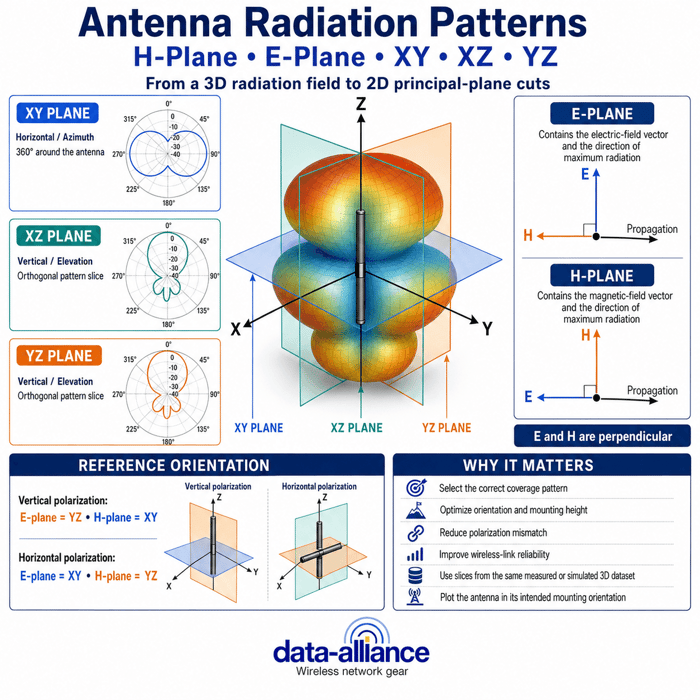
For linearly polarized antennas, the E-plane and H-plane are reference planes used to describe radiation patterns and field orientation:
- The E-plane is the plane containing the electric field and the direction of maximum radiation.
- The H-plane is the plane containing the magnetic field and is perpendicular to the E-plane.
For a vertically polarized omni-directional dipole antenna, the E-plane is vertical, and the H-plane is horizontal. This configuration is commonly used for short-range mesh networks, IoT devices, and local wireless systems.
(Diagram referenced below illustrates the relationship between the E-plane and H-plane for a vertically polarized omni-directional dipole antenna.)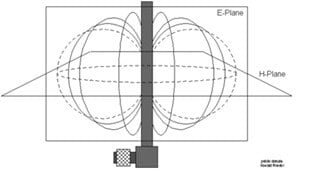
Conclusion
Antenna polarization is a fundamental yet often overlooked aspect of RF system design that has a direct impact on signal strength, efficiency, and overall wireless reliability. Even when factors such as frequency, gain, impedance, and radiation pattern are correctly specified, a polarization mismatch between transmitting and receiving antennas can significantly degrade system performance.
Understanding how polarization works—and how it is influenced by antenna type, orientation, mounting location, and environment—enables better antenna selection and installation decisions. Whether using linear, slant, circular, or dual polarization, ensuring proper alignment and compatibility between antennas is essential for achieving optimal power transfer and minimizing losses.
As wireless systems continue to evolve across applications such as IoT, cellular, networking, and short-range mesh deployments, polarization remains a critical design parameter. Careful consideration of polarization, along with thoughtful antenna placement and mounting, helps ensure robust, consistent, and efficient RF communication in real-world operating environments.
FAQs
What is antenna polarization?
Antenna polarization refers to the orientation of the electric field (E-field) of an electromagnetic wave radiated or received by an antenna. It defines how the signal is oriented in space and determines how efficiently one antenna can transmit energy to or receive energy from another antenna.
Why is antenna polarization important in RF systems?
Polarization directly affects signal strength and power transfer. If the transmitting and receiving antennas do not share the same polarization, significant signal loss can occur—even if frequency, gain, and impedance are properly matched. Proper polarization alignment is essential for reliable wireless performance.
What happens if antenna polarizations do not match?
When antenna polarizations are mismatched, the receiving antenna can only capture a portion of the transmitted signal. A 90-degree mismatch (such as horizontal to vertical) can result in near-total signal loss. Even partial misalignment can reduce data rates and increase error rates.
What are the most common types of antenna polarization?
The most common polarization types are:
- Linear polarization (horizontal or vertical)
- Slant polarization (typically 45 degrees)
- Circular polarization (RHCP or LHCP)
- Elliptical polarization
Each type is suited to different applications depending on orientation stability, reflections, and environmental conditions.
When should circular polarization be used?
Circular polarization is ideal when antenna orientation cannot be controlled or when multipath reflections are present. It is commonly used in mobile systems, satellite communications, GNSS (GPS), and certain IoT applications because it reduces sensitivity to orientation mismatch and signal reflections.
How does antenna mounting affect polarization?
Antenna polarization is directly influenced by how the antenna is mounted. For example, a dipole mounted vertically produces vertical polarization, while the same antenna mounted horizontally produces horizontal polarization. Nearby surfaces, such as walls or ceilings, can also affect polarization and radiation patterns, making proper placement critical.
Are omni-directional antennas always vertically polarized?
Most omni-directional antennas are vertically polarized, especially those used in wireless networking and IoT systems. However, omni-directional antennas can also be circularly polarized or dual-polarized. Circular and dual polarization are often preferred in environments with reflections or variable antenna orientation.