


Antennas, Antenna Cables, Wireless Products: Technical Articles
FAKRA Connector Guide: Color Codes, Keying, Specs & How to Choose
A FAKRA connector is a keyed, color-coded 50-ohm RF coaxial connector designed for automotive and in-vehicle antenna systems, where it locks positively into place, resists vibration, and physically prevents an installer from mating the wrong two RF lines. If you are specifying antenna cabling for GPS/GNSS, cellular/LTE, SDARS satellite radio, remote keyless entry, or in-car Wi-Fi, the FAKRA connector is almost certainly the interface on the radio or module. This guide explains FAKRA color codes, keying, the specs to verify, how FAKRA compares to SMA, and how to choose the right FAKRA connector for your build.
What is a FAKRA connector?
FAKRA is a standardized RF connector system based on the SMB form factor but with a plastic keyed-and-coded housing added around it. The name comes from the German automotive standards body that defined it (Fachkreis Automobil). The electrical interface is a snap-on SMB-style mini coax connection; the plastic shroud adds mechanical retention and a keying system so that a given plug only mates with the matching jack. That mechanical coding is the whole point: in a vehicle harness with a dozen RF lines bundled together, color and key coding stop cross-mating and simplify assembly-line and field work.
Key characteristics to keep in mind:
- Impedance: 50 ohms (the common automotive RF standard). Verify this against your radio — there are 75-ohm variants used for some broadcast/infotainment lines, and a mismatch raises VSWR.
- Frequency range: commonly specified up to roughly 4–6 GHz depending on the exact series and manufacturer. Confirm the rating on the datasheet for your specific part before using it near the top of that range.
- Coupling: snap-on (push-to-lock) with a positive detent, not threaded — fast to mate, vibration-resistant, and keyed so it only goes together one way.
- Typical coax: thin, flexible cable such as RG-174, RG-316, or 1.13 mm micro-coax for short in-vehicle runs.
FAKRA color codes and keying explained
The defining feature of a FAKRA connector is its keying code — a letter (and a matching housing color) that determines which plug fits which jack. The keying is mechanical first; the color is a visual aid that mirrors it. Codes are widely used across the automotive industry, but exact color-to-code and code-to-application assignments can vary by vehicle manufacturer and supplier, so always confirm against the harness or module documentation rather than assuming. The table below lists the color associations you will most often encounter and their typical uses — treat the applications as common conventions to verify, not guarantees.
| Key code | Typical housing color | Common application (verify) |
|---|---|---|
| A | Black | Multiple / general purpose, GPS + SDARS combos |
| B | White / grey | Phone, general purpose |
| C | Blue | GPS / GNSS (1575.42 MHz L1) |
| D | Pink / violet | Keyless entry, cellular |
| E | Green | General purpose |
| F | Light brown / beige | Bluetooth, general purpose |
| G | Green (olive) | General purpose |
| Z | Neutral / water blue | Universal / unkeyed service parts |
Two practical rules: (1) a FAKRA plug will only snap into a jack with the matching key, so if it will not seat, you have the wrong code — do not force it; and (2) color is a convenience, not a spec — the mechanical key is authoritative, and some suppliers use different colors for the same letter code.
How to choose a FAKRA connector: a selection flow
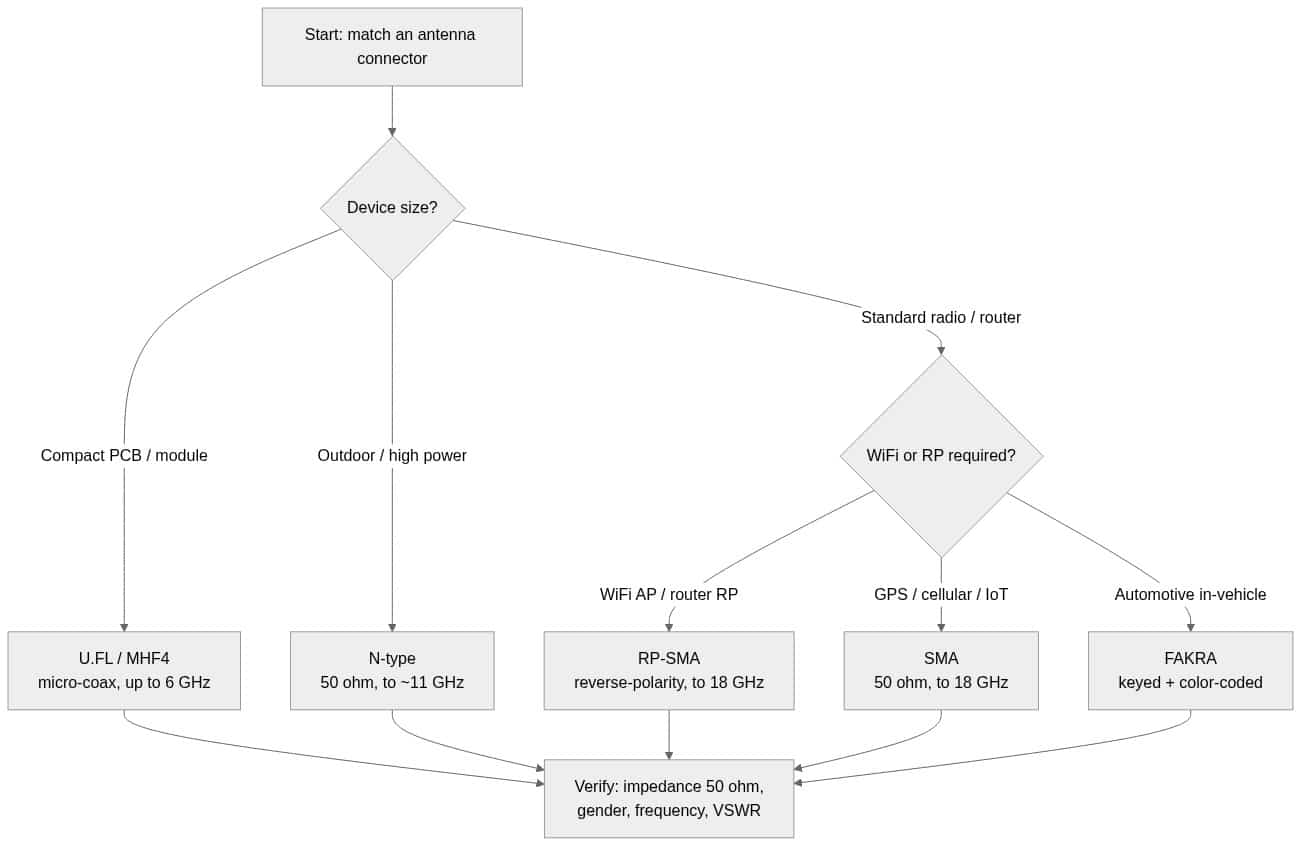
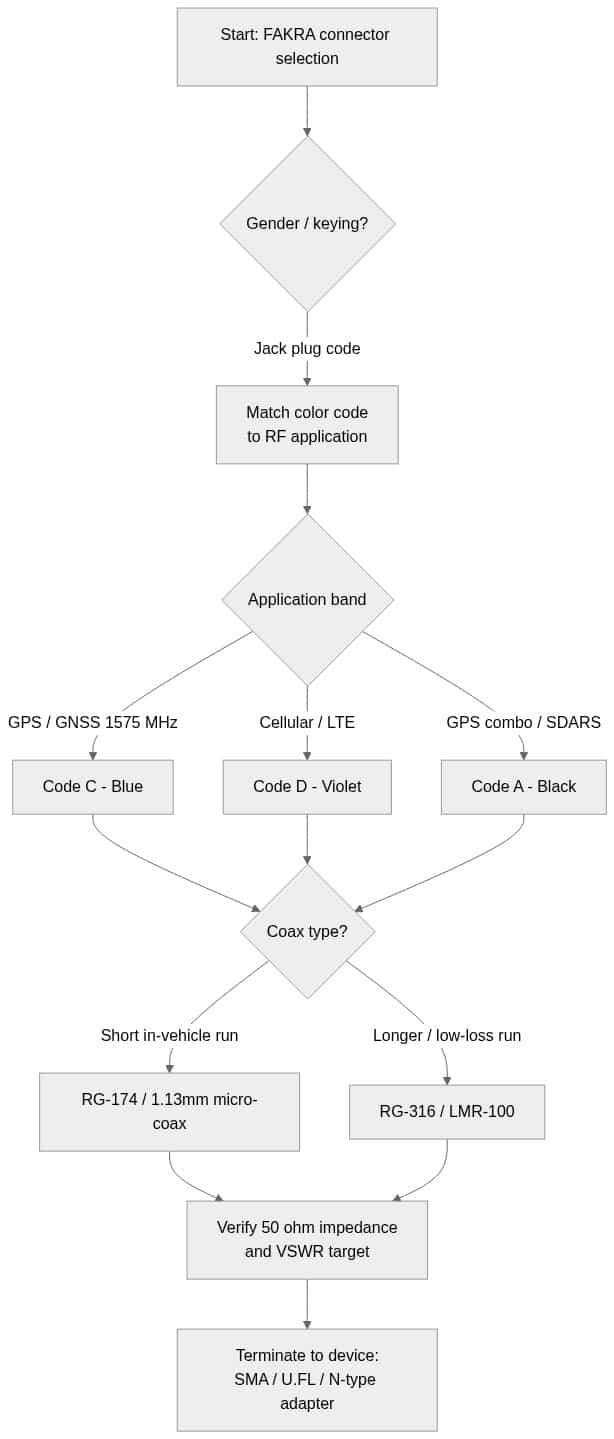
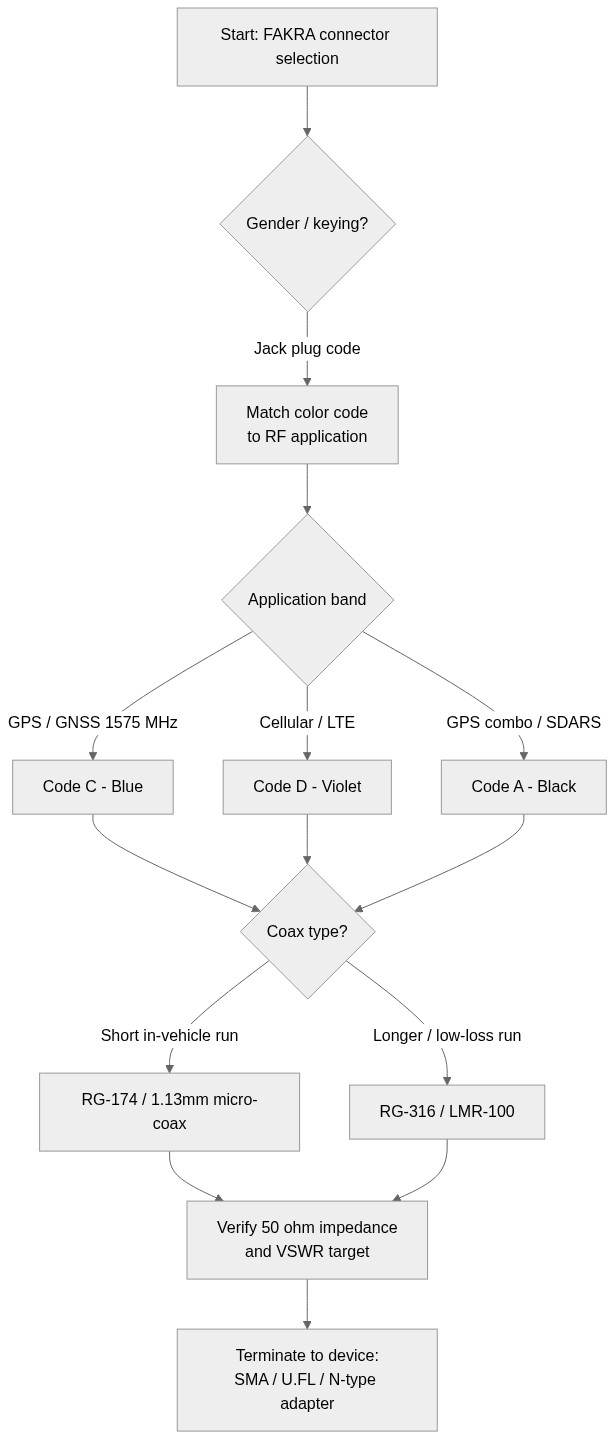
Choosing the right FAKRA connector is a matter of matching the keying to the device, matching the coax to the run, and confirming impedance and VSWR. The flowchart below walks through that decision in the order an integrator actually makes it.
1. Match the keying to the device
Start at the radio or module. Read the code stamped on the mating jack (or in the harness documentation) and buy the matching plug. For GPS/GNSS the line is very often Code C (blue); for cellular/keyless, Code D (pink/violet) is common — but confirm, because OEMs reuse codes differently.
2. Match the coax to the run
FAKRA is a mini-coax interface, so it terminates thin cable. For short in-dash jumpers, RG-174 or 1.13 mm micro-coax is typical; for a slightly longer or lower-loss run, RG-316 is a common step up. If you need to extend a FAKRA antenna line well beyond the dash, plan the link budget — thin coax loses signal quickly at GPS and cellular frequencies, and you may be better served adapting out to a lower-loss cable.
3. Confirm impedance and VSWR
Confirm 50 ohms end to end and check the VSWR target for your band. A keyed connector that is seated correctly but on the wrong coax impedance will still degrade the link. If you are unsure how VSWR affects a GPS or LTE receiver, see our deeper reference below before finalizing the build.
4. Adapt out to your device interface
Most benches and test radios do not have FAKRA ports, so you will frequently need a FAKRA-to-SMA, FAKRA-to-U.FL, or FAKRA-to-N-type pigtail. Choose the adapter by the destination connector's gender and polarity, not just its family.
FAKRA vs SMA and other RF connectors
FAKRA and SMA solve different problems. SMA is a threaded, general-purpose RF connector; FAKRA is a snap-on, keyed, color-coded connector purpose-built for vehicle harnesses. The table contrasts the ones you are most likely to adapt between.
| Connector | Coupling | Impedance | Typical freq. ceiling | Best fit |
|---|---|---|---|---|
| FAKRA | Snap-on, keyed/coded | 50 Ω (75 Ω variants exist) | ~4–6 GHz | Automotive / in-vehicle antenna lines |
| SMA | Threaded | 50 Ω | ~18 GHz | WiFi, cellular, GPS, IoT antennas |
| U.FL / MHF | Snap-on, micro | 50 Ω | ~6 GHz | Board-to-antenna jumpers in compact devices |
| N-type | Threaded | 50 Ω | ~11 GHz | Outdoor, higher-power, weatherproof runs |
If you want to go deeper on the connectors you will be adapting to, these companion guides are worth bookmarking: our SMA connector guide (SMA vs RP-SMA, male/female and specs), the N-type connector guide for rugged outdoor terminations, and the U.FL connector guide for the micro-coax jumpers that often sit on the device side of a FAKRA pigtail. For the older, more detailed breakdown of individual key codes, see our reference on FAKRA connector types.
Where FAKRA connectors are used
- GPS / GNSS: the L1 band at 1575.42 MHz is a classic FAKRA line (often Code C / blue).
- Cellular / LTE / 5G telematics: vehicle modems and TCUs.
- SDARS satellite radio and AM/FM: infotainment antenna feeds.
- Keyless entry, TPMS, V2X and in-car Wi-Fi: short, keyed RF jumpers throughout the harness.
Buy FAKRA cables and adapters
Data Alliance custom-manufactures FAKRA cable assemblies and stocks FAKRA-to-SMA, FAKRA-to-U.FL and other adapters, with same-day shipping on orders placed before 4 pm MST. Browse FAKRA cables & adapters to match a key code to your build, or explore the full antenna cables & adapters range. Need a specific key code, length or connector pairing we don't list? Request a custom quote or contact our technical support team and we'll build the exact assembly you need.
Frequently asked questions
What does FAKRA stand for?
FAKRA refers to the German automotive standards group (Fachkreis Automobil) that defined the keyed, color-coded connector system. In practice, engineers use "FAKRA" as the name of the connector family itself — a snap-on, keyed 50-ohm RF interface for in-vehicle antenna lines.
Are FAKRA connectors 50 ohm or 75 ohm?
The common automotive FAKRA connector is 50 ohms, which matches most GPS, cellular and Wi-Fi radios. There are 75-ohm variants used on some broadcast/infotainment lines, so verify the impedance against your module — mixing 50 and 75 ohms raises VSWR and degrades the link.
What do the FAKRA color codes mean?
Each FAKRA key code is a letter (A, B, C, D, etc.) with an associated housing color that mirrors the mechanical keying, so a plug only mates with the matching jack. Blue (Code C) is commonly GPS/GNSS and pink/violet (Code D) is often cellular or keyless entry, but OEMs reuse codes, so confirm against the harness documentation rather than relying on color alone.
Can I convert FAKRA to SMA?
Yes. FAKRA-to-SMA pigtails and adapters are common because benches, test radios and aftermarket antennas usually use SMA. Choose the adapter by the SMA gender and polarity (SMA vs RP-SMA) you need on the device side, and keep the coax 50-ohm throughout.
What coax is used with FAKRA connectors?
Because FAKRA is a mini-coax interface, it terminates thin cable — RG-174 or 1.13 mm micro-coax for short jumpers, and RG-316 as a common low-loss step up. For longer runs, plan the link budget carefully, since thin coax attenuates quickly at GPS and cellular frequencies.
Is FAKRA the same as SMB?
The electrical interface inside a FAKRA connector is SMB-based, but FAKRA adds a keyed, color-coded plastic housing for mechanical retention and anti-cross-mating. So a FAKRA connector is SMB-derived electrically, but mechanically and functionally it is its own automotive-grade system.