


Antennas, Antenna Cables, Wireless Products: Technical Articles
FAKRA Cable Connector Types
Table of Contents
FAKRA Connector Types
FAKRA connectors are automotive-grade RF (Radio Frequency) connectors designed to provide secure, reliable, and high-frequency signal transmission in environments subject to vibration, temperature extremes, and mechanical stress.
Originally developed for the automotive industry, FAKRA (Fachkreis Automobil) connectors are now widely used in automotive, IoT, and wireless communication systems requiring robust RF performance.
What Is a FAKRA Connector?
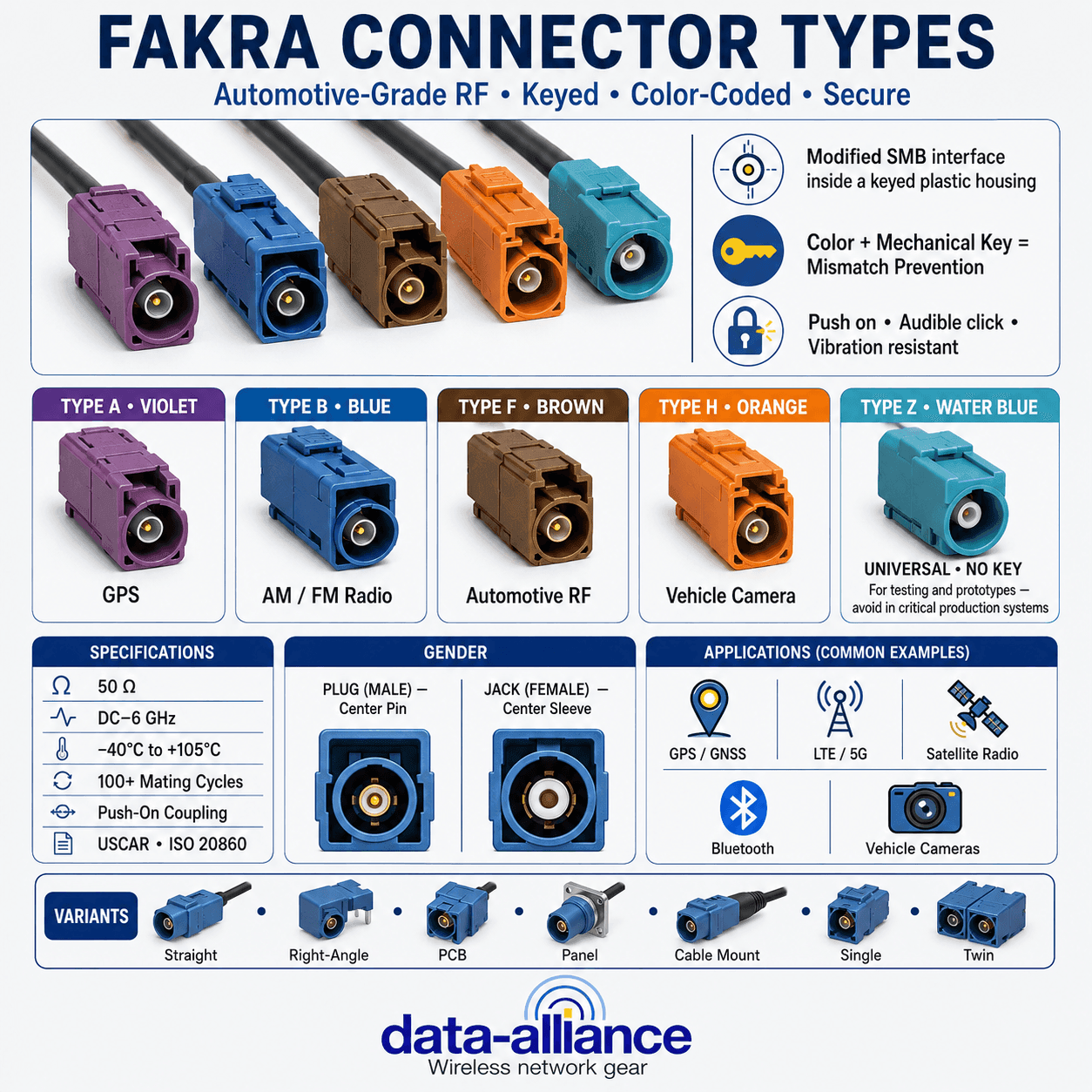
FAKRA connectors are modified SMB (SubMiniature version B) RF connectors enclosed in a keyed, color-coded plastic housing. This housing provides:
- Mechanical stability
- Visual identification through standardized colors
- Physical keying to prevent mismating
- Improved vibration resistance and safety
FAKRA connectors are commonly used for GPS, LTE, AM/FM radio, satellite radio, Bluetooth, and vehicle camera systems
Key Features of FAKRA Connectors
Key Features of FAKRA Connectors
- Standardized Color Coding
Each FAKRA connector type uses a specific color and mechanical key to prevent incorrect mating during installation. - High Durability
Designed for harsh automotive environments, FAKRA connectors operate reliably from −40°C to +105°C. - High-Frequency Performance
Supports RF frequencies up to 6.0 GHz, making FAKRA suitable for modern wireless technologies. - Secure Locking Mechanism
Push-on SMB interface combined with primary and secondary locking features ensures vibration-resistant connections. - Single and Dual Configurations
Available in both single FAKRA and FAKRA double (twin) formats for multi-channel RF applications.
FAKRA Connector Standard
FAKRA is a global automotive RF connector standard, defined under:
- USCAR
- ISO 20860
The standard specifies a plastic housing with 14 mechanically keyed, color-coded elements to eliminate incorrect mating.
The FAKRA standard specifications are:
Impedance | 50 Ohm |
Frequency Range | DC - 6 GHz |
Voltage Rating | 335 Volts RMS Continuous |
Dielectric Withstanding Voltage | 800 VRMS Max |
VSWR (Return Loss) (3 - 6 GHz) | 1.6 (-13dB) Max |
Insulation Resistance | 100 MΩ Min |
Insertion Loss (3 - 6 GHz) | 0.45 dB |
Power Handling | 95 W Max @ 1 GHz @ 25ºC |
Mating Cycles | 100 Min |
Coupling Mechanism | Push-On |
Temperature Range | −40°C to +105°C |
FAKRA Connector Types & Coding System
FAKRA connectors use letter-coded housings (A–Z), each associated with:
- A specific color
- A unique mechanical key
This system ensures connectors can only mate with the correct counterpart.
Universal FAKRA Z (Water Blue)
- FAKRA Z (Water Blue) has no mechanical key
- Can mate with any FAKRA type
- Commonly used for:
- Test environments
- Lab prototypes
- Non-critical applications
Because it allows mismating, FAKRA Z is not recommended for production automotive systems.
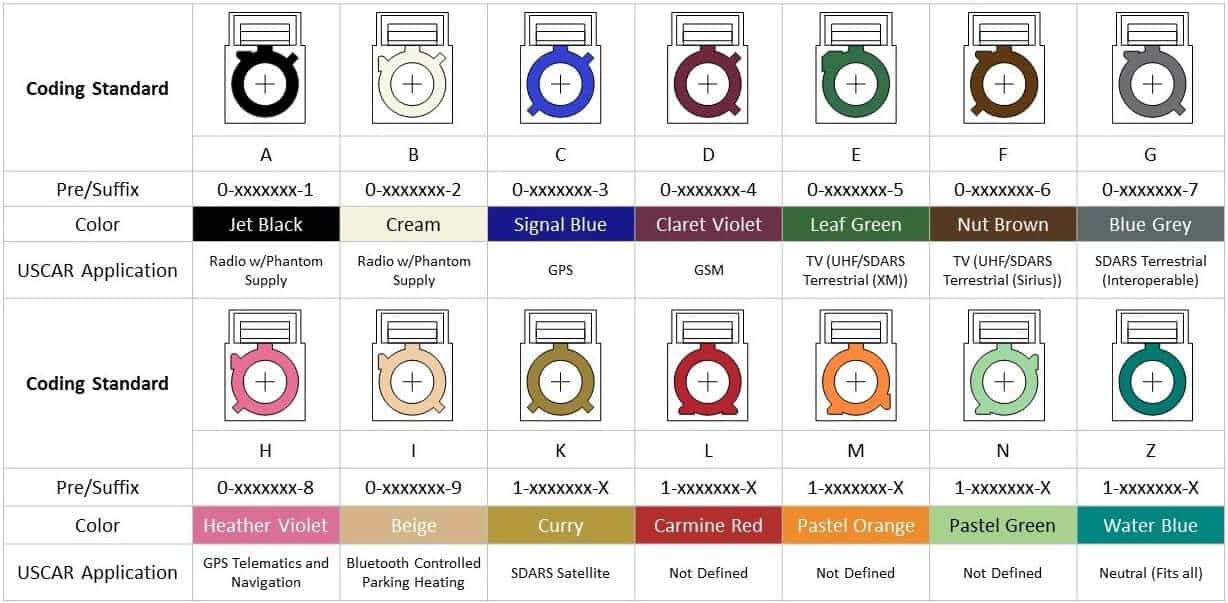
FAKRA Type F connectors are color-coded brown, corresponding to RAL 8011. This standard is consistently documented across multiple reputable references:
- The Rosenberger FAKRA Number Code chart lists Type F as brown (RAL 8011). Rosenberger Group
- The Mouser Electronics FAKRA Number Code document also specifies Type F with a brown color code. Mouser Electronics+1Rosenberger Group+1
- The element14 Community's comprehensive guide to FAKRA connectors confirms the brown color coding for Type F. element14 Community+1element14 Community+1
The brown color coding for Type F connectors is standardized under the USCAR and ISO 20860 specifications, ensuring consistency across manufacturers and applications. This coding helps prevent mismating and simplifies installation and maintenance in automotive RF and communication systems.
Gender and Mating
- FAKRA Plug (Male): Center pin, usually goes on the cable side.
- FAKRA Jack (Female): Center sleeve, usually on the device/housing.
Variants and Mounting Styles
FAKRA connectors come in various configurations, including:
- Straight or right-angle
- PCB mount or panel mount
- Cable mount (crimp or solder)
- Sealed or unsealed
FAKRA connector standard
The mechanical keying system in FAKRA connectors is a crucial feature designed to prevent mismating, ensure correct signal routing, and maintain safety—especially in complex automotive and RF environments where multiple similar-looking connectors are used.
Here’s a breakdown of how the mechanical keying in FAKRA connectors works:
1. Unique Plastic Housing with Keying Features
Each FAKRA connector is built around a standard SMB RF interface, but it's enclosed in a rectangular plastic housing that provides:
- Color coding (visual identification)
- Mechanical keying (physical differentiation)
The keying consists of protrusions (ridges) and notches (slots) on the outer housing that are unique for each FAKRA code (A through Z). These physical features prevent connectors with different key codes from mating.
2. Mating Compatibility is Code-Specific
- A FAKRA Plug (male) with code A (violet) can only mate with a FAKRA Jack (female) that has the same mechanical key and color (code A).
- Even if two connectors look similar in size and shape, if their keys don’t match, they won’t physically connect.
- This design eliminates human error during installation, particularly important in automotive manufacturing lines where speed and accuracy are critical.
3. FAKRA Z – The Universal Option
The exception is FAKRA Z (water blue), which has no keying. It can physically mate with any other FAKRA type. It’s typically used:
- In test environments
- For lab prototypes
- When a universal connection is acceptable
But Z-type connections sacrifice the safety of keying, so they’re not used in critical automotive systems.
4. Application Examples
- GPS (Code A, violet): Only connects to GPS modules
- Camera (Code H, orange): Only connects to camera inputs
- FM Radio (Code B, blue): Only plugs into FM antenna ports
This ensures that a GPS antenna isn’t accidentally plugged into an FM radio port, avoiding signal mismatches or system failure.
5. Locking and Retention
Once aligned correctly (keyed ridges match), the connectors snap together with an audible "click", indicating a secure connection. Most housings also include a locking tab or retention clip for vibration resistance.
Data Alliance offers a variety of FAKRA connectors and cables designed for RF applications, particularly in automotive, IoT, and wireless communication systems. Here's an overview of the types available:
Types of FAKRA Connectors Available at Data Alliance
- FAKRA-Female to SMA-Female Cables
These cables connect FAKRA female connectors to SMA female connectors, facilitating integration between automotive-grade RF systems and standard SMA-equipped devices. - FAKRA-Female to RP-SMA-Female Cables
Designed to connect FAKRA female connectors to RP-SMA female connectors, these cables are suitable for applications requiring reverse polarity SMA interfaces. - FAKRA Type F Male to Female Extension Cable – 20 inches (52cm), LMR-100 Equivalent.
Data Alliance provides these cables in multiple lengths (e.g., 2-inch, 4-inch, 6-inch, 24-inch) to accommodate different installation requirements.
Applications
- Automotive: Used in GPS systems, in-vehicle entertainment, keyless entry, parking sensors, and more.
- IoT Devices: Ideal for devices requiring stable wireless connections in varying environmental conditions.
- Telecommunications: Enhances signal reliability in various telecommunication equipment.
For more detailed information and to explore their product offerings, you can visit Data Alliance's FAKRA Cables & Adapters page.
When NOT to Use FAKRA
FAKRA connectors may not be the best choice when:
- The application is non-automotive and does not require keyed or color-coded connections
- Space is limited and a smaller connector (SMA, SMB) is needed
- Cost is a priority and automotive-grade ruggedness isn’t required
- Frequent mating cycles are expected (FAKRA ≈ 100 cycles)
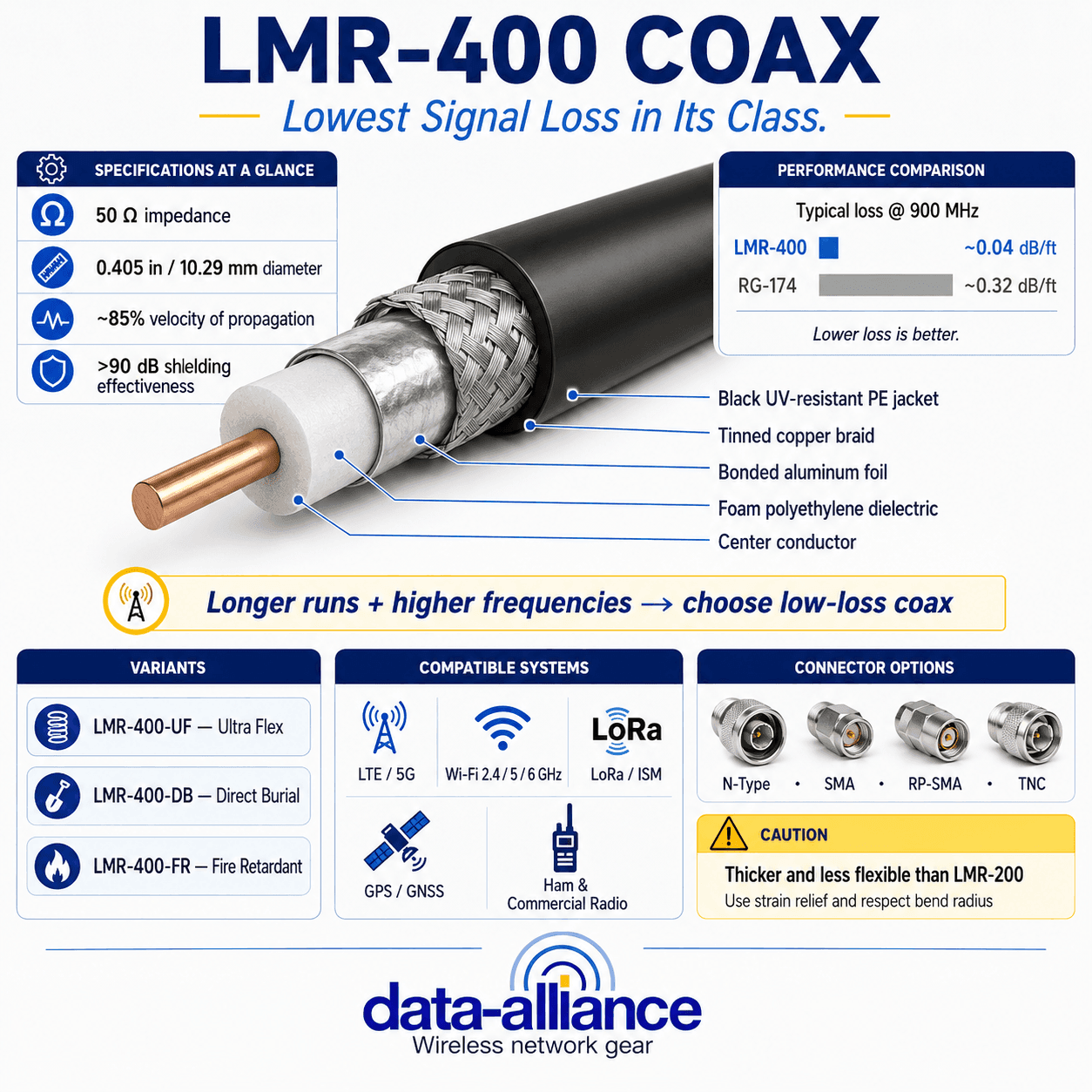
- Large, high-power coax (e.g., LMR-400 with N-Type connectors) is more appropriate
In these cases, standard RF connectors such as SMA, SMB, or N-Type may be a better fit.
Conclusions
For industries leaning heavily on IoT and automotive advancements, FAKRA connectors and cables seem to be the bridge leading to a more connected and efficient future.
The dynamic technological landscape has pushed the boundaries of wireless communication, resulting in more stringent requirements for connectors and cables. A remarkable entrant in this domain is FAKRA (Fachkreis Automobil), a German acronym that translates to "expert group for automotive." These cables have made a significant impact in the domain of wireless technologies, particularly in automobile and IoT applications.
FAQs
What are FAKRA connectors and why are they important?
FAKRA connectors are specialized RF connectors designed for automotive and IoT applications. They are modified SMB connectors housed in a plastic shell that adds color coding, mechanical keying, and vibration resistance. This ensures secure, error-free, and high-frequency signal transmission for GPS, LTE, AM/FM, satellite radio, Bluetooth, and more.
What are the key features of FAKRA connectors?
- Standardized color coding to prevent mismatches
- Durability: Operates in -40°C to +105°C conditions
- High-frequency performance up to 6.0 GHz
- Secure locking mechanism with primary and secondary locks
- Versatility: Available in single or double configurations, with straight, right-angle, PCB mount, or cable mount options
What standards govern FAKRA connectors?
FAKRA connectors follow the USCAR and ISO 20860 standards. These define 14 mechanical, color-coded keying systems, ensuring correct mating, safety, and global compatibility across automotive and wireless applications.
How does FAKRA color coding and keying work?
Each FAKRA connector type is assigned a unique color and mechanical key. This ensures that, for example, a GPS antenna (violet, Code A) can only connect to a GPS port. The physical ridges and slots in the housing prevent incorrect mating, eliminating installation errors in complex automotive systems. The only universal option is FAKRA Z (water blue), which mates with any type but lacks keying safety, so it’s mainly used in labs and test setups.
What are the electrical and mechanical specifications of FAKRA connectors?
- Impedance: 50 Ohm
- Frequency range: DC – 6 GHz
- Voltage rating: 335 V RMS continuous
- Dielectric withstand voltage: 800 V RMS max
- VSWR (3–6 GHz): 1.6 (–13 dB) max
- Insertion loss (3–6 GHz): 0.45 dB
- Power handling: 95 W max @ 1 GHz, 25°C
- Mating cycles: 100 minimum
- Temperature range: –40°C to +105°C
What is the difference between FAKRA plugs and jacks?
- FAKRA Plug (Male): Has a center pin and is usually mounted on the cable side.
- FAKRA Jack (Female): Has a center sleeve and is typically integrated into the device or housing.
This distinction helps ensure proper connectivity between devices and cables.
What types of FAKRA cables and adapters does Data Alliance offer?
- FAKRA-Female to SMA-Female Cables – connects FAKRA systems to SMA-equipped devices
- FAKRA-Female to RP-SMA-Female Cables – for reverse polarity SMA interfaces
- FAKRA Type F Male to Female Extension Cables (LMR-100 equivalent, available in 2–24 inch lengths)
These options support integration between automotive systems and standard RF equipment.
What are the main applications of FAKRA connectors?
- Automotive: GPS navigation, in-vehicle entertainment, FM/AM radio, keyless entry, parking sensors, cameras
- IoT devices: Reliable wireless connectivity in varying environments
- Telecommunications: Ensures stable RF transmission in network equipment