


Antennas, Antenna Cables, Wireless Products: Technical Articles
Antenna Connector Types Explained: SMA, RP-SMA, N, U.FL, FAKRA & How to Choose
If you are trying to figure out which antenna connector types your radio, antenna, and coax actually need, the short answer is: match four things every time — impedance (almost always 50 ohm in wireless), the connector family (SMA, RP-SMA, N, U.FL/MHF4, BNC, TNC or FAKRA), the gender/polarity, and the frequency the connector is rated to. Get those four right and the parts mate cleanly with low VSWR; get one wrong and you either can't connect at all or you quietly lose signal. This guide breaks down the common antenna connector types, where each one belongs, and the specs to verify before you buy.
What defines an antenna connector type
An "antenna connector type" is really a combination of several independent attributes. Two connectors can share a family name and still not mate, so check each of these:
- Family / interface: SMA, RP-SMA, N, TNC, RP-TNC, BNC, U.FL, MHF4, MMCX, MCX, FAKRA, TS9, etc. This sets the mechanical shape and coupling.
- Impedance: 50 ohm for virtually all WiFi, cellular, GPS, LoRa and IoT RF. 75 ohm exists (mostly video/CATV, e.g. some BNC and F-type) and must not be mixed into a 50-ohm RF path.
- Gender and polarity: male (plug) vs female (jack), plus reverse-polarity (RP) variants where the center-pin convention is swapped.
- Frequency rating: the usable upper frequency before the interface degrades (e.g. SMA to 18 GHz, N to ~11 GHz, BNC to ~4 GHz).
- Coupling style: threaded (SMA, N, TNC), bayonet (BNC), or snap/push-on (U.FL, MHF4, MMCX).
Confirm all five and the connection behaves. Guess, and you end up with mismatches like an SMA-to-RP-SMA pair that looks right but won't seat.
Antenna connector types compared (reference table)
The figures below are typical industry values and good starting points for spec'ing a connection. Always verify the exact rating against the specific part's datasheet, because build quality and body style change the real numbers.
| Connector | Impedance | Typical freq. rating | Coupling | Common use |
|---|---|---|---|---|
| SMA | 50 ohm | to 18 GHz | Threaded | WiFi, GPS, cellular, IoT antennas & pigtails |
| RP-SMA | 50 ohm | to 18 GHz | Threaded (reverse polarity) | Consumer/WiFi routers & access points |
| N-type | 50 ohm | to ~11 GHz | Threaded | Outdoor, high-power, low-loss coax (LMR-400) |
| TNC / RP-TNC | 50 ohm | to ~11 GHz | Threaded | Vibration-prone mobile/outdoor links |
| BNC | 50 or 75 ohm | to ~4 GHz | Bayonet | Test gear, video, legacy RF |
| U.FL (IPEX MHF1) | 50 ohm | to ~6 GHz | Snap-on | Compact PCBs, M.2/mini-PCIe cards |
| MHF4 (IPEX MHF4) | 50 ohm | to ~6 GHz+ | Snap-on | Ultra-compact modules, modern M.2 radios |
| MMCX / MCX | 50 ohm | to ~6 GHz | Snap-on (MMCX) / snap-on (MCX) | Space-constrained boards, GPS modules |
| FAKRA | 50 ohm | to ~6 GHz | Keyed, locking | Automotive / in-vehicle GPS, LTE, V2X |
| TS9 | 50 ohm | to ~6 GHz | Snap-on | USB modems & mobile hotspots |
Treat these as orientation values. Impedance is fixed by the design, but frequency ceilings and loss depend on the exact connector build and the coax it's terminated on.
How to choose the right antenna connector type
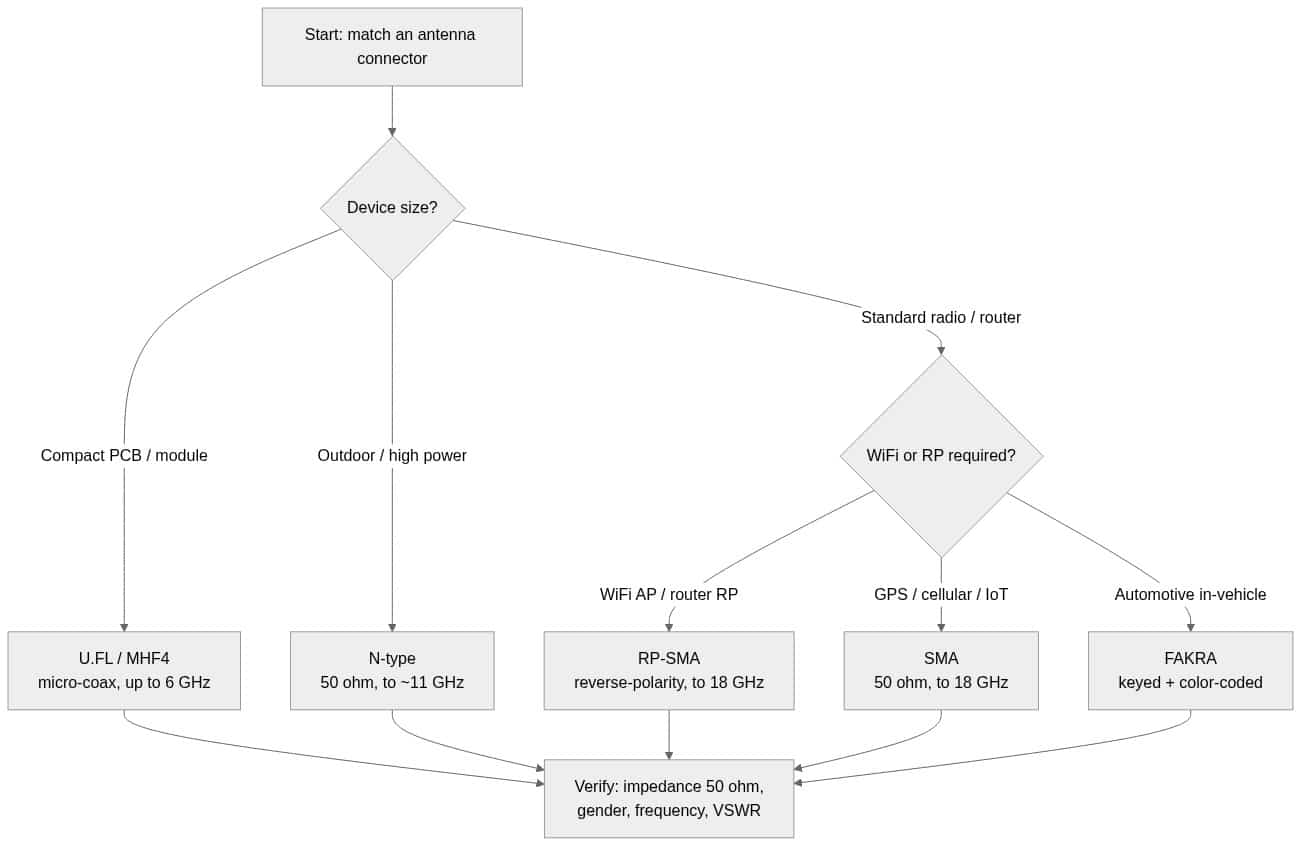
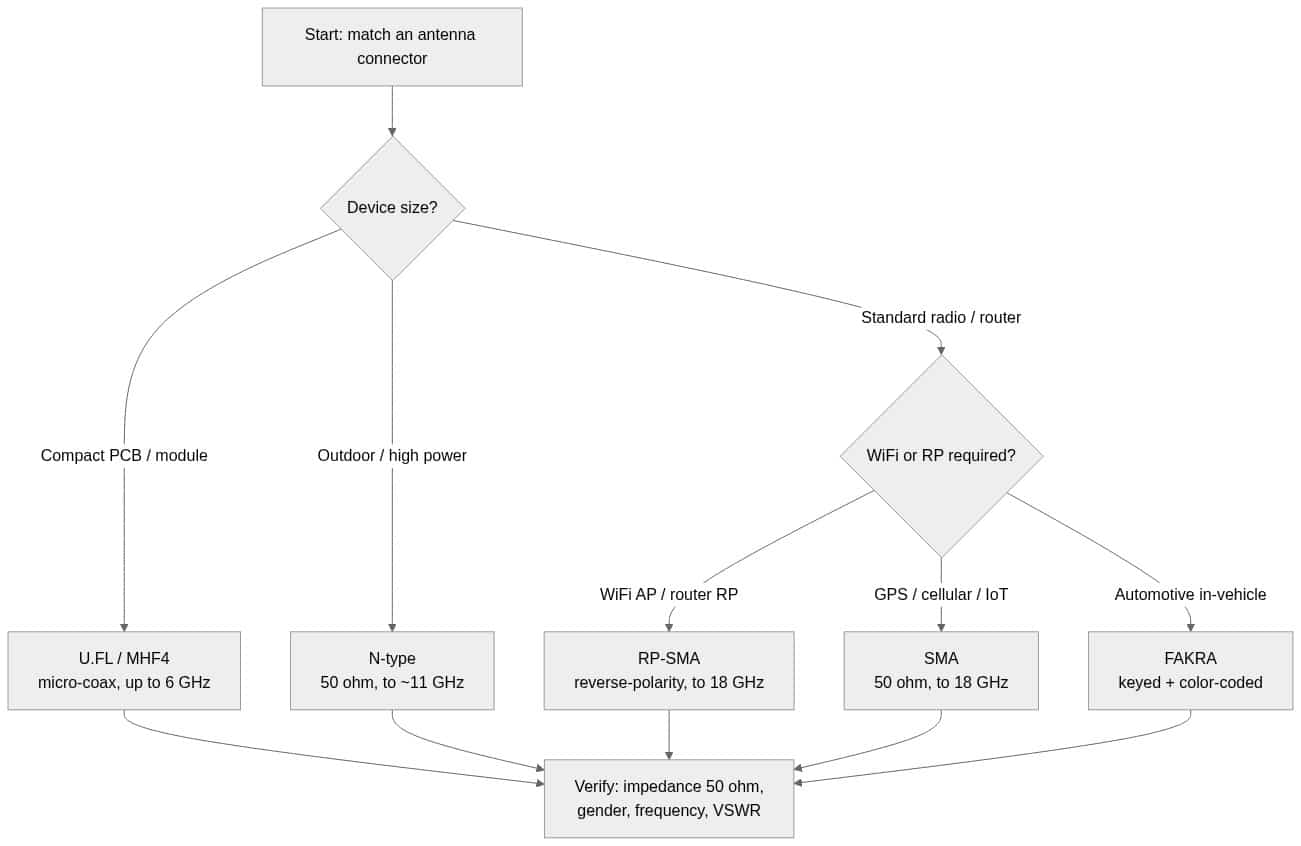
The fastest way to narrow the field is to work from the device outward. The decision tree below walks from device size and application to a connector family, then reminds you to verify the electrical specs before you commit.
By device and environment
- Compact PCBs and radio cards (M.2, mini-PCIe, IoT modules): U.FL or MHF4 micro-coax, usually terminated to an SMA or RP-SMA bulkhead pigtail.
- WiFi routers and access points: RP-SMA is the consumer-equipment convention; verify RP vs standard before ordering an antenna or pigtail.
- GPS, cellular and general IoT antennas: SMA is the workhorse — 50 ohm, rated to 18 GHz, widely stocked.
- Outdoor, high-power or long low-loss runs: N-type on LMR-400-class coax for durability and lower loss at the connector.
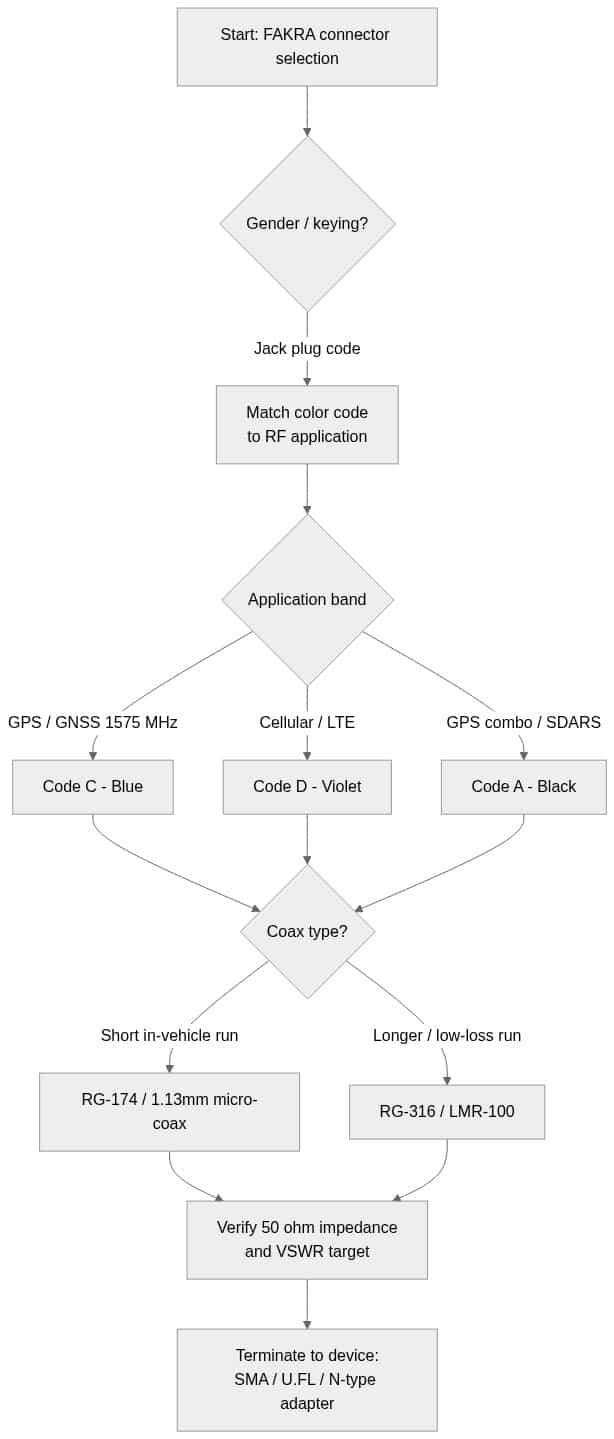
- Automotive / in-vehicle: FAKRA, which adds keying and color coding so the right RF line mates only with its matching port.
Watch the RP (reverse-polarity) trap
RP-SMA and RP-TNC swap the center-contact convention versus standard SMA/TNC. An RP-SMA male has a female-style center, so it will physically thread onto a standard SMA but the pins won't make contact. If a "matching" connector screws together yet the link is dead, a reverse-polarity mismatch is the first thing to check.
Specs to verify before you order
- Impedance: keep the whole path at 50 ohm for wireless. Don't drop a 75-ohm BNC into a 50-ohm chain.
- Gender and polarity: confirm male/female AND standard vs reverse polarity on both ends.
- Frequency headroom: the connector's rating should clear your operating band with margin (e.g. don't run 5 GHz WiFi through a connector only characterized to 4 GHz).
- Coax compatibility: the connector body must match the cable it terminates (RG-174, RG-316, LMR-240, LMR-400, 1.13 mm micro-coax, etc.). Mismatched bodies raise VSWR and loss.
- VSWR / return loss: a good connection should hold low VSWR across band; a bad adapter or crimp shows up as reflected power.
- Mating cycles & environment: snap-on micro-coax (U.FL) is rated for very few mating cycles; threaded N/SMA and weatherized bodies suit outdoor, repeated-service installs.
Adapters, pigtails and keeping loss down
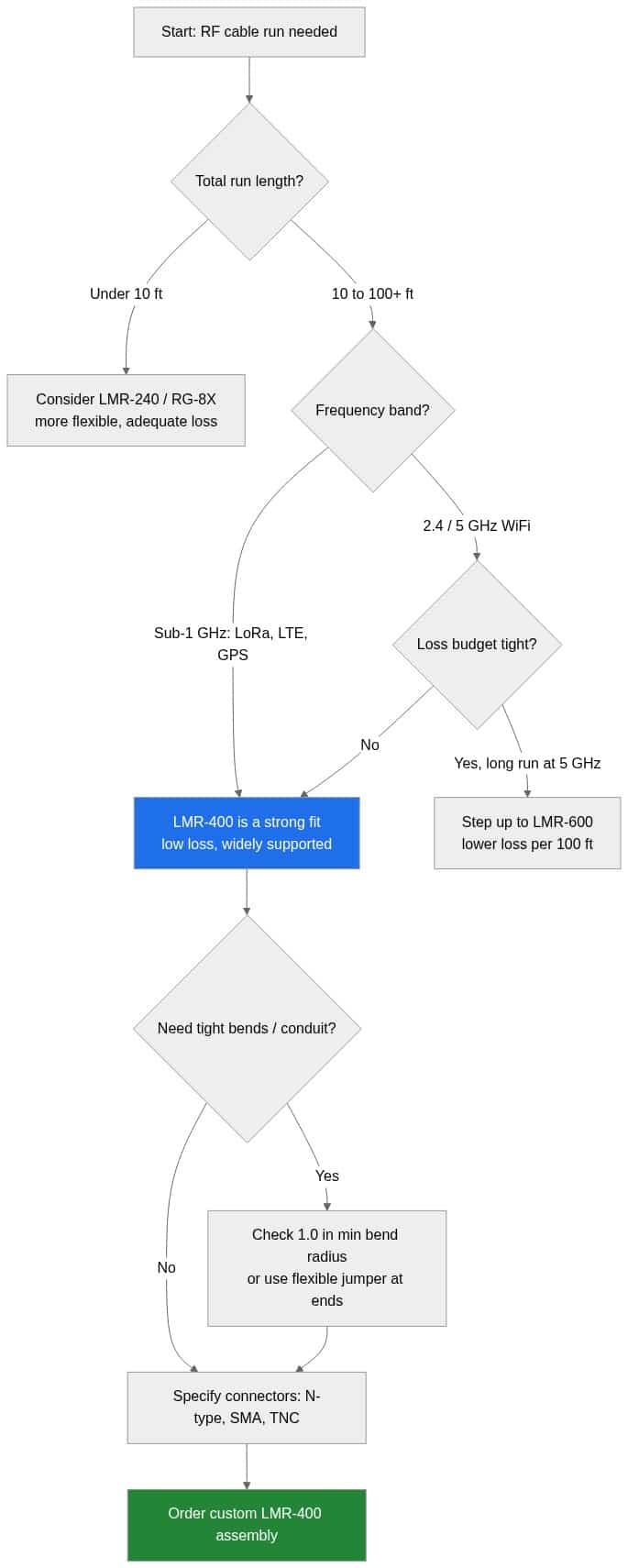
You won't always have the exact interface you need on both ends — that's what adapters and pigtails solve (N-to-SMA, SMA-to-U.FL, TS9-to-SMA, and so on). Every extra junction adds a little insertion loss and one more potential VSWR bump, so minimize the number of interfaces in a path and favor a single correctly-terminated assembly over a stack of adapters. When a run is long, the connector choice matters less than the coax: a well-matched N-type on low-loss cable beats an SMA on thin coax over distance. For the full cable-selection logic, see our antenna cable selection guide, which maps coax type, connector, length and signal loss to your link budget.
Connector-by-connector deep dives
Each major family has its own trade-offs. These detailed guides cover specs, gender/polarity and selection for the connectors you'll meet most often:
- SMA connector guide: SMA vs RP-SMA, male/female and specs — the most common WiFi/cellular/GPS interface.
- N-type connector guide: specs, N vs SMA and how to choose — for outdoor, high-power and low-loss runs.
- U.FL connector guide: U.FL vs MHF4 and choosing the right micro-coax — for compact boards and radio cards.
- FAKRA connector guide: color codes, keying and how to choose — for automotive and in-vehicle antenna systems.
Need help matching a connector to a specific radio or cable? Browse the antenna cables & adapters range or request a custom quote — Data Alliance custom-manufactures cable assemblies to your exact connectors, coax and length, with same-day shipping on orders placed before 4pm MST.
Frequently asked questions about antenna connector types
What is the most common antenna connector type?
SMA is the most widely used antenna connector in wireless. It's a 50-ohm threaded interface rated to 18 GHz and appears on WiFi, cellular, GPS, LoRa and IoT antennas and pigtails. On consumer WiFi routers and access points you'll more often see its reverse-polarity cousin, RP-SMA.
What's the difference between SMA and RP-SMA?
They share the same threaded body but swap the center-contact convention. A standard SMA male has a center pin; an RP-SMA male has a center socket. Because the threads match, the two can screw together but won't make electrical contact — so an SMA antenna will not work on an RP-SMA port even though it "fits." Always confirm standard vs reverse polarity on both ends.
Are all antenna connectors 50 ohm?
Almost all wireless RF connectors are 50 ohm, and your whole signal path should stay 50 ohm. The main exception is 75-ohm hardware used for video/CATV (some BNC and F-type), which must not be mixed into a 50-ohm antenna chain or you'll create an impedance mismatch and reflected power.
Which connector should I use for an outdoor, long cable run?
N-type on low-loss coax such as LMR-400 is the usual choice. The larger N body handles higher power, weatherizes well, and keeps connector loss low at the frequencies used for point-to-point and long-range links. For shorter indoor jumpers, SMA or RP-SMA is typically fine.
Do adapters reduce signal?
Yes — every adapter or extra junction adds a small amount of insertion loss and one more place for a VSWR bump. A single correctly-terminated cable assembly is better than a stack of adapters. When you can, order a pigtail or assembly with the exact end connectors you need rather than adapting in the field.
How do I know which connector my device uses?
Check the device's datasheet or the markings near the RF port, and verify family, gender and polarity. Compact radio cards usually use U.FL or MHF4; routers and APs usually use RP-SMA; most standalone antennas use SMA; automotive systems use FAKRA. If you're unsure, our technical support team can identify the interface and spec a matching cable.