


Antennas, Antenna Cables, Wireless Products: Technical Articles
BNC Connector Guide: Specs, 50 vs 75 Ohm, BNC vs SMA & How to Choose
A BNC connector is a quick-connect RF coaxial connector that uses a spring-loaded bayonet coupling — a quarter-turn twist-and-lock mechanism — instead of threads, which is why it is the go-to connector for test equipment, video, and gear that gets connected and disconnected constantly. If you are deciding whether a BNC connector is right for your build, the four things that matter are impedance (50-ohm vs 75-ohm), operating frequency, the coax you are terminating, and connector gender. This guide walks through each, with a reference spec table and a decision flow, so IT pros, integrators, and network consultants can spec the right part the first time.
What is a BNC connector?
BNC stands for Bayonet Neill–Concelman, named after its two inventors and its bayonet-style coupling. The defining feature is that quarter-turn locking collar: you push the plug onto the jack and twist roughly 90 degrees to lock it. That makes a BNC connector far faster to mate than a threaded SMA or N-type, while still giving a positive, vibration-resistant connection — the reason it dominated lab bench equipment, oscilloscope probes, and professional video for decades.
BNC connectors are made in two distinct impedances that look nearly identical but are not interchangeable for high-performance work: 50-ohm (RF, data, and antenna systems) and 75-ohm (video, broadcast, and CCTV). Mixing them creates an impedance mismatch that raises VSWR and reflects signal — fine at low frequencies, costly at higher ones. More on that below.
Key specifications to verify
Treat the figures below as typical ranges for standard commercial BNC connectors. Exact values vary by manufacturer and coax, so always confirm against the specific part's datasheet before you commit a design.
| Spec | Typical value | Notes |
|---|---|---|
| Impedance | 50 Ω or 75 Ω | Must match the coax and system; not interchangeable at high frequency |
| Frequency range | DC to ~4 GHz | 50-ohm BNC is commonly rated to about 4 GHz; performance degrades toward the top end |
| Coupling | Bayonet (quarter-turn) | Twist-lock; faster than threaded, good vibration resistance |
| Mating cycles | 500+ (typical) | Verify on the datasheet; one of BNC's strengths vs micro-coax connectors |
| Body / plating | Brass, nickel or gold plated | Gold on the center pin for low contact resistance; nickel body for durability |
| Termination | Crimp, solder, or clamp | Crimp is fastest for volume; match the crimp die to the coax |
50-ohm vs 75-ohm: picking the right BNC connector
This is the decision that trips people up most. A 50-ohm BNC connector is built for RF transmission and power handling — antennas, radios, LoRa and IoT gateways, GPS splitters, and test equipment. A 75-ohm BNC connector is optimized for low-loss video and digital signals: analog CCTV, SDI/HD-SDI broadcast, and MADI digital audio. The physical difference is in the dielectric spacing around the center pin; 75-ohm bodies often use less dielectric material.
At low frequencies and short runs you can sometimes get away with mixing them, but on an HD-SDI video link or a multi-GHz RF run the impedance step creates reflections that show up as return loss and signal degradation. For a deeper treatment of where each sits — including which RG coax each pairs with — see our companion article on BNC cables in 50 ohm and 75 ohm. The rule of thumb: match the connector impedance to the coax and the system, every time.
How to choose a BNC connector
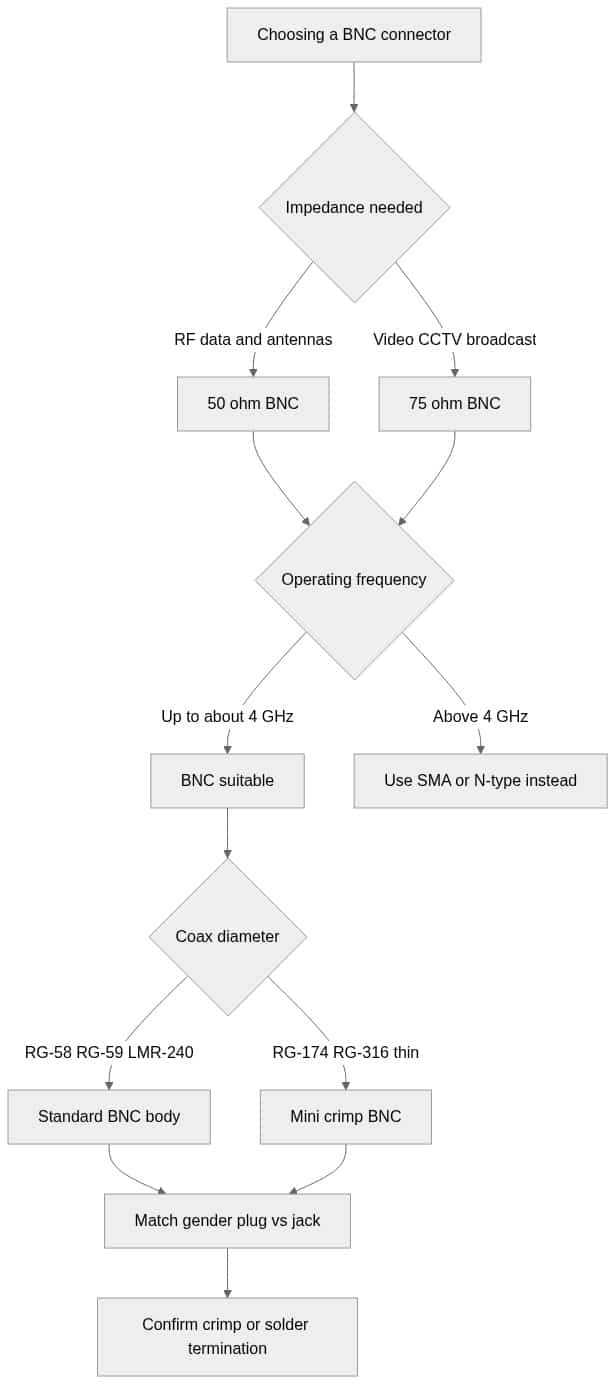
The flow below summarizes the selection process — impedance first, then frequency, then coax, then gender and termination.
1. Match impedance to the system
50-ohm for RF, antenna, and data; 75-ohm for video, CCTV, and broadcast. Confirm what your radio or receiver expects and match the coax to it.
2. Confirm the frequency is in range
BNC is comfortable from DC through the low gigahertz. If your system runs above roughly 4 GHz — many 5 GHz Wi-Fi, 5.8 GHz, and microcell designs — a threaded connector like SMA or N-type is the safer choice.
3. Match the connector to your coax
The connector body and crimp die are specific to the cable's outer diameter and dielectric. Standard BNC bodies suit RG-58, RG-59, and LMR-240-class coax; thin coax like RG-174 or RG-316 needs a mini/crimp BNC sized for it. For help picking the cable side of the assembly, see our antenna cable selection guide, which covers coax type, length, and signal loss.
4. Get the gender right
A BNC plug (male) has the bayonet collar that rotates; a BNC jack (female) has the pins the collar locks onto. Verify both ends of every link before ordering.
BNC vs SMA vs N-type: when to use which
BNC is one of several RF connectors you will spec, and the choice usually comes down to frequency, size, and how often the connection is mated.
| Connector | Coupling | Typical frequency | Best for |
|---|---|---|---|
| BNC | Bayonet (quick) | DC–~4 GHz | Test gear, video, frequent mating |
| SMA | Threaded | DC–18 GHz | WiFi, cellular, GPS, IoT antennas |
| N-type | Threaded | DC–~11 GHz | Outdoor, high-power, weatherproof runs |
If your design is pushing into Wi-Fi and cellular frequencies, a threaded connector handles the frequency and the environment better. Compare the two most common alternatives in our SMA connector guide and our N-type connector guide, and for a side-by-side of all four families see comparing RF connectors: SMA vs N-type vs TNC vs BNC.
Where BNC connectors are used
- Test and measurement: oscilloscopes, signal generators, spectrum analyzers — the fast bayonet mate is ideal for benches where cables change constantly.
- Analog video and CCTV: 75-ohm BNC on RG-59 remains the workhorse for surveillance and composite video.
- Broadcast and pro A/V: HD-SDI and 3G-SDI links and MADI digital audio over 75-ohm BNC.
- RF and amateur radio: 50-ohm BNC on handhelds, scanners, and low-power transmitters below a few GHz.
Order BNC connectors and custom cable assemblies
Data Alliance manufactures custom coaxial cable assemblies with BNC connectors in both 50-ohm and 75-ohm, terminated to the coax and length your build needs. Browse antenna cables & adapters to configure an assembly, or if you need a non-standard length, connector combination, or coax type, request a custom quote from our technical team. Orders placed before 4pm MST ship same day.
Frequently asked questions
Is a BNC connector 50 ohm or 75 ohm?
Both exist. 50-ohm BNC connectors are used for RF, data, and antenna systems; 75-ohm BNC connectors are used for video, CCTV, and broadcast. They look nearly identical but are not interchangeable for high-frequency work, so match the connector impedance to your coax and system.
What is the maximum frequency of a BNC connector?
Standard 50-ohm BNC connectors are commonly rated to about 4 GHz, with performance degrading toward the top of that range. Above roughly 4 GHz, a threaded connector such as SMA (to 18 GHz) or N-type (to about 11 GHz) is the better choice. Always verify the rating on the specific part's datasheet.
What does BNC stand for?
BNC stands for Bayonet Neill–Concelman, named after the bayonet coupling mechanism and its two inventors, Paul Neill and Carl Concelman.
Can I use a 75-ohm BNC connector on 50-ohm coax?
You can physically mate them, but the impedance mismatch raises VSWR and reflects signal. On short, low-frequency links the effect may be negligible; on high-frequency RF or HD-SDI video links it degrades performance measurably. Best practice is to match connector impedance to the coax and the system end to end.
How do I terminate a BNC connector onto coax?
BNC connectors come in crimp, solder, and clamp styles. Crimp is fastest and most repeatable for volume work, but the crimp die and connector body must be sized for the exact coax. If you would rather not terminate connectors yourself, Data Alliance builds the assembly to spec and tests it before it ships.
Need help matching a BNC connector to your coax and application? Contact our technical support team or request a custom quote.