


Antennas, Antenna Cables, Wireless Products: Technical Articles
SMA Antenna Guide: How to Choose the Right SMA & RP-SMA Antenna
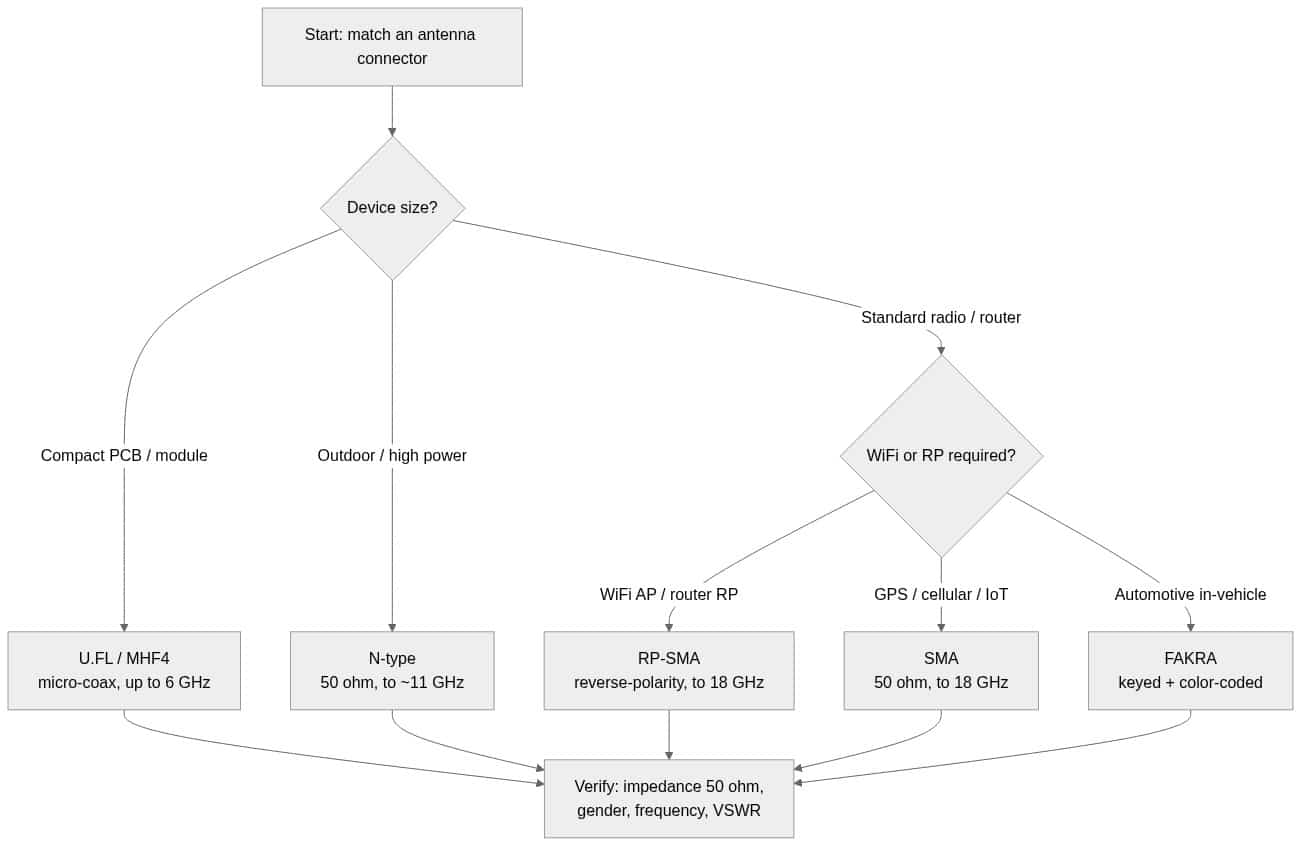
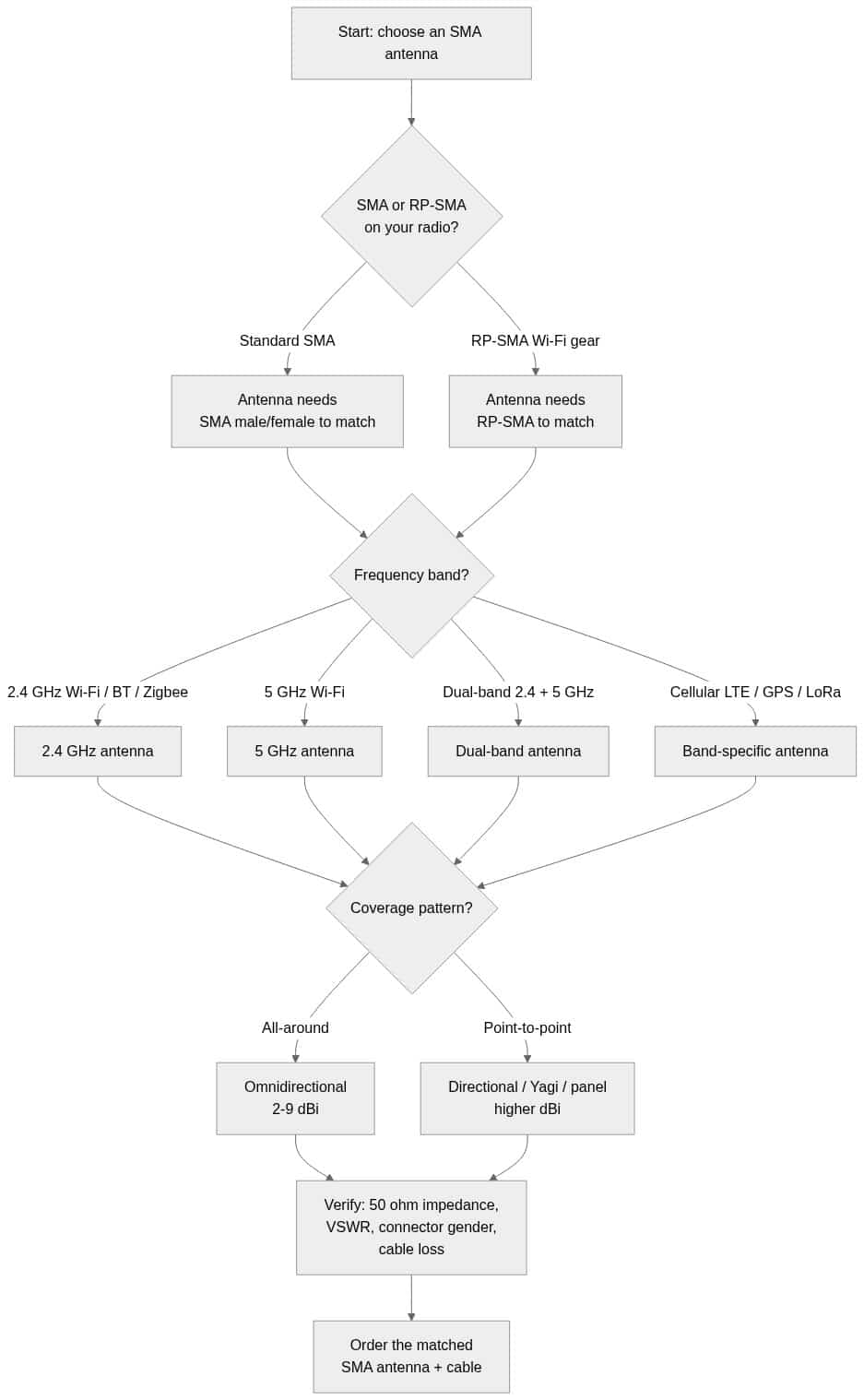
An SMA antenna is any antenna that terminates in a 50-ohm SMA-family connector — standard SMA or the reverse-polarity RP-SMA variant — so it can thread directly onto a radio, router, modem, or SMA pigtail. The right choice comes down to four things you must match: the connector standard (SMA vs RP-SMA), the connector gender (male vs female), the frequency band your radio operates on, and the gain and radiation pattern your coverage goal needs. Get those four right and the antenna mates mechanically and performs electrically; get one wrong and you either can't connect it or you waste signal. This guide walks through each decision for IT professionals, integrators, and network consultants who buy on verifiable specs.
What is an SMA antenna?
"SMA" stands for SubMiniature version A — a compact, threaded 50-ohm RF coaxial connector. An SMA antenna is simply an antenna built with that connector (or its reverse-polarity cousin) on its base or pigtail. SMA is one of the most common antenna interfaces in wireless networking because it is small, rugged, and threaded for a secure connection, and it is rated across the frequencies most WiFi, cellular, GPS, and IoT radios use. The connector itself is a 50-ohm interface, so the antenna, cable, and radio should all be 50-ohm to avoid impedance mismatch. If you need the full mechanical and electrical breakdown of the connector, see our SMA connector guide: SMA vs RP-SMA, male/female, specs & how to choose.
SMA vs RP-SMA: the first thing to verify
The single most common ordering mistake with an SMA antenna is confusing SMA with RP-SMA (Reverse Polarity SMA). They look nearly identical and share the same threads, but the center contact is swapped, so they do not interoperate correctly. The distinction exists largely for historical regulatory reasons on consumer WiFi equipment.
- Standard SMA — the male connector has the center pin, the female has the center socket. Common on cellular modems, GPS modules, LoRa radios, and most RF test gear.
- RP-SMA — genders are reversed: the "male" housing carries a socket and the "female" housing carries a pin. Dominant on consumer and prosumer WiFi routers, access points, and USB WiFi adapters.
Before you buy, look at the jack on your device and identify both the standard and the gender it presents, then order the mating half. A quick physical check: if the threaded coupling nut is on the connector but there is a pin inside, and the body is a WiFi device, you are almost certainly looking at RP-SMA.
SMA vs RP-SMA gender reference
| Connector | Center contact | Typical on | Mates with |
|---|---|---|---|
| SMA male | Pin | Pigtails, cellular/GPS antennas | SMA female |
| SMA female | Socket | Radios, cables | SMA male |
| RP-SMA male | Socket (reversed) | WiFi antennas | RP-SMA female |
| RP-SMA female | Pin (reversed) | WiFi routers / APs | RP-SMA male |
Verify the gender printed on your device's spec sheet — markings are not always visible on the hardware.
Match the SMA antenna to the frequency band
An antenna is tuned to a band; an SMA connector only governs how it attaches, not what frequencies it radiates. A 915 MHz LoRa antenna and a 5 GHz WiFi antenna can both have an SMA connector and still be useless on each other's radio. Match the antenna's rated band to your radio.
Common SMA antenna bands
| Application | Typical band(s) | Common connector | Typical antenna type |
|---|---|---|---|
| WiFi 2.4 GHz | 2400–2483.5 MHz | RP-SMA | Omni whip / dipole |
| WiFi 5 GHz | ~5150–5850 MHz | RP-SMA | Omni / panel |
| Dual-band WiFi | 2.4 & 5 GHz | RP-SMA | Dual-band omni |
| Cellular / LTE | ~698–2700 MHz (wideband) | SMA | Wideband whip / panel |
| GPS / GNSS | 1575.42 MHz (L1) | SMA | Active patch |
| LoRa / ISM sub-GHz | 868 MHz (EU) / 915 MHz (NA) | SMA | Omni whip |
Bands and tuning vary by model — always confirm the antenna's rated frequency range and VSWR across that range on the datasheet before ordering. If you are building out a 2.4 GHz deployment, our 2.4 GHz antenna guide breaks down omni vs directional types and realistic gain for that band.
Gain and radiation pattern: omni vs directional
Once the connector and band are settled, gain (in dBi) and radiation pattern decide coverage. Gain is not "more power" — it is a trade of coverage shape. A higher-dBi omnidirectional antenna flattens its doughnut-shaped pattern to push energy toward the horizon, which helps on the same floor but can under-cover devices above or below.
- Omnidirectional (typically ~2–9 dBi) — 360° horizontal coverage. Best for access points serving clients all around, or a base station in the center of a site.
- Directional — panel, patch, or Yagi antennas concentrate energy into a beam for point-to-point links, long-range backhaul, or reaching one specific area. Higher effective gain in the target direction, narrow elsewhere.
Treat manufacturer dBi figures as nominal and confirm them against the datasheet; peak gain and average gain can differ. For a deeper look at how feedline mismatch wastes gain, see our explainer on VSWR and impedance matching in antennas.
Impedance, VSWR, and cable loss
An SMA antenna should present a 50-ohm impedance, matched to 50-ohm coax and a 50-ohm radio. Mismatch raises VSWR, reflects power back toward the transmitter, and reduces radiated signal. Two numbers to verify on the datasheet:
- VSWR — lower is better; many antennas target roughly 1.5:1 or better across their rated band, though acceptable values depend on the application.
- Return loss — the dB expression of the same match; higher dB is better.
If you are not mounting the antenna directly on the radio, the cable between them adds loss, and that loss grows with frequency and length. At 5 GHz, thin pigtail coax such as RG-174/RG-316 loses signal quickly, so keep those runs short or step up to a lower-loss cable for longer distances. When you need a custom length or connector combination, Data Alliance manufactures SMA and RP-SMA cable assemblies to order — browse antenna cables & adapters or request a custom quote for a specific build.
How to choose an SMA antenna: quick checklist
- Connector standard — SMA or RP-SMA? (Check the radio, not the antenna.)
- Connector gender — order the mating half so pin meets socket.
- Frequency band — match the antenna's rated band to your radio.
- Pattern & gain — omni for all-around, directional for point-to-point.
- Impedance & VSWR — confirm 50-ohm and a low VSWR across the band.
- Cable loss — keep high-frequency runs short or use low-loss coax.
Ready to buy? Shop the full range of SMA antennas at Data Alliance — add to cart for same-day shipping on orders placed before 4pm MST, or contact technical support if you need help matching an antenna to your radio.
Frequently asked questions about SMA antennas
Is an SMA antenna the same as an RP-SMA antenna?
No. They share the same threads and look nearly identical, but the center contact is reversed on RP-SMA, so they are not cross-compatible. Standard SMA is common on cellular, GPS, and LoRa gear; RP-SMA is standard on WiFi routers, access points, and USB WiFi adapters. Always confirm which one your radio uses before ordering.
Are all SMA antennas 50 ohm?
SMA is a 50-ohm connector standard, and antennas built for RF networking are overwhelmingly 50-ohm to match 50-ohm radios and coax. Still verify the antenna's impedance on its datasheet, because impedance is a property of the antenna design, not just the connector.
Can I use a 2.4 GHz SMA antenna on a 5 GHz radio?
Not reliably. The connector will physically mate, but the antenna is tuned to a specific band. A 2.4 GHz antenna used at 5 GHz will show poor VSWR and weak performance. For both bands, use a dual-band antenna rated for 2.4 and 5 GHz.
How do I know if my device uses SMA male or female?
Check the device's datasheet for the connector callout, or inspect the jack: identify the threaded coupling and whether a pin or socket is in the center, remembering that WiFi gear is usually RP-SMA (reversed). When in doubt, contact technical support with your device model and we can confirm the mating connector.
Does the cable between the radio and SMA antenna matter?
Yes. Any coax between the radio and antenna adds insertion loss that increases with frequency and length. At 5 GHz especially, keep thin pigtail runs short or move to a lower-loss cable. For longer runs, a low-loss coax assembly preserves far more of your signal than a thin RG-174 jumper.