


Antennas, Antenna Cables, Wireless Products: Technical Articles
Yagi Antenna Guide: How Directional Gain, Beamwidth & Connectors Work
A Yagi antenna (properly a Yagi-Uda array) is a directional antenna that concentrates RF energy into a narrow forward beam, trading the all-around coverage of an omnidirectional whip for higher gain and longer usable range in one direction. If you are linking two fixed points, reaching a distant tower, or trying to pull in a weak signal from a known bearing, a Yagi antenna is usually the right tool — provided you match its frequency band, gain, beamwidth, connector and feedline to the job. This guide explains how those specs interact so you can spec one with confidence.
What a Yagi antenna is and how it works
A Yagi-Uda array is built along a central boom from three kinds of elements:
- Driven element — the single element actually connected to the feedline (your connector lands here). It is typically a half-wave dipole or folded dipole.
- Reflector — one element behind the driven element, slightly longer, that reflects energy forward.
- Directors — one or more elements in front of the driven element, slightly shorter, that pull the beam forward. More directors generally means more gain and a narrower beam.
Only the driven element is fed; the reflector and directors are "parasitic" and are coupled by the field around them. The combined effect is a strong main lobe aimed off the front of the boom. The diagram below shows the element order and where the gain goes.

Yagi antenna gain, beamwidth and front-to-back ratio
Three numbers define how directional a Yagi antenna is, and they trade against each other:
- Gain (dBi) — how much the forward beam is concentrated versus an isotropic radiator. More elements raise gain, roughly a few dB per doubling of the array, but with diminishing returns.
- Beamwidth — the angular width (in degrees) of the main lobe at the −3 dB points. Higher gain means a narrower beam, so aiming accuracy matters more.
- Front-to-back ratio (dB) — how much weaker the signal is off the back than off the front. A high front-to-back ratio helps reject interference and noise coming from behind the antenna.
The practical consequence: a 15 dBi Yagi hits harder and farther than a 9 dBi one, but its beam may be only ~25–30° wide instead of ~45–50°, so it must be aimed more precisely and mounted rigidly so wind does not swing it off target. Always confirm gain, beamwidth and front-to-back figures against the manufacturer's published pattern for the specific model and band — do not assume a number from a similar-looking antenna.
Yagi antenna vs omnidirectional: when to choose which
The core decision is coverage shape, not raw gain. Use the quick comparison below.
| Factor | Yagi (directional) | Omnidirectional |
|---|---|---|
| Coverage pattern | Narrow forward beam | 360° around the mast |
| Typical use | Point-to-point links, reaching one tower, pulling a known-bearing signal | Point-to-multipoint, covering clients spread in all directions |
| Relative gain | Higher in the aimed direction | Lower, spread evenly |
| Aiming | Must be aimed; narrower beam = tighter alignment | No aiming required |
| Interference rejection | Good — rejects signals off the back/sides | Poor — hears noise from everywhere |
If clients or nodes sit in every direction around your mast, an omnidirectional is correct. If you are hitting one distant endpoint, the Yagi's gain and interference rejection win. For the broader trade-offs across antenna styles and bands, see our 2.4 GHz antenna guide, which compares omnidirectional, panel and Yagi options for the 2.4 GHz band.
Connectors, impedance and polarization
A Yagi antenna is only as good as the connection into it. Verify these before you buy:
- Impedance — RF Yagis for WiFi, cellular and ISM work are 50 ohm. Match the whole chain (antenna, cable, radio) to 50 ohm; a mismatch raises VSWR and wastes power. See our explanation of VSWR for how mismatch maps to reflected power.
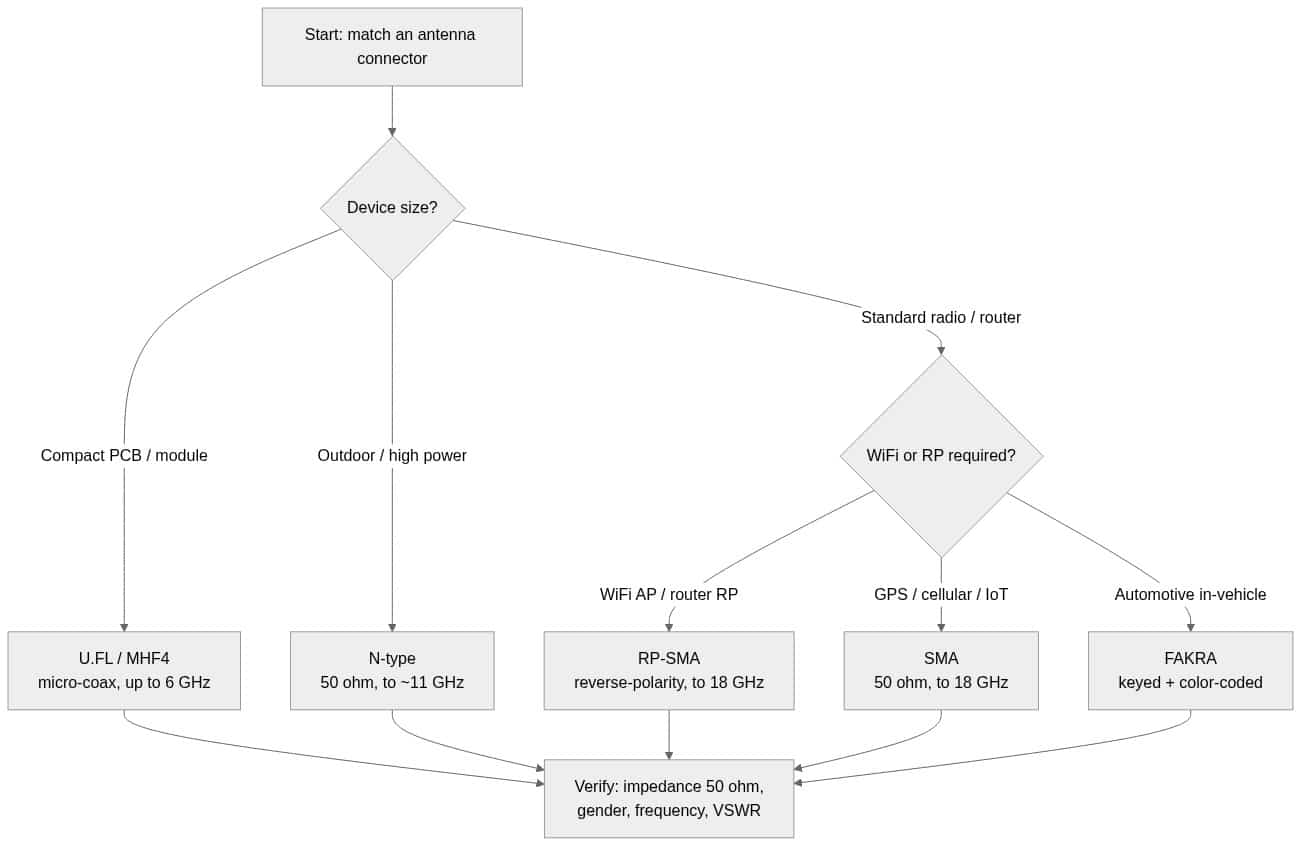
- Connector type — outdoor Yagis commonly terminate in an N-type connector for its ruggedness and weatherproofing; smaller units may use SMA or RP-SMA. Confirm gender and polarity and use a pigtail or adapter only if you cannot match natively.
- Polarization — most Yagis are linearly polarized (vertical or horizontal). Both ends of a link must share the same polarization, or you lose significant signal to cross-polarization.
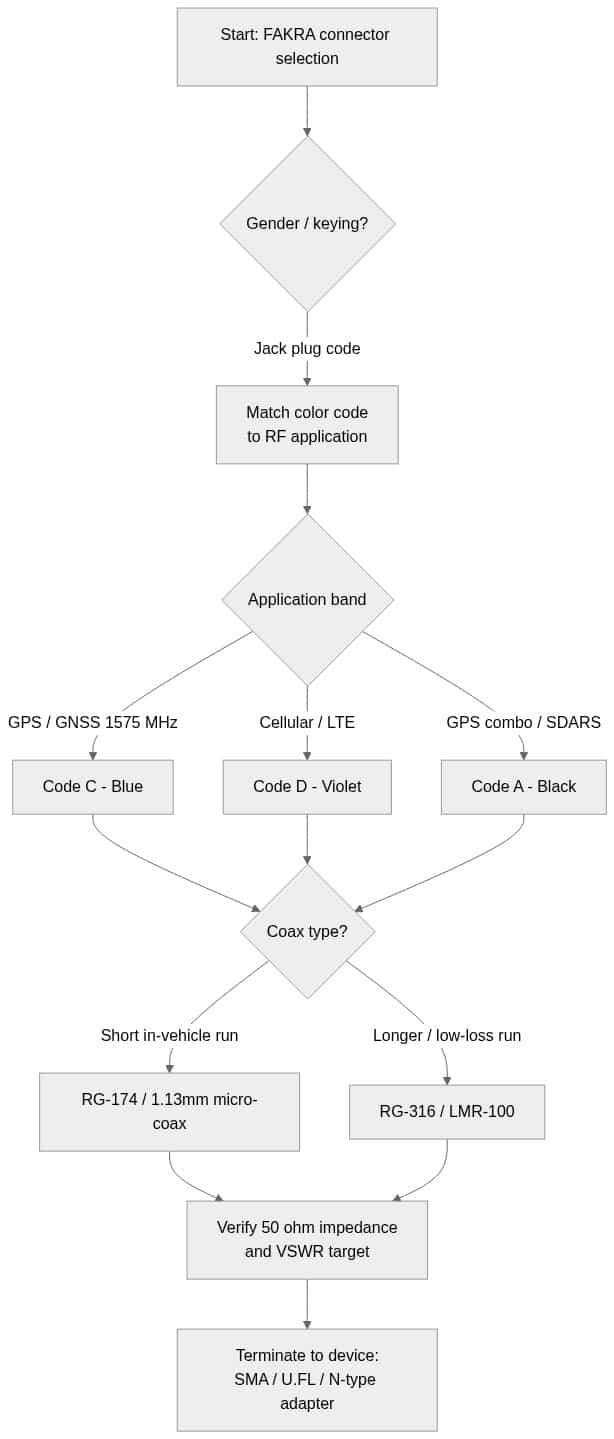
Not sure which connector the radio and antenna use? Our antenna connector types guide walks through SMA, RP-SMA, N, U.FL and FAKRA and how to match them. For a 360° comparison and ground-plane effects on pattern, the ground plane antenna guide is a useful companion.
Feedline and cable loss on a Yagi run
Gain you buy at the antenna is easy to lose in the cable. Every foot of coax between the radio and a mast-mounted Yagi attenuates signal, and loss rises with frequency — so a run that is acceptable at 900 MHz may be lossy at 5 GHz. The rule of thumb: keep the feedline as short as practical, and step up to low-loss coax for longer runs.
For runs of any real length, LMR-400-class cable is the common choice because of its low loss per 100 ft; our LMR-400 cable guide gives loss figures by frequency and when to move to LMR-600. To weigh coax type, connector, length and loss together, use the antenna cable selection guide. Always check the actual attenuation spec for your cable at your operating frequency rather than assuming.
How to aim a Yagi antenna
Because the gain lives in a narrow lobe, aiming is where installs succeed or fail:
- Point the front of the boom (the director end) at the far endpoint — not the reflector end.
- Match polarization at both ends (both vertical or both horizontal).
- Mount rigidly on a stable mast so wind cannot swing the narrow beam off target.
- Peak the alignment using the radio's RSSI/SNR readout, sweeping slowly through the bearing and locking down at the strongest reading.
- Keep the feedline short and weatherproof every outdoor connection.
Spec checklist before you buy
- Band — does the antenna cover your exact operating frequency (e.g., 900 MHz, 2.4 GHz, 5 GHz, a cellular band)?
- Gain (dBi) and beamwidth — enough gain for the link budget, with a beam you can realistically aim and hold.
- Front-to-back ratio — adequate rejection if interference comes from behind.
- Impedance — 50 ohm throughout.
- Connector — type, gender and polarity that match your cable and radio.
- Feedline — coax rated for low loss at your frequency and run length.
- Mounting and environment — mast hardware and weather rating for the install site.
Ready to spec one? Browse Data Alliance's WiFi and directional antennas and match it with a custom-built antenna cable or adapter — add to cart for in-stock items, or request a custom quote if you need a specific connector, length or assembly. Our technical team can help confirm the right gain, connector and feedline for your link.
Frequently asked questions
What is a Yagi antenna used for?
A Yagi antenna is used for directional, point-to-point RF links: reaching a single distant tower or access point, bridging two fixed sites, or pulling in a weak signal from a known bearing. Its narrow beam gives higher gain in one direction and rejects interference from the back and sides.
Is a Yagi antenna better than an omnidirectional antenna?
Neither is universally "better" — they solve different problems. A Yagi is better when you need range and interference rejection toward one endpoint. An omnidirectional is better when you need to cover clients spread in all directions around the mast. Choose by coverage shape first, then gain.
How much gain does a Yagi antenna have?
It varies widely by element count and band, commonly ranging from roughly the high single digits to the mid-teens in dBi. More elements raise gain but narrow the beam, so confirm the exact gain and beamwidth on the manufacturer's published pattern for the specific model and frequency.
What connector does a Yagi antenna use?
Outdoor Yagis frequently use an N-type connector for ruggedness and weatherproofing; smaller or indoor units may use SMA or RP-SMA. Always verify the connector type, gender and polarity so it matches your cable and radio, and keep the whole chain at 50 ohms.
Does polarization matter on a Yagi link?
Yes. Most Yagis are linearly polarized, and both ends of a link must use the same polarization — both vertical or both horizontal. Mismatched polarization causes a large signal loss, so align the antennas the same way at each end.
How far can a Yagi antenna reach?
Range depends on gain, frequency, transmit power, feedline loss, antenna height and line of sight — not the antenna alone. A higher-gain Yagi on a short, low-loss feedline with clear line of sight reaches farther. Build a link budget rather than relying on a single advertised "range" number.