


Antennas, Antenna Cables, Wireless Products: Technical Articles
Yagi Antenna Guide: How Directional Gain, Beamwidth & Elements Work
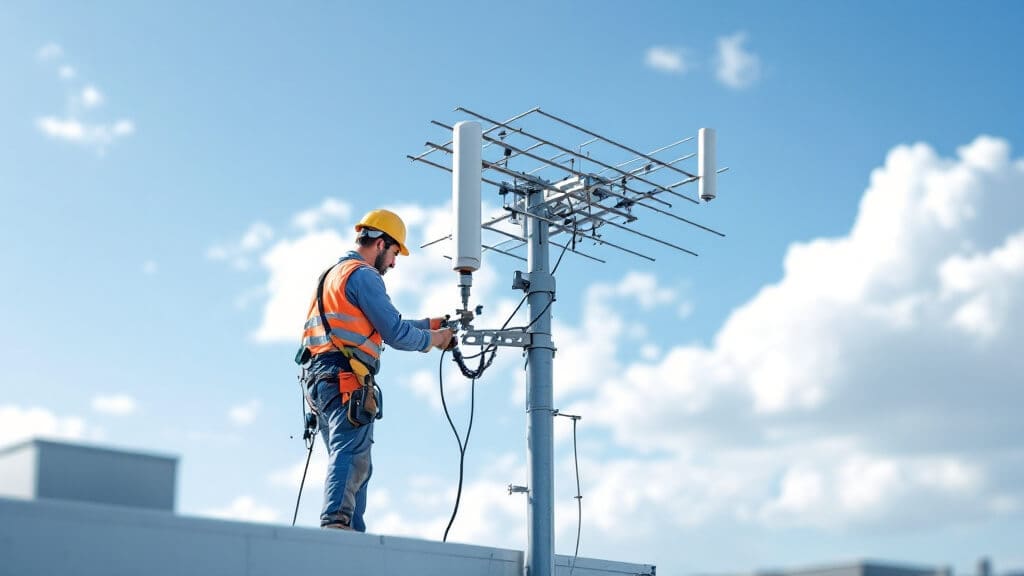
A Yagi antenna is a directional antenna that concentrates radio energy into a narrow forward beam instead of radiating equally in all directions. That focus is what gives a Yagi its two defining traits for technical buyers: higher gain on a single heading and a much longer usable range than an omnidirectional antenna of comparable size. If you are aiming a point-to-point link, reaching a distant access point, or trying to pull in a weak cellular or ISM-band signal from one direction, a Yagi antenna is usually the right tool — provided you can aim it and keep it aimed.
This guide explains how a Yagi actually works, what gain and beamwidth numbers to expect, how to choose connectors and cable, and how to decide between a Yagi and other directional options. It is written for installers, integrators, and network consultants who buy on verifiable specifications rather than marketing range claims.
What a Yagi antenna is and how it works
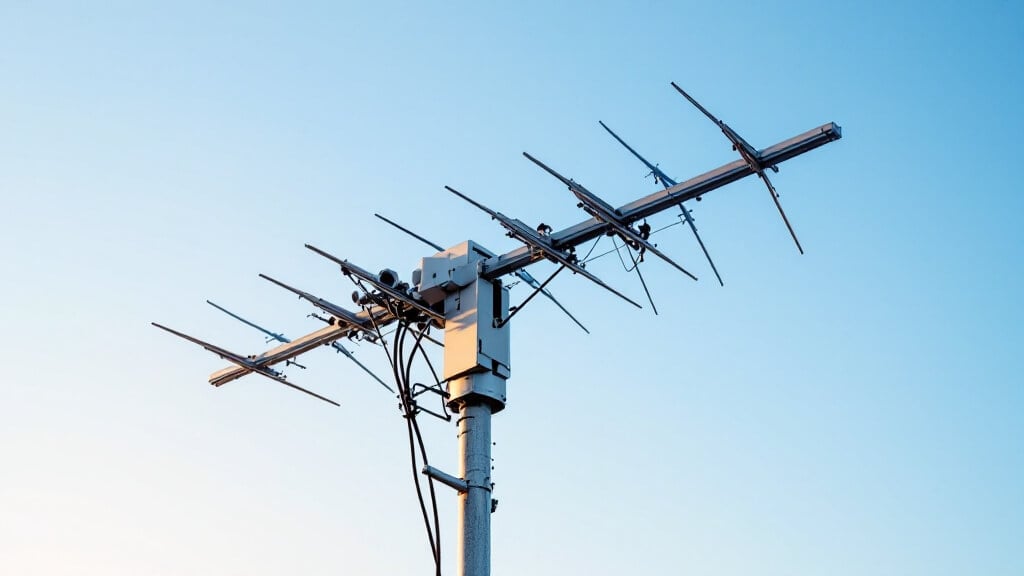
The Yagi-Uda design (usually shortened to "Yagi") uses several parallel elements mounted along a single boom. Only one of them — the driven element — is connected to your coax. The others are parasitic: they are not fed directly but reshape the radiation pattern through mutual coupling. A reflector sits behind the driven element and pushes energy forward; one or more directors sit in front and pull the beam into a tighter forward lobe. Adding more directors generally increases gain and narrows the beam, at the cost of a longer boom.

The practical result is a pattern with a strong main lobe in one direction, small side lobes, and a suppressed back lobe. The ratio between forward and rearward radiation — the front-to-back ratio — is a key spec: a higher figure means the antenna rejects interference and noise arriving from behind it, which matters as much as raw gain in congested RF environments.
Yagi antenna gain and beamwidth: what to expect
Gain and beamwidth are inseparable on a Yagi. Because the antenna does not create energy, higher gain simply means the same power squeezed into a narrower cone. A high-gain Yagi will reach farther but is harder to aim and less forgiving of a moving or drifting target.
Gain is quoted in dBi (decibels relative to an isotropic radiator). If you are unsure how dBi translates into real coverage, our companion article on what dBi means for antenna gain breaks down the math. The figures below are typical ranges — always confirm the exact gain, beamwidth, and front-to-back ratio on the datasheet of the specific model you are buying, because element count and boom length vary widely:
| Element count (typical) | Typical gain (dBi) | Approx. horizontal beamwidth | Best use |
|---|---|---|---|
| 3 elements | ~6–8 dBi | ~50–65° | Short-range fill, easy aiming, wider target |
| 5–7 elements | ~9–12 dBi | ~35–50° | Most point-to-multipoint and moderate links |
| 9–12 elements | ~13–15 dBi | ~25–35° | Longer point-to-point links, weak-signal pickup |
| 15+ elements | ~16 dBi and up | <25° | Long-haul links with a fixed, aimable endpoint |
Two rules of thumb: (1) doubling distance requires roughly 6 dB more system gain, and (2) every added dB of gain narrows your aiming tolerance. Beyond about 15 dBi, precise mechanical alignment and a rigid, stable mount matter more than adding elements.
Yagi vs. omnidirectional and other directional antennas
A Yagi is not always the answer. Choose based on whether your target is a single fixed direction or spread around you:
- Omnidirectional: radiates 360°. Correct when clients are on all sides (a coverage hub). Lower gain per direction.
- Yagi: a line of elements on a boom. Best all-round directional choice for point-to-point and long single-heading links; good gain-to-cost ratio.
- Panel / patch: flat, wider beamwidth than a high-element Yagi, easier to mount flush on a wall. Good for sector coverage.
- Parabolic dish / grid: highest gain and narrowest beam for extreme-distance links, but bulky, wind-loaded, and unforgiving to aim.
If you need to shape or steer coverage electronically rather than mechanically, that is a different technology entirely — see our explainer on how beamforming antenna arrays improve connectivity.
Choosing the right Yagi antenna: frequency, connectors and cable
A Yagi is tuned for a specific frequency band; the element spacing and lengths are dimensioned for it. Match the antenna to your system's band — common ones include 900 MHz ISM, 2.4 GHz Wi‑Fi/ISM, cellular LTE/5G bands, and various LoRa/LoRaWAN sub-GHz bands. A 2.4 GHz directional Yagi will not perform on a 900 MHz LoRa link and vice versa.
Connectors and impedance
Most RF systems here are 50 ohm, and connector choice should follow your radio and cable. Outdoor Yagis commonly terminate in an N-type connector for its weather resistance and low loss at higher frequencies, while smaller units may use SMA or RP-SMA. Getting the gender and polarity right is where a lot of installs go wrong — if you are matching a Yagi to your radio, our guide to antenna connector types (SMA, RP-SMA, N-type, TNC and more) covers the compatibility rules.
Cable loss is part of the antenna budget
Antenna gain is easy to erase with the wrong cable. At 2.4 GHz, thin cable like RG‑174 loses signal quickly, so long runs demand low-loss coax such as LMR‑240 or LMR‑400. Keep the run as short as possible and calculate loss for your exact length and frequency — a few dB of cable loss can undo the benefit of moving up an element size. When you are budgeting a link, treat cable loss the same way you would in a GPS install; the same signal-budget thinking is laid out in our GPS antenna selection guide covering cable loss and connectors.
Mounting and aiming a Yagi
Because a Yagi's beam is narrow, the mount is not an afterthought. Use a rigid pole or bracket that will not twist in wind, and set the antenna's polarization (usually vertical for most data links) to match the far end — a polarization mismatch can cost you many dB. Aim on the strongest received signal (RSSI), not by eye, and lock the mount down once peaked. On long links, both ends should be aligned to each other.
Shop directional antennas and RF cable
Data Alliance stocks directional antennas and custom-manufactures the antenna cables to connect them, with same-day shipping on orders placed before 4pm MST. Browse our Wi‑Fi and directional antennas and pair them with the right antenna cables and adapters for your connector and length. Not sure which Yagi or cable assembly fits your link budget? Request a custom quote or contact our technical support team with your frequency, distance, and radio connector and we will spec it for you.
Frequently asked questions about Yagi antennas
How far can a Yagi antenna reach?
There is no single number — range depends on gain at both ends, transmit power, receiver sensitivity, frequency, cable loss, and clear line of sight. A higher-gain Yagi reaches farther on a fixed heading, but the limiting factor on long links is usually line of sight and Fresnel-zone clearance, not the antenna alone. Calculate a link budget rather than trusting a "reaches X miles" claim.
Is a Yagi antenna better than an omnidirectional antenna?
Only for a single direction. A Yagi delivers more gain and range toward one heading, while an omnidirectional antenna covers all directions with lower gain per direction. Use a Yagi for point-to-point or a distant single target; use an omni when clients surround the antenna.
What connector does a Yagi antenna use?
It varies by model. Outdoor Yagis often use a 50-ohm N-type connector for durability and low loss; smaller Yagis may use SMA or RP-SMA. Match the connector type, gender, and polarity to your radio and cable — verify on the datasheet before ordering.
Does a Yagi antenna work for both transmit and receive?
Yes. Antennas are reciprocal, so a Yagi's directional gain and pattern apply equally whether you are transmitting or receiving. The same forward focus that boosts your signal out also improves how well it hears a signal arriving from that direction.
What gain do I actually need?
Enough to close the link budget with margin — not the highest number on the shelf. Excess gain narrows the beam and makes aiming and stability harder. Estimate your required system gain from distance and frequency, then choose a Yagi that meets it with a few dB of headroom.