





Antennas, Antenna Cables, Wireless Products: Technical Articles
Beamforming: How Modern Antenna Arrays Improve Connectivity
Table of Contents
Beamforming
Wireless communication has evolved rapidly over the past decade as technologies such as 5G NR, Wi-Fi 6, Wi-Fi 6E, Wi-Fi 7, LTE-Advanced, and Industrial IoT continue pushing the limits of speed, capacity, and reliability. Behind many of these advancements is beamforming, an intelligent signal-processing technique that enables antenna arrays to direct wireless energy toward specific users or devices instead of transmitting equally in every direction. This targeted approach significantly improves signal strength, reduces interference, increases network capacity, and extends coverage. Today, beamforming is no longer limited to cellular base stations; it is widely implemented in enterprise Wi-Fi access points, 5G routers, LTE gateways, phased-array antennas, fixed wireless access (FWA) equipment, and industrial wireless systems. Understanding how beamforming works helps network designers, installers, and system integrators build faster, more reliable wireless networks while making better antenna and equipment selections.

A Brief Introduction to Beamforming
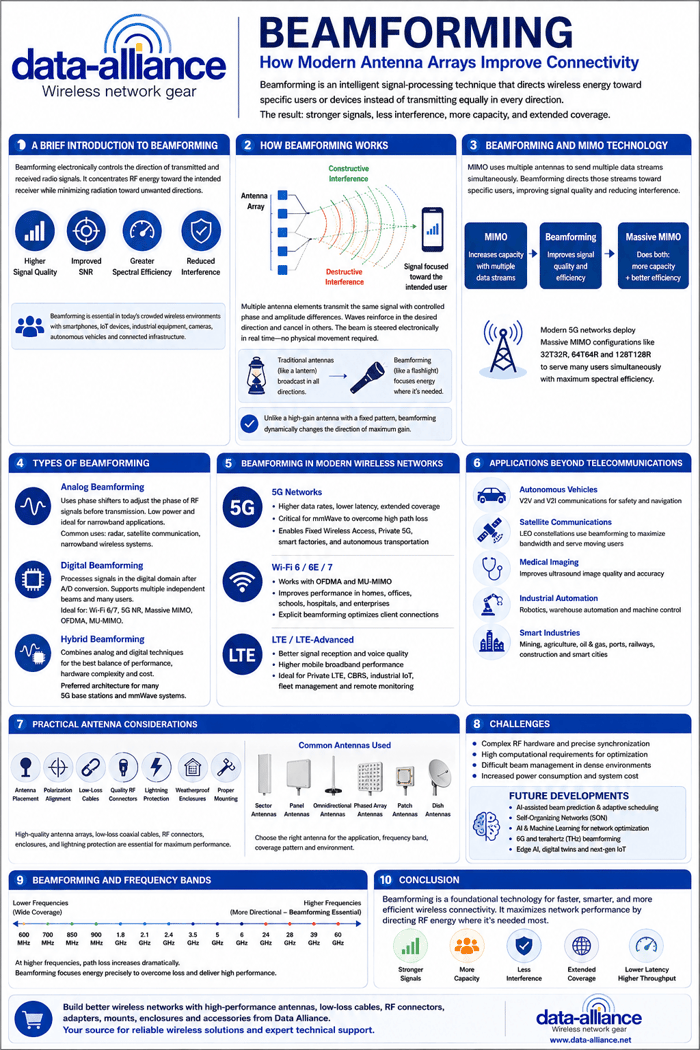
Beamforming is a signal-processing technique that electronically controls the direction of transmitted and received radio signals. Unlike traditional omnidirectional transmission, where energy is radiated uniformly in all directions, beamforming concentrates RF energy toward the intended receiver while minimizing radiation toward unwanted directions. The result is higher signal quality, improved signal-to-noise ratio (SNR), greater spectral efficiency, and reduced interference between nearby wireless devices.
As wireless environments become increasingly crowded with smartphones, IoT sensors, industrial equipment, security cameras, autonomous vehicles, and connected infrastructure, efficient spectrum utilization has become essential. Beamforming enables wireless systems to support more simultaneous users while maintaining higher throughput and lower latency, making it a cornerstone technology for modern communications.
How Beamforming Works
Beamforming relies on multiple antenna elements working together as an antenna array. Each element transmits the same RF signal with carefully controlled phase and amplitude adjustments. These small timing differences cause radio waves to reinforce one another in the desired direction through constructive interference while canceling one another in unwanted directions through destructive interference. Rather than physically moving the antenna, the radio beam is steered electronically in real time.
An easy analogy is comparing a lantern to a flashlight. A lantern emits light equally in every direction, similar to a conventional omnidirectional antenna. A flashlight concentrates its light into a focused beam that reaches farther while wasting less energy. Beamforming applies this same concept to radio frequency signals.
It is also important to distinguish beamforming from traditional antenna gain. A high-gain directional antenna focuses energy through its physical design and maintains a fixed radiation pattern. Beamforming, however, dynamically changes the direction of maximum gain electronically, allowing the system to continuously follow users or adapt to changing wireless conditions without mechanically repositioning the antenna.
Beamforming and MIMO Technology
Beamforming is often associated with Multiple Input Multiple Output (MIMO) technology, but the two are not identical. MIMO uses multiple transmitting and receiving antennas to increase data throughput and communication reliability by sending multiple data streams simultaneously. Beamforming complements MIMO by directing those streams toward specific users, improving signal quality and reducing interference.
Modern wireless systems frequently combine both technologies through Massive MIMO, where dozens or even hundreds of antenna elements operate together. Configurations such as 32T32R, 64T64R, and 128T128R are commonly deployed in advanced 5G networks, allowing base stations to communicate with many users simultaneously while maximizing spectral efficiency and network capacity.
Types of Beamforming
Beamforming is generally classified into analog, digital, and hybrid implementations.
- Analog beamforming adjusts the phase of RF signals before transmission using hardware phase shifters. It offers relatively low power consumption and is commonly used in radar systems, satellite communications, and narrowband wireless applications.
- Digital beamforming performs signal processing after analog-to-digital conversion, allowing much greater flexibility. Multiple independent beams can be generated simultaneously, making digital beamforming ideal for Wi-Fi 6, Wi-Fi 7, 5G NR, and Massive MIMO deployments that must serve numerous users across varying frequencies.
- Hybrid beamforming combines analog and digital techniques to achieve an effective balance between hardware complexity, cost, and performance. It has become the preferred architecture for many commercial 5G base stations and millimeter-wave communication systems.
Beamforming in Modern Wireless Networks
Beamforming plays an essential role across virtually every major wireless technology.
In 5G networks, beamforming enables higher data rates, lower latency, improved spectral efficiency, and extended coverage. It is especially important for millimeter-wave (mmWave) frequencies, where propagation losses are much greater than at lower frequencies. By directing narrow beams toward individual users, 5G networks can overcome path loss while supporting applications such as fixed wireless access, private 5G, smart factories, and autonomous transportation.
In Wi-Fi 6, Wi-Fi 6E, and Wi-Fi 7, beamforming works alongside technologies such as OFDMA and MU-MIMO to improve wireless performance in homes, offices, warehouses, schools, hospitals, and enterprise environments. Explicit beamforming allows compatible client devices and access points to exchange channel information so transmissions can be optimized for maximum performance.
For LTE and LTE-Advanced networks, beamforming improves signal reception, enhances voice quality, increases mobile broadband performance, and allows base stations to support larger numbers of connected users with reduced interference. Private LTE and CBRS deployments also benefit from beamforming, particularly in industrial facilities where reliable wireless coverage is essential.

Applications Beyond Telecommunications
Although beamforming is most commonly associated with wireless networking, its applications extend into numerous industries.
Autonomous vehicles use beamforming for Vehicle-to-Vehicle (V2V) and Vehicle-to-Infrastructure (V2I) communications, enabling faster exchange of navigation and safety information. Low Earth Orbit (LEO) satellite constellations employ beamforming to efficiently serve moving users across large geographic areas while maximizing available bandwidth. Medical ultrasound equipment uses beamforming to improve image quality and diagnostic accuracy. Industrial robotics, warehouse automation, mining operations, agriculture, ports, smart cities, and oil and gas facilities increasingly depend on beamforming to provide reliable wireless connectivity for sensors, cameras, automated equipment, and remote monitoring systems.
Practical Antenna Considerations
Successful beamforming depends not only on sophisticated electronics but also on proper antenna system design. High-quality antenna arrays, low-loss coaxial cables, precision RF connectors, weatherproof enclosures, lightning protection, and appropriate mounting hardware all contribute to overall system performance. Excessive cable losses, poor connector quality, incorrect antenna polarization, or improper installation can significantly reduce the benefits of beamforming.
Different antenna types are selected according to the application. Sector antennas provide focused coverage for cellular base stations, panel antennas are widely used for point-to-point and point-to-multipoint wireless links, omnidirectional antennas offer uniform coverage where users move freely, while phased-array antennas provide the electronic beam steering required for advanced beamforming systems.
Challenges and Future Developments
Despite its many advantages, beamforming presents several engineering challenges. Advanced antenna arrays require complex RF hardware, precise synchronization, and significant digital signal processing resources. Optimizing beam patterns in dense urban environments where numerous wireless systems coexist can also be computationally demanding. In addition, large antenna arrays may increase power consumption and system cost.
Future advancements are expected to address many of these challenges through artificial intelligence and machine learning. AI-assisted beam prediction, adaptive scheduling, and Self-Organizing Networks (SON) will allow wireless infrastructure to continuously optimize beam patterns based on user location, traffic demand, environmental conditions, and interference levels. Looking ahead to 6G, beamforming is expected to extend into terahertz frequencies, enabling extremely high-capacity wireless networks that support immersive extended reality (XR), advanced robotics, digital twins, and next-generation Industrial IoT applications.

Conclusion
Beamforming has become one of the foundational technologies behind modern wireless communications, enabling faster data rates, greater coverage, improved spectral efficiency, and more reliable connectivity across 5G, LTE, Wi-Fi, satellite communications, and Industrial IoT networks. By intelligently directing radio signals where they are needed most, beamforming maximizes network performance while reducing interference and making more efficient use of valuable spectrum resources.
Achieving the full benefits of beamforming requires more than advanced signal processing. Careful selection of antennas, coaxial cables, RF connectors, mounting hardware, and outdoor protection components is equally important for building dependable wireless infrastructure. Whether deploying enterprise Wi-Fi, private LTE, 5G, fixed wireless access, smart city networks, or industrial automation systems, choosing high-quality RF components and properly engineered antenna solutions helps ensure reliable long-term performance. As wireless technologies continue to evolve, beamforming will remain a driving force behind faster, smarter, and more efficient connectivity for virtually every industry.
FAQs
What is beamforming and why is it important?
Beamforming is an advanced signal-processing technique that electronically directs wireless signals toward a specific device instead of broadcasting them equally in every direction. This improves signal strength, increases network capacity, reduces interference, and enhances overall wireless performance in LTE, 5G, Wi-Fi, and IoT networks.
What is the difference between beamforming and MIMO?
MIMO (Multiple Input Multiple Output) uses multiple antennas to transmit and receive several data streams simultaneously, increasing network capacity. Beamforming complements MIMO by steering those signals toward individual users, improving signal quality and spectral efficiency. Modern 5G systems typically combine Massive MIMO with beamforming for maximum performance.
Which wireless technologies use beamforming?
Beamforming is widely used in Wi-Fi 6, Wi-Fi 6E, Wi-Fi 7, LTE-Advanced, 5G NR, Private LTE, Private 5G, CBRS networks, satellite communications, fixed wireless access (FWA), Industrial IoT, and phased-array radar systems.
What types of antennas are commonly used with beamforming?
Beamforming systems typically use phased-array antennas, sector antennas, panel antennas, patch antennas, and other multi-element antenna arrays. The appropriate antenna depends on the application, operating frequency, desired coverage pattern, and deployment environment.
Does beamforming improve wireless coverage and network speed?
Yes. By concentrating RF energy toward connected devices, beamforming increases signal strength, improves signal-to-noise ratio (SNR), extends coverage, supports higher data rates, reduces latency, and minimizes interference. These advantages are particularly beneficial in high-density enterprise Wi-Fi deployments, 5G cellular networks, and Industrial IoT applications.
What factors should be considered when deploying a beamforming antenna system?
Successful beamforming deployments require more than advanced antenna arrays. Proper antenna placement, correct polarization, low-loss coaxial cables, high-quality RF connectors, weatherproof enclosures, lightning protection, and careful network planning all contribute to maximizing beamforming performance and long-term wireless reliability.