


Antennas, Antenna Cables, Wireless Products: Technical Articles

GPS Antenna Selection Guide: Active vs Passive, Cable Loss, Connectors & Mounting
Table of Contents
- What Is a GPS Antenna? The Short Answer for Buyers
- Active vs. Passive GPS Antenna: The Decision You Make First
- The Cable Loss Section: Why Your Run Length Determines Your Antenna Type
- Connector Selection: SMA, TNC, N-Type, FME, and MCX
- GNSS Frequency Bands: What L1, L2, and L5 Mean for Antenna Selection
- Mounting: Magnetic, Surface, Pole, and Flush Mount
- Internal Link Suggestions
- FAQs
What Is a GPS Antenna? The Short Answer for Buyers
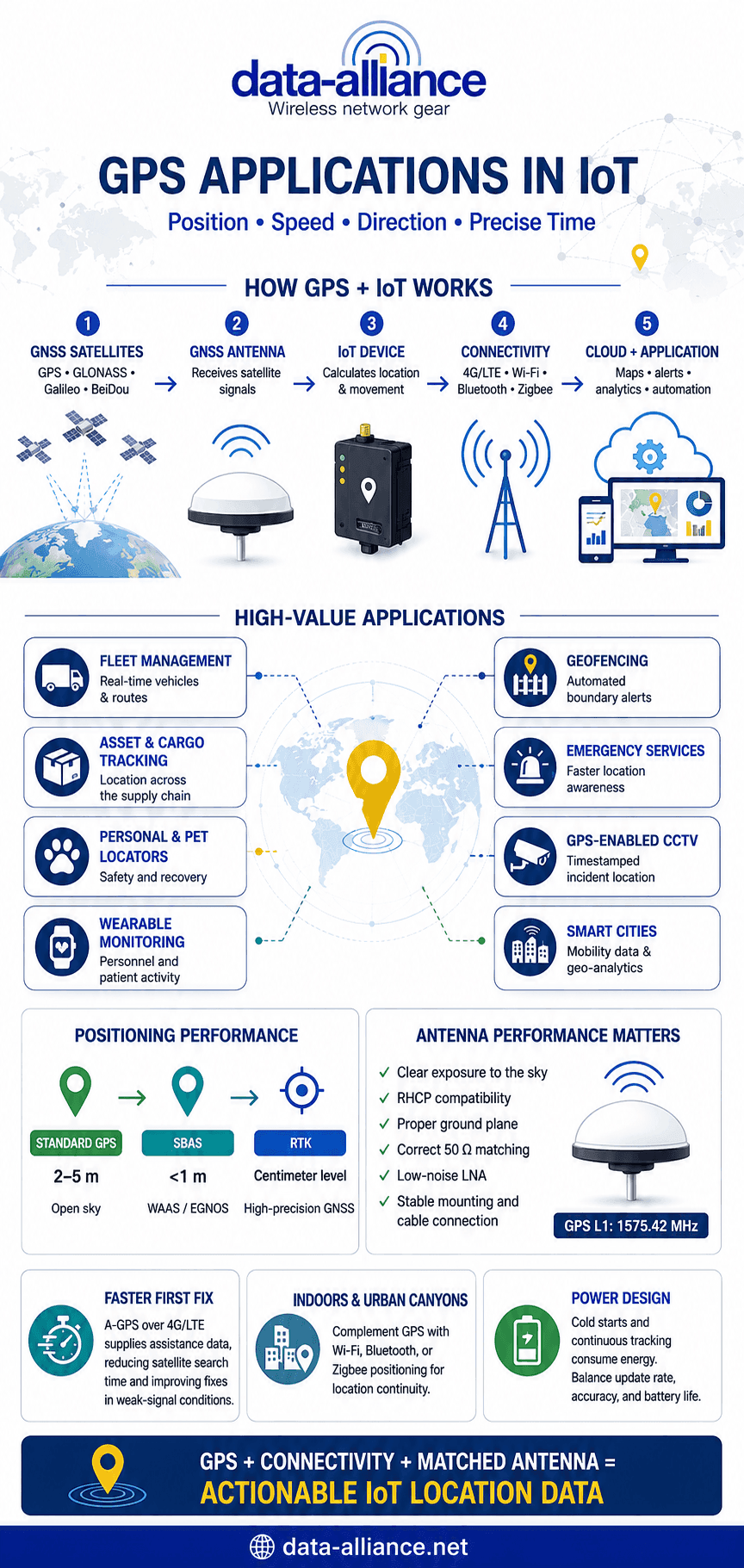
A GPS antenna is a receiving antenna tuned to the 1.1–1.6 GHz frequency range used by global navigation satellite systems (GNSS). It captures the extremely weak RF signals broadcast by satellites orbiting at roughly 20,000 km altitude and delivers them to a GPS receiver, RTK base station, timing module, telematics unit, or any other GNSS-dependent device.
GPS is one constellation within the broader GNSS ecosystem. Modern receivers and antennas increasingly support multiple constellations simultaneously:
- GPS (USA) — L1: 1575.42 MHz, L2: 1227.60 MHz, L5: 1176.45 MHz
- GLONASS (Russia) — 1598–1606 MHz
- Galileo (EU) — E1: 1575.42 MHz, E5: 1176.45 MHz
- BeiDou (China) — B1: 1561.10 MHz, B2: 1207.14 MHz
When a spec sheet says "GNSS antenna" it means the antenna supports at least some combination of these constellations. When it says "GPS antenna" it typically means L1-only or L1/L2 GPS. Verify band coverage against your receiver's spec sheet before ordering.

Active vs. Passive GPS Antenna: The Decision You Make First
This is the most important decision in GPS antenna selection and the one most buyers get wrong by defaulting to active without thinking through the system.
What Is a Passive GPS Antenna?
A passive GPS antenna contains only the radiating element — a ceramic patch or small dipole — and no internal electronics. It receives satellite signals and passes them directly to the receiver via coaxial cable. No power is required. Signal level at the receiver output equals signal captured by the antenna minus all cable and connector losses.
Passive GPS antennas are correct when:
- Cable run from antenna to receiver is under 3–5 meters
- The receiver has its own internal LNA (low-noise amplifier) — most modern GPS chipsets do
- System noise budget can absorb cable loss without degrading position accuracy
- Power supply to the antenna feed line is unavailable or undesirable
What Is an Active GPS Antenna?
An active GPS antenna integrates a low-noise amplifier (LNA) directly inside the antenna housing, immediately behind the radiating element. The LNA amplifies the received satellite signal at the source — before cable loss degrades the signal — and sends an amplified signal down the coaxial cable to the receiver.
Active GPS antennas require DC power (typically 3.3V or 5V) supplied via the coaxial cable from the receiver. Most GPS receivers with an external antenna port supply this voltage automatically.
Active GPS antennas are required when:
- Cable run exceeds 5 meters (signal budget math will show you why — see below)
- Operating in signal-attenuated environments (inside vehicles, under partial obstruction)
- Using small-aperture patch antennas with inherently low passive gain
- Receiver has no internal LNA and requires pre-amplified signal
Active vs. Passive Decision Table
____________________________________________________________
The Cable Loss Section: Why Your Run Length Determines Your Antenna Type
This is the section most GPS antenna guides skip. It is also the section that determines whether your system works or doesn't.
GPS signals arrive at the Earth's surface at an extremely low power level — typically around -130 dBm at the antenna. This is barely above the noise floor of most receivers. Every dB of loss in your coaxial cable run directly degrades position accuracy and satellite acquisition time.
Cable Loss Is Frequency-Dependent
GPS L1 operates at 1575.42 MHz. At this frequency, coaxial cable loss is significantly higher than at WiFi 2.4 GHz or lower frequencies. Loss increases with both frequency and cable run length.
Approximate cable loss at 1575 MHz (GPS L1):
Rule of thumb: If your passive GPS antenna has 3 dBi of gain and your receiver needs at least -140 dBm to acquire satellites, you have roughly 10–13 dB of cable loss budget before you start losing lock. At GPS L1 frequencies on RG58, that budget is exhausted in under 50 feet.
The Signal Budget Calculation
Signal at Receiver (dBm) =
Satellite Signal at Antenna (~-130 dBm)
+ Antenna Gain (dBi)
+ LNA Gain (active antennas only, dB)
− Cable Loss (dB/ft × run length)
− Connector Loss (~0.2–0.5 dB per connector)
Example — Passive, 25 ft RG58 run:
- Satellite signal: -130 dBm
- Antenna gain: +3 dBi
- Cable loss (25 ft RG58 at 1575 MHz): -7 dB
- 2 connectors: -0.6 dB
- Signal at receiver: -134.6 dBm — marginal, degraded acquisition
Example — Active, 50 ft LMR240 run:
- Satellite signal: -130 dBm
- Antenna gain: +3 dBi
- LNA gain: +28 dB
- Cable loss (50 ft LMR240): -5.5 dB
- 2 connectors: -0.6 dB
- Signal at receiver: -105.1 dBm — excellent, fast acquisition
This is why long cable runs force active antennas. It is not a product preference — it is signal budget math.
Shop Data Alliance low-loss antenna cables: data-alliance.net/antenna-cables Custom cable assemblies available in LMR200, LMR240, LMR400, and LMR600 with your choice of connector — cut to exact length. Request a custom cable quote →
____________________________________________________________
Connector Selection: SMA, TNC, N-Type, FME, and MCX
The connector on your GPS antenna cable is not an afterthought. A mismatched or low-quality connector introduces impedance discontinuities that degrade signal, and at GPS frequencies (1.5+ GHz) even a marginal connector adds measurable loss.
Connector Type by Application
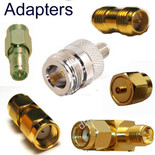
https://www.data-alliance.net/SMA-adapters/
https://www.data-alliance.net/RP-SMA-adapters/
The Adapter Penalty
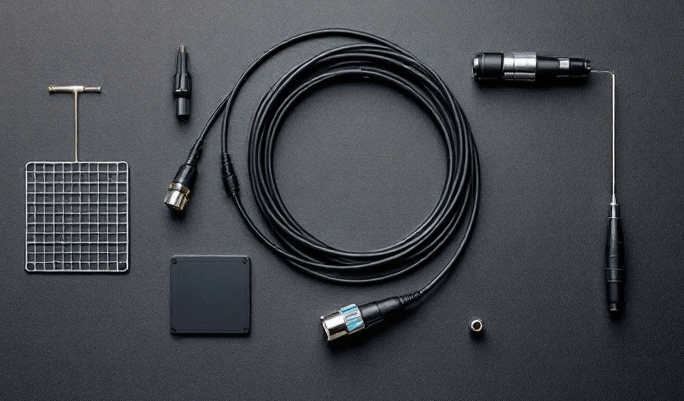
Every gender-change adapter or connector-type adapter in your signal chain adds approximately 0.2–0.5 dB of loss and one more potential point of water ingress. For GPS systems, minimize adapters. If your antenna has a TNC female and your receiver has an SMA male, order the cable with TNC male on one end and SMA female on the other — not a cable plus two adapters. Data Alliance custom cable assemblies are built to spec with any connector combination.
____________________________________________________________
GNSS Frequency Bands: What L1, L2, and L5 Mean for Antenna Selection
Most commercial GPS antennas are L1-only. Understanding when you need L2 or L5 coverage is critical for precision applications.
L1 (1575.42 MHz) — Standard Positioning
L1 is the primary civilian GPS signal. An L1-only GPS antenna is correct for:
- Asset tracking, fleet telematics
- General navigation (vehicle, marine, aviation)
- IoT location tagging
- Single-frequency RTK at short baselines (10 km)
L1 + L2 (1227.60 MHz) — Survey and RTK
Adding L2 allows the receiver to compute and correct for ionospheric delay — the primary error source in precision positioning. L1/L2 dual-frequency is required for:
- Surveying and mapping
- RTK (Real-Time Kinematic) positioning at centimeter accuracy
- Long-baseline RTK (10 km baselines)
- Geodetic reference stations
L1/L2 antennas are physically larger (to maintain efficiency at both frequencies) and more expensive. The antenna must have a ground plane sufficient to reject multipath at both frequencies.
L1 + L5 (1176.45 MHz) — Safety-Critical and Multi-Constellation
L5 is a newer, higher-power, more accurate civilian signal. L1/L5 dual-frequency support is required for:
- Aviation precision approach (SBAS/WAAS dependent)
- Autonomous vehicle positioning
- Multi-constellation GNSS receivers (GPS + Galileo E5 at 1176.45 MHz)
Multi-Constellation GNSS Antennas
Modern high-precision antennas cover the full L-band: roughly 1164–1610 MHz, capturing GPS L1/L2/L5, GLONASS L1/L2, Galileo E1/E5, and BeiDou B1/B2 simultaneously. These antennas deliver:
- More visible satellites at any time
- Better geometric dilution of precision (GDOP)
- Faster fix times and better performance under obstruction
Frequency Band Summary Table:
____________________________________________________________
Mounting: Magnetic, Surface, Pole, and Flush Mount
GPS antenna mounting is not just a mechanical decision — it directly affects antenna performance through ground plane size and sky view.
Magnetic Mount
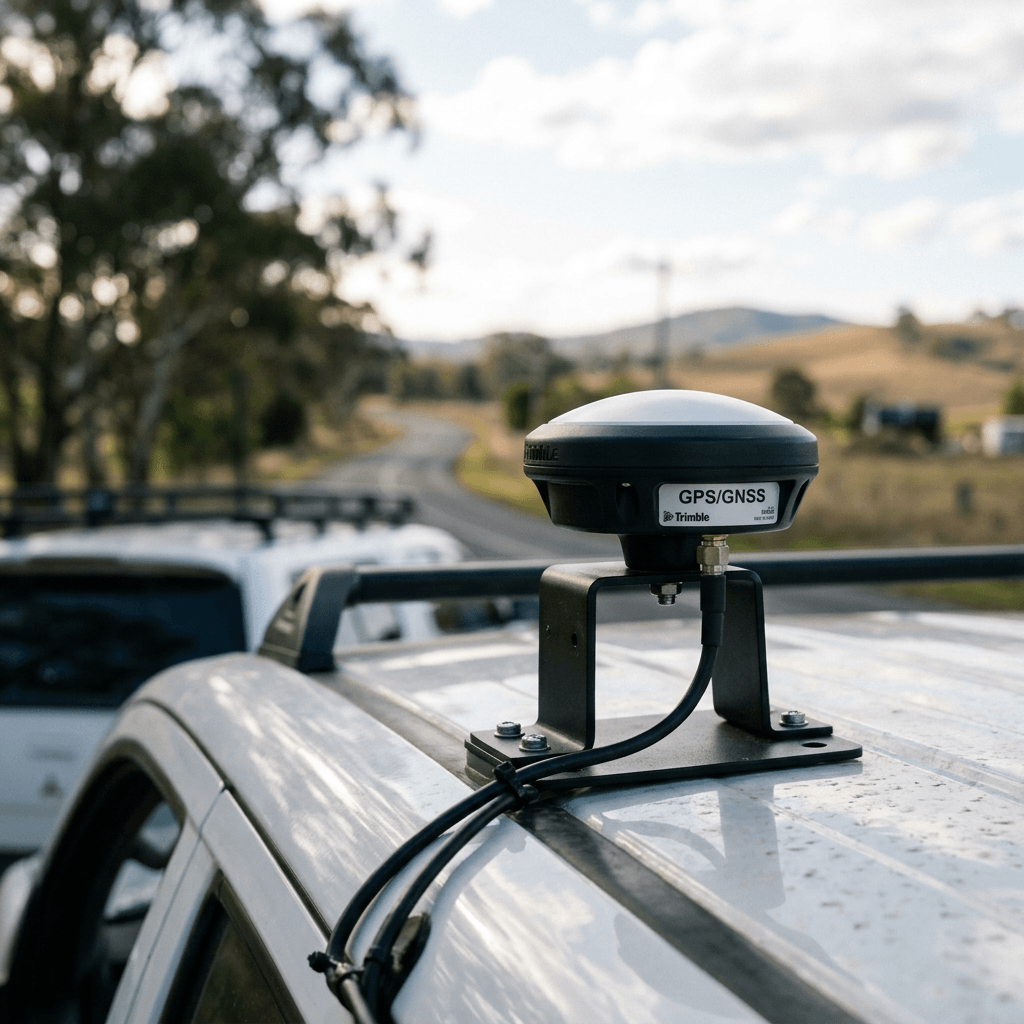
The most common mounting style for vehicle and temporary deployments. A magnetic base GPS antenna attaches to any ferrous metal surface. The metal vehicle roof acts as a ground plane, which actually improves antenna performance by reducing multipath from below.
Best for: Fleet vehicles, survey vehicles, temporary rooftop installs, mobile command units
Key specs to check: Magnet pull force (minimum 5 lbs for highway speeds), cable routing (through door seal vs. permanent), IP rating if exposed to weather.
Surface / Adhesive Mount
Adhesive-base GPS antennas are used where magnetic mount isn't possible — fiberglass boats, plastic vehicle roofs, RVs, and fixed installations without ferrous metal. Performance depends heavily on the ground plane provided by the mounting surface.
Best for: Marine, aviation, permanent vehicle installs, industrial equipment
Pole / Mast Mount
Pole-mount GPS antennas are used in survey, RTK base station, and geodetic reference applications. These antennas are precision-machined with phase-center stability specifications — the mechanical center of the antenna aligns with the measured GPS position. Pole-mount antennas typically feature a 5/8";-11 threaded base (standard survey pole thread).
Best for: RTK base stations, survey rovers, geodetic monitoring, agricultural precision guidance
Browse Data Alliance antenna mounts and mounting hardware: data-alliance.net/antenna-mounts
Flush / Embedded Mount
Used in OEM applications where the antenna must be integrated into a housing, vehicle panel, or enclosure. Typically a patch antenna element on an adhesive or screw-mount base. Performance is heavily dependent on ground plane design.
Internal Link Suggestions
- Antenna Cables — Link from cable loss section
- Custom Cable Quote — Link from cable loss and connector sections
- SMA Connectors — Link from connector table
- TNC Connectors — Link from connector table
- N-Type Connectors — Link from connector table
- BNC Connectors — Link from connector table
- Antenna Mounts — Link from mounting section
- WiFi Antennas — Cross-link for combo GPS+WiFi antenna buyers
- dBi Meaning Blog Post — Cross-link from antenna gain discussion
- PoE Adapters — Cross-link for outdoor base station GPS deployments
____________________________________________________________
Ready to specify your GPS antenna system?
Data Alliance stocks active and passive GPS/GNSS antennas with verified specs, plus the full cable and connector chain to match — custom-cut to your exact run length with any connector combination.
- Shop GPS / GNSS Antennas →
- Request a Custom Cable Assembly →
- Contact Technical Support for help matching antenna gain, cable type, and connector to your system.
Same-day shipping on orders placed before 4 PM MST. Established 2004. Ships to 95+ countries.
____________________________________________________________
© Data Alliance — data-alliance.net | Nogales, AZ | Est. 2004
FAQs
What is the difference between an active and passive GPS antenna?
A passive GPS antenna contains only the radiating element and has no internal amplifier. It is suitable for short cable runs (under 5 meters) where the receiver's internal LNA handles amplification. An active GPS antenna integrates an LNA directly in the antenna housing, amplifying the signal before cable loss degrades it. Active antennas are required for cable runs over 5 meters and in environments with high signal attenuation.
How do I calculate how much cable loss my GPS antenna system can tolerate?
GPS signals arrive at approximately -130 dBm. Your receiver needs a minimum signal level (typically -140 to -145 dBm) to maintain lock. Your cable loss budget is the difference between the signal at the antenna output and the minimum receiver threshold. At GPS L1 (1575 MHz), LMR400 loses approximately 0.65 dB per 10 feet, LMR240 loses approximately 1.1 dB per 10 feet, and RG58 loses approximately 2.8 dB per 10 feet.
What connector does a GPS antenna use?
GPS antennas use 50-ohm RF connectors. SMA is most common for indoor modules and RTK receivers. TNC is standard for outdoor and vehicle installations requiring weatherproofing. N-type is used for long-run outdoor installations with LMR400 or LMR600 cable. FME is common in automotive/telematics glass-mount antennas. Always match the connector type to your receiver port — or order a custom cable assembly with the correct connectors on both ends.
Do I need an L1/L2 or L1/L5 GPS antenna?
For general navigation, asset tracking, and single-frequency RTK at short baselines, an L1-only antenna is sufficient. For survey-grade positioning, long-baseline RTK (>10 km), or applications requiring ionospheric correction, you need an L1/L2 dual-frequency antenna. For aviation precision approach, autonomous vehicles, and multi-constellation GNSS, L1/L5 or full L-band (1164–1610 MHz) antennas are required.
What size ground plane does a GPS patch antenna need?
A GPS patch antenna performs best with a ground plane of at least 70mm × 70mm (for a 25mm patch) up to 100mm × 100mm or larger for optimal low-elevation satellite reception. Larger ground planes reduce multipath interference from signals reflecting off surfaces below the antenna. Magnetic-mount vehicle antennas benefit from the vehicle roof acting as a large ground plane. Pole-mount survey antennas often include a built-in ground plane choke ring to further suppress multipath.