


Antennas, Antenna Cables, Wireless Products: Technical Articles
Antenna Mount Guide: How to Choose L-Brackets, Pole, Roof & Magnetic Mounts
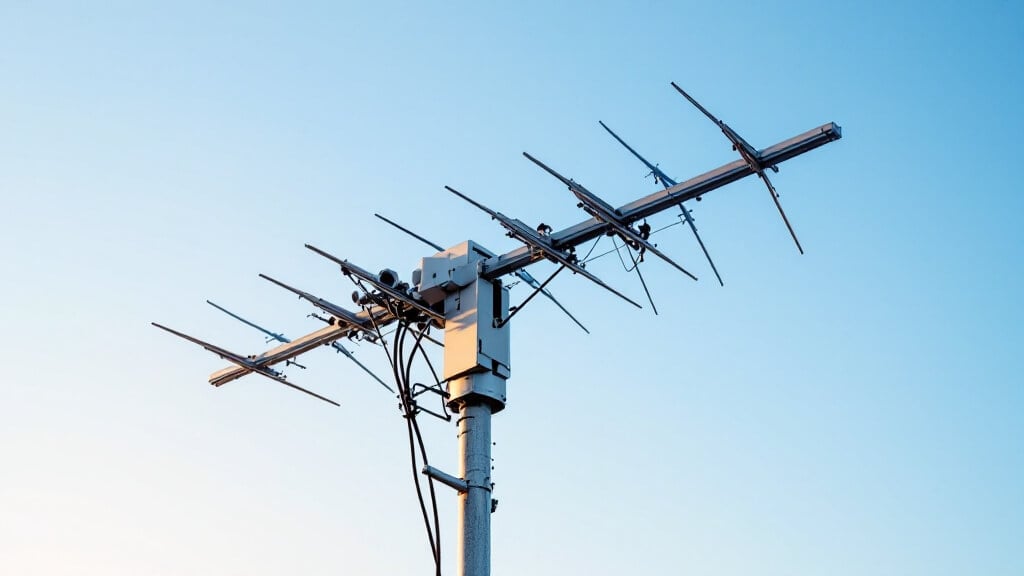
Choosing an antenna mount comes down to four decisions: the surface you are mounting to, the antenna's connector type, how high you can get the antenna, and how you will keep water out of the connection. Get those right and a $10 bracket will outlast the antenna it holds. Get them wrong and even a high-gain antenna will underperform, corrode, or work loose in the first storm. This guide walks IT integrators, installers, and network consultants through every common antenna mount type — L-brackets, U-bolt pole mounts, roof mounts, magnetic and NMO mounts — and the specs worth verifying before you drill.
Why the antenna mount matters as much as the antenna
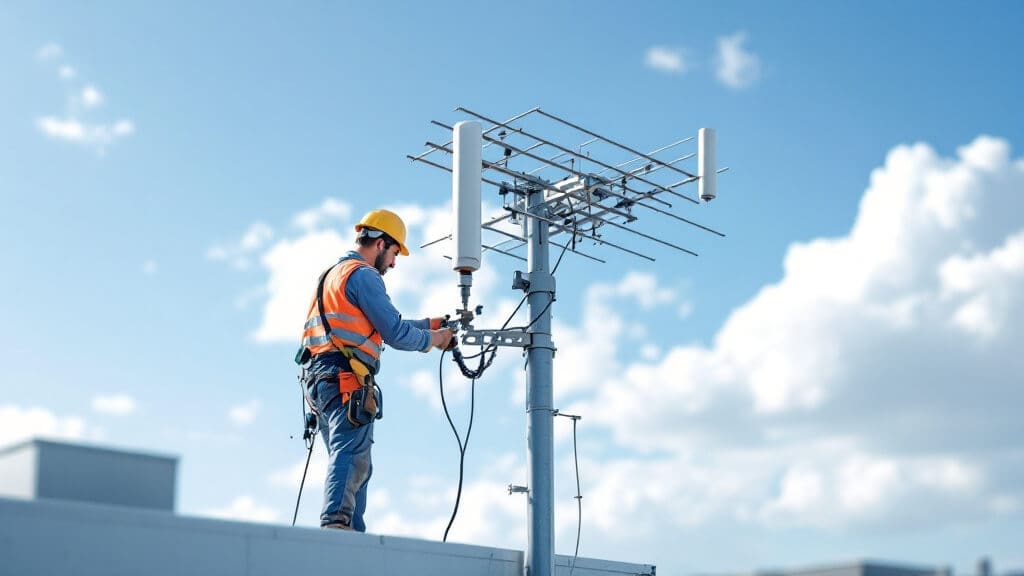
An antenna mount does two jobs at once: it provides a mechanical hold and, on many connector types, it becomes part of the electrical path — either as the ground plane or as the point where the connector is secured and sealed. A poorly matched or badly installed antenna mount will move under wind load, allow moisture ingress that corrodes connectors, or place the antenna where obstructions block line of sight. Positioning is the single biggest lever on real-world range: mount high, keep the line of sight clear, and keep the coax run as short as the install allows, because every meter of cable costs you signal.
How to choose an antenna mount
Use the flow below to narrow down the mount family before you look at individual brackets. It sequences the four decisions — surface, connector, weatherproofing, then final placement.
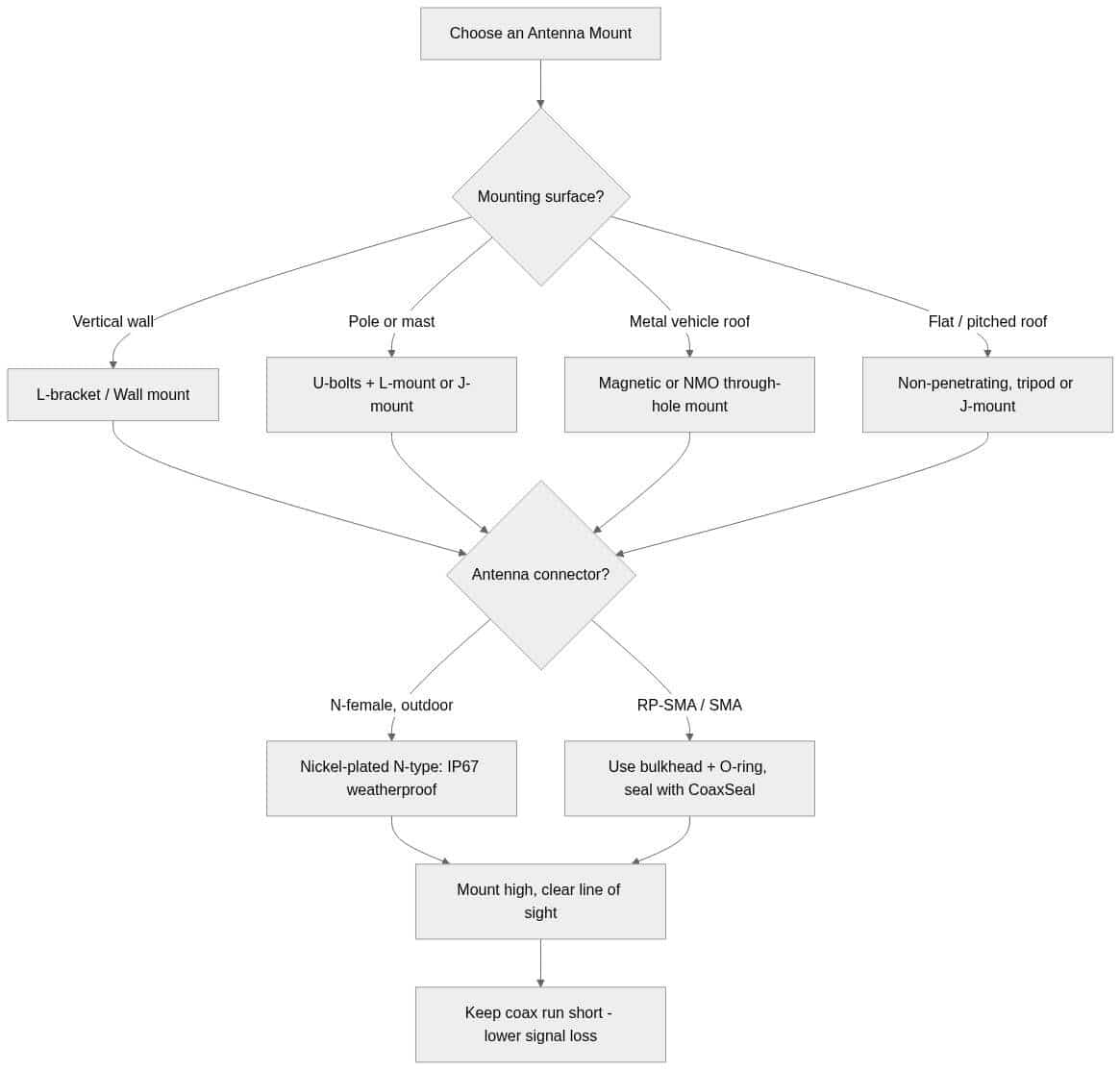
Antenna mount types compared
The table below summarizes the main antenna mount families, what they attach to, and where each is the right call. Load ratings and exact dimensions vary by product — confirm them on the specific mount's page before ordering.
| Mount type | Attaches to | Best for | Removable? |
|---|---|---|---|
| L-bracket / wall mount | Masonry or wood wall (screws + plugs) | Low-profile outdoor antennas, offset from a wall | No (permanent) |
| U-bolt + L-mount / J-mount | Pole or mast (1.5–1.75 in typical) | Omnidirectional and collinear antennas mounted at height | No (permanent) |
| Roof mount (non-penetrating, tripod, J-mount) | Flat or pitched roof | Maximum height on a building; heavy or directional antennas | Non-penetrating types are removable |
| Magnetic mount | Ferrous metal (steel vehicle roof) | Temporary, mobile, and rapid-deploy vehicle installs | Yes |
| NMO through-hole mount | Sheet metal / vehicle roof (drilled hole) | Permanent, rugged vehicle antennas; swappable antenna | Antenna swaps; mount is permanent |
L-brackets and wall mounts
An L-mount is an L-shaped bracket that holds an antenna vertically, offset from a flat surface. Used on its own with screws and wall plugs it is a wall mount; combined with U-bolts it becomes a pole mount. L-brackets are typically stainless steel or galvanized steel for corrosion resistance and carry a hole sized for the antenna's N-female bulkhead or RP-SMA connector. They are the simplest secure way to elevate a low-profile outdoor antenna. Data Alliance's L-mounts and brackets ship with U-bolt options so the same part covers both wall and pole installs.
U-bolt pole mounts
For omnidirectional and collinear antennas, height wins — and a pole mount is how you get there. U-bolts are U-shaped threaded bolts that clamp a bracket to a mast or pipe; a pole mount is usually a combination of U-bolts with an L-mount or J-mount. Match the U-bolt size to your mast diameter (right-angle U-bolts exist for square masts). Stainless steel U-bolt kits resist rust and hold the antenna upright under wind load. See the pole mount options and U-bolt kits for the hardware.
Roof mounts
Roof mounts deliver the greatest height on a building. Three approaches dominate: non-penetrating mounts weighted down with cinder blocks (no roof holes), bolted tripods for heavy or directional antennas that must sit above the roofline, and J-mounts. Assess the roof's load-bearing capacity before mounting heavy antennas, especially with non-penetrating ballasted mounts. Galvanized steel is standard here for weather resistance.
Magnetic and NMO mounts for vehicles
On vehicles, you have two main paths. A magnetic mount uses a strong magnetic base to attach to a steel roof — no drilling, fully removable, ideal for temporary or rapid-deploy setups, but it needs a ferrous surface (it will not hold to aluminum or fiberglass) and uses the vehicle body as its ground plane via capacitive coupling. A New Motorola (NMO) through-hole mount is the permanent counterpart: a hole is drilled in the roof, the mount is sealed with O-rings on both sides, and any NMO-base antenna screws directly on and can be swapped without removing the mount. NMO is the rugged choice for public-safety and fleet vehicles.
Match the mount to your antenna connector
The connector on your antenna dictates the bracket hole and the weatherproofing approach. Outdoor antennas most often use N-female connectors, which are nickel-plated brass — the most corrosion-resistant common RF plating — and, with a rubber O-ring, achieve an IP67 rated, dust- and water-tight mated connection. Wi-Fi and consumer gear frequently use RP-SMA or SMA, which are gold-plated brass and better suited to indoor use; for outdoor RP-SMA/SMA installs, use a bulkhead connector with an embedded O-ring and wrap the mated joint with CoaxSeal for long-term protection. If you are unsure which connector you have, our guide to antenna connector types — SMA, RP-SMA, N-type, TNC, BNC and more breaks down how to identify each one, including the counter-intuitive gender rules on RP connectors. And because outdoor antennas are almost always terminated with an SMA or N-type connector run back to the radio, verify the connector and impedance (50 ohm for wireless) match end to end before you commit to a mount.
Height, line of sight and grounding
Three placement rules apply to nearly every antenna mount:
- Go as high as the clear line of sight allows. The only reason to mount lower is if a lower position gives a more direct, unobstructed path to the signal source.
- Point directional antennas correctly. A Yagi, panel, or dish must face the signal source. If you are working with directional gear, our Yagi antenna guide covering directional gain, beamwidth and elements explains how narrow beamwidth changes where and how you aim.
- Ground per code and keep the mount stable. Follow National Electrical Code guidance for grounding outdoor antennas; a small displacement from wind on a poorly secured mount can cause partial signal loss, so fully tighten every screw and consider guy wires on tall masts.
Safety first: never install near power lines, avoid metal ladders, wear rubber-soled footwear and gloves, and do not mount in wet or windy conditions.
Weatherproofing the mounted connection
Corrosion is progressive and cannot be reversed once it starts, so prevention is the whole game. For any outdoor antenna mount: use nickel-plated N-type connectors where you can, add O-rings at bulkheads, and wrap exposed connections with CoaxSeal tape for long-term exposure. Keep cable runs short and add a drip loop so water is directed away from the connector rather than tracking into it. Galvanized or stainless mounting hardware avoids rust bleed that stains masonry. Browse our full range of waterproofing and weatherproofing products for sealants, O-rings and dust caps.
Ready to mount your antenna?
Start from the surface you are working with, match the bracket to your antenna's connector, and mount high with the coax run kept short. Browse the full range of antenna mounts, brackets, stands and bases — L-mounts, U-bolts, pole, roof, magnetic and NMO — and add the right mount to your cart. Not sure which mount fits your antenna and site? Contact Data Alliance technical support for a recommendation.
Frequently asked questions
What is the best antenna mount for an outdoor omnidirectional antenna?
For most outdoor omnidirectional and collinear antennas, a U-bolt pole mount is the best choice because it lets you get the antenna high and clear of obstructions. Pair the U-bolts with an L-mount or J-mount and secure the mast to a wall, roof mount, or non-penetrating base. Mount as high as your clear line of sight allows and keep the antenna upright.
Do magnetic antenna mounts work on any vehicle?
No. Magnetic mounts require a ferrous metal surface such as a steel roof; they will not hold to aluminum, fiberglass, or soft-top roofs. On a suitable steel surface, a quality magnetic mount holds securely even at speed and uses the vehicle body as the antenna's ground plane. For a permanent vehicle install, or where the surface is not ferrous, an NMO through-hole mount is the better option.
How do I weatherproof an antenna mount connection?
Use nickel-plated N-type connectors for outdoor connections, add a rubber O-ring at any bulkhead for an IP67-rated seal, and wrap the mated connection with CoaxSeal tape for long-term exposure. Keep the coax run short, include a drip loop so water runs off rather than into the connector, and use galvanized or stainless mounting hardware to prevent rust.
Does antenna mount height really affect signal?
Yes. Height and clear line of sight are the biggest factors in real-world performance for most antennas. Mounting higher clears obstructions like trees, walls, and rooflines that attenuate or reflect the signal. The exception is when a lower position offers a more direct, unobstructed path to the signal source — in that case, the clearer line of sight can outweigh the extra height.
What connector do outdoor antenna mounts use?
Outdoor antennas most commonly use an N-female connector, which is nickel-plated brass and, with an O-ring, forms a weatherproof IP67 connection. Consumer Wi-Fi gear often uses RP-SMA or SMA, which are better suited to indoor use; for outdoor RP-SMA/SMA installs, use a bulkhead with an embedded O-ring and seal the joint. Always confirm the connector type and 50-ohm impedance match between the antenna, mount, cable, and radio.