


Antennas, Antenna Cables, Wireless Products: Technical Articles
GPS Antenna Guide: Active vs Passive, Gain, Connectors & How to Choose
A GPS antenna receives the faint right-hand circularly polarized (RHCP) signal broadcast by GNSS satellites—centered on the GPS L1 band at 1575.42 MHz—and feeds it to your receiver so it can compute a position and time fix. The right GPS antenna is decided by four specs: whether it's active or passive, its gain and LNA figures, the connector and impedance, and how you mount it relative to a ground plane and clear sky view. This guide walks technical buyers through each decision with the numbers you should verify before you specify a part.
What a GPS antenna does (and why L1 and polarization matter)
Consumer and industrial GPS receivers lock primarily to the L1 frequency, 1575.42 MHz. Multi-band and RTK receivers add L2 (1227.60 MHz), L5 (1176.45 MHz), and the equivalent GLONASS, Galileo, and BeiDou bands, which is why a multi-constellation antenna has to be tuned across a wider window than a single-band L1 patch. Satellite signals are RHCP, so a GPS antenna element is designed for right-hand circular polarization—this rejects left-hand multipath reflections and is one reason you can't simply substitute a generic linear whip antenna and expect a solid fix.
Because the received signal is extremely weak (roughly -125 to -130 dBm at the antenna), the signal chain from element to receiver is unforgiving. Every dB of feedline loss and every dB of noise added ahead of the receiver's correlators directly costs you carrier-to-noise ratio, time-to-first-fix, and accuracy in obstructed environments.
Signal path at a glance
The diagram below shows the decision that dominates GPS antenna selection—active versus passive—and where the low-noise amplifier (LNA) sits in the chain.
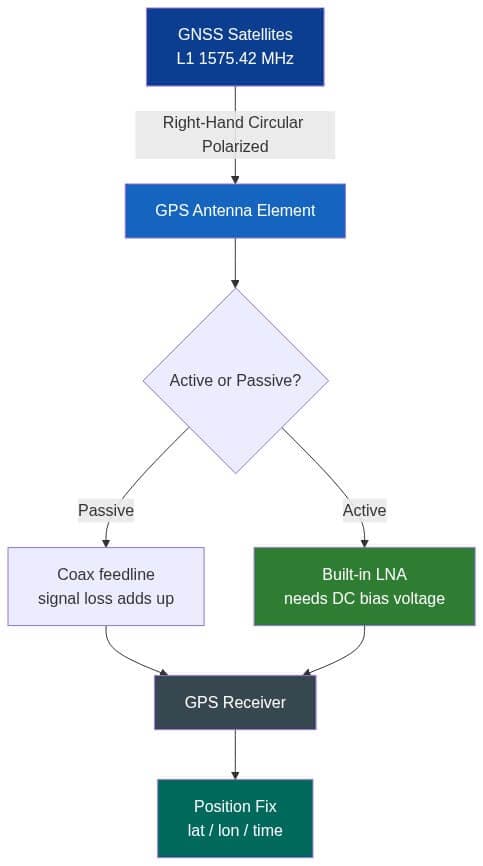
Active vs passive GPS antenna: the decision that matters most
A passive GPS antenna is just the radiating element and matching network—no amplifier. It works well only when the coax run to the receiver is very short and low-loss, because there is nothing to make up for cable attenuation. An active GPS antenna integrates a low-noise amplifier (LNA) right behind the element; the receiver (or an inline bias tee) sends DC voltage up the coax to power it. Placing gain at the antenna sets the system noise figure early in the chain, so the LNA compensates for feedline loss and preserves carrier-to-noise ratio over longer runs.
Most external GPS antennas sold for vehicles, IoT gateways, timing servers, and remote installations are active for exactly this reason. Before you specify one, verify three numbers against your receiver's datasheet:
- LNA gain — commonly in the ~26–30 dB range for automotive/patch modules; confirm the actual figure on the specific part.
- Required bias voltage — typically 2.7–5.5 V DC supplied by the receiver up the coax. The antenna's operating voltage window must include what your receiver outputs.
- Amplifier current draw — often around 5–20 mA; relevant for battery-powered and low-power designs.
Too much total gain ahead of a receiver that already has a sensitive front end can overdrive it, so match the antenna's amplifier to the receiver rather than assuming "more gain is better." When you're unsure, the safe move is to read the receiver's recommended active-antenna gain range and pick within it.
Active vs passive quick reference
| Consideration | Passive GPS antenna | Active GPS antenna |
|---|---|---|
| Built-in LNA | No | Yes |
| Needs DC bias from receiver | No | Yes (typically 2.7–5.5 V) |
| Tolerates long coax runs | Poor — loss is uncompensated | Good — LNA offsets feedline loss |
| Typical use | Antenna mounted at/inside the receiver, very short lead | External/remote mount, vehicles, gateways, timing |
| Selection risk | Cable loss kills sensitivity | Gain/voltage mismatch with receiver |
GPS antenna gain, patch size, and ground plane
Two different "gain" numbers get quoted for a GPS antenna and they are not interchangeable. Element (passive) gain describes how well the radiating element captures the RHCP signal, usually a modest few dBic for a ceramic patch. LNA gain is the amplifier figure discussed above. When a spec sheet lists a single large gain number for an active antenna, it is usually dominated by the LNA.
Ceramic patch elements are ground-plane dependent: a 25 mm patch behaves differently on a small PCB than on a large metal roof, and manufacturers tune the patch for an assumed ground-plane size. Magnetic-mount puck antennas solve this by including their own ground plane, which is a major reason they perform predictably on a vehicle roof. If you are embedding a bare patch, confirm the recommended ground-plane dimensions in the datasheet rather than guessing.
GPS antenna connector types
The connector on a GPS antenna is chosen to match the receiver or module port, the coax diameter, and the mechanical environment. Common choices you'll encounter:
| Connector | Where it's used | Notes |
|---|---|---|
| SMA | External antennas, GPS modules, most 50-ohm RF gear | Threaded, robust; verify polarity (standard SMA, not RP-SMA, for most GPS) |
| Fakra (blue, Code C) | Automotive GPS | Color/keying prevents cross-connection in vehicle harnesses |
| MCX / MMCX | Compact modules, embedded designs | Snap-on, small footprint |
| U.FL / MHF | PCB-level module connections | Board-to-board / board-to-cable, very small; fragile mate cycles |
| TNC | Higher-vibration / outdoor | Threaded version of BNC form factor |
GPS antennas and receivers are a 50-ohm system, so keep the whole chain at 50 ohms. If you need to move between connector families, a quality adapter or a made-to-spec cable assembly is the right approach—our custom cable shop can terminate the exact connectors and length you need. For a deeper reference on any of these interfaces, see our antenna connector types guide covering SMA, N-type, U.FL, MHF4 and more.
Feedline and cable loss: why the run length matters
At 1575 MHz, coax loss climbs quickly, and on a passive antenna that loss comes straight off your link budget. Even on an active antenna, excessive loss after the LNA still erodes signal, so cable type and length are part of the design—not an afterthought. Thin cables like RG-174 are convenient but lossy over distance; low-loss types like LMR-240/LMR-400 preserve much more signal on longer external runs. Work out the loss for your exact frequency and length before committing to a cable; our antenna cable selection guide with real loss-per-foot figures gives the numbers, and if the mismatch you're chasing is on the antenna side, our VSWR explained guide shows how impedance mismatch turns into reflected power.
Mounting and sky view
A GPS antenna needs a clear view of the sky. Because the signal is so weak, obstructions, metal enclosures, and heated/metallized windshields attenuate it heavily—an external antenna almost always outperforms an in-cab or in-enclosure position for vehicles and IoT deployments. Match the mount to the surface and vibration profile: magnetic pucks for temporary or vehicle use, screw/through-hole mounts for permanent installs, and IP-rated housings for outdoor exposure. If you're planning a fixed outdoor install, the same mounting principles in our antenna mount selection guide (surface type, grounding, weatherproofing) apply directly to GPS antennas.
How to choose a GPS antenna: a short checklist
- Bands: Single-band L1 for basic positioning, or multi-band (L1/L2/L5) and multi-constellation for RTK/high-precision.
- Active or passive: Active for any meaningful cable run; passive only for a very short lead at the receiver.
- LNA gain + bias voltage: Both must fall inside your receiver's recommended active-antenna window.
- Connector + impedance: Match the receiver port; keep the chain at 50 ohms.
- Cable type/length: Compute loss at 1575 MHz; use low-loss coax on long runs.
- Ground plane + mount: Confirm ground-plane needs; mount with clear sky view and the right environmental rating.
Ready to spec a part? Browse our GPS antennas and pair them with a made-to-spec antenna cable or adapter. Need a length, connector, or gain combination that isn't in stock? Request a custom quote or contact our technical support team—we manufacture custom cable assemblies and ship same-day on orders placed before 4pm MST.
Frequently asked questions about GPS antennas
What is the difference between an active and passive GPS antenna?
A passive GPS antenna is just the receiving element and works only over very short, low-loss cable runs. An active GPS antenna has a built-in low-noise amplifier (LNA) powered by DC bias voltage from the receiver, which compensates for feedline loss and preserves signal quality over longer runs. Most external GPS antennas are active.
What frequency does a GPS antenna use?
The primary GPS band is L1 at 1575.42 MHz. Multi-band and high-precision receivers also use L2 (1227.60 MHz) and L5 (1176.45 MHz), plus the corresponding GLONASS, Galileo, and BeiDou frequencies. A single-band antenna only needs to cover L1; multi-constellation, high-accuracy work needs a wider-band antenna.
What connector does a GPS antenna use?
SMA is the most common connector on external GPS antennas and modules, with Fakra (typically the blue, keyed variant) standard in automotive harnesses, and MCX, MMCX, U.FL, or MHF used on compact and board-level designs. GPS is a 50-ohm system, so match the connector to your receiver port and keep the whole chain at 50 ohms.
How much LNA gain does an active GPS antenna need?
It depends on your receiver and your cable loss. Many active GPS antennas provide roughly 26–30 dB of LNA gain, but the correct target is whatever falls inside your receiver's recommended active-antenna gain window after subtracting cable loss. Too little gain and cable loss dominates; too much can overdrive a sensitive front end. Always verify against the receiver datasheet rather than assuming more gain is better.
Does a GPS antenna need a ground plane?
Ceramic patch elements are tuned for an assumed ground-plane size and can shift performance if mounted on a plane that's too small. Magnetic-mount puck antennas include their own ground plane, which is why they perform predictably on a vehicle roof. If you're embedding a bare patch, follow the ground-plane dimensions in the antenna's datasheet.
Can I use a longer cable with my GPS antenna?
Yes, but you must account for loss at 1575 MHz. Use an active antenna and low-loss coax (for example LMR-240 or LMR-400) for longer runs, and compute the total cable loss for your specific length before committing. On a passive antenna, even a short lossy cable can prevent a reliable fix.