


Antennas, Antenna Cables, Wireless Products: Technical Articles
BNC Cables 50 Ohm & 75 Ohm Distinctions, Applications, Connectors
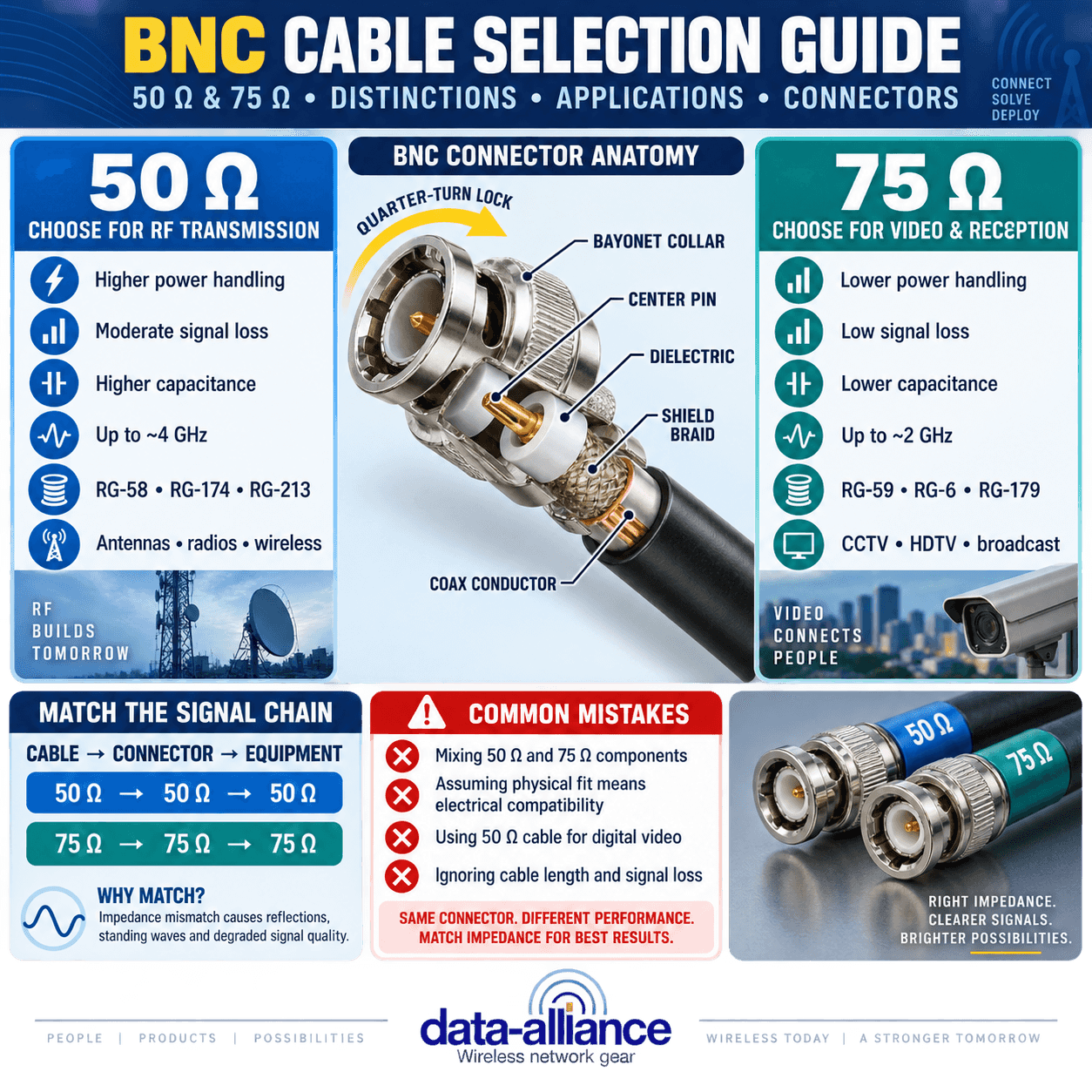
BNC cables are manufactured in two impedances — 50 ohm and 75 ohm — and choosing the wrong one quietly degrades your signal. The short answer: use a 50 ohm BNC cable for RF transmission, antennas and higher-power wireless, and a 75 ohm BNC cable for video, broadcast and digital audio where low signal loss matters most. The two look almost identical and will physically mate, but mixing them creates an impedance mismatch that reflects energy back toward the source. This guide explains the electrical differences, the coax types tied to each impedance, frequency limits, and how to match connectors to cable so your link performs as specified.
Data Alliance manufactures BNC cables and adapters in both impedances, with same-day shipping on orders placed before 4pm MST and custom assemblies to length on request.
50 Ohm vs 75 Ohm BNC Cables: Two Distinct Types
50 ohm and 75 ohm BNC cables are distinguished by their characteristic impedance — the value the cable presents to an AC radio-frequency signal travelling down its length. Both versions use the same bayonet (Bayonet Neill–Concelman) coupling, so the connectors look interchangeable, but they are engineered for different electrical jobs:
- 50 ohm BNC — optimized for RF transmission and power handling. Used with antennas, radios, transmitters and wireless networking. Common coax: RG-58, RG-174, RG-213.
- 75 ohm BNC — optimized for the lowest signal loss and is the standard for analog and digital video. Used with cable TV, HDTV, CCTV and coaxial digital audio. Common coax: RG-59, RG-6, RG-179.
- Both impedances can physically mate and may function in low-frequency or short-run applications. However, electrical performance degrades as frequency rises, making proper impedance matching critical in professional systems.
- Best practice: 50 ohm connectors terminate 50 ohm cable; 75 ohm connectors terminate 75 ohm cable. Keep a single impedance across the whole signal chain.
50 Ohm vs 75 Ohm BNC — Quick Comparison
Feature | 50 Ohm BNC | 75 Ohm BNC |
Primary use | RF transmission | Video & signal reception |
Power handling | High | Low |
Signal loss | Moderate | Low |
Capacitance | Higher | Lower |
Typical applications | Antennas, radios, wireless | CCTV, HDTV, broadcast, digital audio |
Common coax | RG-58, RG-174, RG-213 | RG-59, RG-6, RG-179 |
Frequency range | Up to ~4 GHz | Up to ~2 GHz |
Why 50 Ohm and 75 Ohm?
The use of 50 and 75 ohms as standard characteristic impedances is a deliberate compromise between power handling and the lowest feasible signal loss. Early-20th-century testing found that excellent voltage and power handling peaked near 30 ohm coax, while the lowest attenuation occurred near 77 ohm coax. The two practical standards settled on either side of that trade-off:
- 50 ohm coax gives a good power-handling profile together with low attenuation. Over the following decades it became the primary choice for cable that must handle 100 watts or more, and it is the standard for antenna cables across amateur and broadcast radio, cellular, and wireless networking.
- 75 ohm coax is preferred where low signal loss, low capacitance and minimal distortion matter more than power. It is the cable of choice for receiver-side and video applications — cable television, HDTV and CCTV — and also carries coaxial digital audio, for example in a home-theater system.
What Impedance Actually Measures
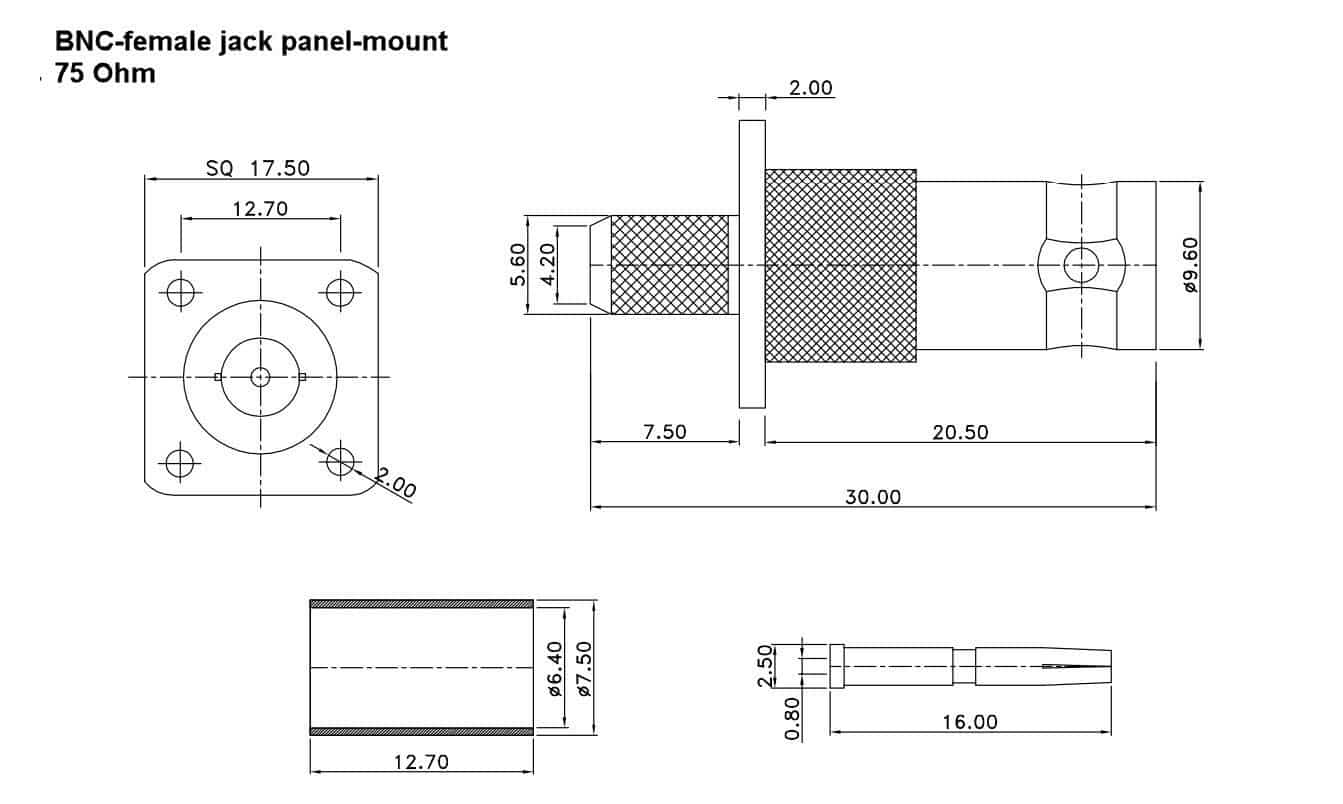
Coaxial cable impedance is measured in ohms, the unit of electrical resistance. RF signals carry an alternating current (AC) rather than DC, so both the magnitude and phase of the signal are shaped by the cable along its length. The impedance rating therefore combines three properties:
- Resistance: opposition to the flow of current.
- Inductance: voltage generated by the magnetic field of the current.
- Capacitance: charge retained within the cable while current flows.
A given coax is built to balance resistance, capacitance and inductance for consistent RF performance. Its characteristic impedance is set by the dielectric constant of the insulating layer and the radii of the inner and outer conductors.
75 Ohm Cable and Digital Transmissions
75 ohm cable is often seen as legacy, but it has strong utility for digital signals. Digital signals have a square waveform rather than the smooth sine wave of analog. High-capacitance cable distorts those square edges, blurring the distinction between stepped peaks and troughs. Because 75 ohm coax has lower capacitance than 50 ohm coax, it preserves the full digital transmission with minimal loss and distortion. 75 ohm coax is therefore preferred for digital audio and video broadcast applications, including:
- Direct-broadcast satellite dishes
- Over-the-air High-Definition Television (HDTV) antennas
BNC Cable Applications by Coax Type
- RG-59 (75 ohm): transmits video from a CCTV camera to the monitor room; a mainstay of analog video.
- RG-179 (75 ohm): a high-temperature cable with a TFE-taped outer jacket rated to roughly 200°C — used in medical equipment, video security cameras and audio security systems.
- RG-58 (50 ohm): general-purpose, lower-cost cable with a wide range of RF uses.
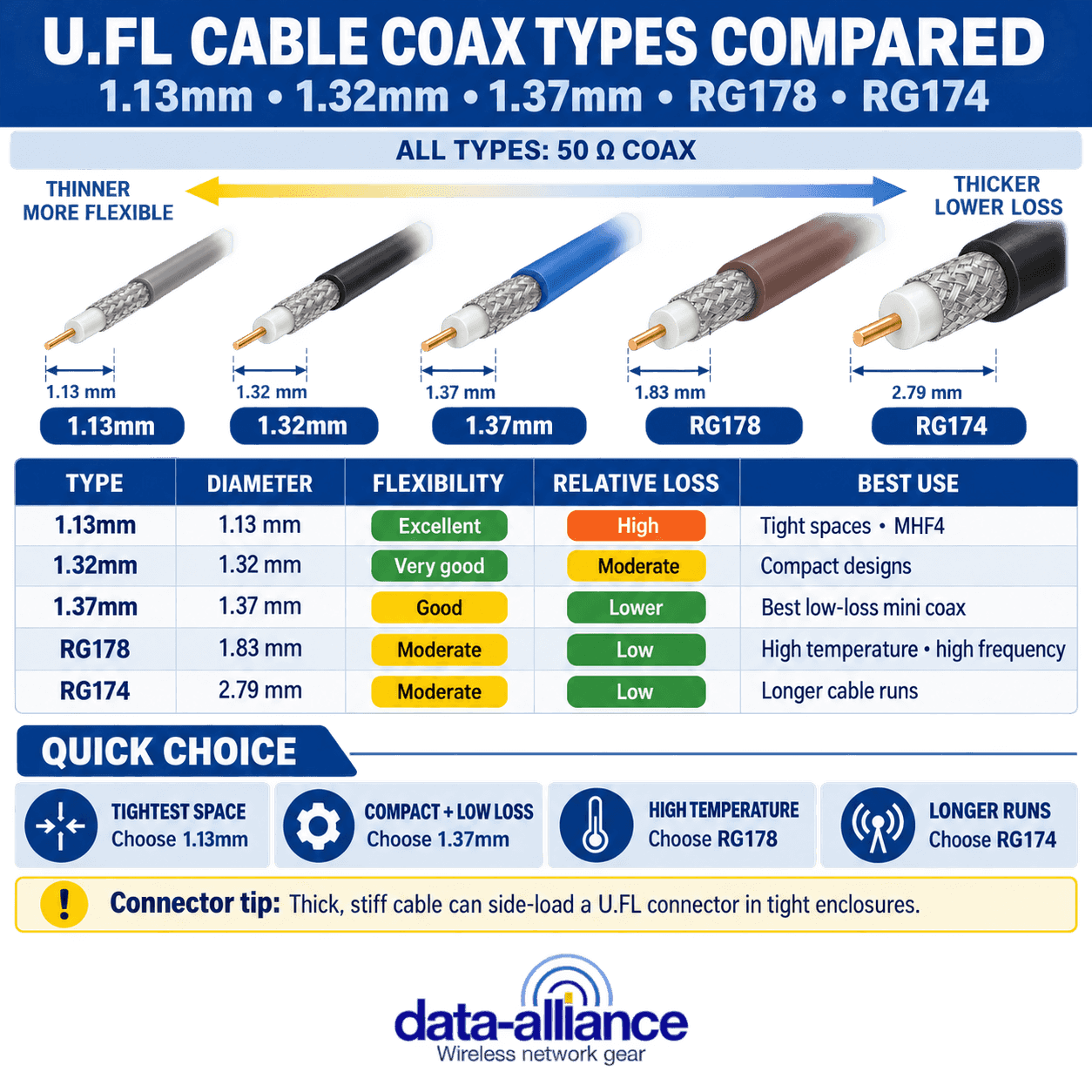
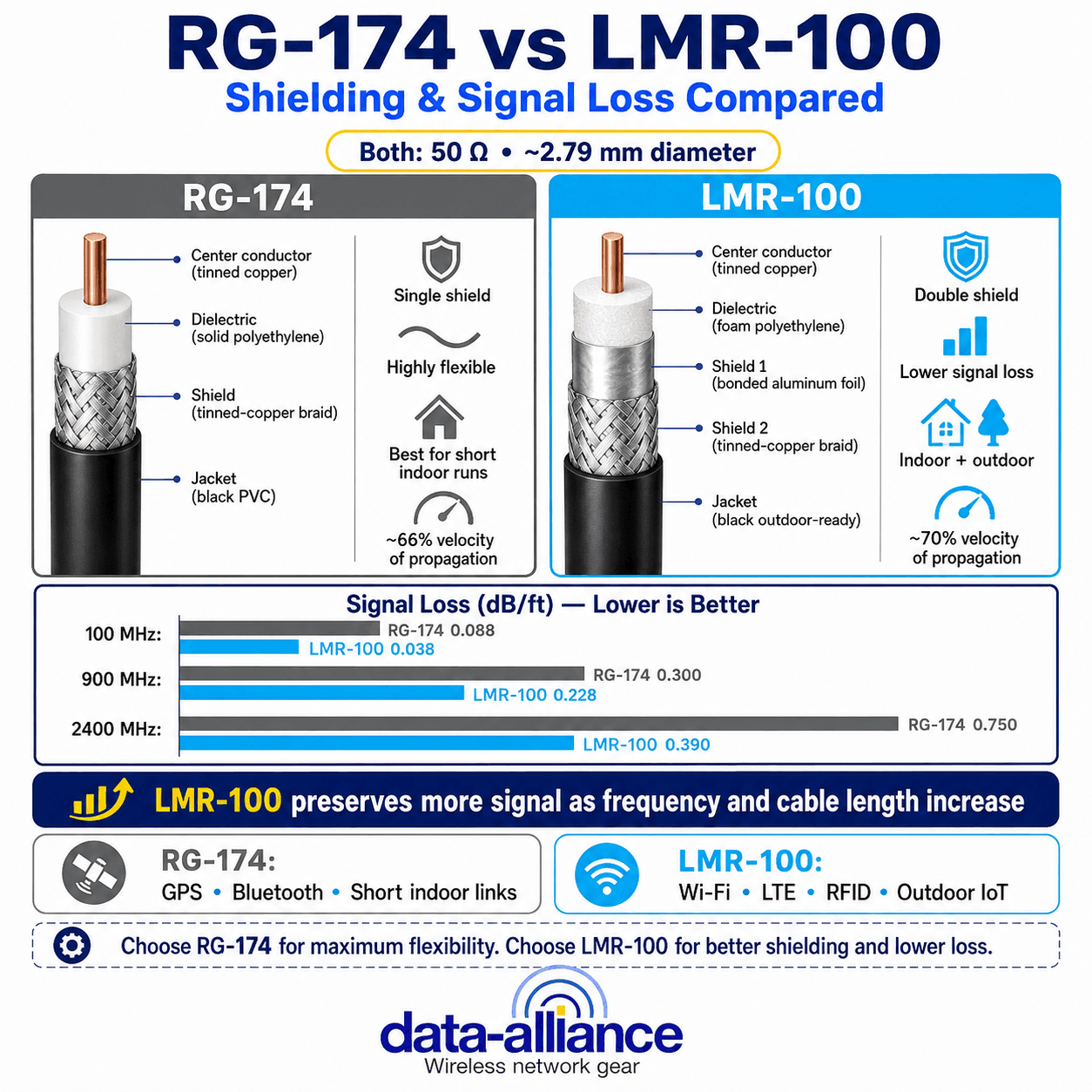
- RG-174 (50 ohm): very thin and flexible — widely used for vehicle GPS antennas and tight routing.
- RG-213 (50 ohm): the thickest BNC coax (nearly half an inch) for high-power runs handling 1,000 watts and more.
BNC 50 Ohm & 75 Ohm Connectors
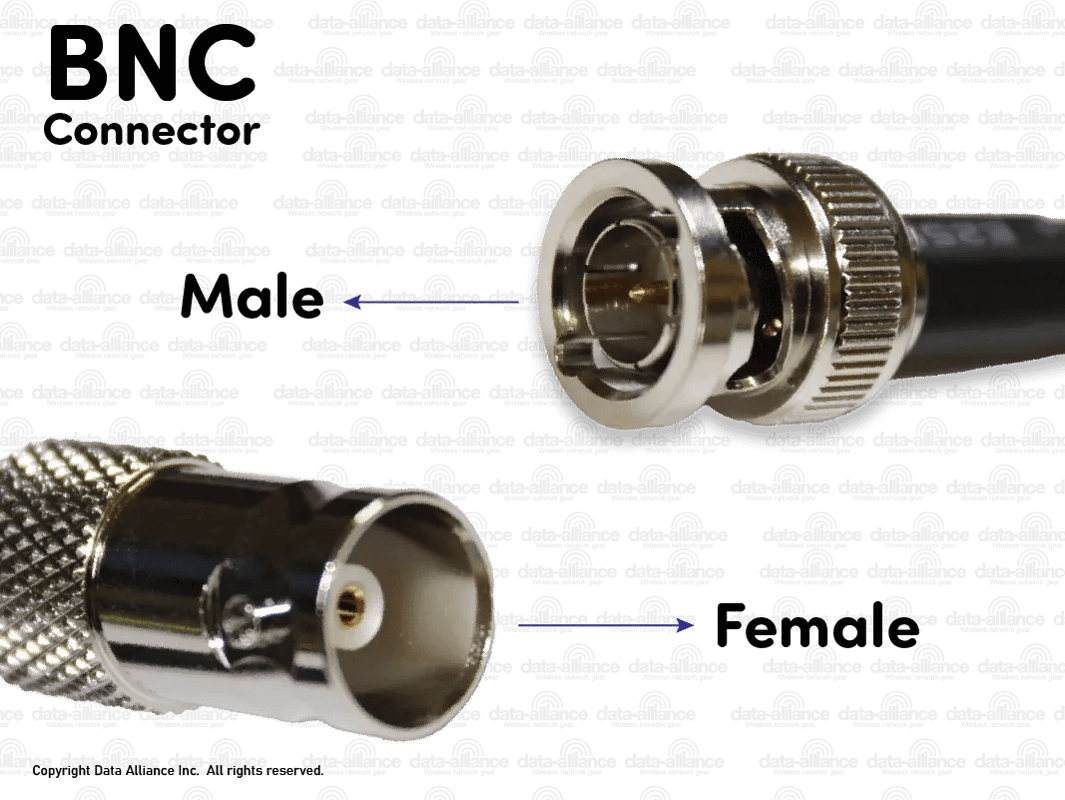
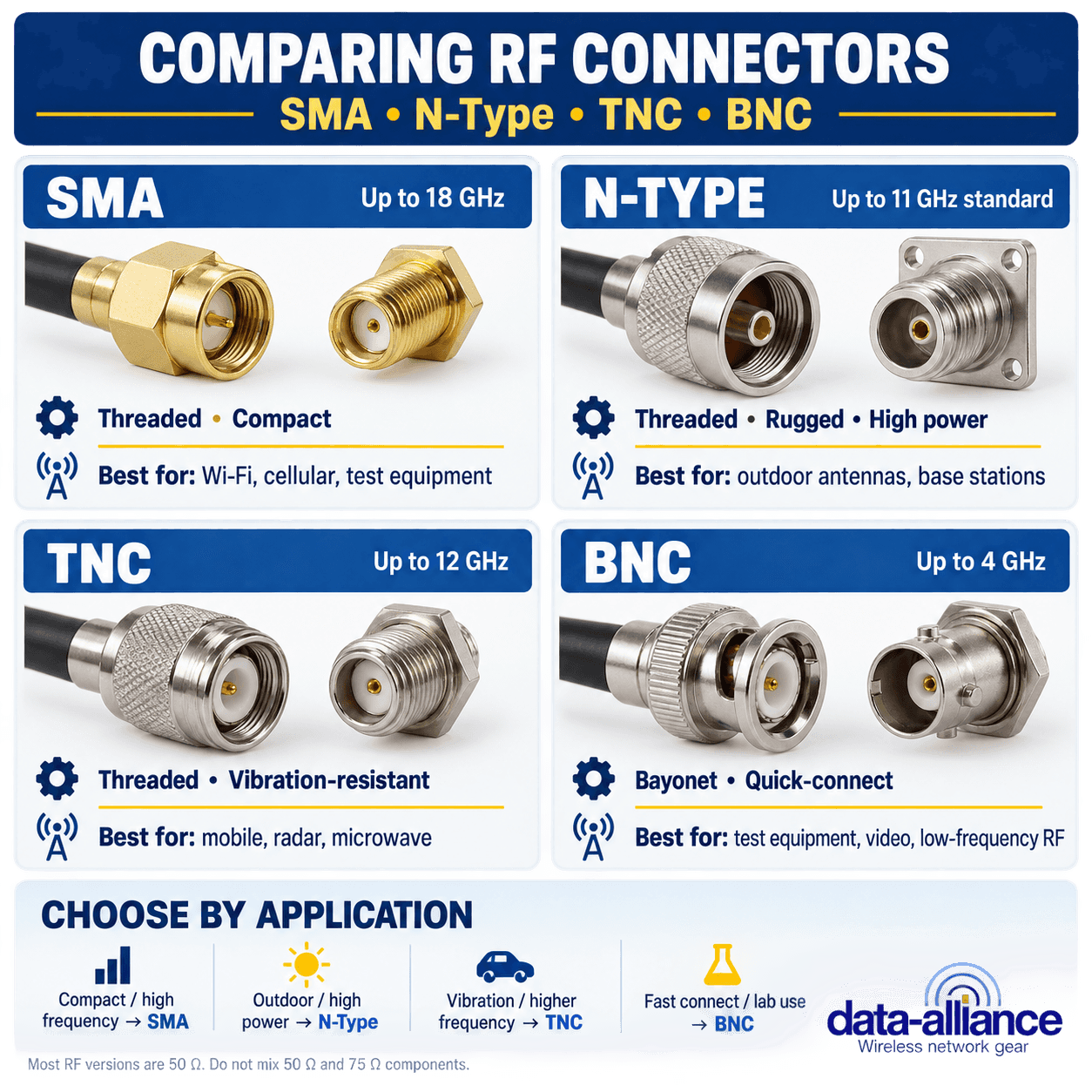
The BNC connector (Bayonet Neill–Concelman) is a miniature quick-release RF connector for terminating RG coax. The female connector has two lugs that latch with a quarter turn to connect or disconnect quickly. Bodies are typically brass, with gold plating for durability in outdoor use and nickel plating where the connector solders to a circuit board.
- 75 ohm BNC connectors use a Teflon dielectric, air-directed outer spring fingers, and a center pin of very consistent diameter front to back.
- 50 ohm BNC connectors use a Delrin dielectric, and the center-pin diameter increases toward the crimp region rather than staying constant.
BNC connectors are produced for commercial, military and industrial use — originally developed for the military and now common in RF and video equipment. Typical applications include aerospace electronics, antennas, automotive wireless devices, broadcast video (75 Ω), cable modems, computer LAN equipment, medical equipment, serial/parallel video devices and telecom. A 95 ohm BNC variant also exists but is rare, used mainly for glass displays in some aircraft.
Terminating BNC Connectors: Clamp or Crimp, and Frequency Limits
A coax cable can be terminated to a BNC connector by either clamping or crimping. Connectors are built in matching 50 ohm and 75 ohm impedances so termination stays consistent with the cable and equipment. 75 ohm connectors are rated to about 2 GHz; 50 ohm connectors conduct signals up to about 4 GHz. Both use a plastic dielectric that raises signal loss above 4 GHz, which sets their moderate frequency ceiling. For low-frequency or short runs the two impedances can be interchanged without damage, but performance suffers as frequency climbs.
Match Cable and Connector Impedance
When self-assembling 75 ohm cables, the BNC connectors must share the cable's impedance. Attaching 50 ohm connectors to a 75 ohm cable creates an impedance mismatch that reflects energy back to the source and generates standing waves. Those reflections cause signal loss, and repeated reflections progressively degrade the signal — and, in video, the image — until it is unrecoverable.
Common Mistakes When Using BNC Cables
- Using 50 ohm BNC connectors on 75 ohm video cable
- Mixing cable impedances in the same signal chain
- Assuming physical compatibility equals electrical compatibility
- Using 50 ohm cable for digital video simply because it is on hand
- Ignoring cable length when evaluating signal degradation
Avoiding these mistakes preserves signal integrity, image quality and system reliability.
How to Choose the Right BNC Cable and Connector
Choose 50 ohm BNC cables and connectors if:
- You are transmitting RF signals
- Power handling is important
- The system includes antennas or transmitters
Choose 75 ohm BNC cables and connectors if:
- Signal loss must be minimized
- The application involves video or digital audio
- The system is receiver-based rather than transmitting
Need a length or connector combination that is not in stock? Browse Data Alliance BNC cables and adapters or request a custom quote for a made-to-order assembly.
Conclusion
Although 50 ohm and 75 ohm BNC connectors and cables look alike and can physically mate, they are engineered for distinctly different electrical purposes. The decision should be driven by application requirements — power handling, signal loss, frequency range and signal integrity.
50 ohm systems balance power handling and attenuation, making them ideal for RF transmission, antennas and high-power applications. 75 ohm systems are optimized for low signal loss and minimal distortion, which is why they dominate video, broadcast, digital audio and receiver-based applications. To achieve optimal performance, cables and connectors must always be impedance-matched; mixing the two leads to reflections, standing waves and degraded quality that worsen at higher frequencies and in digital transmissions.
Frequently Asked Questions
What is the main difference between 50 ohm and 75 ohm BNC cables?
The primary difference is impedance, which affects how signals are transmitted. 50 ohm BNC cables are designed for RF transmission and higher power handling, while 75 ohm BNC cables are optimized for low signal loss and minimal distortion — making them ideal for video, broadcast and receiver-based applications.
Can I connect a 50 ohm BNC connector to a 75 ohm cable?
Physically yes, but electrically it is not recommended. Mixing 50 ohm connectors with 75 ohm cable creates an impedance mismatch that can cause signal reflections, standing waves and degraded performance, especially at higher frequencies or over longer cable lengths.
Why are 75 ohm BNC cables preferred for video and digital signals?
75 ohm coaxial cables have lower capacitance and lower signal attenuation, which helps preserve signal integrity. That makes them ideal for CCTV, HDTV, broadcast video and digital audio, where minimizing signal loss and distortion is critical.
What applications are best suited for 50 ohm BNC cables?
50 ohm BNC cables are best where power handling and RF transmission matter. Common uses include antennas, radios, wireless networking, GPS systems and high-power RF applications using cables such as RG-58, RG-174 and RG-213.
What is RG-179 cable and when should it be used?
RG-179 is a 75 ohm coaxial cable built for high-temperature environments, with a TFE-taped outer jacket rated to about 200°C. It is commonly used in medical equipment, security cameras and audio/video systems where heat resistance and signal integrity are required.
What frequency can BNC connectors handle?
75 ohm BNC connectors are rated to roughly 2 GHz and 50 ohm BNC connectors to roughly 4 GHz. Above about 4 GHz the plastic dielectric raises signal loss, which is why BNC is used for low-to-moderate RF and video rather than microwave links.
How do I choose the right BNC cable and connector for my application?
Choose 50 ohm BNC cables and connectors if your system involves RF transmission, antennas or higher power. Choose 75 ohm BNC cables and connectors if your priority is low signal loss, video quality or digital audio/video performance. Always ensure the cable and connector impedances match for best results.