


Antennas, Antenna Cables, Wireless Products: Technical Articles
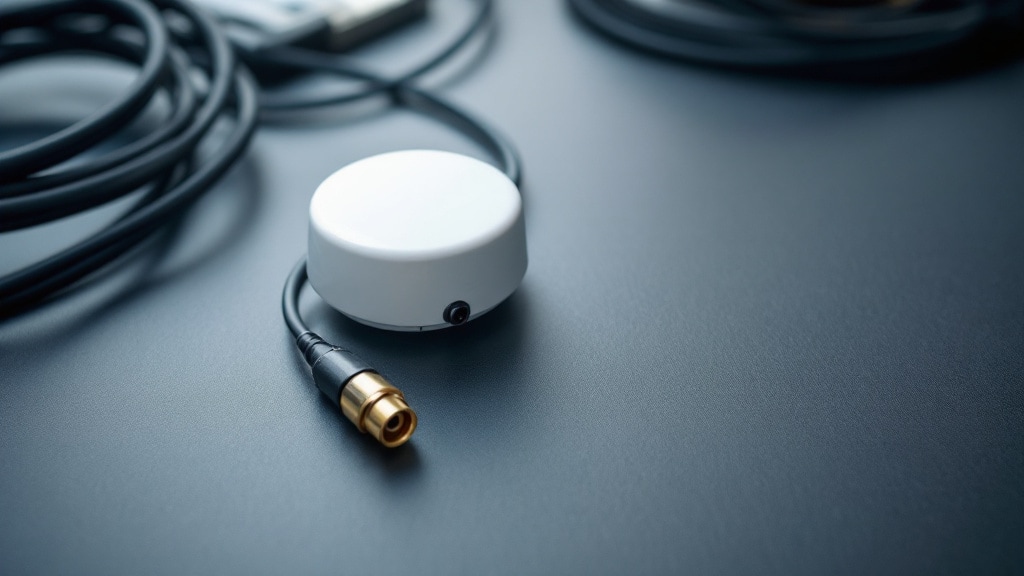
GPS Antenna Guide: Active vs Passive, Frequency, Connectors & How to Choose
A GPS antenna is a receive-only antenna tuned to the GPS L1 carrier at 1575.42 MHz — and increasingly to the wider set of GNSS bands — that captures the faint satellite signal and delivers it to your receiver or module. For technical buyers the real decision is not "which GPS antenna looks right" but four verifiable things: whether it is active or passive, the frequency bands it covers, the connector it terminates in, and how it will be mounted and grounded. Get those four right and the position fix is fast and stable; get one wrong and you chase intermittent lock for weeks. This guide walks through each decision the way an integrator would spec it.
What a GPS antenna actually has to do
GPS satellite signals arrive at the earth's surface at roughly −125 to −130 dBm — well below the noise floor. A GPS antenna therefore has to present a clean 50-ohm match at the GNSS frequencies, hold a right-hand circular polarization (RHCP) to match the satellite transmission, and — in most real installations — add low-noise gain before the signal is degraded by cable loss. That last requirement is why the active-vs-passive choice comes first.
Active vs passive GPS antenna
The single most important distinction is whether the antenna contains a built-in low-noise amplifier (LNA).
- Passive GPS antenna — no amplifier. The antenna element feeds the receiver directly. Workable only when the cable run is very short (a few inches to a couple of feet) and the receiver has enough front-end sensitivity. Any meaningful coax length will bury the signal in loss.
- Active GPS antenna — contains an LNA, typically 20–30 dB of gain, powered by DC bias fed up the coax from the receiver (phantom power). This compensates for cable loss and is the correct choice for almost every external-mount installation.
If you choose an active antenna, you must match two things to the receiver: the bias voltage (commonly 2.7 V, 3.0 V, 3.3 V, or 5 V — verify your module's datasheet) and the antenna's current draw. Feeding 5 V into a 3 V LNA, or failing to supply bias at all, is a classic cause of "antenna connected but no fix." Confirm the exact LNA gain, noise figure, and bias range on the specific product page rather than assuming — these vary by model.
GPS antenna frequency: L1, L2/L5 and multi-band GNSS
A basic GPS antenna only needs to cover GPS L1 at 1575.42 MHz. Modern receivers, however, often use multiple constellations and bands for faster, more accurate fixes, so match the antenna's band coverage to the receiver:
| Band | Center frequency | Used by |
|---|---|---|
| GPS L1 / GLONASS G1 / Galileo E1 / BeiDou B1 | ~1559–1610 MHz (L1 is 1575.42 MHz) | Standard single-band and multi-GNSS receivers |
| GPS L2 | 1227.60 MHz | Dual-frequency / survey receivers |
| GPS L5 / Galileo E5a | 1176.45 MHz | High-precision / RTK, multipath rejection |
Rule of thumb: a single-band "GPS/GNSS L1" antenna serves the vast majority of tracking, telematics and timing jobs. Specify a multi-band (L1+L2+L5) antenna only when the receiver genuinely supports those bands — paying for L5 coverage a single-band module can't use buys you nothing.
GPS antenna types and form factors
- Patch (ceramic) antenna — the flat element inside most pucks and embedded modules. Requires a ground plane beneath it to achieve its rated pattern and gain.
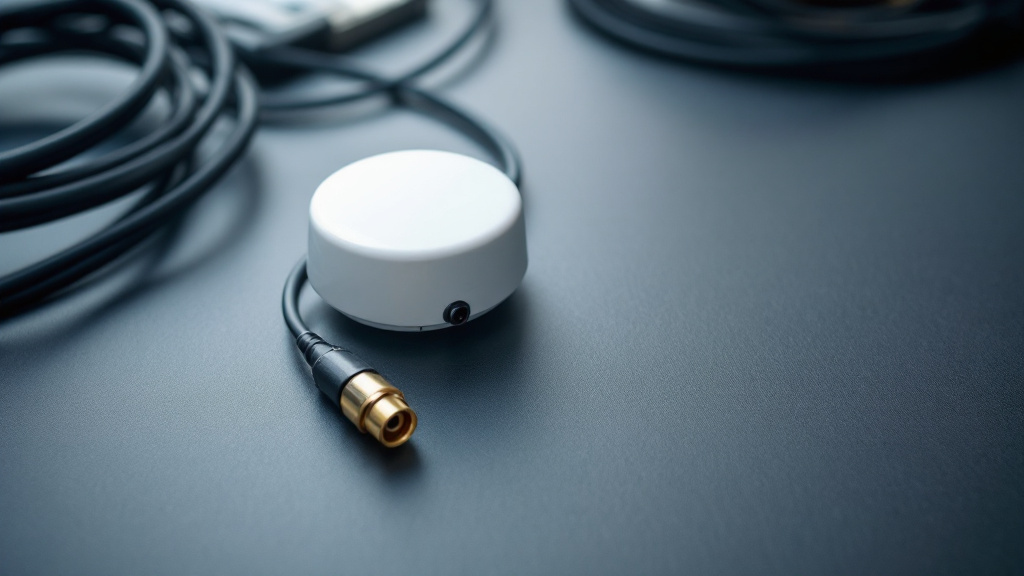
- Puck / dome antenna — a sealed, weatherproof housing (magnetic, adhesive, or screw/through-hole mount) wrapping a patch element plus LNA. The workhorse external active GPS antenna.
- Helical antenna — a compact element that works without a dedicated ground plane, useful on handhelds and small IoT devices.
- Timing / survey antenna — larger choke-ring or multipath-resistant designs for fixed-reference stations and precise timing.
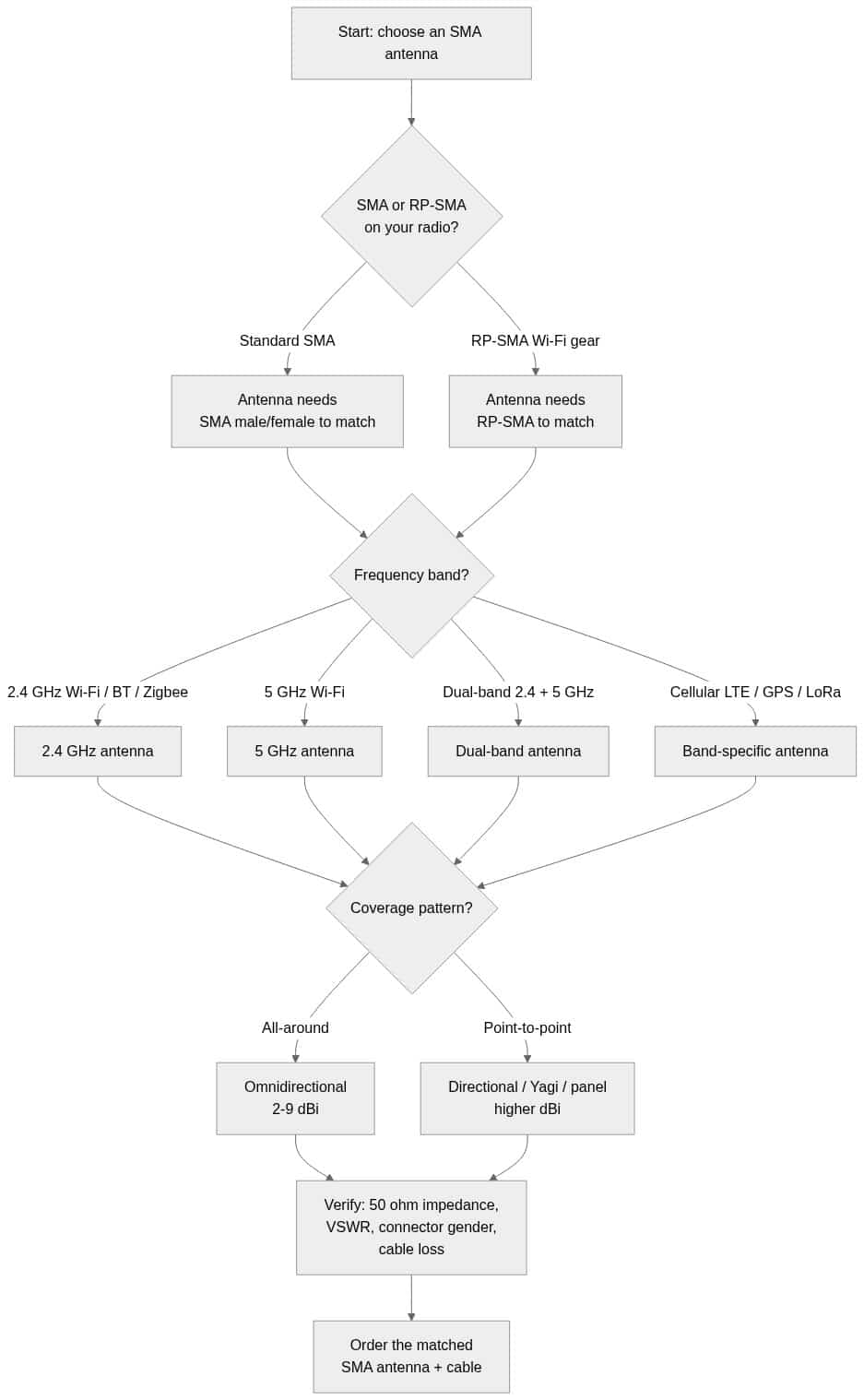
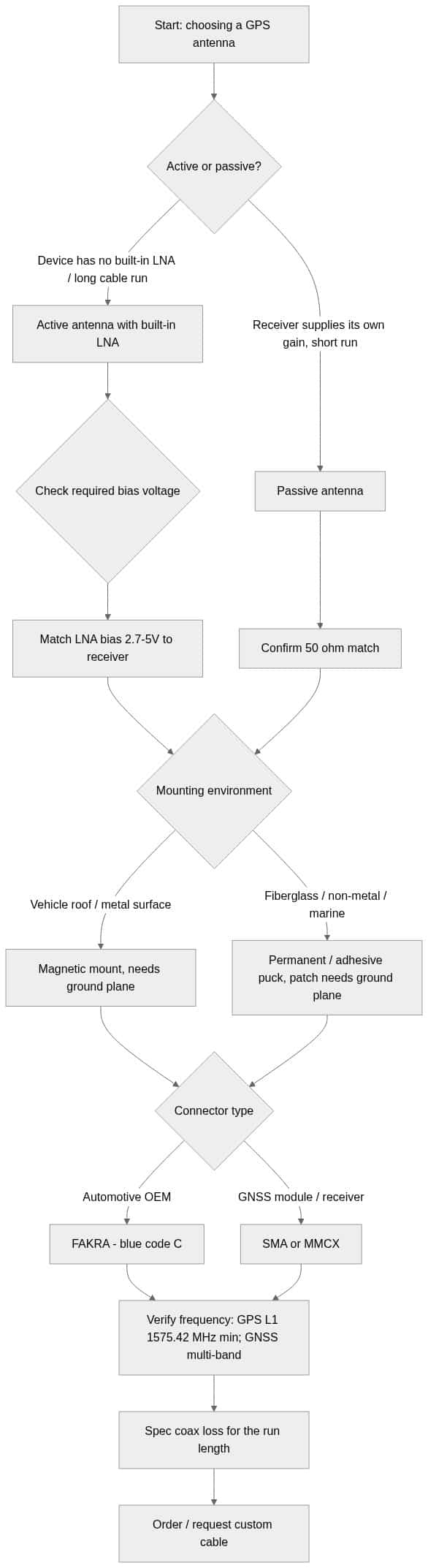
How to choose a GPS antenna: a decision flow
The order of decisions matters. Work active-vs-passive first, then mounting, then connector, then frequency and cable loss:
GPS antenna connectors
The connector has to match both the receiver/module port and the environment. The common choices on a GPS antenna are:
- SMA — the default on most GNSS receivers and development boards (50 ohm, rated to ~18 GHz). Note true SMA vs RP-SMA polarity before ordering.
- MMCX / U.FL (MHF) — small snap or push-on connectors used on compact modules and embedded designs.
- FAKRA — the keyed, color-coded automotive standard; GPS/GNSS uses the blue, code C key. This is what you'll meet on vehicle OEM and telematics harnesses.
- BNC / TNC — occasionally on marine and industrial timing gear.
If you're unsure which connector pairs with your radio, start with our guide to antenna connector types (SMA, RP-SMA, N, U.FL and FAKRA), and for in-vehicle GPS harnesses see the detailed FAKRA connector guide with color codes and keying. When the antenna and receiver use different connectors, a short pigtail adapter solves it without re-terminating the cable.
Ground planes and mounting
Patch-element GPS antennas are specified against a metal ground plane. On a steel vehicle roof the roof is the ground plane, which is why magnetic-mount pucks perform well there. On fiberglass, plastic, or marine surfaces there is no ground plane, so either choose a puck engineered to work without one, choose a helical element, or add a conductive disc beneath the patch. If you want the underlying physics of how a ground plane sets pattern, gain and VSWR, our ground plane antenna guide covers it. Mount the antenna with a clear, unobstructed view of the sky — GPS needs line of sight to satellites, and metal structures above the antenna will block or reflect the signal and cause multipath.
Cable loss: why the run length changes your spec
At ~1.5 GHz, coax loss is significant, which is the whole reason active antennas exist. For short jumpers, thin cable is fine; for longer external runs, step up to low-loss coax so the LNA output isn't eaten before it reaches the receiver. For runs beyond a few meters, size the feedline deliberately — see our LMR-400 cable guide for loss-per-100-ft figures by frequency and when to go heavier. We manufacture custom GPS antenna cables in-house, so if a stock length or connector pairing doesn't exist you can have one made to spec.
GPS antenna spec checklist
| Spec | What to verify |
|---|---|
| Active or passive | Active (built-in LNA) for any real cable run; passive only for inches |
| LNA gain & noise figure | Typically 20–30 dB gain; confirm on the product page |
| Bias voltage | Match receiver output (2.7 / 3.0 / 3.3 / 5 V) |
| Frequency band(s) | L1 only vs multi-band L1/L2/L5 — match the receiver |
| Impedance | 50 ohm throughout |
| Polarization | RHCP |
| Connector | SMA / RP-SMA / MMCX / U.FL / FAKRA (blue, code C for GPS) |
| Mount & ground plane | Magnetic, adhesive, through-hole; ground plane present or not |
| Cable loss | Spec coax to the run length at ~1.5 GHz |
Shop GPS antennas and cables
Ready to spec one? Browse our GPS antennas for active and passive options across SMA, MMCX and FAKRA connectors, and our antenna cables & adapters for the matching feedline. Orders placed before 4pm MST ship same day. Need a non-standard length, connector pairing or GNSS band combination? Request a custom quote or contact our technical support team and we'll build the cable assembly to your spec.
Frequently asked questions
What is the difference between an active and a passive GPS antenna?
A passive GPS antenna has no amplifier and only works with a very short cable run, while an active GPS antenna contains a built-in low-noise amplifier (typically 20–30 dB) powered by DC bias from the receiver, which compensates for cable loss. For almost any external-mount installation, use an active antenna.
What frequency does a GPS antenna use?
The core GPS signal is L1 at 1575.42 MHz. Many modern multi-GNSS receivers also use nearby L1-band signals from GLONASS, Galileo and BeiDou, and high-precision receivers add L2 (1227.60 MHz) and L5 (1176.45 MHz). Match the antenna's band coverage to what your receiver actually supports.
Which connector does a GPS antenna use?
SMA is the most common on receivers and dev boards; compact modules often use MMCX or U.FL/MHF; automotive and telematics harnesses use FAKRA, with the blue code-C key reserved for GPS/GNSS. Check your receiver port and use a pigtail adapter if the antenna and receiver connectors differ.
Does a GPS antenna need a ground plane?
Patch-element GPS antennas are specified against a metal ground plane. A steel vehicle roof provides one for magnetic-mount pucks. On fiberglass, plastic or marine surfaces, use a puck designed to work without a ground plane, a helical element, or add a conductive disc beneath the antenna.
How long can the cable be on a GPS antenna?
It depends on the antenna's LNA gain and the coax loss at ~1.5 GHz. An active antenna's amplifier is sized to overcome a certain amount of cable loss, so for longer runs use low-loss coax and verify that the delivered gain still leaves adequate signal at the receiver. For multi-meter runs, size the feedline deliberately rather than reusing a thin jumper.