


Antennas, Antenna Cables, Wireless Products: Technical Articles
Antenna Mount Guide: Pole, Wall & Articulating Mounts and How to Choose
An antenna mount is the mechanical hardware that fixes an antenna to a mast, wall, rooftop or vehicle and, just as importantly, sets its height, its aim and whether it survives wind and weather. Choosing the right antenna mount is a question of matching four things: the antenna type (omnidirectional vs directional), the mounting surface, the environment (indoor, outdoor, mobile), and the structural load — mast diameter, wind survival and grounding. Get those right and the mount disappears into the background; get them wrong and you get drift, water ingress, or a dish that walks off heading in the first storm.
This guide is written for integrators, installers and network consultants who buy on verifiable specs. It compares the common antenna mount styles, lists the figures to confirm before you order, and points to the related hardware — feedline, grounding and ground planes — that a clean install depends on.
How to choose an antenna mount: the four decisions
Every antenna mount decision collapses to the same four questions. Walk them in order and the correct mount type usually falls out on its own.
- Antenna type and pattern. An omnidirectional antenna only needs to be vertical and in the clear, so a simple pole or mast mount works. A directional antenna — a Yagi, panel or dish — needs a mount that lets you set and lock azimuth (and often elevation/tilt), because a few degrees off heading can cost you a usable link.
- Mounting surface. Pole/mast, wall or soffit, flat roof, ground, or a metal vehicle panel each call for a different bracket family.
- Environment. Outdoor and exposed means UV-stable, corrosion-resistant metal and stainless hardware; indoor can use lighter brackets.
- Structural load. Confirm the mast outer diameter the clamp accepts, the antenna's weight and wind-load area, and how you will ground and strain-relieve the coax.
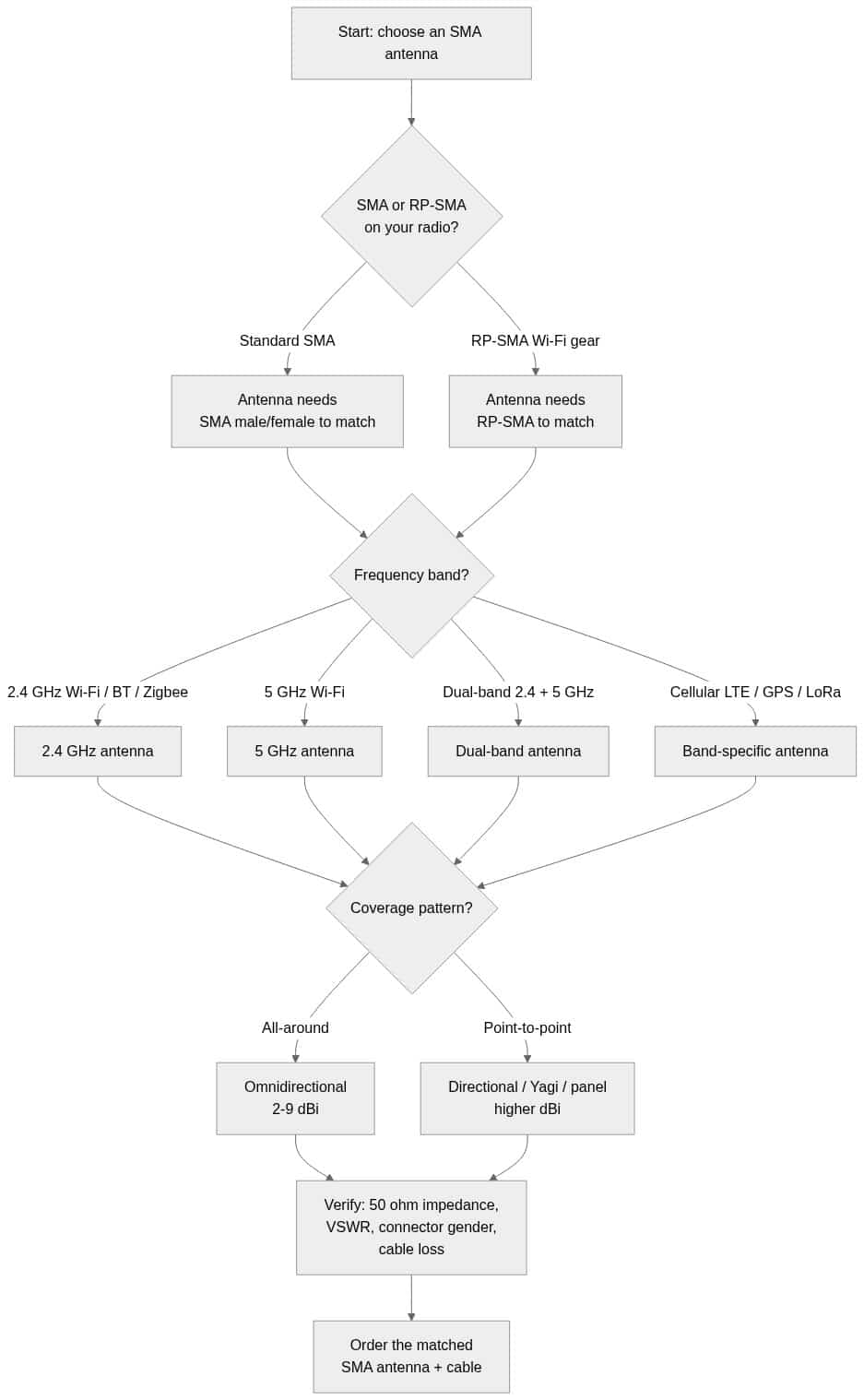
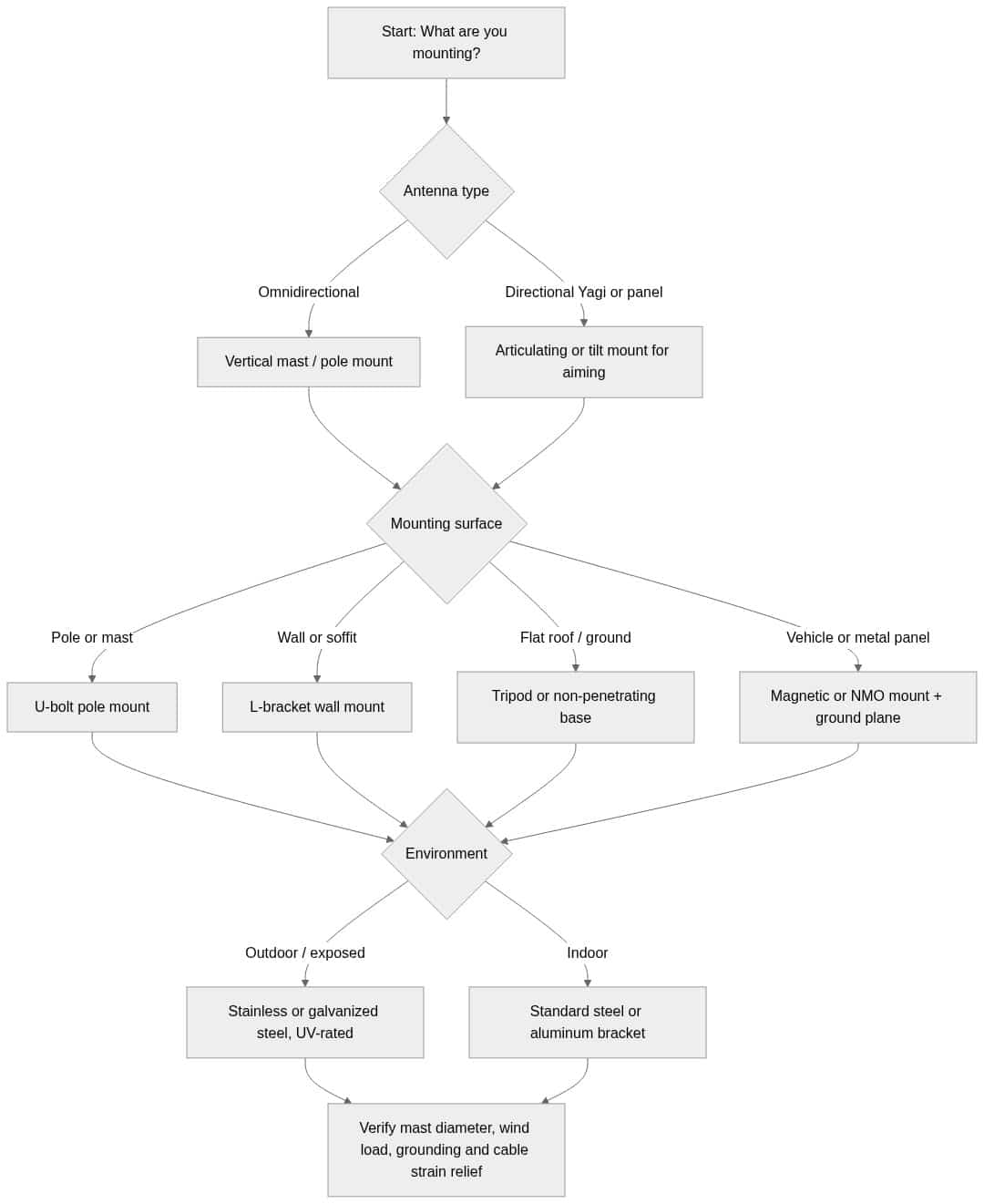
The flowchart below walks the same logic from antenna type down to the final verification step.
Antenna mount types compared
The table below summarizes the common antenna mount families and where each fits. Treat the figures as typical ranges to confirm against the specific part you order — mast-diameter capacity and load ratings vary by bracket.
| Mount type | Best for | Typical surface | Aiming | Notes to verify |
|---|---|---|---|---|
| U-bolt pole / mast mount | Omni and directional antennas on an existing mast | Round pole or pipe | Rotate on mast | Mast OD range the U-bolts accept (e.g. ~1–2 in) |
| Wall / L-bracket mount | Short masts off a building face or soffit | Masonry, siding, soffit | Fixed heading | Standoff distance, fastener type, wall material |
| Articulating / tilt mount | Yagi, panel and dish antennas needing precise aim | Pole or wall | Azimuth + elevation, lockable | Tilt range in degrees and locking method |
| Non-penetrating roof mount | Flat commercial roofs where you can't drill | Flat roof (ballasted) | Rotate on mast | Ballast weight needed for local wind load |
| Tripod / peak mount | Sloped roofs and gable peaks | Shingle / metal roof | Rotate on mast | Sealing of penetrations, leg spread |
| Magnetic / NMO mount | Vehicle and temporary metal-surface installs | Metal vehicle panel | Vertical only | Needs a metal ground plane; cable routing |
Pole and mast mounts
The workhorse of outdoor wireless. A U-bolt clamp wraps a round mast and a bracket carries the antenna; loosen, rotate to heading, retighten. The spec that bites people is the mast outer diameter the clamp actually fits — confirm it against your pipe before ordering. For long-range directional links the mast's rigidity matters as much as the clamp, because mast flex translates directly into pointing error on a narrow-beam antenna.
Wall and L-bracket mounts
An L-bracket pushes a short mast out from a wall or under a soffit, keeping the antenna clear of the structure. Match the fastener to the wall material (masonry anchors vs lag screws into a stud or rafter) and verify the standoff distance is enough to clear gutters and eaves.
Articulating and tilt mounts
Directional antennas live or die on aim. An articulating mount adds a lockable elevation/tilt axis on top of azimuth rotation so you can set downtilt on a panel or peak a Yagi, then lock it. Check the usable tilt range in degrees and how positively it locks — a mount that creeps under wind load will walk your link off over time. If you are selecting the antenna itself, our Yagi antenna guide on directional gain, beamwidth and connectors explains how beamwidth sets how tightly you have to aim.
Non-penetrating and roof mounts
On a flat commercial roof you often can't drill. A non-penetrating mount uses a ballasted base (concrete blocks or weights) to hold a mast upright without roof penetrations — size the ballast for your local wind load. On sloped roofs, a tripod or peak mount spreads the load and must be flashed and sealed properly to stay watertight.
Magnetic and NMO mounts
For vehicles and temporary installs, magnetic and NMO mounts clamp to a metal panel. The critical caveat: these mounts rely on the metal surface acting as the antenna's ground plane, so performance degrades badly on fiberglass or plastic roofs or an undersized metal patch. If the surface can't serve as a ground plane, pick an antenna designed to be ground-plane independent.
Specs to verify before you buy an antenna mount
- Mast diameter capacity. The OD range the clamp or U-bolt accepts — the single most common mismatch.
- Material and finish. Outdoors, use galvanized or stainless steel with stainless hardware; UV-stable where exposed. Avoid dissimilar-metal contact that invites galvanic corrosion.
- Load and wind rating. The antenna's weight and projected wind area versus the mount's rated load, for your site's wind zone.
- Grounding path. How the mast and antenna bond to earth. Outdoor runs also want surge protection inline on the coax.
- Cable management and strain relief. The mount should let you route and secure the feedline so connectors aren't bearing weight or flexing.
On that last point, feedline choice is part of the mount decision: the higher you mount an antenna, the longer the coax run and the more loss you add. For outdoor runs, plan the cable alongside the mount — our LMR-400 low-loss coax guide covers loss per 100 ft by frequency and when to step up to a lower-loss cable. If you're still choosing the antenna for a 2.4 GHz deployment, the 2.4 GHz antenna guide compares omni, panel and Yagi options that each imply a different mount.
Grounding, surge protection and corrosion
A mount is also part of your lightning and surge strategy. An outdoor mast should be bonded to the building's grounding system, and the coax should pass through an inline surge arrestor at entry. Do not rely on the mount bracket alone as a ground path. Seal every outdoor connector against water ingress, and use stainless fasteners to avoid rust streaks and galvanic corrosion where dissimilar metals meet.
Shop antenna mounts and mounting hardware at Data Alliance
Data Alliance stocks pole, wall, articulating and vehicle antenna mounts plus the brackets, U-bolts and hardware that go with them, and we custom-manufacture antenna cables to match your run. Browse antenna mounts and brackets, pair them with antenna cables and adapters, and request a custom quote or contact technical support if you need help matching a mount to your mast and antenna. Orders placed before 4pm MST ship the same day.
Frequently asked questions about antenna mounts
What size mast does an antenna pole mount fit?
It depends on the clamp. Pole and U-bolt mounts specify an outer-diameter range they accept — commonly around 1 to 2 inches for light-duty brackets. Always confirm the mount's stated OD range against your actual mast or pipe before ordering, because this is the most frequent mismatch.
Do I need a ground plane for a magnetic or NMO antenna mount?
Usually yes. Magnetic and NMO mounts assume the metal surface they clamp to acts as the antenna's ground plane. On fiberglass, plastic or an undersized metal area, performance drops. Either mount to adequate metal or choose an antenna that does not require a ground plane.
What material should an outdoor antenna mount be?
Use galvanized or stainless steel with stainless hardware for outdoor, exposed installs. The goal is corrosion resistance and UV stability over years of weather. Avoid pairing dissimilar metals in direct contact, which accelerates galvanic corrosion.
How do I keep a directional antenna from drifting off aim?
Use an articulating or tilt mount that locks positively in both azimuth and elevation, mount it on a rigid mast, and torque the hardware to spec. Mast flex and loose clamps are the usual causes of a directional antenna walking off heading under wind load.
Should the antenna mast be grounded?
Yes. An outdoor mast should be bonded to the building's grounding system, and the coax should pass through an inline surge arrestor at the point of entry. The mount bracket itself is not a substitute for a proper grounding and surge-protection path.