




Antennas, Antenna Cables, Wireless Products: Technical Articles
RG59 Coax for BNC Cables: Best for CCTV: 75 Ohm
Table of Contents
RG59 Coax Cable with BNC Connectors for CCTV, Analog Video & Surveillance Systems
RG59 coax cable with BNC connectors remains one of the most widely used solutions for analog video transmission, CCTV camera systems, broadcast video, and legacy surveillance installations. Its 75 Ohm impedance and compatibility with BNC terminations make it ideal for short-to-medium distance video signal transmission where dependable performance and cost-effective installation are important.
Data Alliance offers RG59 coax cable assemblies, BNC patch cables, adapters, surge protection accessories, and custom cable solutions for CCTV, surveillance, broadcast video, and industrial video applications.
RG 59 cable assemblies with BNC connector
Key applications of this cable include:
- Closed Circuit Television (CCTV):
RG59 cable has demonstrable performance for analog video and remains a preferred cable for connecting CCTV systems, which routinely operate at 75 Ohm impedance. It is weather-resistant, durable, and is often used in place of fixed-length pre-packaged cables supplied with video equipment. Its smaller diameter makes it easy to route and install, while its cost-effectiveness allows custom cable lengths for specific surveillance applications. Patch or jumper cables with BNC connectors can relay video signals between security cameras, DVRs, and monitors.
Modern HD-over-coax CCTV technologies including HD-TVI, HD-CVI, and AHD can also operate over quality RG59 cable infrastructure. Existing analog CCTV cabling is often reused during surveillance system upgrades, helping reduce installation costs while supporting higher-resolution video transmission.
- Cable Television:
RG59 was commonly used in early CATV and analog video installations but has largely been replaced by RG6 in modern digital cable and broadband systems due to the lower attenuation and improved shielding performance of RG6. - Satellite TV:
RG59 is occasionally used for short cable runs in satellite TV applications. However, RG6 is generally preferred because of its lower signal attenuation and improved high-frequency performance.
RG59 Siamese cable combines RG59 coax and paired 18-gauge power wires in a single jacket for added convenience in CCTV installations. It is durable and helps reduce the time and cost associated with installing separate power and video cables.
Both RG59 cable and BNC connectors are widely used for low-bandwidth and lower-frequency applications including baseband video, CCTV surveillance, and broadcast video systems, usually over shorter distances to minimize signal attenuation. RG59 performs best in lower-frequency video and RF applications and is most commonly used below several hundred MHz. Signal loss increases significantly at higher frequencies and over longer cable runs.
RG179 as an Alternative to RG59 Cable
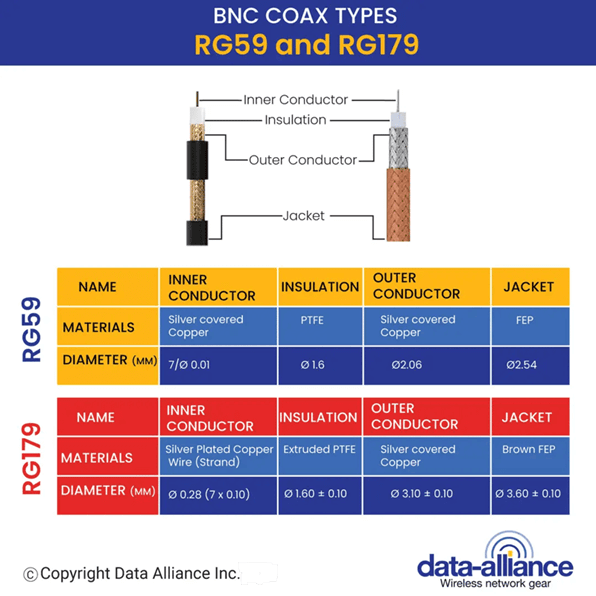
RG179 also has a 75 Ohm impedance but is a thinner, single-shielded cable with a 7-stranded center conductor and an overall diameter of approximately 2.8 mm (0.11 inches). It is far more flexible with a smaller bend radius, making it ideal for compact routing applications and tight installations.
RG179 patch cables support frequencies up to 3 GHz but exhibit higher attenuation than RG59. At 1000 MHz, RG179 attenuation is significantly higher than RG59, making RG59 the better choice for longer CCTV and analog video cable runs.
50 Ohm vs 75 Ohm Coax Cable
The primary difference between 50 Ohm and 75 Ohm coax cable relates to intended application and electrical performance characteristics.
50 Ohm coaxial cable is generally preferred for RF transmission and wireless communications because it provides a balance between power handling capability and signal loss. It is commonly used for antennas, wireless systems, cellular amplifiers, WiFi equipment, IoT devices, and radio communications.
75 Ohm coaxial cable is optimized for lower attenuation and is commonly used for video transmission, broadcast applications, CCTV systems, and cable television infrastructure.
The widespread use of 75 Ohm coaxial cable in homes and businesses as a legacy of audiovisual and surveillance installations means it continues to be widely used, especially for shorter cable runs where reliable performance can be maintained.
RG59 is a type of coaxial cable with a characteristic impedance of 75 Ohm. RG stands for “Radio Guide,” a legacy designation retained since the 1940s. The cable number itself is not directly associated with the cable diameter or the original military specification. Materials and construction can vary slightly between manufacturers, but RG59 typically has an overall diameter of approximately 6.15 mm.
Physical characteristics of RG 59
RG 59 is comprised of:
- A solid inner conductor that is 0.22 inches (0.56 millimeters) in diameter and made from copper-clad steel (CCS).
- A solid polyethylene (PE) or gas injected foam fluorinated ethylene propylene (FEP) dielectric of 0.146 inches (3.71 millimeters).
- A single outer shielding layer of tinned copper braid with a diameter of 0.165 inches (4.19mm). Coverage can range between 60 and 90 percent depending on the manufacturer.
- A black PVC jacket outer layer of 0.242 inches (6.15 millimeters).
Versions of this cable can vary in flexibility but the bend radius of RG 59 is typically 2 inches (50 millimeters) unless otherwise specified. It is suitable for both indoor and outdoor use with an operating temperature range of -25 to +70 degrees Celsius (-13 to 158 degrees Fahrenheit).
Electrical characteristics of RG 59

- Impedance: 75 Ohm
- Frequency Range: DC to 1 GHz
- Capacitance: 20.4 pF/ft / 66.93 pF/m
- Velocity of Propagation (Vp): 66 percent
- Operating Voltage: 2300 Volts max.
- Attenuation of RG 59
- At 100 MHz the attenuation is 3.81 dB per 100 foot
- At 200 MHz the attenuation is 5.37 dB per 100 foot
- At 550 MHz the attenuation is 9.18 dB per 100 foot
- At 800 MHz the attenuation is 11.21 dB per 100 foot
- At 1000 MHz the attenuation is 12.68 dB per 100 foot
RG59 vs RG6
Compared with RG59, RG6 cable generally offers:
- Lower attenuation
- Improved shielding effectiveness
- Better high-frequency performance
- Longer recommended cable runs
RG59 remains popular for shorter-distance CCTV and analog video installations because of its flexibility, smaller diameter, and lower cost.
The BNC connector
BNC stands for Bayonet Neil-Concelman and is a miniature RF connector available in both 50 Ohm and 75 Ohm versions. Developed in the late 1940s, the BNC connector is known for its quick-connect bayonet locking system, allowing fast connection and disconnection while maintaining reliable RF performance.
BNC connectors are commonly used in CCTV systems, analog video equipment, test equipment, broadcast video systems, and certain RF applications.
Physical features of the BNC connector
The male BNC connector has an overall diameter of 0.570 inches (0.145 millimeters). It is typically made of brass with a nickel finish. It is larger than the female connector and carries the bayonet lock into which the female twin lugs are inserted and secured with a quarter turn. The male connector is a conducting pin made from gold or silver-plated brass. The pin is surrounded by a Teflon or Delrin insulator The female conductor is also made from nickel-plated machined brass with two lugs on its outer body. The female center receptacle is made from phosphor bronze with a PTFE dielectric. There may be a slight difference in dimensions between the 50 and 75 Ohm BNC connectors with the 75 Ohm connector having less dielectric material.
Electrical specifications of the 75 Ohm BNC connector
- The frequency range of the 75 Ohm BNC connector is DC up to a maximum of 2 GHz.
- Its working voltage is 500 Volts.
- The Voltage Standing Wave Ratio (VSWR) at 1 GHz is 1.05.
The BNC connector can be used for twist-on, crimp-on, and compression assembly with RG 59 cable. RG 59 coax jumper cables or RG 59 patch cables can be purchased pre-assembled.
BNC Connector Styles
BNC connectors are available in several attachment styles including:
- Crimp-on BNC connectors
- Compression BNC connectors
- Twist-on BNC connectors
- Right-angle BNC connectors
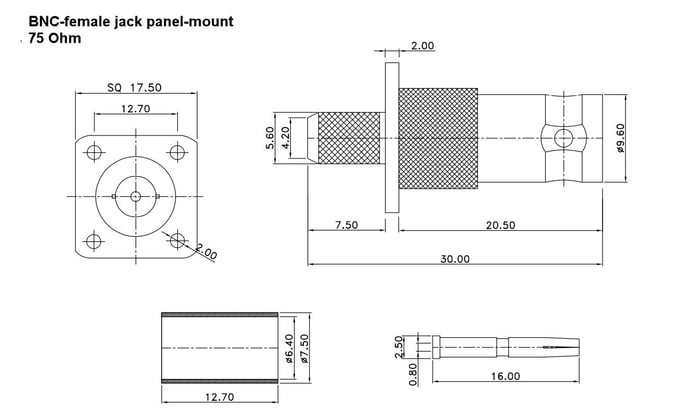
- Bulkhead BNC connectors
Compression and crimp-style connectors are generally preferred for professional CCTV and surveillance installations because they provide improved shielding integrity and mechanical reliability.
Installation Best Practices
For best performance with RG59 CCTV cable installations:
- Minimize cable run length whenever possible
- Avoid excessively tight bend radii
- Use weatherproof connectors for outdoor installations
- Separate video cabling from high-voltage power lines
- Use properly matched 75 Ohm connectors and equipment
- Test cable continuity and signal quality after installation
Common RG59 CCTV Issues
Common issues in RG59 CCTV systems include:
- Video signal loss from excessive cable length
- Interference caused by poor shielding or grounding
- Loose BNC connector terminations
- Impedance mismatches between equipment
- Moisture intrusion in outdoor connectors
- Power loss in Siamese cable installations
Proper connector installation and use of quality cable assemblies can significantly improve long-term system reliability.
Conclusion
RG59 coax cable assemblies terminated with BNC connectors continue to provide a reliable and cost-effective solution for CCTV, analog video, and surveillance applications. Their 75 Ohm impedance, ease of installation, flexibility, and broad compatibility with existing video infrastructure make them practical for many short-to-medium distance video transmission systems.
While newer cable types such as RG6 are preferred for higher-frequency and long-distance applications, RG59 remains widely used in security, broadcast, industrial monitoring, and HD-over-coax surveillance environments where dependable analog video performance is required.
Data Alliance provides RG59 coaxial cable assemblies, BNC patch cables, adapters, and custom RF cable solutions for surveillance, broadcast video, industrial monitoring, and wireless infrastructure applications.
FAQs
What is RG 59 cable commonly used for?
RG 59 cable is most commonly used for analog video applications, especially CCTV systems operating at 75 Ohms. It is also found in legacy cable TV installations and is occasionally used for short satellite TV runs, although RG 6 is preferred for modern digital systems.
Is RG 59 suitable for modern digital or high-frequency signals?
No. RG 59 is designed for low-bandwidth, low-frequency applications and performs best below 1 GHz. It does not provide the signal integrity required for modern digital cable TV or long-distance, high-frequency transmission.
What is RG 59 Siamese cable and when is it used?
RG 59 Siamese cable combines RG 59 coaxial cable with paired 18-gauge power wires in a single jacket. It is commonly used in CCTV installations, allowing both video and power to be run together, reducing installation time and cost.
How does RG 59 compare to RG 179 cable?
Both cables have a 75 Ohm impedance, but RG 179 is thinner and more flexible, making it ideal for tight or compact installations. However, RG 179 has significantly higher attenuation than RG 59, making RG 59 better suited for longer runs at lower frequencies.
What is the difference between 50 Ohm and 75 Ohm coaxial cable?
50 Ohm cable supports higher power handling and higher frequencies, making it ideal for antennas and wireless data applications.
75 Ohm cable, such as RG 59, is optimized for video and audiovisual signals and remains widely used due to existing infrastructure and cost effectiveness for short runs.
Why are BNC connectors used with RG 59 cable?
BNC connectors provide a secure, quick-connect bayonet coupling and are well matched to 75 Ohm video applications. They support frequencies up to 2 GHz, offer low VSWR, and are designed for frequent mating, making them ideal for CCTV and broadcast video connections.