


Antennas, Antenna Cables, Wireless Products: Technical Articles
LMR-300 and LMR-600 Coax: Specifications, Signal Loss & When to Use Them
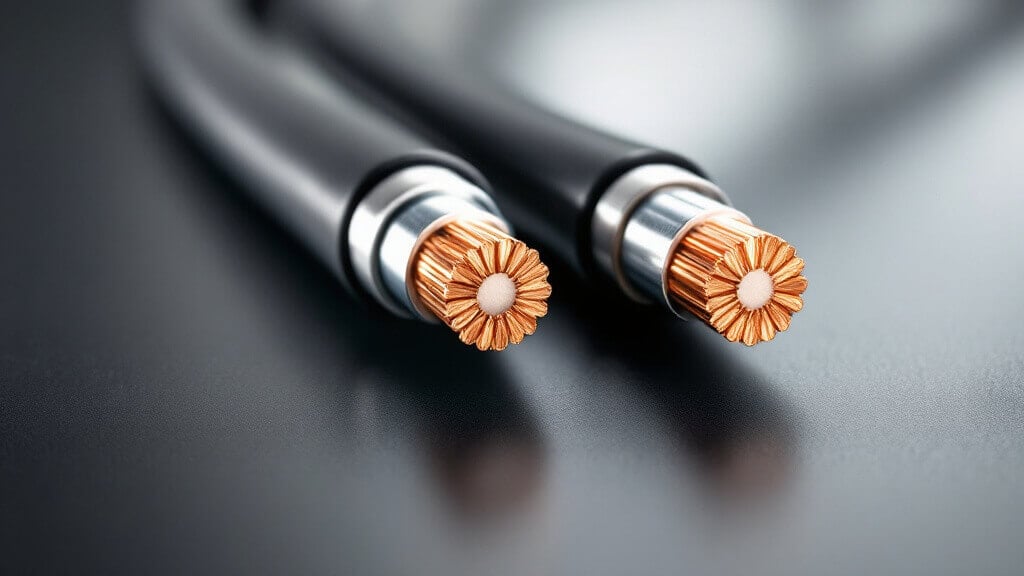
LMR-300 and LMR-600 are the less-common, larger-diameter members of the LMR low-loss coax family. LMR-300 slots in between LMR-240 and LMR-400, while LMR-600 sits above LMR-400 with meaningfully lower attenuation — making it a feeder-grade cable for long runs and higher-power links. Both are 50-ohm cables built to the same construction philosophy as the rest of the LMR line: a solid or stranded copper center conductor, foam-PE dielectric, an aluminum-tape-plus-tinned-copper-braid shield, and a UV-resistant jacket.
Data Alliance manufactures cable assemblies with LMR-300-equivalent and LMR-600-equivalent coax by special order. These two coax types are not stock items, but we regularly build custom assemblies with them — terminated with the connectors, lengths, and weatherproofing your install requires — for established customers. If you need an LMR-300-equivalent or LMR-600-equivalent assembly, request a custom quote or contact our technical support team with your connector, length, and frequency requirements.
Where LMR-300 and LMR-600 fit in the LMR family
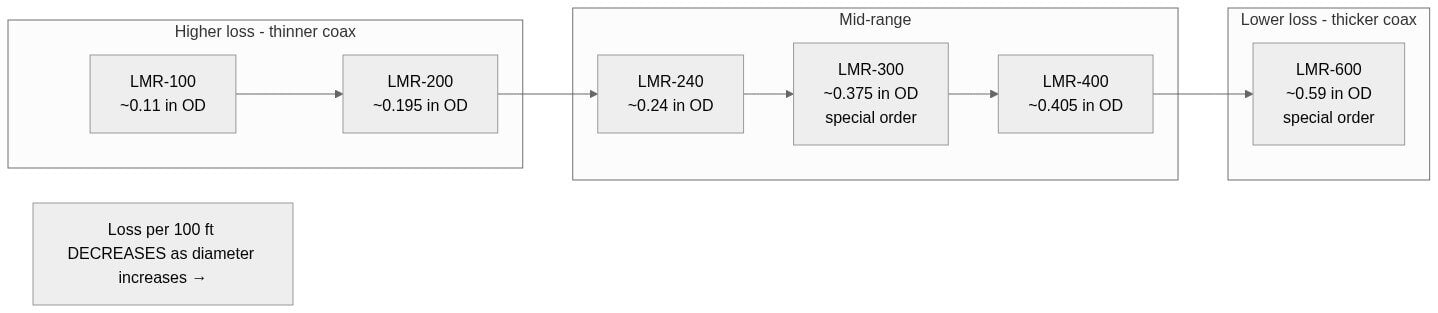
Within any coax family, loss per foot falls as cable diameter rises — a larger center conductor and more dielectric mean less resistive and dielectric loss at a given frequency. That trade-off is the whole reason these larger sizes exist: you accept a stiffer, heavier, more expensive cable to buy back signal over distance. The diagram below places LMR-300 and LMR-600 relative to the sizes covered in our comparison of LMR-100, LMR-200 and LMR-400 coax.
LMR-300 and LMR-600 specifications at a glance
The table below summarizes typical published specifications for standard LMR-300 and LMR-600, with LMR-400 shown for reference. Treat all figures as typical values — always verify against the current manufacturer datasheet (e.g. Times Microwave) for the exact cable you are buying, as construction and ratings vary between the genuine LMR product and equivalent alternatives.
| Specification | LMR-300 | LMR-400 (reference) | LMR-600 |
|---|---|---|---|
| Impedance | 50 Ω | 50 Ω | 50 Ω |
| Overall diameter | ~0.300 in (7.6 mm) | ~0.405 in (10.3 mm) | ~0.590 in (15.0 mm) |
| Center conductor | Solid bare copper-clad aluminum | Solid bare copper-clad aluminum | Solid bare copper-clad aluminum |
| Dielectric | Foam polyethylene | Foam polyethylene | Foam polyethylene |
| Shielding | Aluminum tape + tinned copper braid | Aluminum tape + tinned copper braid | Aluminum tape + tinned copper braid |
| Velocity of propagation | ~82% | ~85% | ~87% |
| Min. bend radius (installation) | ~0.75 in | ~1.0 in | ~1.5 in |
| Relative loss | Between LMR-240 and LMR-400 | Baseline | Lower than LMR-400 |
Note the practical consequences of diameter: LMR-600's larger minimum bend radius and greater weight make it a feeder/backbone cable, not something you route inside an enclosure or around tight corners. For the mechanics of routing thicker coax without kinking it, see our guide to the bend radius of LMR coaxial cable types.
Signal loss (attenuation) of LMR-300 and LMR-600
Attenuation is the headline reason to step up to these larger cables. The values below are typical published attenuation per 100 ft and are provided for planning context only — confirm the exact figures on the manufacturer's datasheet for your build and frequency before committing to a link budget.
| Frequency | LMR-300 (typical dB/100 ft) | LMR-400 (typical dB/100 ft) | LMR-600 (typical dB/100 ft) |
|---|---|---|---|
| 150 MHz | ~3.3 | ~2.7 | ~1.7 |
| 450 MHz | ~5.8 | ~4.8 | ~3.1 |
| 900 MHz | ~8.4 | ~6.8 | ~4.4 |
| 1800 MHz | ~12.2 | ~9.9 | ~6.3 |
| 2400 MHz | ~14.3 | ~11.6 | ~7.3 |
The takeaway: at 2.4 GHz, LMR-600 delivers roughly a third less loss than LMR-400 over the same run, and LMR-300 sits modestly above LMR-400. Over a short jumper the difference is negligible; over a 75–150 ft feeder to a rooftop or tower-mounted antenna, it can be the difference between a workable link and one starved of signal. If you are building a link budget, our antenna cable selection guide walks through how to weigh loss per foot against length and connector choice.
When to choose LMR-300
LMR-300 is a middle-ground cable. Reach for it when:
- LMR-240 is too lossy but LMR-400 is too stiff or bulky for the routing you have. LMR-300 buys back loss over LMR-240 while remaining more manageable than LMR-400.
- You need a medium-length run (roughly 20–75 ft) where the extra diameter of LMR-400 is not justified but a thin cable would eat too much signal.
- Connector availability and assembly cost matter — LMR-300 is less common than LMR-400, which is exactly why it is a special-order build rather than a stock item.
When to choose LMR-600
LMR-600 is a feeder/backbone cable. It makes sense when:
- The run is long — think 75 ft and beyond to a rooftop, tower, or mast-mounted antenna, where every dB of saved loss improves the link.
- You are pushing higher transmit power or need maximum receive sensitivity, and cannot afford the loss LMR-400 would introduce.
- The path is fixed and gently routed — LMR-600's larger bend radius and weight suit permanent, well-supported cable trays and mast runs, not tight indoor routing.
Because LMR-600 is heavy and stiff, connector termination and strain relief matter more than with thinner coax. Whether an assembly is crimped or soldered, and how the shield is handled, has a direct effect on VSWR and long-term reliability on an outdoor feeder.
Getting LMR-300 and LMR-600 cable assemblies from Data Alliance
Data Alliance stocks and custom-manufactures antenna cables across the common LMR sizes, and builds LMR-300 and LMR-600 assemblies by special order — cut to length and terminated with N-type, SMA, TNC, or the connectors your equipment requires, with appropriate weatherproofing for outdoor runs. Same-day shipping applies to in-stock orders placed before 4 pm MST; special-order assemblies are quoted individually.
To get started, browse our antenna cables & adapters or contact technical support with your coax type, connectors, length, and operating frequency, and we will quote the build.
Frequently asked questions about LMR-300 and LMR-600 coax
Is LMR-600 better than LMR-400?
For lowering signal loss over distance, yes — LMR-600 has noticeably lower attenuation per 100 ft than LMR-400 at the same frequency, roughly a third less at 2.4 GHz. The trade-offs are that LMR-600 is larger in diameter, heavier, stiffer (larger bend radius), and more expensive, so it is best reserved for long feeder runs rather than short jumpers or tight routing.
What is LMR-300 used for?
LMR-300 is a middle-ground low-loss coax used for medium-length runs where LMR-240 is too lossy but the size and stiffness of LMR-400 are not warranted. It is a less common size, typically supplied as a custom/special-order cable assembly rather than a stock item.
Are LMR-300 and LMR-600 50-ohm cables?
Yes. Both are 50-ohm coaxial cables, consistent with the rest of the LMR low-loss family and with the wireless, cellular, and RF systems they are used in. Always confirm impedance and construction on the datasheet for the specific cable you order.
Does Data Alliance sell LMR-300 and LMR-600 cables?
Yes — as special-order custom cable assemblies. These coax types are not stock items, but Data Alliance regularly builds LMR-300 and LMR-600 assemblies terminated with the connectors, length, and weatherproofing a project needs. Request a custom quote with your requirements to get pricing.
What connectors work with LMR-300 and LMR-600?
Because both are larger-diameter coax intended for outdoor and feeder use, N-type is the most common termination, though other connectors can be specified. The connector must be rated for the cable's diameter and for the operating frequency; verify connector-to-coax compatibility when ordering a custom assembly.