


Antennas, Antenna Cables, Wireless Products: Technical Articles
LoRa Antenna Guide: Frequency, dBi Gain, Connectors & How to Choose
A LoRa antenna is a sub-GHz antenna tuned to the unlicensed ISM band your LoRaWAN network runs on — most commonly 902–928 MHz (centered near 915 MHz) in North America and 863–870 MHz (868 MHz) in Europe. Because LoRa trades data rate for range and link budget, the antenna you bolt onto a node or gateway has an outsized effect on how far the link reaches. This guide covers the frequency you must match, what dBi gain realistically buys you, how to choose between omnidirectional and directional types, which connectors you will meet, and how cable loss eats into your budget — so you can match the antenna to the site rather than guessing.
Match the LoRa antenna to your frequency band first
The single most important spec on a LoRa antenna is the frequency band. LoRa uses regional sub-GHz ISM bands, and an antenna tuned to the wrong band will present a poor impedance match, high VSWR, and wasted transmit power. Confirm your regional plan before anything else:
- North America (US915): 902–928 MHz — antennas are usually specified as "915 MHz" or "902–928 MHz". This is the same band GSM/ISM gear uses in the US.
- Europe (EU868): 863–870 MHz — antennas specified as "868 MHz".
- Asia (AS923) and others: around 920–925 MHz depending on country; 433 MHz is also used in some regions.
Many broadband sub-GHz antennas are specified across a wide range such as 860–960 MHz, which covers both 868 and 915 MHz — convenient for stocking one antenna across regions. Verify the exact frequency range and the rated VSWR (aim for ≤ 1.9 across your band) on the product page rather than trusting the marketing label. If you need the underlying band detail, our LoRa frequency bands guide breaks down 915, 868 and 433 MHz allocations region by region.
How a LoRa antenna fits in the link
Before picking gain or type, it helps to see where the antenna sits in the chain — and that the same choice applies whether you are equipping an end node or a gateway.
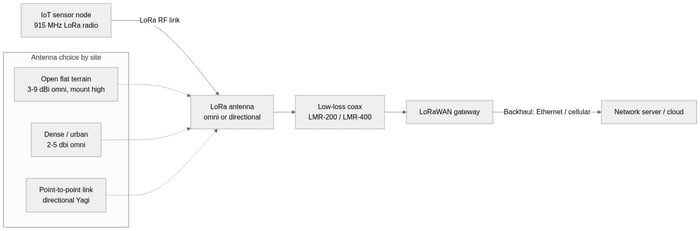
Omnidirectional vs directional LoRa antennas
LoRa antennas come in two broad families. The right one depends on whether you need coverage in all directions or a focused link to one point.
Omnidirectional (dipole, fiberglass collinear)
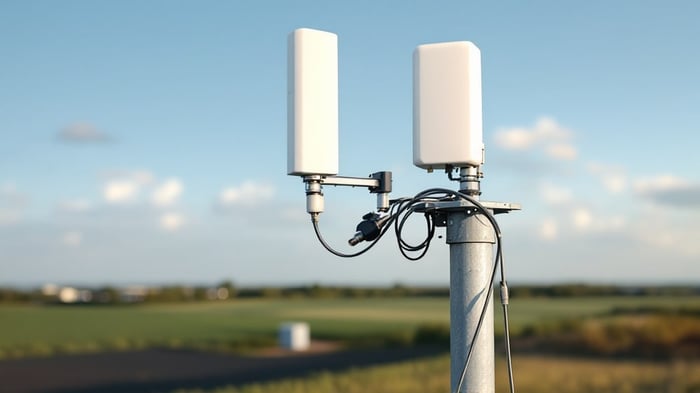
Omnidirectional antennas radiate 360° in the horizontal plane and are the default for gateways serving nodes spread in every direction. Short rubber-duck dipoles suit indoor gateways and nodes; tall fiberglass collinear antennas are the workhorse for outdoor, pole-mounted gateways because they raise gain and survive weather. Fiberglass radomes are UV- and corrosion-resistant and hold their shape far longer than plain plastic.
Directional (Yagi, panel)
Directional antennas concentrate energy into a beam for a single heading. A LoRa Yagi antenna is the choice for a fixed point-to-point link — for example, connecting a remote node cluster back to a distant gateway, or reaching over a single large obstruction. You gain range and reject off-axis interference, but you must aim it, and it only "sees" what it is pointed at.
What LoRa antenna gain actually buys you
Gain (in dBi) does not create power — it reshapes the radiation pattern, trading vertical coverage for horizontal reach. Higher gain on an omni flattens the pattern into a thinner "disk," which is great over flat, open terrain but can shoot straight over nearby nodes if the antenna is mounted very high. Use this as a starting point and verify against your own link:
| Antenna | Typical gain | Pattern | Best-fit site |
|---|---|---|---|
| Rubber-duck / dipole | 2–3 dBi | Omni | Indoor gateways, nodes, dense urban |
| Fiberglass collinear (short) | 5–6 dBi | Omni | Suburban / mixed terrain gateways |
| Fiberglass collinear (tall) | 8–9 dBi | Omni (flat disk) | Open, flat, rural — mount at height |
| Yagi (directional) | 10–13 dBi | Directional beam | Point-to-point / point-to-multipoint links |
Verify before you commit to high gain. Effective radiated power is regulated by the FCC; a high-gain antenna combined with full transmit power can exceed the legal EIRP limit for the band, so confirm your gateway's transmit settings and local rules. The exact dBi, VSWR and beamwidth vary by model — treat the table as guidance and read the datasheet for the antenna you actually buy.
Connectors: match the gender and polarity
LoRa gear uses a small set of RF connectors, and the type usually tracks whether the equipment is indoor or outdoor:
- N-type (usually N-female on the antenna): the standard on outdoor gateways and fiberglass antennas. Nickel-plated, weatherproof, rated to ~11 GHz — far more than LoRa needs — and the most durable choice for exposed installs.
- RP-SMA: common on North American indoor hotspots and miners. Note the reverse-polarity trap — an RP-SMA male carries a socket, not a pin, and will not mate correctly with a standard SMA.
- SMA: common on European (868 MHz) indoor gateways and many modules.
- U.FL / MHF4: tiny board-level connectors on LoRa modules and mini-PCIe cards; you pigtail up to N, SMA or RP-SMA to reach an external antenna.
SMA and RP-SMA look almost identical but are not interchangeable — always confirm both the connector type and the gender on the gateway and the antenna before ordering, and use an adapter cable if they differ. For the full breakdown of frequency limits, impedance and gender for every connector family, see our antenna connector types guide.
Cable loss: keep the run short and low-loss
Every foot of coax between the antenna and the radio costs you signal, and at LoRa frequencies (860–960 MHz) that loss adds up fast. LoRa links are already low-power and long-range, so protect the budget:
- Keep the cable run as short as physically possible — bring the gateway close to the antenna, not the other way round.
- Use double-shielded, low-loss coax. LMR-200-equivalent is a good general choice; LMR-400-equivalent is preferred for longer outdoor runs because of its markedly lower attenuation per foot.
- Avoid stacking adapters — every mated junction is another small loss and another potential point of intrusion for moisture.
- Weatherproof outdoor connectors with self-amalgamating coax-seal tape and, for gold-plated brass connectors, dielectric grease.
Thin, single-shielded cable like RG-174 has much higher loss per foot than LMR-grade coax at 900 MHz — fine for a short indoor pigtail, poor for an outdoor run. For a side-by-side of shielding and signal loss between common coax grades, see how RG-58 compares to LMR-200 and LMR-100.
Choosing a LoRa antenna by site
Put it together and the decision usually resolves to three cases:
- Open, flat, rural: tall fiberglass omni (8–9 dBi), mounted high on a pole with a short LMR-400 run and an N-type connection.
- Dense or urban: a lower-gain omni (2–5 dBi) that keeps a fuller vertical pattern so you still reach nodes at different elevations rather than overshooting them.
- Fixed point-to-point link: a directional Yagi at both ends, carefully aimed, to maximize range and reject interference.
LoRa is one of several long-range, low-power IoT options — if you are still weighing protocols, our comparison of the top six industrial IoT wireless technologies puts LoRaWAN alongside NB-IoT, Zigbee and cellular, and our look at Wi-Fi HaLow versus LoRa and NB-IoT covers the sub-GHz alternatives. If you already know LoRaWAN is your platform, the gateway side is covered in our LoRaWAN gateways guide.
Ready to spec an antenna? Browse Data Alliance's LoRa / LoRaWAN antennas in 915 MHz and 868 MHz, from compact dipoles to high-gain fiberglass and Yagi models, and pair them with double-shielded antenna cables and adapters cut to length. Not sure which gain or connector fits your gateway? Contact our technical support or request a custom quote — antennas and cables ship same day on orders placed before 4pm MST.
Frequently asked questions
What frequency should a LoRa antenna be?
Match the antenna to your regional LoRaWAN plan: 902–928 MHz (near 915 MHz) in North America, 863–870 MHz (868 MHz) in Europe. Broadband antennas rated 860–960 MHz cover both. An antenna tuned to the wrong band will show high VSWR and waste transmit power.
How much gain does a LoRa antenna need?
It depends on the site. 2–3 dBi suits indoor and dense urban use; 5–6 dBi is a good all-round outdoor choice; 8–9 dBi extends range over open, flat terrain when mounted high. Very high gain flattens the vertical pattern and can overshoot nearby nodes, and it must stay within the FCC EIRP limit for the band — verify your gateway's transmit power.
Omnidirectional or directional (Yagi) LoRa antenna — which is better?
Use an omnidirectional antenna for a gateway serving nodes in all directions. Use a directional Yagi for a fixed point-to-point link where you can aim it at the far end — it adds range and rejects off-axis interference but only covers the direction it points.
What connector do LoRa antennas use?
Outdoor gateways and fiberglass antennas typically use weatherproof N-type. Indoor hotspots use RP-SMA (North America) or SMA (Europe). Modules use tiny U.FL or MHF4 board connectors that pigtail up to a larger connector. Confirm both the type and gender before ordering — SMA and RP-SMA are not interchangeable.
Does cable length matter for a LoRa antenna?
Yes. Coax loss at 900 MHz is significant, so keep runs short and use double-shielded low-loss cable — LMR-200-equivalent for general use, LMR-400-equivalent for longer outdoor runs. Every extra adapter or foot of thin cable subtracts from an already tight link budget.