



Antennas, Antenna Cables, Wireless Products: Technical Articles
LMR-200 Cable Specifications Compared to LMR-100
Table of Contents
- Overview of LMR-200 Coaxial Cable
- Lower Signal Loss (Attenuation)
- Flexible Cable Design
- Typical Applications for LMR-200 Cable
- LMR-200 Cable Construction
- LMR-200 Compared to Standard RG Coaxial Cable
- LMR-200 vs LMR-100 Cable Comparison
- Comparison of CLF-100 & CLF-200 in cables between 5-10 feet
- Cost vs Performance Consideration
- Data Alliance Antenna Cable Options
- LMR-100 Compared to RG-316
- Summary
- FAQs
Overview of LMR-200 Coaxial Cable
LMR-200 coax cable is a low-loss 50-ohm radio frequency (RF) cable commonly used in wireless antenna systems, IoT networks, WiFi installations, cellular systems, and other RF applications. Compared with standard coaxial cables such as RG-58, LMR-200 offers lower signal attenuation, improved shielding, and better overall RF performance.
One of the key advantages of LMR-200 is its double-shielded design, which significantly reduces signal loss and electromagnetic interference (EMI). This construction provides improved signal integrity compared to many traditional coaxial cable standards.
LMR-200 is also frequently compared to LMR-100 cable, which is thinner and used in shorter antenna cables. While both cables are suitable for RF applications, LMR-200 generally provides better performance due to its larger diameter and lower attenuation.
At Data Alliance, LMR-200 is widely used in our antenna extension cables, RF adapters, and wireless antenna assemblies designed for IoT devices, routers, gateways, and industrial wireless equipment.
Key Advantages of LMR-200 Cable
LMR-200 provides several advantages over smaller coaxial cables:
Lower Signal Loss (Attenuation)
Signal attenuation occurs whenever RF signals travel through coaxial cable. The longer the cable, the greater the loss. LMR-200 reduces this loss due to its larger diameter conductor and improved shielding design.
For example:
- LMR-200 attenuation at 2.4 GHz:
0.30 dB per foot (0.98 dB per meter)
This lower attenuation helps preserve antenna gain and maintain stronger wireless signals over longer cable runs.
Double Shielding
LMR-200 uses two shielding layers:
- Aluminum foil shield
- Tinned copper braid
This dual-shield construction improves:
- EMI protection
- Signal stability
- RF leakage reduction
The result is cleaner signal transmission, which is especially important in environments with multiple wireless devices or electrical noise.
Flexible Cable Design
Despite its improved performance, LMR-200 remains flexible and easy to route. It is similar in flexibility to RG-58 cable while offering much better electrical performance.
This flexibility makes it ideal for:
- Router antenna extensions
- IoT device antenna cables
- Wireless access point installations
- RF test setups
- Industrial wireless equipment
Indoor and Outdoor Compatibility
LMR-200 cables are typically rated for both indoor and outdoor use and are designed to withstand temperature variations.
Typical temperature rating:
−40°C to +85°C
This allows LMR-200 cables to perform reliably in environments such as:
- Outdoor wireless antenna installations
- Industrial IoT environments
- Commercial networking installations
- Remote monitoring systems
Typical Applications for LMR-200 Cable
LMR-200 coaxial cable is widely used in RF applications across many frequency ranges. It performs well in systems operating between 0 GHz and 18 GHz, making it suitable for a broad range of wireless technologies.
Common applications include:
WiFi Networks
LMR-200 cables are frequently used with Wi-Fi antennas for standards such as:
Typical WiFi frequencies include:
Because of its low loss, LMR-200 helps maintain stronger signals between routers and external antennas.
IoT and Wireless Sensor Networks
Many Internet of Things devices use external antennas connected with coaxial cable. LMR-200 is commonly used in IoT systems operating at:
These systems include:
- industrial monitoring sensors
- agricultural IoT devices
- smart infrastructure
- wireless gateways
- remote data collection systems
Cellular and LTE Applications
LMR-200 is also used in some cellular antenna applications such as:
- LTE routers
- cellular modems
- signal boosters
- M2M communication systems
RF Test Equipment
Because of its consistent impedance and shielding, LMR-200 can also be used in:
- RF testing environments
- laboratory equipment
- antenna testing setups
LMR-200 Cable Construction
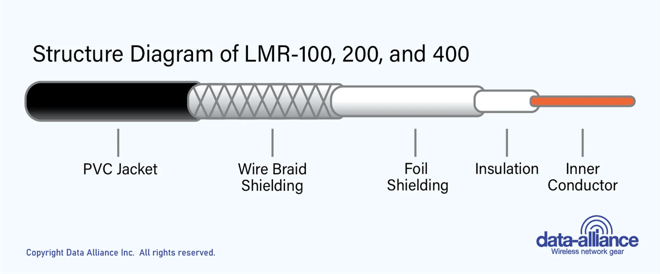
LMR-200 coaxial cable uses a layered construction designed to maintain signal quality and durability.
Component | Material | Diameter |
Inner Conductor | Solid Copper | 1.12 mm |
Dielectric | Foamed Polyethylene (PE) | 2.95 mm |
Shielding | Aluminum Foil + Tinned Copper Braid | 3.66 mm |
Cable Jacket | PVC | 4.95 mm |
Key characteristics:
- 50-ohm Impedance
- low-loss dielectric
- double shielding
- flexible PVC jacket
The foam dielectric helps reduce capacitance while maintaining signal propagation efficiency.
LMR-200 Compared to Standard RG Coaxial Cable
LMR-200 is often compared to common coaxial cable types such as RG-58.
Although RG-58 has been widely used for many years, LMR-200 provides several performance improvements:
Feature | RG-58 | LMR-200 |
Shielding | Single | Double |
Signal Loss | Higher | Lower |
Diameter | Similar | Similar |
Flexibility | Good | Good |
EMI Protection | Moderate | Higher |
The double shielding and improved materials allow LMR-200 to achieve lower attenuation while maintaining flexibility similar to RG-58.
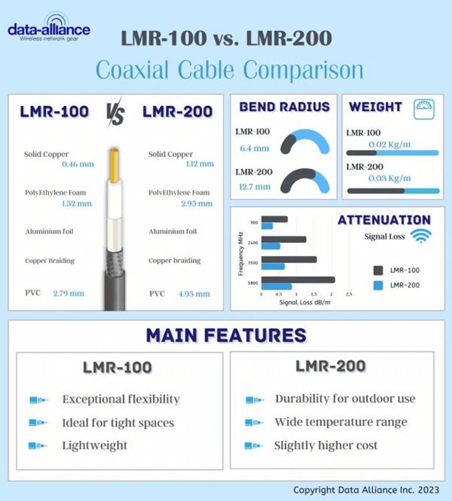
LMR-200 vs LMR-100 Cable Comparison
LMR-100 is another cable type used in many antenna cables, particularly when space is limited or shorter cable lengths are required.
While LMR-100 cables are thinner and more flexible, LMR-200 offers lower signal loss due to its larger size.
Attenuation Comparison
Example attenuation values:
CLF-100 coax (similar to LMR-100):
- 0.39 dB per foot
- Over 6 feet: 2.34 dB signal loss
CLF-200 coax (similar to LMR-200):
- 0.30 dB per foot
- Over 6 feet: 1.80 dB signal loss
Difference:
0.54 dB less signal loss with CLF-200 / LMR-200 cable.
Although this difference may seem small, RF systems are very sensitive to signal loss.
Why Small dB Differences Matter
In wireless systems, even small improvements in signal strength can significantly affect performance.
Example:
- 3.0 dB net antenna gain = 2× power increase
- 3.5 dB net antenna gain = 2.6× power increase
In this example, a 0.5 dB improvement results in approximately a 25% power increase.
This illustrates why choosing a lower-loss cable like LMR-200 can meaningfully improve the overall performance of an antenna system.
Comparison of CLF-100 & CLF-200 in cables between 5-10 feet
Six feet is not too long for the LMR-100-equivalent cable that we use for shorter antenna cables. However, it is right at the threshold at which we would recommend that you consider the thicker cable. This comparison shows that the expenditure for the thicker cable, which is about 25% higher cost, is proportional to the benefit of lesser signal loss (attenuation). If you are using small antennas you may need as much gain as possible retained during passage through the cable and it would make good sense to pay the additional 25% for the 200-thickness cable:
- CLF-100 coax (quality similar to LMR-100, but better): Attenuation (signal loss) is 0.39dB per foot: Over six feet, you would lose 2.34dB CLF-200 (quality similar to LMR-200, but better): Attenuation (signal loss) is 0.30dB per foot: Over six feet, you would lose 1.80dB
- The difference is 0.54dB. You may know that addition of an antenna multiplies the power of the WiFi device, such that even a difference of 0.54dB makes a big difference:
- 3.0dB net antenna gain (after cable loss) = 2.0X power increase for WiFi device
- 3.5dB net antenna gain (after cable loss) = 2.6X power increase for WiFi device <- a 25% power increase coming from a 0.5dB net antenna gain in this example.
- For a six foot cable VS. ten foot cable, the difference in your cost between using 100 thickness cable VS. 200-thickness would be $1.25.
- Therefore your power increase would be roughly proportional to the difference in cost of the cable.
Cost vs Performance Consideration
When comparing cable options, cost differences are usually small compared to the performance benefit.
For example:
A 6-foot cable using LMR-200 instead of LMR-100 may cost about $1.25 more, yet provide measurable improvements in signal strength.
For small antennas or long cable runs, using the thicker cable can help retain more of the antenna's gain.
Recommended Connectors for LMR-200
LMR-200 cables can be terminated with a wide range of RF connectors commonly used in wireless systems.
Typical connectors include:
These connectors allow LMR-200 cables to be used with many types of wireless equipment, including:
- routers
- antennas
- modems
- gateways
- RF testing equipment
Data Alliance Antenna Cable Options
Data Alliance manufactures antenna cables using several high-quality coaxial cable types, including:
- LMR-100
- CLF-100
- LMR-200
- CLF-200
- LMR-400
All of these cables are double-shielded designs, which provide improved RF performance compared to many standard coaxial cables.
Our antenna cables are commonly used with:
- WiFi routers
- cellular modems
- IoT gateways
- wireless access points
industrial wireless systems
LMR-100 Compared to RG-316
LMR-100 cables are often compared with RG-316 coaxial cable, which is another thin cable type commonly used in RF applications.
LMR-100 typically provides:
- lower signal loss
- improved shielding
- better performance in WiFi and IoT applications
Because of this, LMR-100 is frequently used in shorter antenna cables where space and flexibility are important.
Summary
LMR-200 coaxial cable offers an excellent balance of low signal loss, flexibility, and durability, making it a strong choice for many wireless antenna systems.
Compared with thinner cables such as LMR-100, LMR-200 provides:
- lower attenuation
- improved signal retention
- better performance for longer cable runs
For applications involving WiFi, IoT devices, cellular systems, and RF equipment, selecting the appropriate cable type can significantly impact overall system performance.
Data Alliance provides a wide range of antenna cables and RF adapters built with LMR-series coaxial cables to support reliable wireless connectivity across many industries.
FAQs
What is LMR-200 coaxial cable used for?
LMR-200 coaxial cable is a low-loss 50-ohm RF cable commonly used in wireless antenna systems such as WiFi networks, IoT devices, cellular systems, and RF test equipment. It is designed to carry radio frequency signals with lower attenuation and improved shielding compared with many standard coaxial cables like RG-58.
LMR-200 is often used for antenna extension cables, router antennas, LTE modems, wireless gateways, and industrial IoT equipment where maintaining signal strength between the radio device and the antenna is important.
What is the difference between LMR-200 and LMR-100 coaxial cable?
The main difference between LMR-200 and LMR-100 is cable diameter and signal loss.
LMR-200 is thicker and provides lower attenuation, which means less signal loss over distance. LMR-100 is thinner and more flexible, making it useful for shorter antenna cables or tight installations.
In general:
- LMR-100: better for short cables and compact devices
- LMR-200: better for longer cables and higher signal retention
For example, LMR-200 may reduce signal loss by about 0.5 dB over a 6-foot cable compared to LMR-100, which can improve overall antenna performance.
Why does lower cable attenuation matter in antenna systems?
Cable attenuation reduces the amount of RF signal that reaches the antenna or radio device. Even small losses can significantly affect wireless performance.
For example:
- 3 dB signal gain = approximately 2× power increase
- 3.5 dB signal gain = about 2.6× power increase
Because of this relationship, reducing cable loss by even 0.5 dB can noticeably improve signal strength in wireless systems such as WiFi, IoT networks, or cellular antennas.
Using a lower-loss cable like LMR-200 helps preserve antenna gain and maintain stronger signal transmission.
How flexible is LMR-200 cable compared to RG-58?
LMR-200 cable is similar in flexibility to RG-58 coaxial cable, making it easy to route through equipment racks, walls, and antenna installations.
However, LMR-200 typically provides better RF performance than RG-58 due to its:
- double shielding
- low-loss dielectric
- improved signal attenuation characteristics
This combination makes LMR-200 a popular upgrade over RG-58 for many wireless antenna installations.
What frequencies can LMR-200 coaxial cable support?
LMR-200 coaxial cable can support RF applications across a wide frequency range from approximately 0 GHz to 18 GHz.
This makes it suitable for many wireless technologies, including:
- 900 MHz ISM band
- 2.4 GHz WiFi
- 5 GHz WiFi
- cellular LTE frequencies
- IoT wireless networks
- RF testing and laboratory applications
Because of its low signal loss at higher frequencies, LMR-200 performs well in modern wireless systems.
What connectors are commonly used with LMR-200 cable?
LMR-200 cables can be terminated with a variety of standard RF connectors, depending on the type of wireless device or antenna.
Common connectors include:
- SMA
- RP-SMA
- BNC
- TNC
- N-type
- Mini-UHF
- PL-259 (UHF)
These connectors allow LMR-200 cables to be used with routers, antennas, cellular modems, gateways, and RF testing equipment.
When should I choose LMR-200 instead of LMR-100?
LMR-200 is typically recommended when:
- the antenna cable length is greater than about 6 feet
- you want to minimize signal loss
- the antenna system requires maximum performance
- the installation environment has RF interference
LMR-100 is often sufficient for short antenna cables or compact devices, but when cable length increases, LMR-200 helps preserve more of the antenna’s signal gain.
For many wireless installations, the small increase in cable cost is outweighed by improved signal performance.