



Antennas, Antenna Cables, Wireless Products: Technical Articles
GPS Antennas: Types, Characteristics & How to Choose | Data Alliance
Table of Contents
- What is a GPS antenna?
- Active vs. passive GPS antennas: how to choose
- Key physical and electrical characteristics of GPS / GNSS antennas
- Types of GPS antenna
- GPS frequency bands
- How GPS works
- GPS antenna applications
- GPS interference and limitations
- GNSS alternatives and multi-constellation use
- Choosing the right GPS antenna and cable: a quick checklist
- In conclusion
- FAQs
A GPS antenna is a right-hand circularly polarized (RHCP) radio-frequency antenna that receives the weak L-band signals broadcast by Global Positioning System satellites and feeds them to a GPS or GNSS receiver for positioning, navigation, and timing (PNT). Because the satellite signal arrives below the noise floor, the antenna's sensitivity, polarization, ground plane, and (for active types) its low-noise amplifier are what ultimately determine how fast and how accurately a device gets a fix.
We've supplied GPS and GNSS antenna cables, connectors, and mounts at Data Alliance since 2004, and the single most common mistake we see isn't the antenna choice at all — it's the cable run. Pairing a passive antenna with a long coax run, or putting the connector or LNA in the wrong place, will quietly cost you signal that no receiver setting can recover. This guide covers the physical and electrical characteristics that matter, the antenna types, and — in plain terms — how to choose the right combination for your application.
What is a GPS antenna?
A GPS antenna is an RF antenna designed to receive signals from the Global Positioning System (GPS), a satellite-based radio-navigation system developed and operated by the United States Government. Connected to a compatible GPS or GNSS receiver, the antenna captures the extremely weak satellite signals required for positioning, navigation, and timing.

The antenna must be sensitive enough, and have the resonant properties necessary, to detect the GPS signal broadcast by the satellite constellation. It often needs a Low Noise Amplifier (LNA) to lift that signal above the receiver's noise floor before it travels down the cable. The receiver's front end and software then extract timing and positional information through correlation techniques and display it as a location, route, or time reference. Receivers range from professional survey-grade and precision-timing units down to the Portable Navigation Devices (PNDs) in vehicles, smartphones, and wearables.
GPS vs. GNSS
GPS is one component of the broader category of Global Navigation Satellite Systems (GNSS). GPS refers specifically to the U.S. system, while GNSS also encompasses GLONASS (Russia), Galileo (EU), and BeiDou (China). Modern antennas and receivers frequently support multiple constellations to improve accuracy, availability, and reliability — which is why "GNSS antenna" and "GPS antenna" are often used interchangeably in product listings.
Active vs. passive GPS antennas: how to choose
For most buyers this is the decision that matters first, because it's driven by your cable length and where the antenna sits relative to the receiver.
| Factor | Passive GPS antenna | Active GPS antenna |
|---|---|---|
| Amplification | None — no LNA | Built-in LNA (typically ≥15 dB gain, noise figure <1 dB) |
| Power needed | No external power | Requires DC bias from the receiver or an auxiliary source |
| Cable length | Keep short — under ~1 m (3.3 ft) | Tolerates longer runs by overcoming feedline loss |
| Best for | Low-power embedded devices with the antenna close to the receiver | Automotive, industrial, IoT, obstructed locations, fast TTFF, high-sensitivity receivers |
Rule of thumb: choose an active antenna whenever the cable run exceeds about 1 meter, signal obstruction is present, you need a fast Time-To-First-Fix (TTFF), or you're feeding a high-sensitivity receiver. Choose a passive antenna only when the antenna can sit close to the receiver on a short run. When you do run an active antenna, mount the LNA — and therefore the antenna — as close to the sky-facing position as possible, and keep the connecting feedline short to limit signal loss. The right GPS antenna cable and connector pairing is as important to the result as the antenna itself.
Key physical and electrical characteristics of GPS / GNSS antennas
Because the signal from the satellite constellation is so weak, sound antenna design plays an outsized role in the final performance of a GPS-enabled device.
What a GPS antenna is made of
- Radiating element — determines bandwidth and how the antenna radiates and receives electromagnetic energy.
- Ground plane — influences the radiation pattern; especially critical for patch antennas.
- Amplifier (LNA) — present in active antennas to overcome feedline loss.
- Radome — encloses and protects the element and can influence the phase center. Phase center matters because the position a receiver reports refers to where the antenna actually captures the signal (the electrical phase center).
GPS antennas are typically high-efficiency, 50-ohm devices, making them well matched to commonly available coaxial cable transmission lines. The GPS signal is transmitted with right-hand circular polarization (RHCP), so GPS antennas are usually RHCP and omnidirectional, with a near-hemispherical radiation pattern that receives signal across the arc of the sky from zenith to horizon.
In the United States, the FCC regulates GPS receiver operation and amplification so devices don't interfere with adjacent radio services. GPS antennas themselves are passive receiving elements, but active antennas with LNAs must comply with strict limits on gain, noise, and emissions.

Antenna efficiency, VSWR, and positioning
GPS antennas are optimized for receiving efficiency — converting a high proportion of incoming RF energy into usable signal for the receiver front end. High efficiency improves sensitivity, limits noise-figure degradation, and shortens Time-To-First-Fix (TTFF). Voltage Standing Wave Ratio (VSWR), the measure of how efficiently energy transfers between the line and the antenna, should be as low as possible and is generally acceptable at 2:1 or below. See our primer on VSWR and impedance matching for the underlying theory.
Positioning and orientation should be optimized for clear sky visibility at all times. To achieve the fastest TTFF, the antenna needs to receive as many satellites as possible; poor visibility leads to positional drift and degraded accuracy, which makes antenna mounting a first-order design decision rather than an afterthought.
Key performance metrics
- Axial ratio — circular polarization purity (lower is better).
- Phase center stability — critical for surveying and precision timing.
- Noise figure (active antennas) — sets effective receiver sensitivity.
- Gain pattern — optimized for hemispherical sky coverage.
- Ground-plane dependence — especially important for patch antennas.
Types of GPS antenna
The main types differ in form factor, gain, and where they're used.
| Type | Description & typical use |
|---|---|
| Internal / integrated | Built into the device (usually a patch or quadrifilar element on a PCB). Optimized by positioning the whole device rather than the antenna alone. |
| External | A separate antenna connected to the receiver via GPS coaxial cable or an adapter. Larger and higher-gain; used when an internal antenna can't acquire signal. |
| Patch | A flat conductive element over a ground plane, fabricated on ceramic or PCB. Low profile; geometry sets resonance and bandwidth. Ground-plane dependent. |
| Helix | A wire coiled into a helix to save space; quad-helix designs use four helices to raise gain. |
| Active | Includes an LNA (typically ≥15 dB gain, <1 dB noise figure) close to the element to overcome feedline loss. Needs power; the LNA should only draw current when in use. |
| Passive | No amplifier, no external power. Must sit close to the receiver on a short cable run. |
| Reradiating | A paired donor/receiver antenna system linked by an extension cable — common in vehicles to relay outdoor signal to an indoor receiver. Powered. Note: GNSS repeaters are illegal in the UK outside licensed use. |
| GPS + LTE combo | GPS paired with LTE antennas, with the GPS input isolated from the cellular path. Combo antennas integrate this in one housing. |
| Parabolic / turnstile / radome | Specialized forms: parabolic for high-gain directional monitoring; turnstile (crossed dipoles) for circular polarization; radome-protected designs for harsh environments, with a hemispherical dome that passes the signal without shifting the phase center. |
GPS frequency bands
GPS signals are broadcast in the L-band at sub-2 GHz frequencies, which penetrate cloud, rain, fog, and vegetation well and do not require a directional beam antenna for reception. Modern GNSS antennas are often designed to receive L1, L2, and L5 simultaneously for higher accuracy, faster convergence, and improved multipath rejection.
| Band | Center frequency | Bandwidth | Primary use |
|---|---|---|---|
| L1 | 1575.42 MHz | 15.345 MHz | Primary civilian access; carries PRN, ephemeris, almanac data |
| L2 | 1227.60 MHz | 11 MHz | Dual-frequency use; combined with L1 for faster acquisition and extended range |
| L5 | 1176.45 MHz | 12.5 MHz | High-performance and "safety-of-life" applications such as aviation |
These frequencies are multiples of the satellite atomic clock's base L-band frequency (10.23 MHz). Dual-frequency receivers that combine L1 and L2 deliver faster signal acquisition, quick TTFF, and more reliable performance than single-band units.
How GPS works
A working constellation of 24 satellites occupies medium Earth orbit, arranged so that at least 4 are visible from anywhere on Earth. Each satellite circles the planet twice per day, traveling at over 8,000 mph (12,875 km/h), continually emitting a signal picked up by the receiver's antenna. That signal carries the satellite's position and the precise time from synchronized onboard atomic clocks.
The GPS signal contains three components:
- Pseudorandom noise (PRN) code — identifies the transmitting satellite.
- Ephemeris data — the date, time, and status of the broadcasting satellite.
- Almanac data — coarse orbital data for the whole constellation.
From the time of arrival and time of flight, and knowing signal speed, satellite positions, and transmit time, the receiver calculates its location, heading, and speed — compensating for atmospheric delay. With unobstructed visibility of at least 4 satellites, a standard single-frequency civilian receiver typically achieves accuracy on the order of 3–5 meters; dual-frequency, SBAS-augmented, or RTK systems can reach sub-meter to centimeter-level accuracy. The system is monitored and corrected from the ground by the U.S. Space Force Operational Control Segment.
GPS antenna applications
Many modern applications require multi-band, multi-constellation GNSS antennas, including precision agriculture, autonomous vehicles, fleet tracking, timing synchronization (5G, power grids), and IoT asset tracking. More broadly, GPS spans marine, agriculture, transportation and logistics, aviation, defense, emergency services, infrastructure, and security.
By application, GPS antennas group into three tiers:
- Handheld receiver antennas — in smartphones and dashboard devices; usually narrowband, low-cost, light, and low-power, but lower-sensitivity and more prone to interference.
- Geodetic antennas — high-gain arrays on roof-mount masts feeding fixed receivers for precision surveying.
- Rover antennas — mounted on a movable pole or tripod for mobile survey work in forestry, construction, and engineering.
GPS interference and limitations
GPS signals reach Earth below the noise floor, which makes them vulnerable to intentional jamming, unintentional interference, and adjacent-band emissions — especially in urban and industrial environments. A good external antenna helps, but these limitations persist regardless of antenna or receiver:
- Multipath — reflected or diffracted signals off buildings arrive delayed and corrupt the position calculation; worse without a clear sky view.
- Poor weather — ice, snow buildup, or wind displacement can degrade reception even though the signal itself penetrates weather well.
- Dense vegetation — tree canopy reflects and attenuates signal.
- Urban canyons — buildings block line of sight and cause heavy multipath.
- Indoors — no direct satellite visibility; walls attenuate any signal that does penetrate.
- Power draw — active antennas consume more energy, affecting battery-driven device design.
- Receiver software / mapping — outdated or mis-rendered maps cause routing errors regardless of signal quality.
GNSS alternatives and multi-constellation use
GPS was the first and is by far the most widely used satellite-navigation system, but it isn't the only one:
- GLONASS — Russia's system, launched in the 1980s, with a 24-satellite constellation.
- BeiDou — China's system; the global BeiDou-3 constellation of around 30 satellites was completed in 2020, providing worldwide coverage.
- Galileo — the European Union's system, now operational with a constellation of roughly 30 satellites (including spares) and partial interoperability with GPS.
GPS and GLONASS frequencies are close enough that a GPS antenna may receive both, but the data is packaged differently, which affects receiver and LNA performance. The only reliable way to use multiple systems is a true multi-constellation GNSS antenna and receiver.
Assisted GPS (A-GPS) shortens TTFF in built-up areas — common in cellphones and valuable for emergency-call location — by using external data (the carrier network or nearest base station) to speed the initial fix.
How to mount a GPS antenna on a vehicle
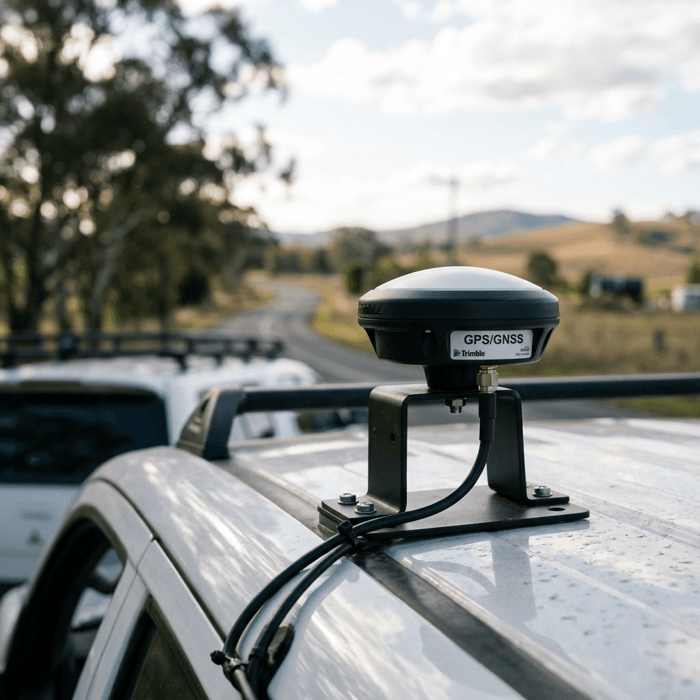
A vehicle's metal roof, curvature, and structures like roof racks all reflect signal. Position the antenna in the center of the roof, as high as possible, away from metal obstructions. Magnetic roof mounts give adjustable positioning on a metal roof.
Choosing the right GPS antenna and cable: a quick checklist
- Active or passive? Long cable run, obstruction, or fast TTFF → active. Antenna near the receiver on a short run → passive.
- Single-band or multi-band/GNSS? Consumer tracking is fine on L1; precision, timing, and safety-critical work want L1/L2/L5 multi-constellation.
- Connector type. Match the antenna and receiver — SMA, RP-SMA, N, TNC, FME, MMCX, and more. Mismatches are easily solved with the right GPS antenna cable or adapter.
- Cable length and loss. Budget for attenuation; a long passive run is the most common cause of weak fixes. Review signal loss in antenna cables before committing to a run length.
- Mounting and sky view. Clear, unobstructed sky exposure beats almost any other optimization. Choose the right mount for the surface and environment.
Browse our GPS antennas, GPS precision antennas, and GPS antenna cables, or contact us if you'd like help matching an antenna, cable, and connector for your application.
In conclusion
GPS antennas are the key to using the Global Positioning System: they receive, and usually amplify, the relatively weak signal from orbiting satellites. Antenna type, design, and characteristics drive not just sensitivity but the receiver's design and power requirements — and careful mounting with maximum sky exposure unlocks the best real-world performance. In our experience, the antenna and its cable run should be specified together; getting the active/passive decision right for your cable length is what separates a fast, reliable fix from an intermittent one.
Learn more: GPS and IoT (Internet of Things) applications
FAQs
What does a GPS antenna do?
A GPS antenna receives the radio-frequency signals transmitted by Global Positioning System satellites. Connected to a GPS receiver, it captures the timing and positional data needed to calculate accurate location, navigation, and time.
What is the difference between active and passive GPS antennas?
Active GPS antennas contain a Low Noise Amplifier (LNA) that boosts weak satellite signals and compensates for cable loss, making them ideal for longer cable runs or low-signal installations. Passive antennas have no amplifier, need no power, and must sit close to the receiver to minimize signal loss.
How long can a GPS antenna cable be?
With a passive antenna, keep the run short — generally under about 1 meter (3.3 ft). For longer distances, use an active antenna with an LNA and a low-loss coaxial cable, and account for attenuation when budgeting the run length.
Which connector does my GPS antenna need?
It depends on your receiver and antenna — common options include SMA, RP-SMA, N, TNC, FME, and MMCX. If the antenna and receiver use different connectors, the correct cable or adapter resolves the mismatch without compromising performance.
What GPS frequency bands do antennas receive?
GPS antennas typically receive L1 (1575.42 MHz) and L2 (1227.60 MHz) for civilian navigation. A third band, L5 (1176.45 MHz), supports safety-critical and high-precision applications. Dual- and triple-band antennas acquire signal faster and deliver better accuracy.
Why does GPS accuracy vary in different environments?
Accuracy degrades from signal reflections (multipath), blocked sky visibility, buildings, terrain, dense vegetation, poor weather, or indoor locations — all of which interfere with the line-of-sight needed between the antenna and multiple satellites.
Can a GPS antenna work with GLONASS, Galileo, or BeiDou?
Some GPS antennas can receive other GNSS signals, but full multi-constellation operation depends on both frequency support and receiver capability. For reliable GPS + GLONASS + Galileo + BeiDou use, choose a GNSS antenna and receiver built for multi-band, multi-system operation.