




Antennas, Antenna Cables, Wireless Products: Technical Articles
dBm Explained: How to Read Signal Power, Build a Link Budget & Fix Weak Links
dBm is decibels relative to one milliwatt — an absolute measure of RF power where 0 dBm equals exactly 1 mW into a 50-ohm system. Because it is logarithmic, every 3 dB step doubles (or halves) the power and every 10 dB step changes it by 10×, which is why engineers quote transmit power, receiver sensitivity and RSSI in dBm rather than in watts. If you can read a dBm value you can tell at a glance whether a wireless link has the margin to stay up. This guide covers the math, the thresholds that matter in the field, how dBm differs from dBi and dBW, and how to turn a marginal number into a reliable link.
What dBm means and why it is an absolute unit
The "m" in dBm is the key: it fixes the reference at 1 milliwatt. That makes dBm an absolute power unit — a reading of −67 dBm describes a specific amount of power, full stop. Plain "dB" and "dBi" are relative units: they describe a ratio (a gain or a loss) and mean nothing until you tie them to a reference. This is the single most common point of confusion on an RF datasheet, so it is worth stating plainly: you add and subtract dB and dBi values to and from a dBm value to track power through a system.
The conversion between dBm and milliwatts is:
P(dBm) = 10 × log₁₀( P(mW) ) and P(mW) = 10^(P(dBm) / 10)
dBm to watts: a reference table
These are exact conversions you can keep on hand. Note how each 10 dBm step is a factor of ten, and 3 dBm is roughly a factor of two.
| dBm | Power | Typical context |
|---|---|---|
| +36 dBm | 4 W | Max EIRP for point-to-point 5 GHz (region-dependent) |
| +30 dBm | 1 W | Common ceiling for 2.4 GHz EIRP (region-dependent) |
| +20 dBm | 100 mW | Typical Wi-Fi radio transmit power |
| +15 dBm | ~32 mW | Low-power IoT / BLE transmit |
| 0 dBm | 1 mW | The dBm reference point |
| −30 dBm | 1 µW | Very strong received signal (close range) |
| −67 dBm | ~200 pW | Solid Wi-Fi RSSI for voice/video |
| −90 dBm | ~1 pW | Near the usable edge for many Wi-Fi rates |
| −100 dBm | 0.1 pW | Approaching the noise floor |
Because negative dBm values are the norm for received signals, "more negative" always means "weaker." −60 dBm is far stronger than −80 dBm — a 20 dB difference, or 100× the power.
Reading signal strength in dBm (RSSI thresholds)
When a radio reports RSSI, it is almost always reporting received power in dBm. The practical thresholds most integrators work to on Wi-Fi are:
- −30 to −50 dBm: Excellent. You are essentially on top of the access point.
- −60 to −67 dBm: Good — the usual target for reliable voice and video.
- −70 dBm: Workable for basic data and web browsing.
- −80 dBm and below: Marginal; expect retransmits, low MCS rates and drops.
- −90 dBm and below: Unusable on most Wi-Fi links — at or below the noise floor.
What matters is not the raw RSSI alone but its distance above the noise floor — the signal-to-noise ratio (SNR). A −70 dBm signal over a −95 dBm noise floor gives 25 dB of SNR, which is plenty; the same −70 dBm over a −85 dBm noise floor (a noisy, congested band) leaves only 15 dB and will throttle your data rate. For a deeper treatment of how receivers report and interpret that number, see our RSSI (Received Signal Strength Indicator) guide.
dBm vs dBi vs dBW: keeping the units straight
These three units show up together in every link budget, and mixing them up produces errors of tens of dB. Here is the distinction stated once, cleanly:
| Unit | Reference | Type | Used for |
|---|---|---|---|
| dBm | 1 milliwatt | Absolute power | Transmit power, RSSI, receiver sensitivity |
| dBW | 1 watt | Absolute power | Higher-power systems; 0 dBW = +30 dBm |
| dBi | Isotropic radiator | Relative gain | Antenna gain |
| dB | None (pure ratio) | Relative | Cable loss, connector loss, SNR |
The rule to remember: dBm ± dB = dBm. You add antenna gain (dBi) and subtract cable and connector loss (dB) from a transmit power (dBm) to get radiated power (dBm). We cover the antenna side of that equation in our dBi, dB, dBm and dBmW definitions explainer.
Building a link budget in dBm
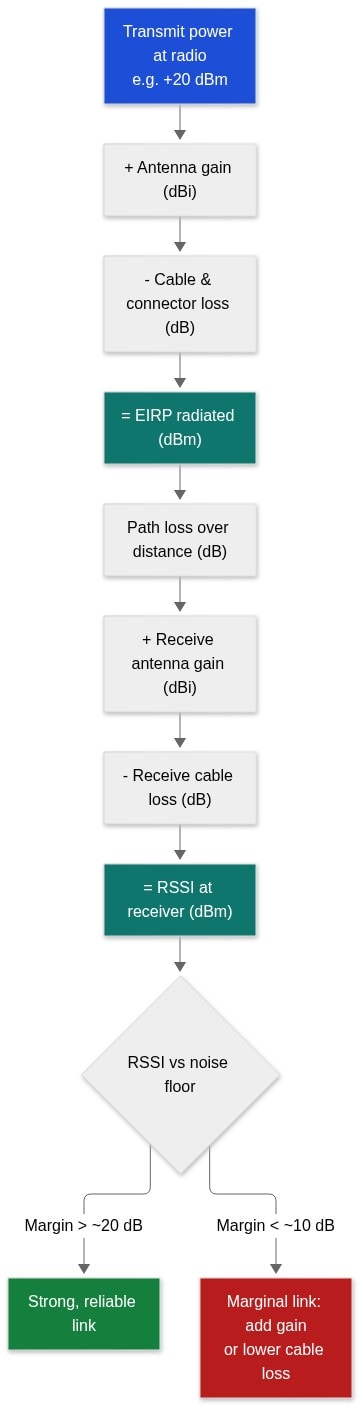
A link budget is simply dBm bookkeeping from the transmitter to the receiver. Start with the radio's transmit power in dBm, add every gain, subtract every loss, and compare the result at the far end against the receiver's sensitivity. If the received power sits comfortably above sensitivity, the link has margin.
A worked example
Take a 5 GHz backhaul radio transmitting at +20 dBm, feeding a 15 ft coax run and a 19 dBi panel:
- Transmit power: +20 dBm
- Cable + connector loss (example figure — verify against your cable's published loss at 5 GHz): −2.5 dB
- Antenna gain: +19 dBi
- EIRP = 20 − 2.5 + 19 = +36.5 dBm
If free-space path loss to the far end is about 103 dB and the receive antenna adds 19 dBi with 1 dB of receive-side loss, the received signal is roughly 36.5 − 103 + 19 − 1 = −48.5 dBm. Against a receiver sensitivity of around −75 dBm, that is ~26 dB of fade margin — a robust link. The loss and path-loss figures above are illustrative; always substitute the actual loss-per-100-ft rating for your specific coax at your operating frequency and the real distance.
Fixing a weak (too-negative) dBm reading
If your measured RSSI is weaker than you need, every fix is about adding dB to the budget. In rough order of cost-effectiveness:
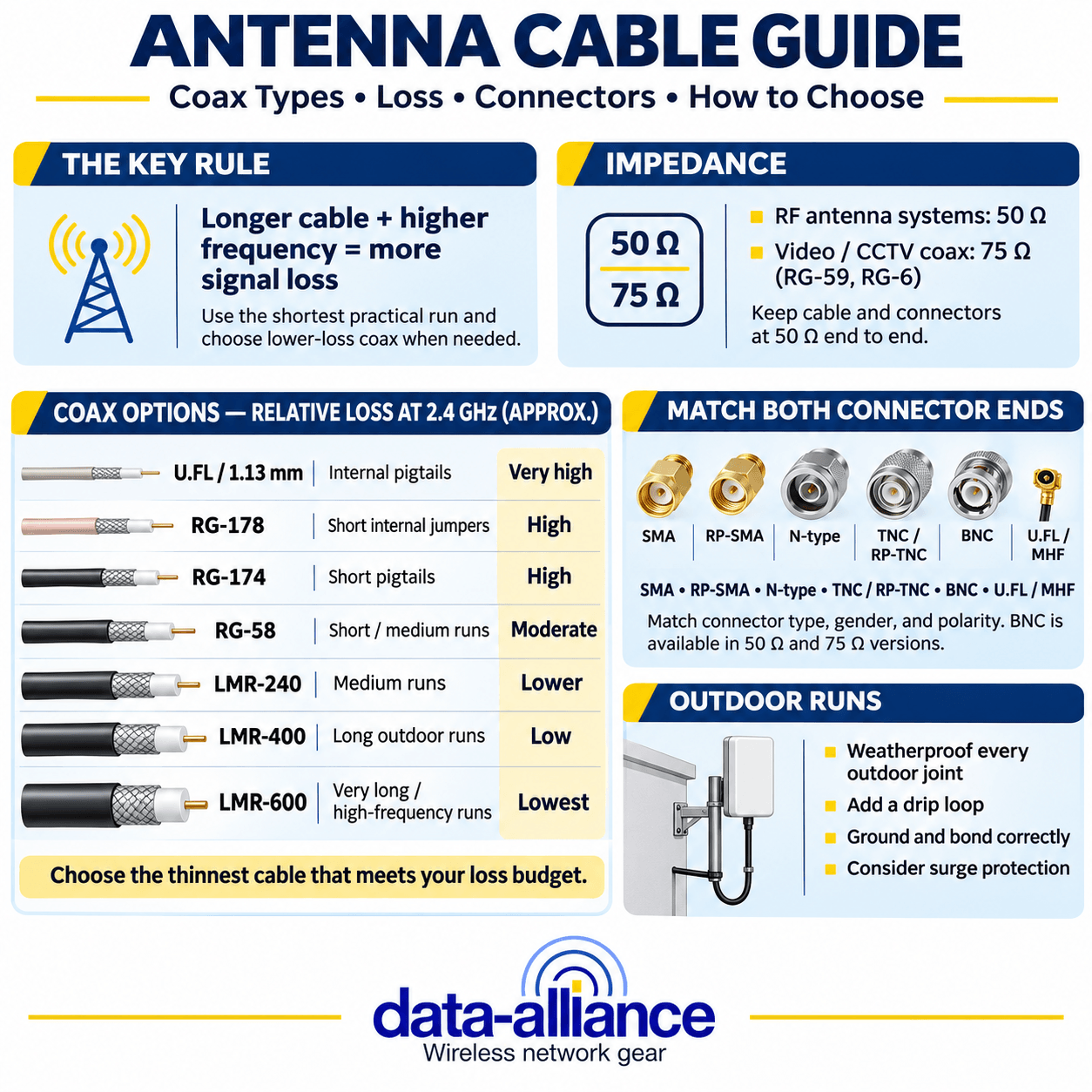
- Cut cable loss. Loss in dB scales directly with cable length and rises with frequency. Shortening the run or stepping up to lower-loss coax such as LMR-400 can recover several dB. Compare grades in our LMR-100 vs LMR-200 vs LMR-400 comparison.
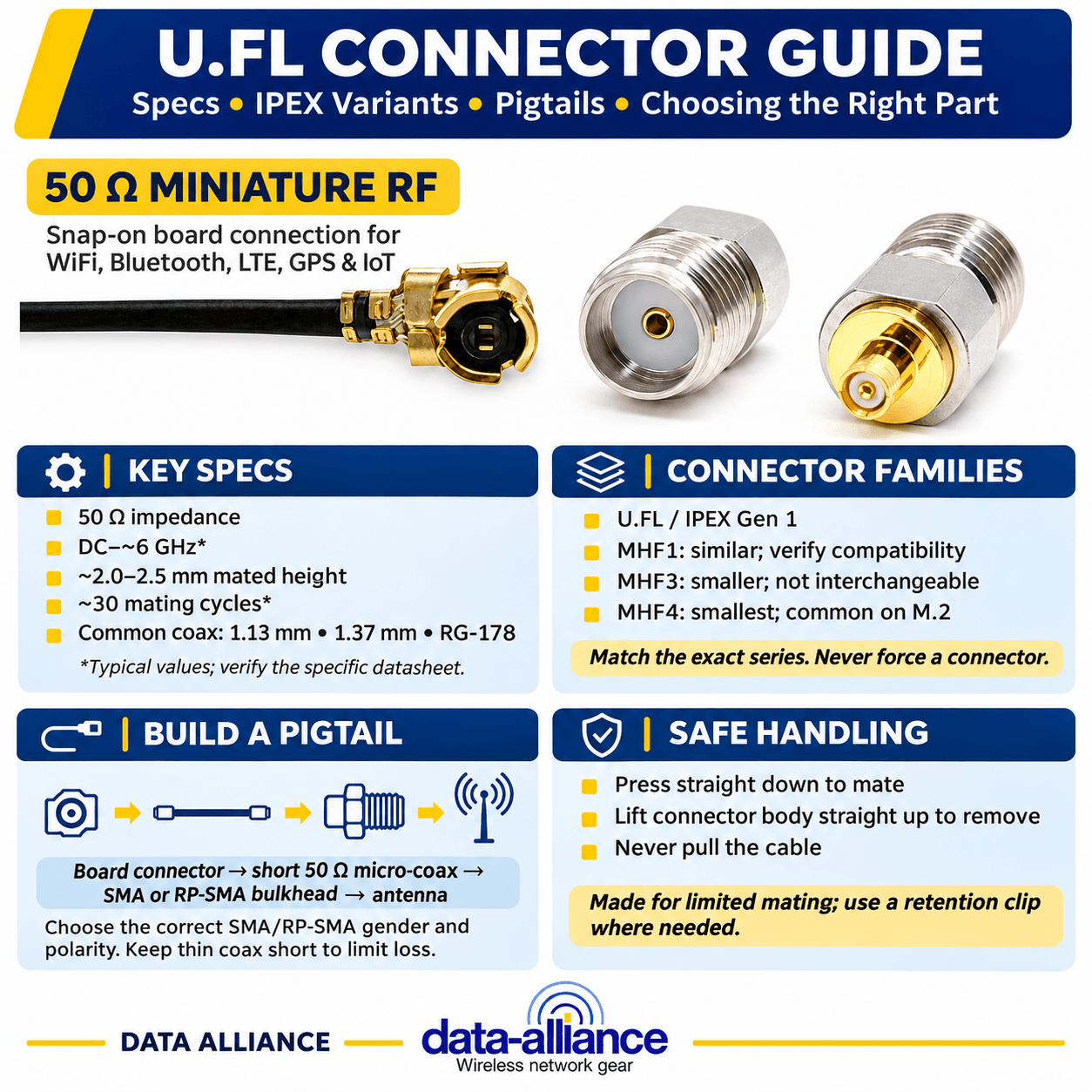
- Add antenna gain. Swapping an omni for a directional antenna concentrates power toward the far end. On the connector side, make sure the whole chain matches — our SMA connector specifications reference helps you avoid a mismatched or lossy junction.
- Raise or re-aim the antenna to clear obstructions and improve line of sight.
- Move to a cleaner band or channel to lift the signal further above the noise floor. If you are weighing 2.4 vs 5 GHz for a given link, our 5 GHz wireless frequency guide lays out the range-versus-throughput trade-offs.
- Add an in-line amplifier or signal booster only where regulations and the noise budget allow — amplifiers raise noise as well as signal.
Need the hardware to recover those dB? Browse our low-loss antenna cables and adapters for custom-built 50-ohm assemblies, or our cellular signal boosters to lift a marginal link. Not sure which assembly fits your radio and connector chain? Request a custom quote from our technical team and we will spec it with you.
Frequently asked questions about dBm
Is a higher or lower dBm better?
It depends on sign. For received signals, which are negative, a higher (less negative) number is stronger: −55 dBm is better than −75 dBm. For transmit power, which is usually positive, a higher dBm means more output power. The confusion comes from the negative values, so always keep the sign in mind.
What is a good dBm for Wi-Fi?
Aim for −67 dBm or stronger for reliable voice and video, and treat −70 dBm as the lower bound for solid data. Below −80 dBm the link becomes marginal with retransmits and reduced data rates. What ultimately matters is the margin above the noise floor (SNR), not the RSSI alone.
What is the difference between dBm and dBi?
dBm is an absolute power measured against 1 milliwatt; dBi is a relative antenna gain measured against an isotropic radiator. You add an antenna's dBi gain to a transmit power in dBm to estimate radiated power, but the two are never interchangeable — one is a power, the other is a ratio.
How do I convert dBm to watts?
Use P(mW) = 10^(dBm/10), then divide by 1000 for watts. So +30 dBm = 10^3 mW = 1000 mW = 1 W, and +20 dBm = 100 mW = 0.1 W. Every 10 dBm step multiplies or divides the power by ten.
Why are Wi-Fi signal values negative?
Received Wi-Fi power is a tiny fraction of a milliwatt — often billionths of a milliwatt — so on the logarithmic dBm scale it lands below 0 dBm and reads as a negative number. The reference (0 dBm = 1 mW) is simply far stronger than anything a receiver sees in normal operation.
What dBm is the noise floor?
The thermal noise floor depends on bandwidth and environment, but for a typical 20 MHz Wi-Fi channel it sits near −95 to −100 dBm in a quiet band and rises (gets less negative) in congested RF environments. Your usable signal must stay well above whatever the local noise floor actually is, which is why measuring SNR beats trusting RSSI alone.