





Antennas, Antenna Cables, Wireless Products: Technical Articles
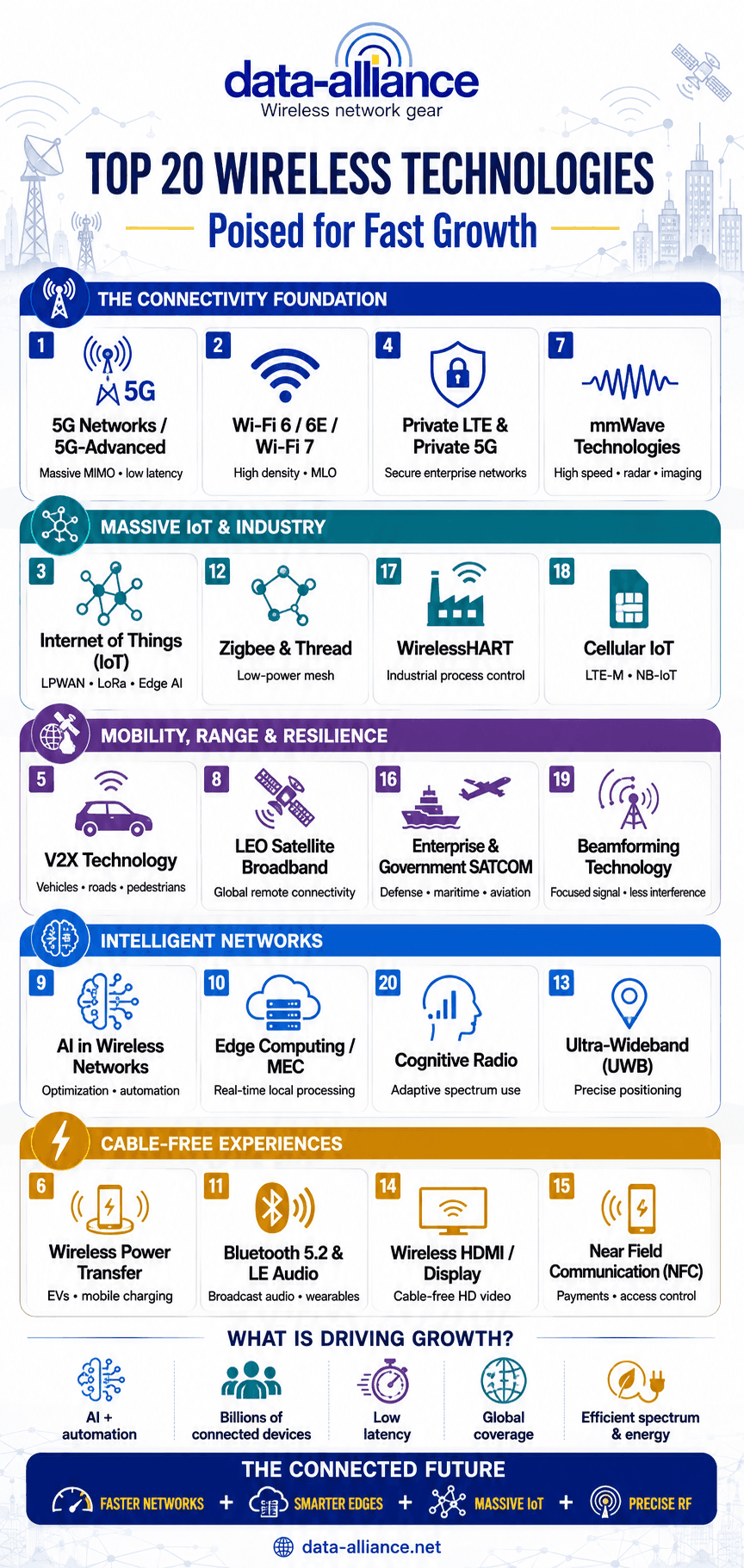
Top 20 Wireless Technologies Poised for Growth (2025–2026)
Wireless Technologies Poised for Growth in 2025–2026
The wireless technologies poised for growth in 2025 and 2026 are the sectors business and technology leaders are prioritizing for investment: 5G-Advanced, Wi-Fi 7, private 5G, cellular IoT, LEO satellite broadband, UWB, edge computing and more. Below is the full top-20 list, what drives each one, and — because every one of them ultimately rides on an RF link — the antennas, connectors and cables they depend on.
Global wireless data traffic continues to grow exponentially, driven by cloud computing, AI workloads, IoT expansion, industrial automation, and consumer demand for seamless connectivity. As spectrum efficiency, latency reduction, and energy optimization become strategic priorities, these wireless technologies represent high-impact investment opportunities.

The Top 20 Wireless Technologies
1. 5G Networks and 5G-Advanced
5G networks have already started to revolutionize telecommunications, providing ultra-fast, low-latency connections. As 5G continues to expand globally, investment in its infrastructure and supporting technologies remains a priority, while research into 6G and beyond has already begun. The evolution toward 5G-Advanced (3GPP Release 18) is introducing enhanced uplink performance, improved massive MIMO, AI-native air interfaces, and expanded support for industrial automation and XR applications — bridging current 5G deployments with early 6G research.
2. Wi-Fi 6, Wi-Fi 6E and Wi-Fi 7
Wi-Fi 6 (802.11ax) and its extended version, Wi-Fi 6E, deliver faster speeds, higher capacity, and reduced latency — ideal for high-density environments such as offices, stadiums, and public spaces. Wi-Fi 7 (802.11be) is now emerging, delivering multi-link operation (MLO), 320 MHz channels, and ultra-low latency. Enterprises upgrading infrastructure today are increasingly evaluating Wi-Fi 7 for high-density, high-throughput deployments. See our guide to the WiFi network standards compared for the full band and speed breakdown, and browse dual-band WiFi antennas for these deployments.

3. The Internet of Things (IoT)
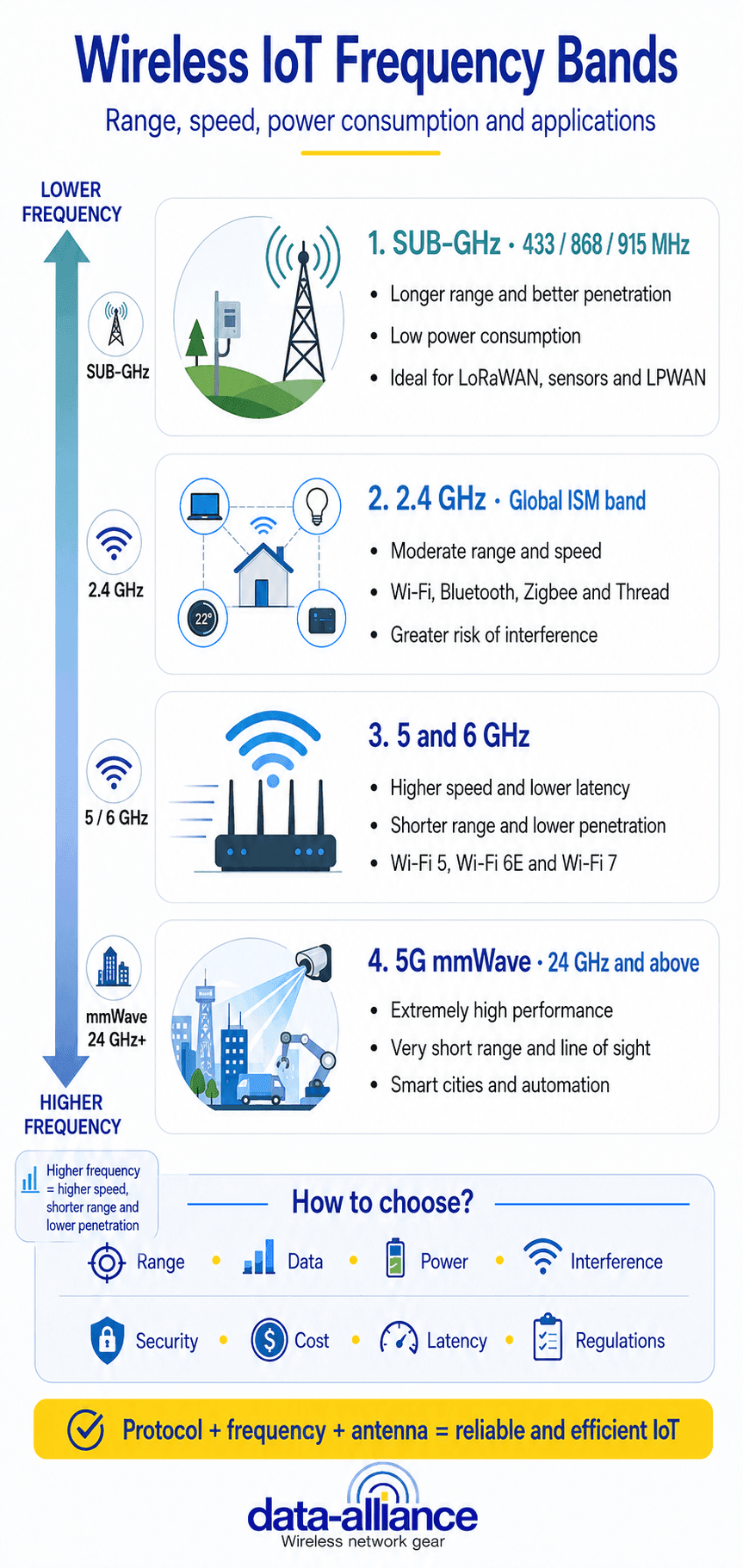
The Internet of Things (IoT) continues its rapid growth, driving connectivity solutions such as Low-Power Wide-Area Networks (LPWAN), Narrowband IoT (NB-IoT), and Long Range (LoRa). These enable long-range, low-power, cost-effective connections for a vast array of devices. The convergence of IoT with edge AI is accelerating intelligent endpoints capable of local decision-making, predictive maintenance, and autonomous optimization.
4. Private LTE and Private 5G Networks
Private LTE and 5G networks provide dedicated, secure wireless connectivity for enterprises, industrial facilities, and critical infrastructure, offering enhanced reliability, low latency, and support for large device counts. The availability of CBRS spectrum in the United States and shared-spectrum models globally has significantly lowered the barrier to private 5G deployment in manufacturing, logistics, mining, and energy.
5. V2X Technology
V2X (vehicle-to-everything) enables communication between vehicles and their surroundings — other vehicles, infrastructure, and pedestrians. As autonomous vehicles and smart cities become more prevalent, V2X plays a vital role in road safety and efficient traffic management, and investment in V2X infrastructure and applications continues to grow.
6. Wireless Power Transfer
Wireless power transfer technologies, such as inductive charging and resonant coupling, are gaining traction for charging electric vehicles, smartphones, and other devices. As demand for wire-free charging increases, investment in wireless power transfer continues to expand.
7. Millimeter Wave (mmWave)
Millimeter wave (mmWave) technologies are a key component of 5G, offering high-speed data transmission and ultra-low latency. mmWave also has applications beyond telecom — radar systems, high-speed data links, and imaging — driving innovation and new use cases across industries.
8. LEO Satellite Broadband Constellations (Starlink, Kuiper, OneWeb)
The expansion of low-Earth-orbit satellite networks such as SpaceX's Starlink and Amazon's Project Kuiper has renewed interest in satellite-based connectivity. These networks aim to provide global high-speed internet coverage, even in remote and underserved areas, helping bridge the digital divide.
9. AI in Wireless Networks
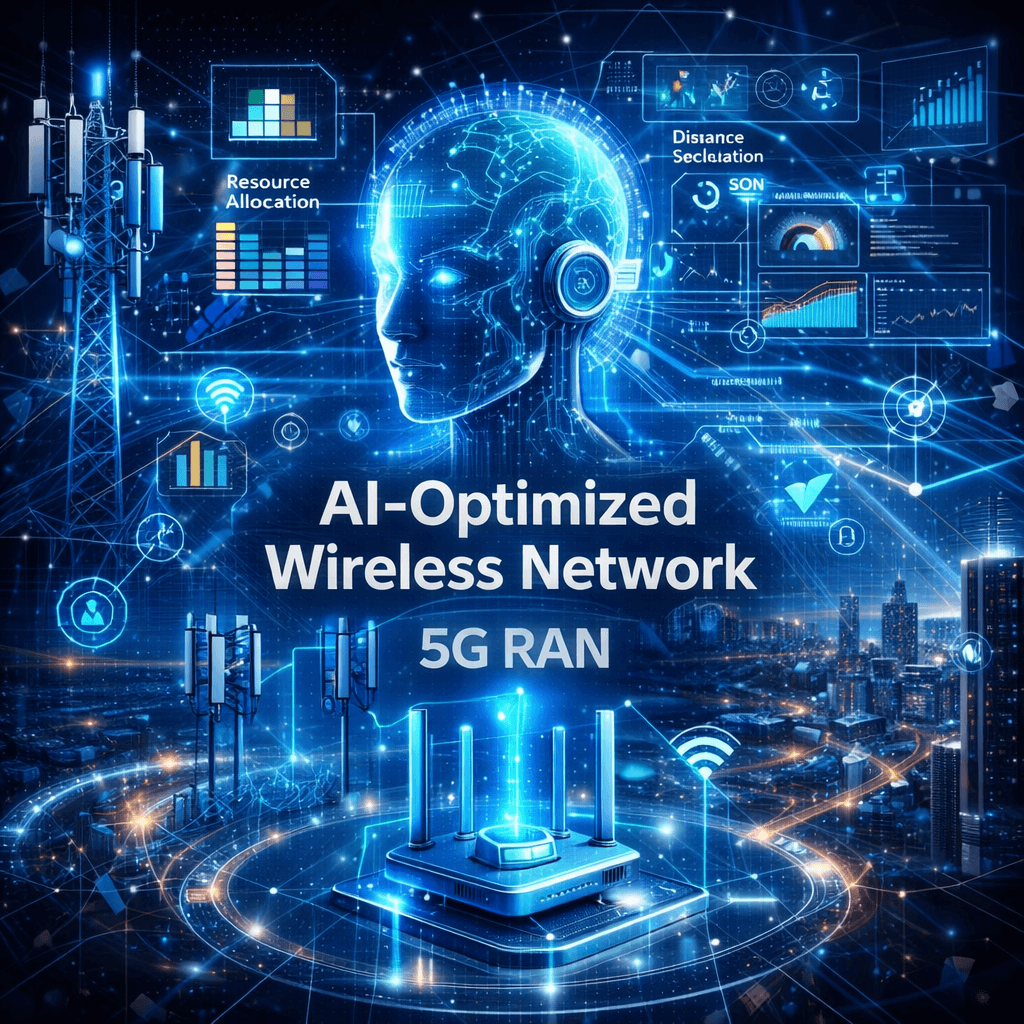
Artificial intelligence and machine learning are increasingly important in optimizing wireless networks — predicting congestion, allocating resources efficiently, and improving overall performance. AI is now embedded directly into the Radio Access Network (RAN), enabling self-optimizing networks (SON), predictive maintenance, automated beam management, and dynamic spectrum allocation.
10. Edge Computing and MEC
Edge computing brings data processing closer to the source, reducing latency and improving real-time performance. As IoT devices and 5G networks proliferate, Multi-access Edge Computing (MEC) becomes critical for latency-sensitive applications such as autonomous vehicles, AR/VR, smart factories, and real-time analytics.
11. Bluetooth 5.2 and LE Audio
Bluetooth 5.2 is the latest iteration of this essential short-range standard. LE Audio enhances Bluetooth Low Energy with high-quality audio streaming, broadcast audio sharing, and improved hearing-aid support. With growing demand for wireless audio devices, Bluetooth 5.2 and LE Audio are expected to flourish.
12. Zigbee and Thread
Zigbee and Thread are low-power, mesh networking protocols for IoT devices, enabling smart devices to communicate and form connected networks for home automation, building management, and industrial applications. Both offer secure, reliable, scalable networking for the future of IoT.
13. Ultra-Wideband (UWB)
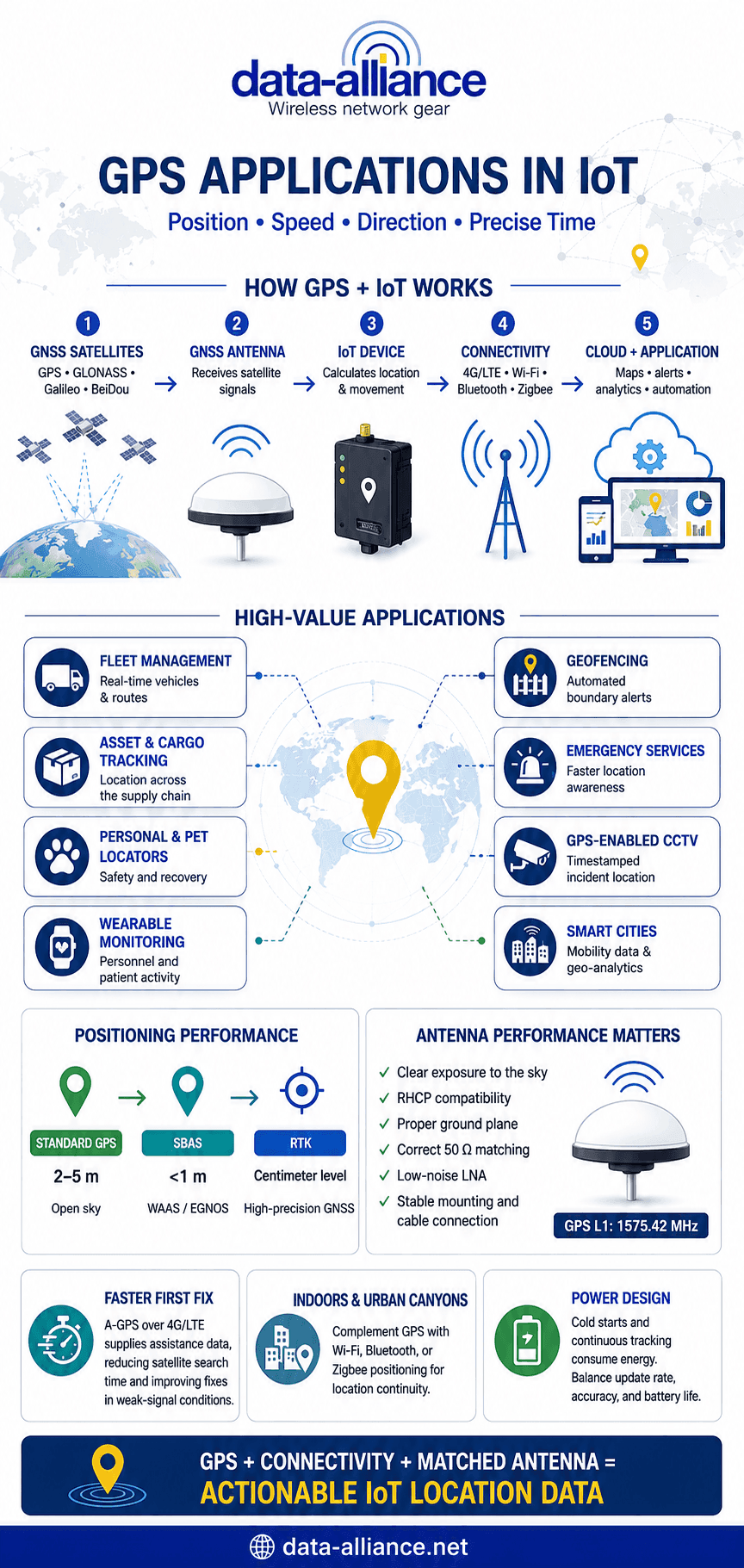
Ultra-Wideband is a short-range technology providing precise location and positioning. Operating over a wide frequency range, UWB offers high data rates, low power consumption, and high positioning accuracy. Applications include indoor positioning, secure keyless entry, and device-to-device communication — and demand for precise positioning is driving adoption across industries.
14. Wireless HDMI and Display Technologies
Wireless HDMI and display technologies transmit high-definition audio and video without cables. Standards such as WiGig and WirelessHD allow clutter-free workspaces and home entertainment systems, and demand for streamlined setups continues to drive growth.
15. Near Field Communication (NFC)
NFC is a short-range technology that lets devices exchange data in close proximity. Widely adopted for contactless payments, access control, and information sharing, NFC remains essential as contactless transactions and IoT devices grow.
16. Enterprise and Government SATCOM
Satellite communication transmits data, voice, and video across long distances using satellites as relay points, providing global coverage ideal for remote and underserved areas. Demand for reliable, uninterrupted communication continues to drive SATCOM growth in defense, maritime, and aviation.
17. WirelessHART
WirelessHART is a wireless industrial communication protocol designed for process automation and control. It provides a secure, reliable, low-power wireless mesh network for transmitting data between sensors, actuators, and control systems — valuable as industry demands real-time data monitoring and control.
18. Cellular IoT (LTE-M and NB-IoT)
Cellular IoT technologies such as LTE-M and NB-IoT provide low-power, wide-area connectivity for IoT devices, offering extended coverage and support for massive device counts. As the IoT market expands, cellular IoT plays a crucial role in connecting and managing devices.
19. Beamforming Technology
Beamforming focuses signal transmission in a specific direction, enabling higher throughput, improved signal quality, and reduced interference. Already used in Wi-Fi and 5G, beamforming is expected to be a key component of future wireless systems.
20. Cognitive Radio (CR)
Cognitive Radio is an adaptive, intelligent radio technology that automatically detects available spectrum and changes transmission parameters to optimize communication. CR can improve spectrum utilization, reduce interference, and enhance system performance as demand for efficient spectrum usage rises.
Bonus: Open RAN (O-RAN)
Open Radio Access Network architectures disaggregate hardware and software, enabling vendor interoperability, cost efficiency, and accelerated innovation. Governments and telecom operators worldwide are investing heavily in Open RAN to reduce dependency on traditional infrastructure vendors.
Summary Table: Top 20 Wireless Technologies Poised for Growth (2025–2026)
# | Technology | Core Focus | Key Growth Drivers | Primary Applications |
1 | 5G Networks / 5G-Advanced | Ultra-fast, low-latency connectivity | Massive MIMO, AI-native RAN, XR support, path to 6G | Telecom, industrial automation, smart cities |
2 | Wi-Fi 6 / 6E / Wi-Fi 7 | High-density wireless networking | Multi-Link Operation (MLO), 320 MHz channels, ultra-low latency | Enterprises, stadiums, public spaces |
3 | Internet of Things (IoT) | Large-scale device connectivity | LPWAN, NB-IoT, LoRa, Edge AI convergence | Smart cities, industrial IoT, agriculture |
4 | Private LTE & Private 5G | Dedicated enterprise networks | CBRS spectrum, secure low-latency operations | Manufacturing, logistics, mining, energy |
5 | V2X Technology | Vehicle-to-everything communication | Autonomous driving, smart infrastructure | Transportation, smart cities |
6 | Wireless Power Transfer | Cable-free energy delivery | EV charging demand, mobile device charging | EVs, consumer electronics |
7 | mmWave Technologies | High-frequency high-speed transmission | 5G expansion, radar, imaging innovation | Telecom, defense, automotive radar |
8 | LEO Satellite Broadband | Global broadband coverage | Starlink, Kuiper, rural connectivity demand | Remote internet, maritime, aviation |
9 | AI in Wireless Networks | Network optimization & automation | Self-optimizing networks (SON), AI-RAN, dynamic spectrum allocation | Telecom operators, enterprise networks |
10 | Edge Computing / MEC | Low-latency local data processing | Real-time analytics, autonomous systems | Smart factories, AR/VR, IoT |
11 | Bluetooth 5.2 & LE Audio | Short-range wireless audio | Broadcast audio, hearing aid support | Consumer electronics, wearables |
12 | Zigbee & Thread | Low-power mesh networking | Secure scalable IoT networks | Smart homes, building automation |
13 | Ultra-Wideband (UWB) | Precise positioning & short-range data | High-accuracy indoor location demand | Secure access, asset tracking |
14 | Wireless HDMI / Display | Cable-free HD video transmission | Clean workspace & entertainment setups | Home entertainment, enterprise AV |
15 | Near Field Communication (NFC) | Contactless data exchange | Digital payments, access control growth | Fintech, IoT, mobile devices |
16 | Enterprise & Government SATCOM | Long-distance satellite communications | Defense, aviation, maritime expansion | Military, aerospace, maritime |
17 | WirelessHART | Industrial wireless automation | Secure real-time process monitoring | Oil & gas, chemical plants |
18 | Cellular IoT (LTE-M, NB-IoT) | Low-power wide-area cellular IoT | Massive device deployment | Smart meters, asset tracking |
19 | Beamforming Technology | Directional signal optimization | Higher throughput, interference reduction | Wi-Fi 7, 5G networks |
20 | Cognitive Radio (CR) | Adaptive spectrum utilization | Spectrum scarcity, efficiency demands | Defense, telecom optimization |
— | Open RAN (O-RAN) | Disaggregated radio access architecture | Vendor interoperability, cost reduction | Telecom infrastructure |
The RF Hardware Behind Every Wireless Technology
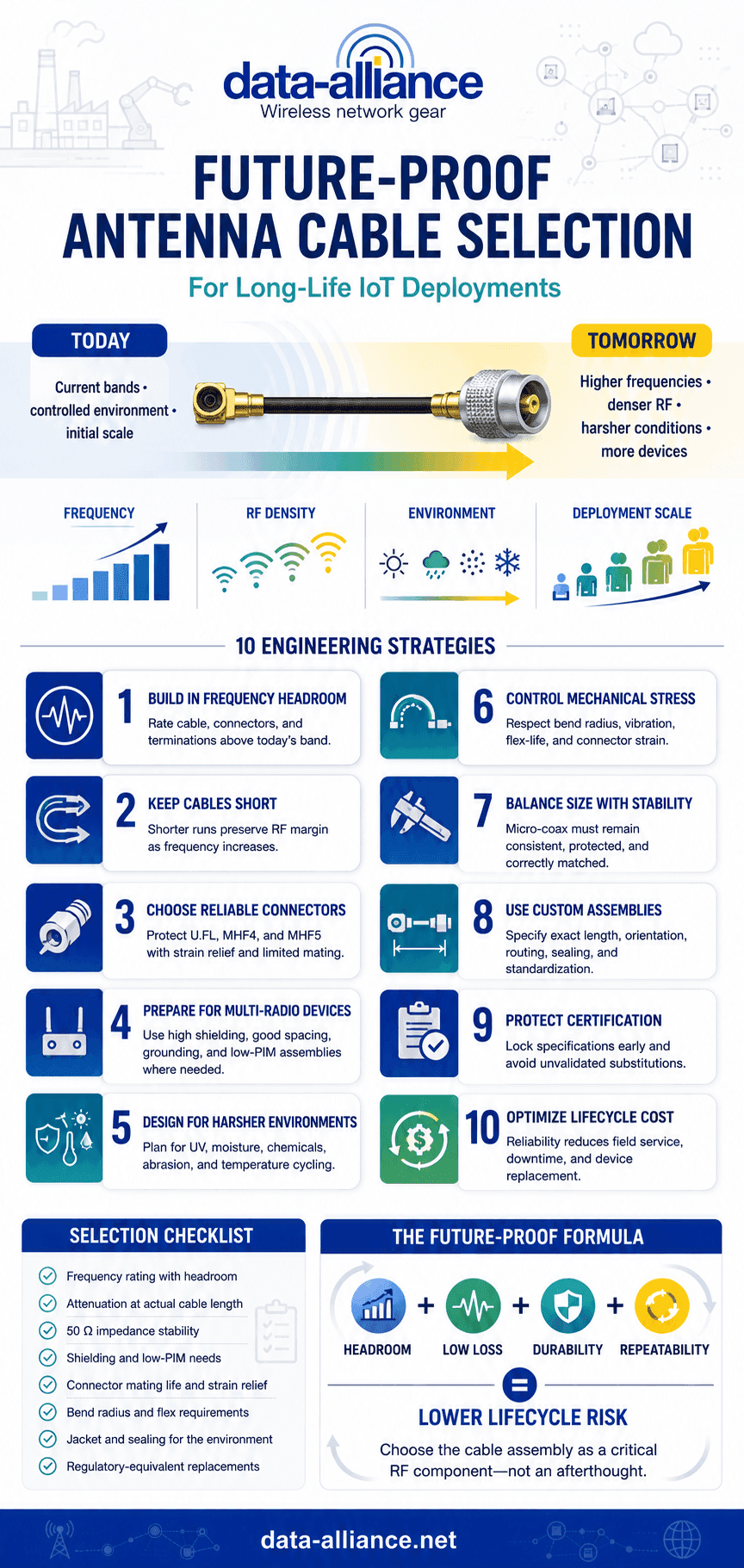
Every technology on this list ultimately depends on a reliable RF link. Whether you are deploying private 5G, a LoRaWAN sensor fleet, or Wi-Fi 7 access points, performance is gated by the antenna, the connector, and the coax that carries the signal. Data Alliance manufactures and stocks the components these deployments need, including WiFi and cellular antennas, custom antenna cables and adapters, and LoRa / LoRaWAN antennas for long-range IoT. For projects with non-standard connector, length, or frequency requirements, request a custom quote and our technical team can spec the assembly.
Conclusion
Wireless technologies continue to redefine global connectivity across consumer, enterprise, industrial, and government sectors. From 5G-Advanced and private networks to AI-driven optimization, satellite broadband, and intelligent IoT ecosystems, the wireless landscape is entering a new phase of acceleration. Organizations that strategically invest in these emerging technologies in 2025 and 2026 will position themselves at the forefront of digital transformation, operational efficiency, and competitive advantage.
Frequently Asked Questions
Which wireless technologies will see the most growth in 2025–2026?
The strongest growth is expected in 5G-Advanced, Wi-Fi 6/6E and Wi-Fi 7, private 5G, AI-optimized networks, IoT connectivity (LTE-M, NB-IoT, LoRa), LEO satellite broadband, edge computing, and Open RAN. These technologies support increasing data demand, automation, and AI-driven infrastructure.
How is 5G-Advanced different from standard 5G?
5G-Advanced (3GPP Release 18) enhances uplink performance, massive MIMO, AI-native air interfaces, and industrial support. It acts as a bridge between current 5G deployments and early 6G research, improving efficiency, automation, and XR capabilities.
Why are private 5G networks gaining momentum?
Private LTE and 5G networks provide secure, low-latency, high-reliability connectivity for enterprises and industrial facilities. The availability of CBRS spectrum and shared-spectrum models has reduced deployment barriers, accelerating adoption in manufacturing, logistics, energy, and mining.
What role does AI play in wireless networks?
AI is increasingly embedded directly into the Radio Access Network (RAN). It enables self-optimizing networks (SON), predictive maintenance, automated beamforming, dynamic spectrum allocation, and real-time congestion management — improving efficiency and lowering operational costs.
How are satellite networks influencing global connectivity?
LEO satellite constellations such as Starlink, Kuiper, and OneWeb are expanding high-speed broadband access worldwide, particularly in remote and underserved regions. Enterprise and government SATCOM also continue to grow in defense, maritime, and aviation sectors.
Why is Open RAN considered a major investment trend?
Open RAN (O-RAN) disaggregates hardware and software in radio networks, enabling vendor interoperability, cost efficiency, and faster innovation. Governments and telecom operators are investing in Open RAN to reduce dependency on traditional vendors and create more flexible, future-proof network architectures.
What antennas and cables do these wireless technologies require?
It depends on the band and environment: 2.4/5/6 GHz Wi-Fi and Bluetooth typically use RP-SMA or U.FL; cellular and private 5G use multiband SMA or N-type antennas; LoRa and sub-GHz IoT use 868/915 MHz antennas. Low-loss coax (such as LMR-400 for longer outdoor runs) preserves the link budget. Data Alliance custom-manufactures antenna cables to match any connector, length, and frequency — contact technical support for help specifying.