


Antennas, Antenna Cables, Wireless Products: Technical Articles
How to Future-Proof Antenna Cable Selection for IoT Deployments
Table of Contents
- Introduction
- 1. Design for Higher Frequencies Than You Need Today
- 2. Minimize Cable Length to Preserve RF Margin
- 3. Choose Connector Types With Proven Lifecycle Reliability
- 4. Plan for Multi-Radio and Spectrum-Dense Devices
- 5. Account for Environmental Exposure Early in the Design Phase
- 6. Evaluate Mechanical Stress, Vibration, and Flex-Life
- 7. Balance Miniaturization With Electrical Stability
- 8. Use Custom Cable Assemblies to Eliminate Compromises
- 9. Consider Regulatory and Certification Impacts
- 10. Think in Terms of Total Lifecycle Cost
- Conclusion
- FAQs
Introduction
As Internet of Things (IoT) deployments mature, antenna cable selection has shifted from a secondary hardware decision to a long-term system design consideration. Wireless standards evolve quickly, device lifecycles are extending, and IoT systems are increasingly deployed in environments that are difficult or costly to service.
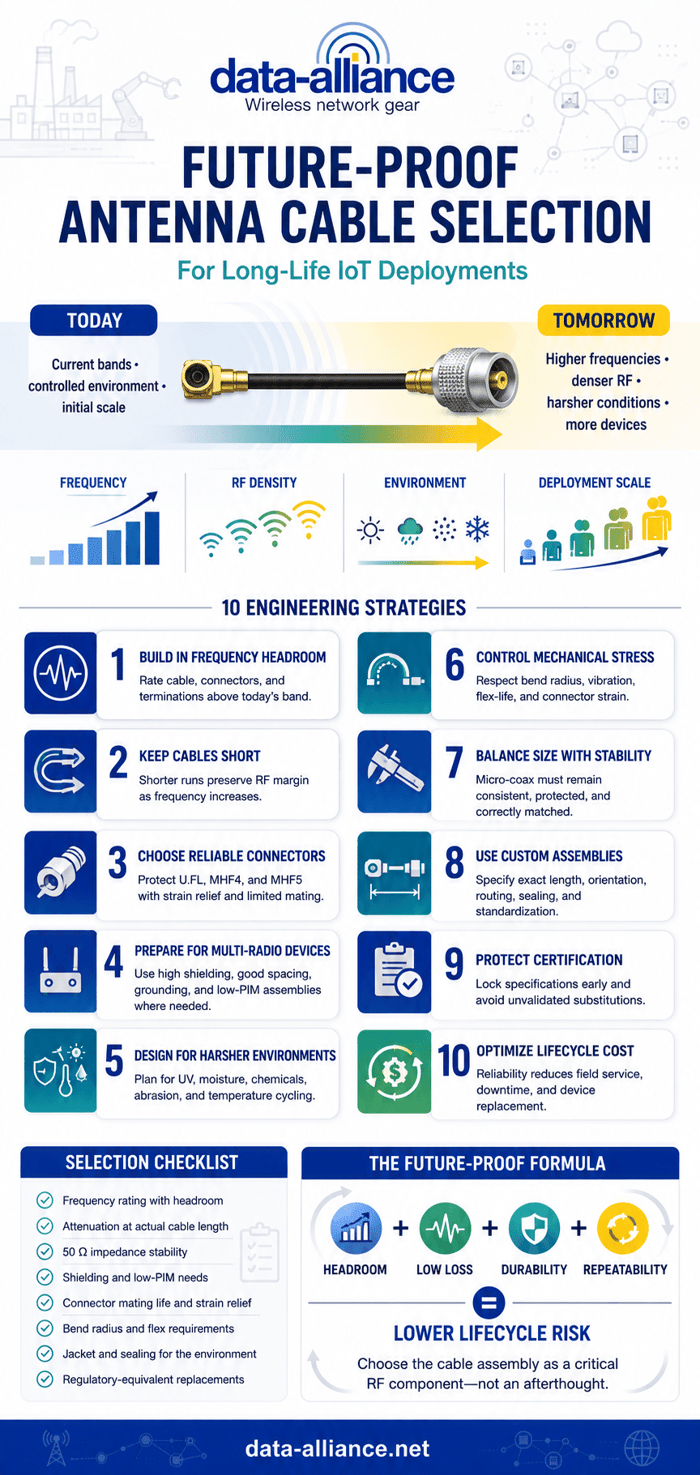
Future-proofing antenna cable selection means choosing cable assemblies that not only meet current requirements, but also remain reliable and relevant as frequencies increase, RF environments become more crowded, and operating conditions become more demanding.
This article outlines practical, engineering-focused strategies to help designers and integrators select antenna cables that support long-term performance, scalability, and reliability.
1. Design for Higher Frequencies Than You Need Today
Wireless technologies rarely stand still. IoT systems that begin life using sub-GHz, LTE Cat-M, or 2.4 GHz radios often evolve to support higher-frequency standards such as 5G sub-6 GHz, CBRS, Wi-Fi 6E, or Wi-Fi 7.
Antenna cables that are marginally acceptable at today’s frequencies may introduce excessive attenuation or impedance instability at future operating bands.
To future-proof frequency performance:
Select cables with documented performance well above current frequency requirements
Avoid using the smallest or lowest-cost coax options at the edge of their usable frequency range
Verify that connectors and terminations are rated for higher frequencies—not just the cable itself
Designing with frequency headroom reduces the likelihood of RF redesigns when radios or firmware are upgraded later.
2. Minimize Cable Length to Preserve RF Margin
Cable length has a compounding effect on signal loss, especially as frequencies increase. Even modest increases in antenna cable length can significantly reduce link margin at higher bands.
Future-proof strategies include:
Keeping antenna cables as short as mechanically feasible
Repositioning antennas instead of extending cable runs
Upgrading to lower-loss coax when length reductions are not possible
Shorter cable runs provide flexibility for future frequency expansion and reduce the need to compensate with higher transmit power or more sensitive receivers.
3. Choose Connector Types With Proven Lifecycle Reliability
RF connectors are often the weakest mechanical point in an antenna system—particularly in compact IoT devices using micro-coax connectors.
When future-proofing connector selection:
Limit repeated mating cycles on U.FL, MHF4, and MHF5 connectors
Incorporate strain relief near board-level connectors
Use connector locking mechanisms where vibration or movement is expected
Ensure connector plating and contact materials support long-term stability
Connector failures are difficult to diagnose in the field and often result in complete device replacement rather than repair.
4. Plan for Multi-Radio and Spectrum-Dense Devices
Future IoT devices increasingly integrate multiple radios operating simultaneously, such as LTE, GNSS, Wi-Fi, Bluetooth, and proprietary sub-GHz links.
In spectrum-dense designs:
Poor shielding can allow cable-to-cable coupling
Intermodulation products may degrade receiver sensitivity
Noise floors can rise unexpectedly over time
To mitigate these risks:
Favor antenna cables with high shielding effectiveness
Consider low-PIM cable assemblies for gateways and infrastructure devices
Maintain proper cable routing, spacing, and grounding practices
As RF congestion increases, antenna cables play a growing role in preserving signal integrity.
5. Account for Environmental Exposure Early in the Design Phase
Many IoT deployments begin indoors or in controlled environments—but expand over time into outdoor, mobile, or industrial settings.
Environmental factors that affect antenna cable longevity include:
UV exposure
Temperature cycling
Moisture ingress
Chemical exposure
Abrasion and mechanical stress
Future-proof antenna cable selection involves choosing materials and constructions that tolerate worse conditions than initially expected, even if early deployments are relatively benign.
6. Evaluate Mechanical Stress, Vibration, and Flex-Life
As IoT devices move into transportation, manufacturing, agriculture, and infrastructure monitoring, mechanical stress becomes unavoidable.
Future-proof designs consider:
Minimum bend radius during installation
Continuous vibration from machinery or vehicles
Repeated motion in wearable or mobile systems
Strain at connector interfaces
Cables with reinforced jackets, improved braid coverage, and proper strain relief help prevent fatigue-related failures that may only appear months or years after deployment.
7. Balance Miniaturization With Electrical Stability
Smaller devices often demand thinner, more flexible micro-coax cables. While miniaturization enables compact designs, it also reduces tolerance to manufacturing variation, mechanical stress, and impedance drift.
To future-proof micro-coax use:
Select cable types with proven consistency at scale
Avoid routing micro-coax near sharp edges or heat sources
Ensure connectors and cables are matched as a system
Miniaturization should never come at the expense of long-term electrical stability.
8. Use Custom Cable Assemblies to Eliminate Compromises
Off-the-shelf antenna cables often force design trade-offs—extra length, suboptimal connector orientation, or inadequate environmental sealing.
Custom antenna cable assemblies allow designers to:
Specify exact cable lengths to minimize loss
Optimize connector orientation and routing
Add overmolding or sealing for harsh environments
Standardize assemblies across product families
Custom assemblies reduce variability and improve repeatability as IoT deployments scale.
9. Consider Regulatory and Certification Impacts
Wireless certifications are increasingly sensitive to antenna system changes. Even small cable substitutions can affect radiated emissions, spurious responses, or antenna patterns.
Future-proofing includes:
Locking down antenna cable specifications early
Avoiding component substitutions late in the product lifecycle
Ensuring replacement cables maintain equivalent electrical characteristics
Stable antenna cable selection helps preserve regulatory compliance across hardware revisions.
10. Think in Terms of Total Lifecycle Cost
The lowest-cost antenna cable is rarely the most economical choice over time. Field failures, service calls, device replacements, and downtime quickly outweigh small upfront savings.
Future-proof selection prioritizes:
Reliability over minimal material cost
Proven materials and manufacturing processes
Long-term performance consistency
In large-scale IoT deployments, antenna cable reliability directly impacts operational cost and customer experience.
Conclusion
Future-proofing antenna cable selection requires a long-term perspective. By designing for higher frequencies, increased RF density, harsher environments, and extended device lifecycles, IoT engineers can reduce redesigns, minimize field failures, and improve system scalability.
Antenna cables are no longer passive afterthoughts—they are critical RF components that influence performance, reliability, and longevity. Choosing the right cable today helps ensure your IoT deployment remains robust tomorrow
FAQs
Why should IoT antenna cables be rated for higher frequencies than current system requirements?
Wireless standards evolve quickly, and many IoT devices are upgraded over time to support higher-frequency bands such as 5G sub-6 GHz, CBRS, Wi-Fi 6E, or Wi-Fi 7. Cables that barely meet today’s frequency needs may introduce excessive attenuation or impedance instability at higher bands. Selecting cables and connectors rated well above current requirements provides frequency headroom and reduces the risk of costly RF redesigns later.
How does antenna cable length impact long-term IoT performance?
Cable length directly affects signal loss, and attenuation increases as frequency rises. Even small increases in cable length can significantly reduce link margin at higher bands. Keeping cables as short as mechanically feasible, repositioning antennas instead of extending runs, and upgrading to lower-loss coax when necessary helps preserve RF margin and supports future frequency expansion.
What connector considerations are critical for long-term IoT reliability?
RF connectors are often the weakest mechanical point in an antenna system, particularly micro-coax connectors like U.FL, MHF4, and MHF5. To ensure long-term reliability, designers should limit repeated mating cycles, add strain relief near board-level connectors, use locking mechanisms in vibration-prone environments, and select connectors with durable plating and contact materials. Connector failures in the field often require full device replacement.
How do multi-radio and spectrum-dense designs influence cable selection?
Modern IoT devices often integrate multiple radios (LTE, GNSS, Wi-Fi, Bluetooth, sub-GHz), increasing the risk of cable-to-cable coupling, intermodulation, and elevated noise floors. High-shielding cable assemblies, proper routing and spacing, good grounding practices, and low-PIM cables for infrastructure devices help maintain signal integrity as RF environments become more crowded.
Why is environmental and mechanical durability important when future-proofing antenna cables?
IoT deployments frequently expand into harsher environments over time, including outdoor, industrial, or mobile settings. UV exposure, temperature cycling, moisture ingress, vibration, and mechanical stress can degrade cable performance. Selecting materials and constructions that tolerate more demanding conditions than initially required helps prevent fatigue-related failures and reduces long-term operational costs.