


Antennas, Antenna Cables, Wireless Products: Technical Articles
MHF4 Connector Locking Mechanism: Understanding the IPEX MHF4L
Table of Contents
Understanding the IPEX MHF4L Locking Mechanism
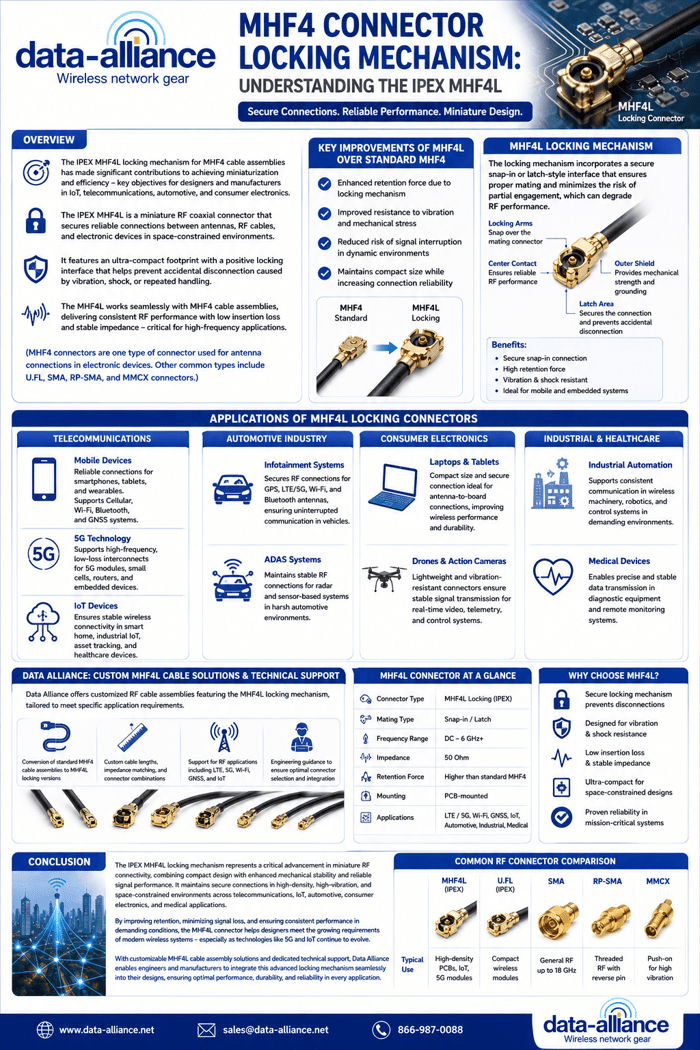
The IPEX MHF4L locking mechanism for MHF4 cable assemblies has made significant contributions to achieving miniaturization and efficiency - key objectives for designers and manufacturers in IoT, particularly in industries like telecommunications, automotive, and consumer electronics.
The IPEX MHF4L locking mechanism is a miniature RF coaxial connector designed to secure reliable connections between antennas, RF cables, and electronic devices in space-constrained environments.
It features an ultra-compact footprint combined with a positive locking interface that helps prevent accidental disconnection caused by vibration, shock, or repeated handling. This makes it especially suitable for high-density PCB layouts and mobile or embedded systems.
The MHF4L is designed to work seamlessly with MHF4 cable assemblies, delivering consistent RF performance with low insertion loss and stable impedance—critical for high-frequency applications.
(MHF4 connectors are one type of connector used for antenna connections in electronic devices. Other common types include U.FL, SMA, RP-SMA, and MMCX connectors.)
Key Improvements of the MHF4L over standard MHF4:
- Enhanced retention force due to locking mechanism
- Improved resistance to vibration and mechanical stress
- Reduced risk of signal interruption in dynamic environments
- Maintains compact size while increasing connection reliability
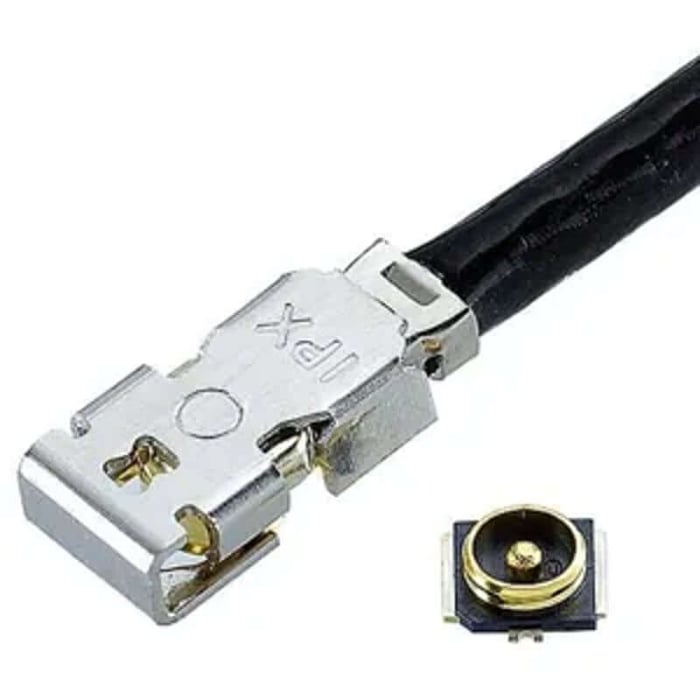
MHF4 Locking Mechanism
The locking mechanism incorporates a secure snap-in or latch-style interface that ensures proper mating and minimizes the risk of partial engagement, which can degrade RF performance. This is particularly important in applications requiring long-term reliability and minimal maintenance.
Applications in Telecommunications
Mobile Devices:
One of the most common applications of the IPEX MHF4L locking mechanism is in mobile devices such as smartphones, tablets, and wearables. These connectors provide reliable signal transmission between internal antennas and the main PCB, supporting Cellular, Wi-Fi, Bluetooth, and GNSS systems.
5G Technology:
With the global rollout of 5G networks, the demand for high-frequency, low-loss interconnects has increased. The IPEX MHF4L locking mechanism supports these requirements by offering strong signal integrity, making it suitable for 5G modules, small cells, routers, and embedded communication devices.
IoT Devices:
IoT deployments depend on stable wireless connectivity. The MHF4L connector ensures consistent performance in smart home systems, industrial IoT, asset tracking, and healthcare monitoring devices, even in environments with vibration or movement.
Automotive Industry
Infotainment Systems:
Modern vehicles rely on multiple antennas for GPS, LTE/5G, Wi-Fi, and Bluetooth. The IPEX MHF4L locking mechanism secures these RF connections, ensuring uninterrupted communication and system performance.
Advanced Driver Assistance Systems (ADAS):
ADAS applications, including radar and sensor-based systems, require high reliability. The MHF4L connector helps maintain stable RF connections in harsh automotive conditions such as temperature fluctuations and vibration.
Consumer Electronics
Laptops and Tablets:
In compact computing devices, internal space is limited. The MHF4L’s small size and secure connection make it ideal for antenna-to-board connections, improving wireless performance and durability.
Drones and Action Cameras:
Lightweight and vibration-resistant components are essential in drones and cameras. The MHF4L connector ensures stable signal transmission for real-time video, telemetry, and control systems.
Industrial and Healthcare Applications
Industrial Automation:
Wireless-enabled machinery and control systems depend on reliable RF connections. The MHF4L locking mechanism supports consistent communication in demanding industrial environments.
Medical Devices:
From diagnostic equipment to remote monitoring systems, medical devices require precise and stable data transmission. The MHF4L connector contributes to system reliability and performance where failure is not an option.
Data Alliance: Custom MHF4L Cable Solutions and Technical Support
Data Alliance offers customized RF cable assemblies featuring the MHF4L locking mechanism, tailored to meet specific application requirements.
Our capabilities include:
- Conversion of standard MHF4 cable assemblies to MHF4L locking versions
- Custom cable lengths, impedance matching, and connector combinations
- Support for RF applications including LTE, 5G, Wi-Fi, GNSS, and IoT
- Engineering guidance to ensure optimal connector selection and integration
Conclusion
The IPEX MHF4L locking mechanism represents a critical advancement in miniature RF connectivity, combining compact design with enhanced mechanical stability and reliable signal performance. Its ability to maintain secure connections in high-density, high-vibration, and space-constrained environments makes it an ideal solution across a wide range of industries, from telecommunications and IoT to automotive, consumer electronics, and medical applications.
By improving retention, minimizing signal loss, and ensuring consistent performance in demanding conditions, the MHF4L connector helps designers meet the growing requirements of modern wireless systems—especially as technologies like 5G and IoT continue to evolve.
With customizable MHF4L cable assembly solutions and dedicated technical support, Data Alliance enables engineers and manufacturers to integrate this advanced locking mechanism seamlessly into their designs, ensuring optimal performance, durability, and reliability in every application.
FAQs
What is the IPEX MHF4L locking mechanism?
The IPEX MHF4L is a miniature RF coaxial connector with an integrated locking feature designed to securely connect antennas to RF cables and PCBs in compact electronic devices.
How does the MHF4L differ from the standard MHF4 connector?
The MHF4L includes a locking mechanism that provides higher retention force, improved resistance to vibration, and reduced risk of accidental disconnection, while maintaining the same compact size as the standard MHF4.
What are the main advantages of using the MHF4L connector?
Key advantages include enhanced connection stability, low insertion loss, consistent impedance, improved durability in dynamic environments, and reliable performance in high-frequency applications.
In which applications is the MHF4L connector commonly used?
The MHF4L connector is widely used in mobile devices, 5G equipment, IoT systems, automotive electronics, laptops, drones, industrial automation, and medical devices.
Is the MHF4L suitable for high-frequency applications like 5G?
Yes, the MHF4L is designed to support high-frequency signals with strong signal integrity, making it suitable for 5G, LTE, Wi-Fi, and GNSS applications.
Can MHF4 and MHF4L connectors be used interchangeably?
While they are similar in size and application, the MHF4L includes a locking feature that requires compatible mating connectors. It is recommended to verify compatibility before replacing one with the other.
Does Data Alliance offer custom MHF4L cable assemblies?
Yes, Data Alliance provides customized MHF4L cable assemblies, including conversions from standard MHF4, custom cable lengths, connector configurations, and engineering support to meet specific application requirements.