





Antennas, Antenna Cables, Wireless Products: Technical Articles
dBi, dB, dBm dB(mW): Defined, Explained and Differentiated
Introduction
Understanding the difference between dB, dBi, and dBm is critical when working with wireless systems, antennas, Wi-Fi equipment, RF amplifiers, and communication networks. These terms are often used interchangeably in casual discussion, but in practice they describe very different aspects of system performance. Misunderstanding them can lead to incorrect antenna selection, regulatory violations, poor signal quality, or inefficient network design.
This article explains each term in detail, preserves their relationships, and provides practical examples to clarify how they are used in real-world RF and wireless applications.
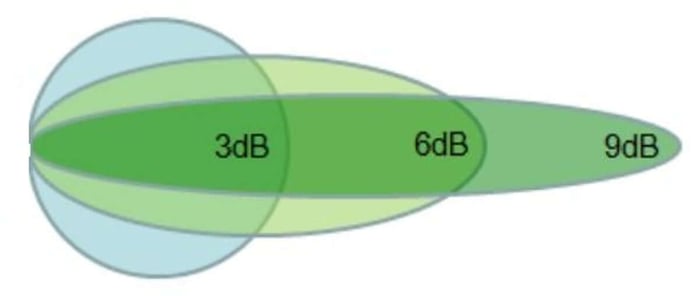
dBi Values Explained:
dBi = dB(isotropic): The forward gain of an antenna, measured in decibels (dBi), The dBi value reflects the antenna's directional / beamwidth characteristics, i.e., directional as opposed to omnidirectional: Generally, the higher the gain (dBi), the narrower the beamwidth - the more directional the antenna.
dBi refers to decibels referenced to an isotropic radiator, which is a theoretical antenna that radiates energy equally in all directions. While an isotropic antenna cannot physically exist, it serves as a perfect baseline for comparing real antennas.
dBi measures how much an antenna focuses energy in a given direction compared to an isotropic antenna.
The dBi value also reflects the antenna's electrical efficiency, differentiating between transmitting and receiving antenna for enhanced characterization of antenna performance.
The forward gain is compared with the hypothetical isotropic antenna, which uniformly distributes energy in all directions. Linear polarization of the EM field is assumed unless noted otherwise.
The dBi value reflects the antenna’s forward gain, which is closely tied to its directional and beamwidth characteristics.
- Higher dBi → narrower beamwidth
- Lower dBi → wider coverage area
This means:
- Low-gain antennas spread energy more evenly (often omnidirectional)
- High-gain antennas concentrate energy into tighter beams (directional)
Importantly, antennas do not create power. They simply redistribute existing power by shaping the radiation pattern.
dBi and Antenna Efficiency
The dBi value also reflects the antenna’s electrical efficiency, incorporating:
- Radiation efficiency
- Losses in materials
- Pattern shaping
This allows dBi to be used to characterize both transmitting and receiving antennas, since antennas are reciprocal devices.
An antenna with higher dBi will both transmit and receive better in its favored direction.Linear polarization of the electromagnetic field is assumed unless otherwise specified.
dB refers to the decibel
dBi refers to decibels measured against an isotropic reference antenna. A good illustration of this is when you are using an application such as a Wi-Fi router. In such an instance, dBi would refer to how effective the WiFi router’s antenna is. Therefore dBi is a term that is used when measuring the relative antenna gain of applications.
dB refers to the decibel, which is the unit of measurement of sound though it is also a relative measure of the power between two levels. Therefore dB is not an absolute measurement but rather a ratio.
dB as a standalone unit represents loss or gain and does not have any dimension. It has to be referenced to something else to provide meaningful measurement.
So, the term "dB" is not a reference but is rather a method and a measurement standard. dB must be used against a standard: dBi & dBm are dB (decibels) measured against a standard:
- dBi (decibels per isotropic dB[isotropic]) is a measure of the forward gain of an antenna: The gain in power emitted by an antenna signal.
- dBm (decibels per milliwatt): The relative power emitted by an amplifier: Refers to decibels as a relative measure of milliwatts.
- There is no direct correlation between watts and dBi. dbm is logarithmic and mw is linear.
dBm dB (mW): dBm is is an expression of power in decibels per milliwatt. We use dBm when we are measuring power emitted from amplifiers. We measure that power in milliwatts which is typically abbreviated as mW.
dB is a comparison, not a quantity.
Key Characteristics of dB
- dB expresses gain or loss
- dB has no units
- dB must be referenced to something else to be meaningful
- dB is logarithmic, not linear
Because it is logarithmic, dB is especially useful in RF and communications systems where power levels can span many orders of magnitude.
dB Formula (Power)
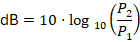
Where:
- P2= output power
- P1= reference power
Examples of dB Usage
- Cable loss: –3 dB (half the power)
- Amplifier gain: +10 dB (10× the power)
- Signal-to-noise ratio (SNR)
- Path loss
- Filter attenuation
Because dB is only a ratio, it must always be tied to a reference to represent an absolute quantity. This is where dBi and dBm come into play.
dBi in Practical Applications (Wi-Fi Example)
dBis tend to vary with the most common indoor WiFi router antennas designed to work at 4-9 dBi, while outdoor antennas range between 15 and 24 dBi. outdoor antennas have better dBis than indoor antennas as they are directional antennas used in point to point and point to multipoint connections.
In applications such as Wi-Fi routers, dBi indicates how effectively the antenna radiates RF energy.
For example:
- A 2 dBi antenna radiates broadly around the router
- An 8 dBi antenna pushes energy farther outward, but with less vertical coverage
This is why replacing router antennas can dramatically change coverage patterns, sometimes improving range in one area while degrading it in another.
Typical dBi Values by Application
- Indoor Wi-Fi antennas: 4–9 dBi
- Outdoor omnidirectional antennas: 6–12 dBi
- Directional panel or Yagi antennas: 12–18 dBi
- Point-to-point dish antennas: 18–24+ dBi
Outdoor antennas typically have higher dBi because they are directional and used for point-to-point or point-to-multipoint links, rather than blanket coverage.
dBi and VSWR
dBi (gain) is related to VSWR in evaluating antennas: VSWR is another very key factor in antenna evaluation.
dBi (gain) is often evaluated alongside VSWR (Voltage Standing Wave Ratio).
- dBi measures how well energy is focused
- VSWR measures how well energy is transferred
A high-gain antenna with poor VSWR may perform worse than a lower-gain antenna with good impedance matching. Both metrics are essential in antenna evaluation.
As such, if you have a WiFi router, dBm measures the power the antenna is emitting, which can play a significant role in how much range the router has. Low dBms provide weak connections and may make working with such a router difficult or even impossible. On the other hand, very high dBms can result in the amplification of interference and background noise, which will result in a poor quality signal. Countries will typically have specific regulations on how much power an antenna may emit.
When used in audio work the milliwatt is referenced to a 600 ohm load, with the resultant voltage being 0.775 volts. When used in the 2-way radio field, the dB is referenced to a 50 ohm load, with the resultant voltage being 0.224 volts. There are times when spec sheets may show the voltage & power level e.g. -120 dBm = 0.224 microvolts.
dBm / dB(mW) is sometimes referred to as decibel milliwatts. The reference finds application in fiber optical communication, microwave and radio networks to express absolute power. It is preferred since it can express both very small and very large values in short form as compared to the BW, whose smallest unit is 1000 mW – one watt.
The unit of measurement is used when measuring absolute power given that it is an absolute unit referenced to the watt. Comparatively, the dB (decibel) is a used for quantifying rations between values such as noise to signal ratio, which makes it a dimensionless unit. The fixed reference value of the dBmW is what makes it an absolute measure.
Tables, Formulas, and Quick-Reference Charts
Key Definitions at a Glance
Term | Full Name | What It Measures | Absolute or Relative | Reference |
dB | Decibel | Ratio of two values (gain or loss) | Relative | None (must be referenced) |
dBi | Decibel isotropic | Antenna forward gain | Relative (fixed reference) | Isotropic antenna |
dBm | Decibel milliwatt | Power level | Absolute | 1 milliwatt (mW) |
mW | Milliwatt | Power | Absolute | Linear unit |
VSWR | Voltage Standing Wave Ratio | Impedance matching | Relative | Transmission line |
dB, dBi, and dBm: Functional Comparison
Characteristic | dB | dBi | dBm |
Measures gain/loss | ✓ | ✓ | ✘ |
Measures antenna directionality | ✘ | ✓ | ✘ |
Measures transmitter power | ✘ | ✘ | ✓ |
Requires reference | Yes | Yes (isotropic) | Yes (1 mW) |
Logarithmic | ✓ | ✓ | ✓ |
Absolute measurement | ✘ | ✘ | ✓ |
dBm to Milliwatts Conversion Chart
dBm | Power (mW) | Power (W) |
-30 dBm | 0.001 mW | 1 µW |
-20 dBm | 0.01 mW | 10 µW |
-10 dBm | 0.1 mW | 100 µW |
0 dBm | 1 mW | 0.001 W |
10 dBm | 10 mW | 0.01 W |
20 dBm | 100 mW | 0.1 W |
30 dBm | 1,000 mW | 1 W |
36 dBm | 4,000 mW | 4 W |
The symbol µW means microwatt.
What µW Stands For
- µ (Greek letter mu) = micro = one-millionth (10⁻⁶)
- W = watt, a unit of power
How µW Fits Into Power Measurements
Unit | Symbol | Watts |
Watt | W | 1 W |
Milliwatt | mW | 0.001 W (10⁻³) |
Microwatt | µW | 0.000001 W (10⁻⁶) |
Nanowatt | nW | 0.000000001 W (10⁻⁹) |
Common dBm Reference Points (Wireless Systems)
Application | Typical dBm |
Wi-Fi router (consumer) | 15–23 dBm |
Cellular handset | 23–28 dBm |
IoT LPWAN device | 10–20 dBm |
Receiver sensitivity | –90 to –130 dBm |
Noise floor (room temp) | ≈ –174 dBm/Hz |
Antenna Gain (dBi) and Coverage Characteristics
Antenna Type | Typical dBi | Radiation Pattern |
PCB antenna | 1–3 dBi | Near-omnidirectional |
Rubber duck | 2–5 dBi | Omnidirectional |
Indoor Wi-Fi antenna | 4–9 dBi | Semi-directional |
Outdoor omni | 6–12 dBi | Flattened doughnut |
Panel antenna | 8–14 dBi | Directional |
Yagi antenna | 10–18 dBi | Highly directional |
Parabolic dish | 18–30+ dBi | Narrow beam |
Beamwidth vs Gain (Rule of Thumb)
Gain (dBi) | Approx. Beamwidth |
2 dBi | ~360° |
5 dBi | ~120° |
8 dBi | ~60° |
12 dBi | ~30° |
18 dBi | ~10° |
24 dBi | ~5° |
FAQs
What is the difference between dB, dBi, and dBm?
dB is a dimensionless ratio used to express gain or loss.
dBi is dB referenced to an isotropic antenna and measures antenna gain and directionality.
dBm is dB referenced to 1 milliwatt and represents absolute power output.
They describe different aspects of RF systems and are not interchangeable.
What does dBi measure in an antenna?
dBi measures antenna forward gain relative to an isotropic radiator. It indicates how effectively an antenna focuses RF energy in a specific direction compared to an ideal, uniform radiator. Higher dBi means more directionality and narrower beamwidth.
Does a higher dBi antenna create more power?
No. Antennas do not create power. A higher dBi antenna simply redistributes existing power by concentrating energy into a narrower radiation pattern, increasing signal strength in certain directions while reducing it elsewhere.
How is beamwidth related to dBi?
Beamwidth and dBi are inversely related:
- Higher dBi → narrower beamwidth
- Lower dBi → wider coverage
Low-gain antennas provide broad, omnidirectional coverage, while high-gain antennas are more directional and suited for point-to-point links.
What is dBm and how is it used?
dBm is an absolute power measurement referenced to 1 milliwatt. It is commonly used to describe transmitter output power, receiver sensitivity, and signal levels in RF, Wi-Fi, cellular, and IoT systems.
Example: 20 dBm = 100 mW.
Why is dB considered a relative measurement?
dB expresses the ratio between two values, not a standalone quantity. By itself, dB has no meaning unless it is referenced to something, such as:
- dBi (isotropic antenna)
- dBm (1 milliwatt)
How do dBi and VSWR relate to antenna performance?
dBi measures how well energy is focused, while VSWR measures how efficiently energy is transferred from the transmitter to the antenna.
A high-gain antenna with poor VSWR can perform worse than a lower-gain antenna with good impedance matching. Both metrics must be evaluated together.
What dBi values are typical for Wi-Fi and outdoor antennas?
Typical antenna gain ranges include:
- Indoor Wi-Fi antennas: 4–9 dBi
- Outdoor omnidirectional antennas: 6–12 dBi
- Directional panel or Yagi antennas: 12–18 dBi
- Point-to-point dish antennas: 18–24+ dBi
Outdoor antennas generally have higher dBi because they are directional and designed for longer-distance links.