




Antennas, Antenna Cables, Wireless Products: Technical Articles
Coax Cable Types for Video and Audio: RG-59 and RG-179 BNC Cables
Table of Contents
Coaxial Cables for CCTV, Video, Audio
Coaxial cables, commonly referred to as coax cables, have long been the standard in numerous connectivity applications. They are essential for transmitting radio frequency (RF) signals, which can include anything from CCTV video feeds and broadcast signals to IoT communications and data transmission systems. Specifically, 75 Ohm coax cables are exceptionally versatile, and their application scope has only broadened with time as new technologies continue to rely on stable, low-loss signal transport.
At Data Alliance, coaxial cables remain a core component in many wireless and wired system designs. Whether supporting legacy video infrastructure or integrating with modern IoT wireless solutions, selecting the correct coax cable type is critical for maintaining signal quality, minimizing loss, and ensuring long-term reliability.
BNC Cables and Their Multifarious Uses
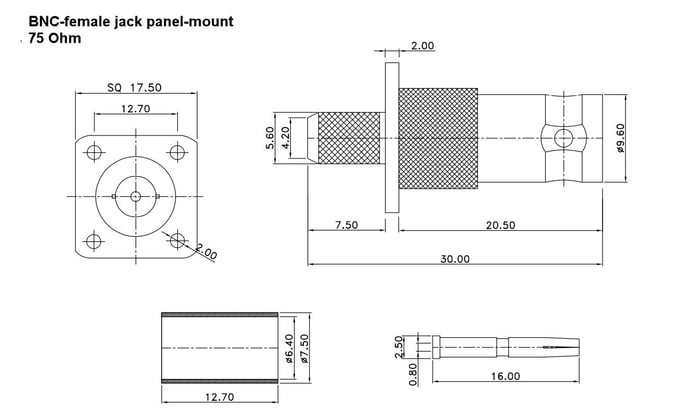
One of the most widely used connectors for 75 Ohm coax cables is the Bayonet Neill-Concelman (BNC) connector. Originally developed for military applications, BNC connectors are valued for their quick-connect, secure locking mechanism and consistent impedance performance. Today, BNC cables are commonly used across multiple industries due to their reliability and ease of installation.
CCTV and Security Cameras
One of the hallmark applications of BNC extension cables is in closed-circuit television (CCTV) and security camera systems. RG-59 and RG-179 BNC cables are frequently used to connect cameras to DVRs or monitoring equipment. Their ability to transmit video signals over moderate to long distances with minimal signal degradation makes them a preferred choice for surveillance systems in commercial, industrial, and residential environments.
Video Transmission
Beyond security systems, 75 Ohm BNC cables and BNC adapters play a significant role in professional video transmission. They are widely used in broadcast studios, video production environments, and test equipment setups. Their consistent impedance helps prevent signal reflections and ensures clean video output, which is especially important in high-quality analog and digital video applications.
Audio Applications
Though less common, BNC male-to-male cables can also be used in specialized audio applications. In professional environments where timing, synchronization, or digital signal integrity is critical—such as studio clock distribution or digital audio interfaces—BNC connectors provide a reliable solution.
Test Equipment and RF Systems
In addition to video and audio, BNC cables are frequently used in RF test equipment, oscilloscopes, and signal generators. At Data Alliance, these applications often intersect with antenna testing and wireless system validation, where accurate signal measurement is essential.
Key Features of 75 Ohm Coax Cables
Signal Integrity
One of the primary strengths of coax cables is their ability to maintain signal integrity. The coaxial design provides excellent shielding against electromagnetic interference (EMI) and radio frequency interference (RFI), ensuring that signals remain stable even in electrically noisy environments. This is especially important in IoT deployments and RF systems where interference can degrade performance.
Durability
Coaxial cables are built with multiple protective layers, including a central conductor, dielectric insulation, shielding, and an outer jacket. This construction makes them robust and capable of withstanding physical stress, environmental exposure, and long-term use in both indoor and outdoor installations.
Versatility
75 Ohm coax cables support both analog and digital signals, making them adaptable across a wide range of applications. From legacy CCTV systems to modern wireless infrastructure and antenna feed lines, these cables continue to serve as a dependable transmission medium.
Ease of Installation
With standardized connectors like BNC, coax cables are relatively easy to install and maintain. This reduces installation time and simplifies troubleshooting, which is valuable in both field deployments and technical support scenarios.
Composition and Materials
The performance of a coax cable is directly influenced by its construction and materials. Each layer plays a specific role in signal transmission and protection:
Central Conductor
Typically made of solid or stranded copper (or copper-clad steel), the central conductor carries the RF signal. Solid conductors are often preferred for better conductivity and lower loss, while stranded conductors offer greater flexibility.
Insulation (Dielectric)
Surrounding the conductor, the dielectric layer—commonly made of polyethylene or foam—maintains spacing and prevents signal leakage. The quality of this material directly affects impedance stability and signal loss.
Shielding
The shielding layer, often composed of braided copper, aluminum, or foil, protects the signal from external interference. Higher shielding coverage improves noise rejection, which is critical in high-interference environments such as industrial facilities or dense electronic installations.
Outer Jacket
The outer jacket provides mechanical protection and environmental resistance. Materials such as PVC or polyethylene are commonly used, with options available for UV resistance, direct burial, or plenum-rated installations depending on the application.
Types of Coax Cables
While there are several types of coax cables available, the most common 75 Ohm cables used for video and related applications include:
RG-59
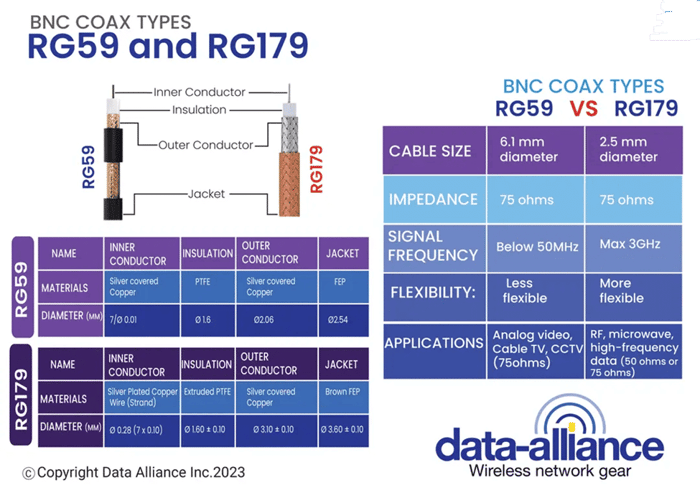
RG-59 is one of the most widely used coax cables for CCTV and baseband video applications. It offers a good balance between performance and cost and is suitable for short to medium-distance runs. RG-59 is commonly used in analog camera systems and remains prevalent in many existing installations.
RG-179
RG-179 is a thinner, more flexible alternative to RG-59. Its smaller diameter makes it ideal for tight routing environments, compact installations, or applications where space is limited. While it has slightly higher signal loss compared to RG-59, its flexibility makes it valuable in specialized video and RF applications.
RG-6
RG-6 is commonly used for cable television, satellite systems, and broadband internet connections. It has lower attenuation than RG-59, making it better suited for longer runs and higher-frequency applications.
RG-11
RG-11 features a larger diameter and lower signal loss, making it ideal for long-distance runs. It is often used in backbone cabling or infrastructure where minimizing attenuation is critical.
Choosing the Right Coax Cable
Selecting the appropriate coax cable depends on several factors:
- Distance: Longer runs require lower-loss cables such as RG-6 or RG-11.
- Flexibility: Tight installations benefit from smaller cables like RG-179.
- Application Type: CCTV systems typically use RG-59, while broadband systems use RG-6.
- Environment: Outdoor or industrial installations may require specialized jackets and enhanced shielding.
At Data Alliance, technical support often involves helping customers match the correct coax cable with antennas, connectors, and wireless equipment to ensure optimal system performance.
In Conclusion
The resilience and adaptability of 75 Ohm coax cables, especially when paired with BNC connectors, demonstrate their continued relevance across both legacy and modern technologies. From traditional CCTV and broadcasting systems to RF testing and IoT infrastructure, coaxial cables remain a foundational component in reliable signal transmission.
As wireless systems evolve, coax cables continue to serve as the critical link between antennas, devices, and infrastructure. Their proven performance, durability, and versatility ensure that they will remain an essential part of connectivity solutions for years to come—bridging the gap between established technologies and the rapidly expanding world of IoT and wireless communication.
FAQs
What is the difference between RG-59 and RG-179 coax cables?
RG-59 is a standard 75 Ohm coax cable commonly used for CCTV and video applications, offering a good balance between performance and cost for short to medium distances. RG-179, on the other hand, is thinner and more flexible, making it ideal for tight routing spaces or compact installations, though it has slightly higher signal loss compared to RG-59.
What are BNC connectors used for in coax cable applications?
BNC connectors are widely used for secure and reliable connections in video, CCTV, RF, and test equipment applications. Their bayonet locking mechanism allows for quick installation while maintaining consistent 75 Ohm impedance, which helps preserve signal quality.
Can coax cables be used for both video and audio signals?
Yes, 75 Ohm coax cables can transmit both video and certain types of audio signals. While they are most commonly used for video (such as CCTV and broadcasting), they are also used in specialized audio applications where signal integrity and synchronization are critical.
Why are 75 Ohm coax cables commonly used in CCTV systems?
75 Ohm coax cables provide excellent signal integrity and low interference, making them ideal for transmitting video signals over distance without significant degradation. This reliability is why they are widely used in CCTV and surveillance systems.
What factors should be considered when choosing a coax cable?
Key factors include cable length (distance), flexibility requirements, application type (CCTV, broadcast, RF), and environmental conditions (indoor vs. outdoor). For example, RG-59 is commonly used for CCTV, while RG-179 is preferred in tight installations where flexibility is important.
How does coax cable construction affect performance?
The performance of a coax cable depends on its components, including the central conductor, dielectric insulation, shielding, and outer jacket. High-quality materials and proper shielding help reduce signal loss and protect against interference, ensuring reliable transmission in demanding environments.