




Antennas, Antenna Cables, Wireless Products: Technical Articles
Cellular Wireless Technologies: 5G, LTE / 4G, GSM / 3G, 2G and 6G
Table of Contents
Cellular Wireless Technology Explained
Cellular wireless technology underpins modern mobile communications, IoT deployments, and industrial connectivity worldwide. From early analog voice systems to today’s ultra-high-speed, low-latency networks, cellular technology has evolved through multiple generations—each enabling new services, applications, and performance improvements. This article explores the evolution of cellular wireless technology from 0G through emerging 6G, highlighting key features, capabilities, and real-world use cases.
Cellular networking has become essential for the high throughput data transfer needed to support not only communication and entertainment but commercial and industrial activity. In this article, we review the key cellular technologies in widespread use and provide top tips on how you can improve your cellular data signal and cellular network performance.
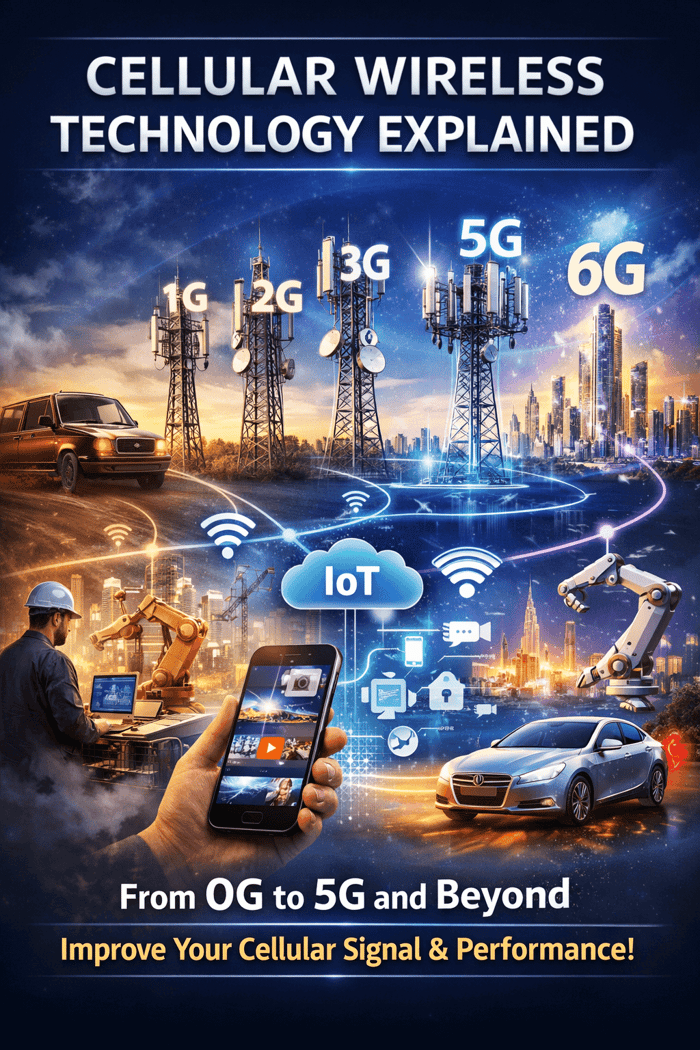
An overview of the cellular networking technology generations.
Cellular Technology Timeline (Summary View)
- 0G: Pre-cellular mobile radio telephony (vehicle-based, analog)
- 1G: Analog cellular voice (AMPS)
- 2G: Digital voice and SMS (GSM, GPRS, EDGE)
- 3G: Mobile data and multimedia (UMTS, W-CDMA)
- 4G: Broadband IP networking (LTE, LTE-Advanced)
- 5G: Ultra-low latency, massive IoT, high-capacity networks
- 6G (future): Terahertz frequencies, AI-driven networking
What is 0G mobile telephony?
Pre-cellular telephony now carries the designation of zero generation. It is also known as the Mobile Radio Telephone System and is essentially the first form of wireless telephony that was part of public switched telephone networks complete with individual telephone numbers. Mobile radio telephones were typically installed in vehicles and connected via the first commercial mobile telephone services provided by companies like Motorola and Bell.
What is 1G cellular?

1G stands for first-generation and denotes the first generation of mobile cellular technology. 1G differs from all subsequent forms of cellular communications technology because it is an analog rather than a digital cellular system. First released in Japan in the 1980s, this voice communication technology uses analog modulation. This involves taking a low-frequency audio signal and transferring it over a higher frequency carrier signal (upwards of 150 MHz) so it can travel longer distances. These early cellular systems typically consisted of:
- A network of cell sites, which cover the network service area and has direct wireless communication with networked mobile phones within its territory.
- A Mobile Switching Center (MSC) which performs the work of correctly routing voice calls either to another mobile phone or to a landline via the public switched telephone network.
- Mobile telephones (radios).
1G cellular technology has been permanently discontinued apart from a few isolated regions in central Asia. Despite its initial utility, notable disadvantages included its lack of security, limited user capacity, poor battery life, and large and unwieldy phones. The 1G communications standard known as the Advanced Mobile Phone System (AMPS) was superseded by 2G within a decade.
What is 2G?

Second generation cellular networks were introduced in the 1990s and harness digital means if data modulation and encryption to transfer both voice calls and data packets. Data is transferred digitally using the frequency shift keying technique where rapid alternation between two frequencies is used to send binary encoded (0s and 1s) data packets. The switch to digital connectivity with the network of cellular radio towers improved the efficiency of use of the radio spectrum with more phones able to simultaneously use each frequency band and the expansion of data services to initially include SMS and MMS. Second generation networks largely operate under the Global Standard for Mobile Communications (GSM) and use two notable technologies for data rates of up to 384 k/bits per second:
- General Packet Radio Service or GPRS is a ‘2.5G’ standard that directs the transfer of data packets which not only facilitates multimedia communications and connectivity on cellular networks but also the bi-directional transfer of data with external networks like the internet. Its data rate is 40 kbit/sec. GPRS has enabled cellular network operators to provide internet access, instant messaging, and multimedia messaging. GPRS relies on several protocols to achieve this including Internet Protocol (IP), Wireless Application Protocol (WAP), Point to Point, and Point to Multipoint protocols that support group calls.
- Enhanced Data Rates for GSM Evolution (EDGE) is an alternate extension for GSM (sometimes termed ‘2.75G’)which provides increased data rates for 2G networking. Though it was released in 2003 it is backward compatible and enables increased data rates for 2 G technology of over 350 k/bits per second.
Despite newer generations, 2G networks are still used today for legacy systems such as basic M2M communications, SMS-based monitoring, and fallback voice services in remote regions.
What is 3G?

Third-generation cellular technology, otherwise known as 3G builds on the advancement of the 2.5G networks to support higher throughput and speeds of data transfer. This enables 3G network operators to deliver a wider range of services including:
- Mobile internet access
- Voice over internet protocol
- Video calls
- Mobile TV
3G also carries increased robustness of security compared to previous generations with user equipment authentication and end to end securing of communications. Services are delivered across allocated portions of the radio spectrum between 400 MHz and 3 GHz. The standards that underpin 3G cellular connectivity, the International Mobile Telecommunications-2000 (IMT-2000) specifications, were devised by the and released by the International Telecommunication Union and realized data transfer speeds of 144 kbit/s minimum. Mbit/sec bit rates were soon achieved by subsequent releases. Its first release was in Japan in 2001.
3G is underpinned by the following notable technologies:
- EDGE: The EDGE extension, released with second-generation networking already fulfilled 3G specifications.
- The Universal Mobile Telecommunications System (UMTS) is based on the GSM standard and specifies all aspects of cellular networking including the radio access network, core network functionality, and user authentication by SIM card. It is capable of supporting data transfer rates of up to 42 Mbit/sec
- Wideband Code Division Multiple Access (W-CDMA) is a channel access method that allows multiple access data transfer of voice, text, MMS, and video streaming over a single channel using multiple transmitters.
What is 4G?

4G stands for the fourth generation and is a broadband cellular networking technology that has largely overtaken 3G with expanded capabilities in mobile telephony and internet access as outlined in the ITU standard,
- Network-wide use of IP-based packet switching
- Scalable bandwidth usage between 20 and 40 MHz and responsive accommodation of more users within each cell.
- Data rates of 100 Mbit/sec if a network user is moving and up to 1Gbit/sec if stationary
- Seamless roaming across networks and geographic territories globally.
4G is reliant on several physical layer networking innovations that support the vastly increased speeds and throughput offered including multi-antenna MIMO, modulation techniques like Orthogonal Frequency Division Multiplexing (to encode transmitted data on multiple carrier frequencies), and error-correcting codes, to minimize noise, interference, and drop-outs during signal transmission.
LTE vs 4G
Long Term Evolution is a contemporaneous technology to 4G but does not meet the requirement of the IMT Advanced standard in some areas. LTE offers peak download speeds of 100 Mbits/sec and is reliant on MIMO antenna arrays for optimal connectivity. LTE-advanced is an upgraded standard that aims to exceed the IMT Advanced standard by modifying LTE networks to utilize additional portions of the spectrum and harness multiplexing to improve performance and speed.
4G LTE is widely used for mobile broadband, fixed wireless access (FWA), video streaming, mobile hotspots, and many IoT gateways requiring moderate latency and high reliability.
What is 5G?
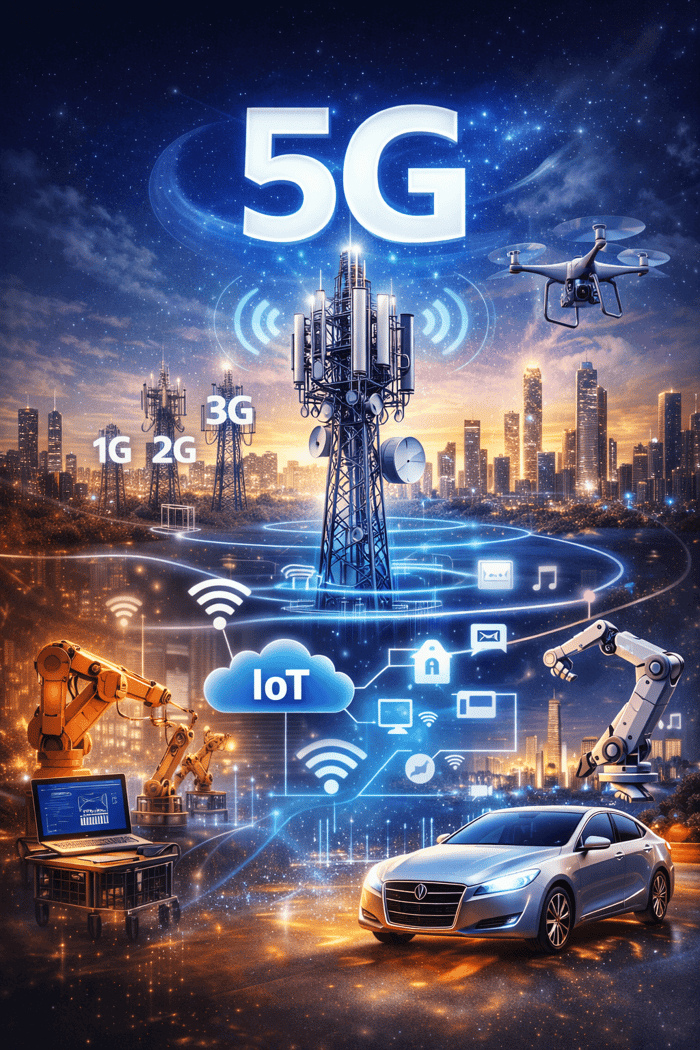
Late 2018 saw the introduction of 5G New Radio (5GNR), the fifth generation of cellular networking technology. The newest generation of cellular communication overhauls the previous 4 generations and uses the cellular network as a mature internet service provider capable of not only serving telephony and broadband connectivity but supporting infrastructure and industrial applications such as the Internet of Things, M2M networking, and C-V2C. The networking standards for 5G are authored by the third generation partnership project (3GPP) with a contribution from the ITU. 5G connectivity is via radio communication with local cellular antennas and is expected to deliver 10 Gbit/sec download speeds once fully realized. Greater capacity and bandwidth is achieved by using more of the radio frequency spectrum with frequency bands well into the gigahertz range. The use of higher frequencies which generally have lower range and penetration necessitates a greater density and variety of cells which can operate at high medium and low frequency depending on capacity and the fastest speeds that can be achieved at specific frequency bands. Full implementation of 5G connectivity as specified will require a new class of compatible devices.
5G enables advanced use cases including smart cities, autonomous vehicles, industrial automation, real-time robotics, private cellular networks, and massive IoT deployments.
Cellular Technology Comparison
Generation | Peak Speed | Latency | Primary Use |
1G | Voice only | High | Analog voice |
2G | <400 kbps | High | Voice, SMS |
3G | ~42 Mbps | Medium | Mobile internet |
4G | 100 Mbps–1 Gbps | Low | Broadband data |
5G | Up to 10 Gbps | Ultra-low | IoT, automation |
6G | TBD | Near-zero | AI-driven networks |
What is 6G?
The sixth generation of cellular networking technology will supersede 5G, which is currently only just commencing global deployment. Slated for an appearance at some point in the 2030s, it is expected to deliver far greater speeds, multi-gigahertz frequencies, and network capacity with latency further lowered. A drastic reduction in cell size with more complex MIMO antenna networking and novel modulation techniques are postulated as key means that will be used to underpin a future 6G network. The United States, South Korea, China, and Finland are currently noted for their efforts to devise globally adopted sixth-generation networking standards.
Improving Cellular Signal Performance
Cellular network performance can often be improved through proper antenna selection, placement, and signal conditioning. External antennas, MIMO configurations, low-loss coaxial cables, and band-specific filters all play an important role in optimizing throughput, signal strength, and reliability—especially for industrial and IoT applications.
Conclusion
Cellular wireless technology continues to evolve to meet growing demands for speed, reliability, and scalability. From early analog voice systems to future AI-enabled networks, each generation has expanded what is possible across consumer, commercial, and industrial applications. Understanding these technologies enables better planning, deployment, and optimization of modern wireless systems—especially as IoT and machine-to-machine communications continue to grow.
FAQs
What is cellular wireless technology?
Cellular wireless technology is a communication system that uses a network of cell sites to provide voice, data, and internet connectivity to mobile devices. It underpins modern mobile communications, IoT deployments, and industrial connectivity by enabling wireless data transfer over wide geographic areas.
What is the difference between 0G, 1G, and modern cellular networks?
0G and 1G were early analog systems primarily used for voice communication, often installed in vehicles and lacking encryption or data services. Modern cellular networks (2G and beyond) are digital, support data transmission, offer higher capacity, improved security, and enable services such as mobile internet, multimedia, and IoT connectivity.
Are 2G and 3G networks still in use today?
Yes, in some regions. While many carriers are phasing them out, 2G networks are still used for legacy applications such as basic M2M communication, SMS-based monitoring, and fallback voice services in remote areas. 3G networks are increasingly being retired in favor of 4G and 5G.
What makes 4G different from earlier generations?
4G introduced broadband, IP-based packet switching, significantly higher data rates, lower latency, and support for technologies like LTE, MIMO, and OFDM. These advancements enabled high-quality video streaming, mobile broadband, fixed wireless access, and more reliable data services.
How is 5G different from 4G LTE?
5G offers much higher peak speeds, ultra-low latency, and the ability to support massive numbers of connected devices. Unlike 4G, which primarily enhanced mobile broadband, 5G is designed to support advanced use cases such as smart cities, industrial automation, autonomous vehicles, private cellular networks, and massive IoT deployments.
What is 6G and when is it expected to be available?
6G is the next generation of cellular wireless technology expected to emerge in the 2030s. It is anticipated to use multi-gigahertz and terahertz frequencies, deliver extremely low latency, and incorporate AI-driven networking. Several countries, including the United States, South Korea, China, and Finland, are actively researching 6G standards.
How can cellular signal strength and performance be improved?
Cellular performance can be improved through proper antenna selection and placement, using external or MIMO antennas, low-loss coaxial cables, and band-specific filters. These techniques are especially important for industrial, fixed wireless, and IoT applications where reliability and throughput are critical.