



Antennas, Antenna Cables, Wireless Products: Technical Articles
Small Cell Cellular Networking Technology
Table of Contents
Small Cell Cellular Networking Technology: How 5G Densification Works in 2026
What Is a Small Cell?
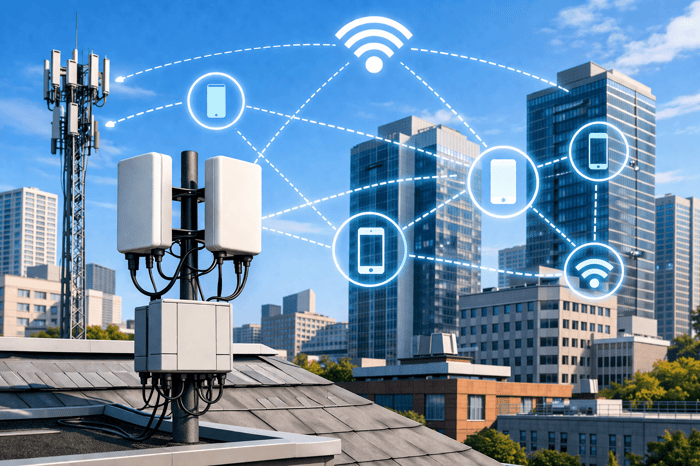 Small Cell Cellular Networking Technology
A small cell is a compact, low-power cellular radio that functions as a base station. Think of it as a miniature cell tower built for a focused service area rather than regional coverage. Like a macrocell, it delivers MIMO, beamforming, LTE, and 5G NR — just at a smaller scale.
Coverage ranges from 10 meters to around 2 kilometers depending on type. Macrocells reach for miles. Small cells can run on licensed carrier spectrum, shared spectrum (CBRS at 3.5 GHz in the U.S.), or unlicensed bands. That flexibility is what makes them the backbone of both carrier densification and private enterprise LTE/5G networks.
One thing we flag early with every customer: small cells need backhaul. Wired Ethernet, fiber, or fixed wireless — the radio still has to reach the core network. Backhaul is often the hidden cost in a deployment.
| Small Cell | Macrocell | |
|---|---|---|
| Coverage | 10 m – 2 km | 1 – 30+ miles |
| Power | 100 mW – 5 W | 20 – 40+ W |
| Mount height | Under 45 ft | Up to 200 ft |
| Deployment | Days to weeks | Months to years |
Small Cell vs. Cellular Booster
This one comes up weekly on our support line.
A cellular booster is a repeater. Donor antenna outside, amplifier in the middle, indoor antenna rebroadcasting the amplified signal. No signal outside means no signal inside — boosters can't create coverage where none exists.
A small cell creates its own signal. It's a real base station generating its own cellular footprint, the same way a tower does. If a stadium has dead zones in the upper deck, a booster won't fix it without a donor signal. A small cell will.
The Four Types of Small Cells
Femtocells are the smallest — palm-sized, around 100 mW, covering 30 to 160 feet. Home and small-office use. They piggyback on existing broadband for backhaul and typically support 8-16 users.
Picocells are bigger, roughly the size of a ream of paper. 250 mW, coverage up to 650 feet, capacity for around 70 devices. Common inside hotels, aircraft, and mid-size commercial buildings where macrocell signal struggles.
Microcells push further — 2 to 5 watts, up to 2 km (1.2 miles) of coverage with wired or fiber backhaul. Malls, transit stations, and stadiums are the usual applications.
Metrocells are the outdoor cousins. Mounted on lampposts, bus shelters, and building façades in cities, they operate on licensed spectrum and are managed by carriers. Coverage runs around 650 feet with low visual impact — the reason planners prefer them over new tower builds.
Why Small Cells Matter in 2026
Three forces are pushing this hard.
Indoor usage dominates. Over 80% of mobile data is now consumed indoors, and modern building insulation and low-E glazing block cellular signal far more than older construction. Small cells solve this by putting the base station inside the building.
Macrocell permits are slow. Getting a new tower approved can take years. A metrocell mounted on a lamppost clears permitting in weeks, which is why carriers are densifying with small cells rather than building towers.
CBRS and private networks are expanding fast. The 3.5 GHz CBRS band lets enterprises deploy their own LTE/5G networks without carrier contracts — warehouses, ports, campuses, hospitals. Our cellular antenna orders have shifted noticeably toward integrator and systems-builder customers over the last two years.
One note on the peer-to-peer model: Helium's CBRS 5G program — privately owned gateways earning crypto rewards for providing coverage — wound down in January 2026, transitioning CBRS radio owners to Wi-Fi hotspots. The CBRS band itself remains fully active for carriers, WISPs, and private LTE.
From the Field: A Stadium Deployment
A regional systems integrator we've supplied for several years called last spring about a 15,000-seat arena with chronic dead zones in the upper bowl. The internal antennas on their picocells covered concourses fine but couldn't punch up to the nosebleeds. They switched to external panel antennas on our recommendation — shrouded panels with SMA connectors, mounted on existing catwalks. Final count dropped from 48 picocells to 34. They saved roughly a third on hardware and a meaningful chunk on the recurring site-maintenance contract. The antenna choice, not the radio, was what moved the numbers.
Antennas for Small Cells
Every small cell radio ships with an internal antenna. It's convenient and reduces footprint, but it's also lower gain and fixed-tilt. You can't adjust it to concentrate the beam where you actually need coverage.
An external antenna — connected via the SMA connector on most small cell radios — gives you three things: higher gain, variable tilt, and better directionality. For outdoor metrocell installs, that usually means a panel or sectoral antenna. For stadiums and malls, shrouded Yagi antennas or discreet canister omnidirectional designs. For outdoor deployments exposed to weather, weatherproof cellular antennas are non-negotiable — a 1% antenna failure rate across a 2,000-node network means 20 truck rolls, and those add up fast.
For over 20 years, we've been supplying RF antenna gear to integrators, WISPs, and carriers across North America. Browse our cellular antenna inventory or email us with your deployment specs — we'll help you pick.
FAQs
What is a small cell in simple terms?
A small cell is a compact, low-power cellular base station that provides targeted coverage in a small area — inside a building, along a city block, or across a venue — rather than the miles-wide coverage of a traditional cell tower.
How far does a small cell reach?
Range depends on type: femtocells cover 30-160 feet, picocells up to 650 feet, microcells up to 2 km, and metrocells around 650 feet outdoors. Power output and antenna choice both affect real-world coverage.
Do small cells need external antennas?
Not always, but for anything beyond a home femtocell, external antennas typically deliver better coverage, higher gain, and adjustable tilt — often reducing the total number of small cells a deployment needs.
What connector do small cell antennas use?
Most small cell radios use SMA connectors for external antenna connections, though some commercial units use N-type. Always verify the connector on your specific radio before ordering cables.
What's the difference between a small cell and Wi-Fi?
Small cells use licensed or CBRS cellular spectrum and integrate with carrier networks for true mobile handoff. Wi-Fi uses unlicensed spectrum and requires device-level authentication — there's no seamless handoff from a macrocell.