





Antennas, Antenna Cables, Wireless Products: Technical Articles
Antenna Beamwidth
Table of Contents
Beamwidth of an Antenna: Definition, Characteristics, and Practical Applications.
Beamwidth is one of the most important parameters used to describe an antenna’s radiation pattern and overall performance. In simple terms, beamwidth represents the angular region over which an antenna radiates most of its power, typically illustrated by the main lobe of the antenna’s radiation pattern.
Beamwidth can be measured in either the horizontal plane (azimuth) or the vertical plane (elevation). It is commonly defined as the angular distance between two points on the main lobe where the radiated power drops to less than half (–3 dB) of the maximum value. This measurement provides a standardized way to describe how focused or spread out an antenna’s energy is in space.
Understanding antenna beamwidth is critical in wireless system design because it directly affects coverage area, signal strength, interference, and link reliability.

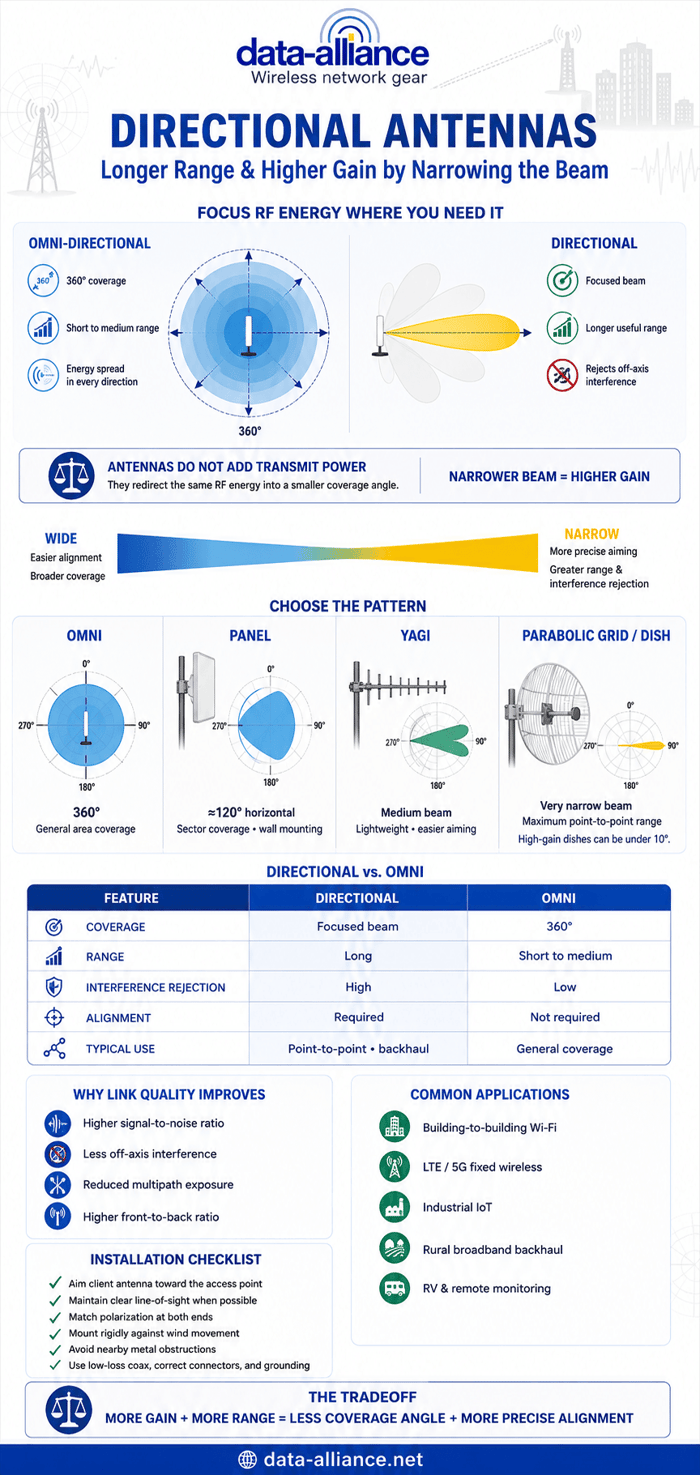
Beamwidth varies with the physical and electronic characteristics of an antenna such as type, design, orientation and frequency. It may be horizontal (azimuth) or vertical (elevation) or in the case of omni-directional antennas around 360 degrees horizontally. Directional antennas focus the RF energy in a specific direction, with the bandwidth inversely proportional to the level gain or directivity of the antenna.
Visualizing Beamwidth in an Antenna Radiation Pattern
Antenna beamwidth is best understood by examining a radiation pattern diagram, which graphically shows how RF energy is distributed around the antenna. The strongest energy appears in the main lobe, while smaller amounts of energy appear in side lobes and back lobes.
In practical terms:
- A wide beamwidth means the antenna radiates energy over a broad area.
- A narrow beamwidth means the antenna concentrates energy into a more focused direction.
This tradeoff between coverage and focus is fundamental to antenna design and selection.
Practical Applications of Beamwidth
Beamwidth is a highly useful analytical parameter in many real-world RF and wireless applications, including:
- Planning antenna coverage within a defined geographic area
- Determining potential interference between neighboring antennas
- Optimizing link performance for point-to-point and point-to-multipoint systems
- Designing indoor and outdoor wireless networks
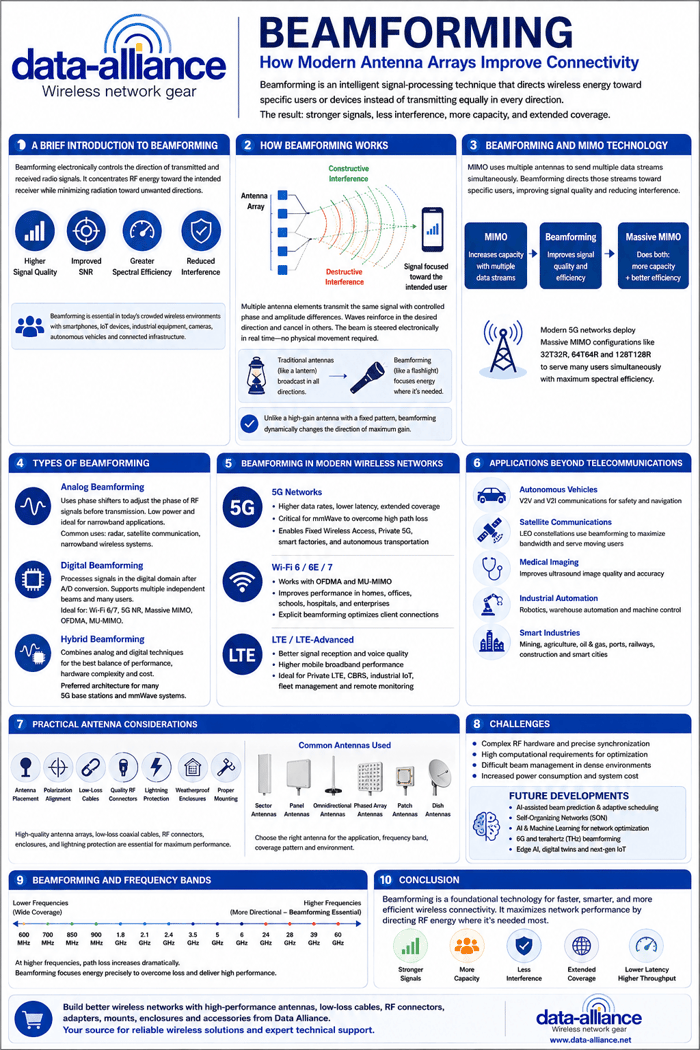
- Deploying cellular, Wi-Fi, LoRa, LTE, and 5G systems
- Supporting network mobility and handoff planning
- Evaluating antenna resolution and spatial selectivity
By understanding beamwidth, engineers can more accurately predict where signal strength will be strongest and where coverage may drop off.
Key Beamwidth Measurements
Within the concept of beamwidth, two additional parameters are especially important:
1. Half Power Beamwidth (HPBW)
Half Power Beamwidth (HPBW) is defined as the angle between the two points on the main lobe where the radiated power drops by 3 dB (50%) from its peak value.
Key characteristics of HPBW:
- Represents the most usable and consistent portion of the antenna’s radiation
- Closely related to antenna gain
- Widely used in antenna specifications and system design
- Helps determine sector overlap in multi-antenna and cellular deployments
When planning antenna arrays or sectorized networks, HPBW often defines the crossover region between adjacent sectors to ensure continuous coverage without excessive interference.
2. First Null Beamwidth (FNBW)
First Null Beamwidth (FNBW) is the angular separation between the first nulls (points of minimum radiation) on either side of the main lobe.
FNBW is useful for:
- Assessing interference potential
- Understanding side-lobe behavior
- Evaluating antenna selectivity and spatial rejection
While HPBW focuses on usable signal strength, FNBW helps define the overall spatial footprint of the antenna’s radiation pattern.
What is the relationship between beamwidth and gain?
Beamwidth and gain are fundamentally linked. Antenna gain describes how efficiently an antenna directs RF energy compared to a reference antenna (usually isotropic or dipole).
The relationship can be summarized as:
- Narrower beamwidth → Higher gain
- Wider beamwidth → Lower gain
Reducing beamwidth concentrates RF energy into a smaller angular region, increasing power density in that direction. This is why high-gain antennas are commonly used for long-distance wireless links, while low-gain antennas are used for local coverage.
Beamwidth and Signal Strength Prediction
When the antenna’s beamwidth and orientation are known, engineers can more accurately estimate:
- Expected signal strength
- Coverage boundaries
- Fade margins
- Link reliability
This makes beamwidth a critical parameter in RF link budgeting and network planning.
Beamwidth and Signal-to-Noise Ratio (SNR)
Because beamwidth directly affects gain and directivity, it also has a significant impact on the signal-to-noise ratio (SNR).
- Narrowing the beamwidth increases gain
- Increased gain strengthens the desired signal
- Reduced off-axis reception lowers unwanted noise and interference
- Resulting SNR improves
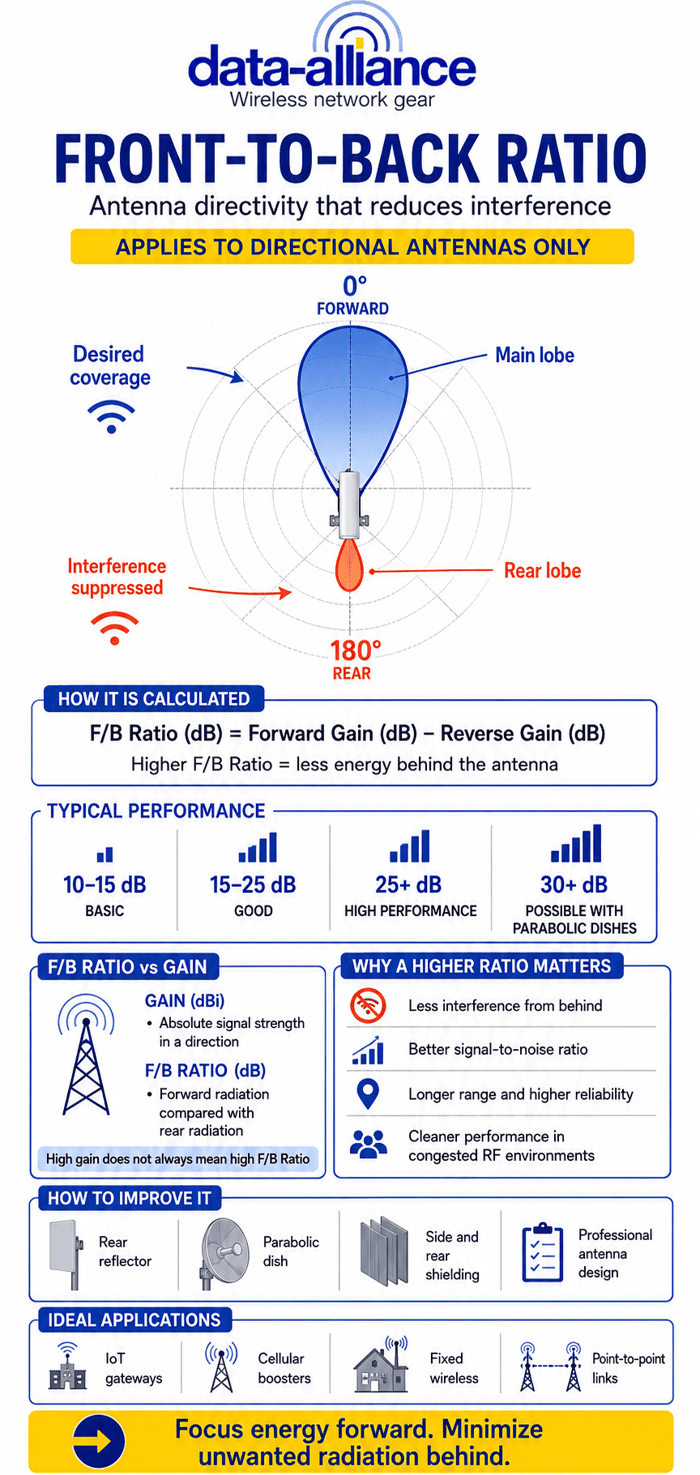
For this reason, narrow beamwidth antennas are preferred for long-distance and high-reliability communication links, such as point-to-point backhaul, microwave links, and directional IoT deployments.
Summary
Beamwidth is a foundational antenna parameter that influences coverage, gain, interference, and overall system performance. By understanding beamwidth—and related measurements such as HPBW and FNBW—engineers and system designers can make informed decisions about antenna selection, placement, and orientation.
In wireless communications, beamwidth is not simply a specification—it is a design tool that enables efficient, reliable, and scalable network deployment.
FAQs
What is beamwidth in an antenna?
Beamwidth is the angular region over which an antenna radiates most of its power. It is typically measured between two points on the main lobe of the radiation pattern where the signal strength drops by 3 dB (50%) from its maximum value. Beamwidth helps describe how focused or spread out an antenna’s energy is in space.
What is the difference between horizontal and vertical beamwidth?
Horizontal beamwidth (azimuth) describes how widely an antenna radiates energy around the horizon, while vertical beamwidth (elevation) describes how energy spreads upward and downward. Omnidirectional antennas usually have a 360-degree horizontal beamwidth, whereas directional antennas have narrower horizontal and vertical beamwidths to focus energy in a specific direction.
What is Half Power Beamwidth (HPBW)?
Half Power Beamwidth (HPBW) is the angle between the two points on the main lobe where the radiated power drops by 3 dB, or half of the peak power. HPBW represents the most usable and consistent portion of the antenna’s radiation and is closely related to antenna gain and sector overlap in multi-antenna systems.
What is First Null Beamwidth (FNBW)?
First Null Beamwidth (FNBW) is the angular separation between the first nulls, or points of minimum radiation, on either side of the main lobe. FNBW helps define the overall spatial footprint of an antenna and is useful for evaluating interference potential and side-lobe behavior.
What is the relationship between antenna beamwidth and gain?
Antenna beamwidth and gain have an inverse relationship. Narrower beamwidth results in higher gain because RF energy is concentrated into a smaller angular region. Wider beamwidth produces lower gain but broader coverage. This tradeoff is fundamental in antenna selection and system design.
How does beamwidth affect signal strength and signal-to-noise ratio (SNR)?
Narrowing an antenna’s beamwidth increases gain and directivity, which strengthens the desired signal while reducing off-axis noise and interference. This improves the signal-to-noise ratio (SNR), making narrow beamwidth antennas ideal for long-distance and high-reliability wireless communication links.