



Antennas, Antenna Cables, Wireless Products: Technical Articles
5G, 4G & 3G Standards: LTE, GSM CDMA, ISM, WCDMA, HSPA
The 5G, 4G and 3G standards — LTE, GSM, CDMA, WCDMA, HSPA and the unlicensed ISM bands — differ mainly in how they encode and transmit data, the frequency bands they occupy, and the speed, latency and coverage they deliver. This guide explains each standard, compares them side by side, and shows which antennas, cables and connectors each one requires so your deployment performs as specified.
Every one of these wireless standards depends on properly matched antennas and RF components to hit its rated performance. Get the frequency band, gain and cable loss right and the link works; get them wrong and even a 5G radio underperforms.
Overview of the 5G, 4G and 3G Standards
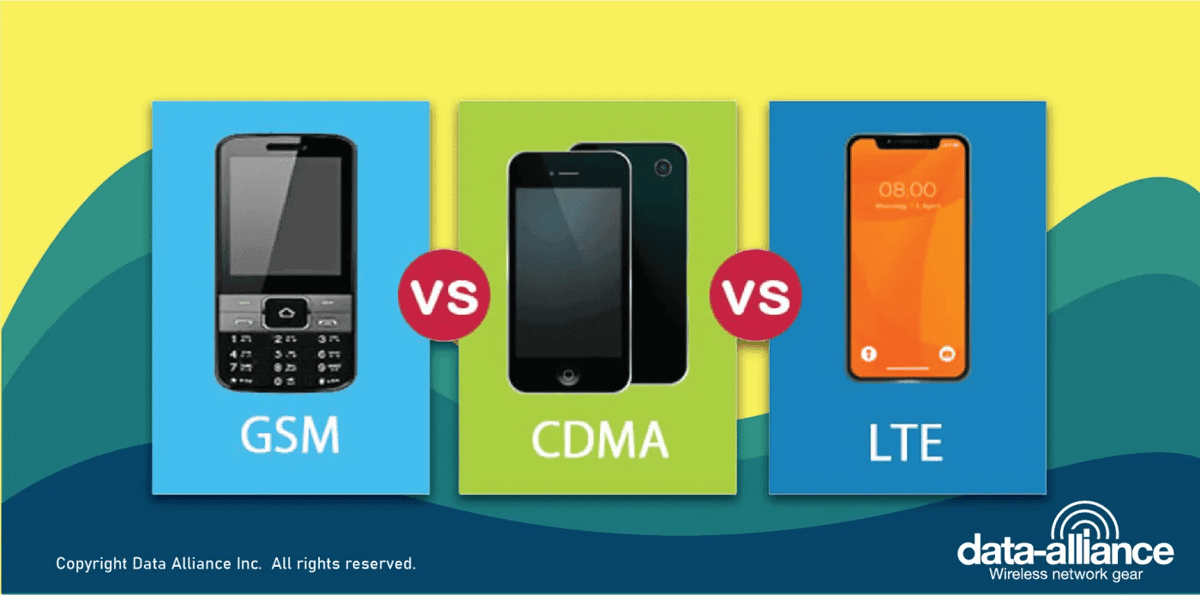
Modern cellular and radio communication is built on a handful of standards: LTE (4G), GSM (2G/3G), CDMA (2G/3G), WCDMA/HSPA (3G), 5G, and the ISM bands used by Wi-Fi and IoT. The fundamental difference between them is how they multiplex and transmit information — by time slot, by code, or by wide-band OFDM — and which frequency bands they run on.
5G Cellular Technology
5G (5th-generation wireless), deployed from 2018 onward, boosts cellular data toward fiber-class speeds with far better bandwidth, capacity and reliability than 4G. It is designed around three use cases: enhanced mobile broadband (eMBB), ultra-reliable low-latency communication (URLLC), and massive machine-type communications (mMTC) — the mix that makes it well suited to IoT, automation and smart infrastructure.
5G deployments rely on advanced antenna designs to support higher frequencies and MIMO configurations.
5G Frequency Bands vs. 4G LTE
5G runs across three frequency tiers: low-band and mid-band from roughly 600 MHz to 6 GHz (especially 3.5–4.2 GHz), and millimeter-wave (mmWave) bands at 26, 28, 38 and 60 GHz that can reach speeds as high as 20 Gbps. Massive MIMO arrays of 64–256 antenna elements deliver throughput roughly ten times that of current 4G networks.
Available 5G bands vary by region: 3100–3550 MHz and 3700–4200 MHz in the USA; 3300–3600, 4400–4500 and 4800–4990 MHz in China; 3600–4200 and 4400–4900 MHz in Japan; 3400–3700 MHz in Korea; and 3400–3800 MHz across Europe. The USA has also begun deployment of very high mmWave bands at 27.5–28.35 GHz and 37–40 GHz.
Compared with 4G LTE — which is primarily a sub-6 GHz technology — 5G spans low-band, mid-band and mmWave, letting carriers trade off coverage, speed and capacity per deployment.
LTE (4G) — Long Term Evolution
LTE (Long Term Evolution) is a 4G standard designed to be about ten times faster than standard 3G, delivering IP-based voice, multimedia and streaming at roughly 100 Mbps to 1 Gbps. Its scheduling algorithm packs large blocks of data into IP, streamlining traffic and reducing latency.
LTE is widely used in smartphones, IoT gateways, routers and industrial cellular devices for its balance of speed, coverage and reliability. Its real-world performance depends heavily on antenna selection, cable loss, and connector type.
WCDMA and HSPA (3G)
WCDMA (Wideband Code Division Multiple Access) is the 3G air interface used by GSM-family (UMTS) carriers. It spreads each user's signal across a wide 5 MHz channel, which improves capacity and data rates over earlier narrowband 2G systems. WCDMA typically operates in bands around 850, 900, 1900 and 2100 MHz depending on region.
HSPA (High Speed Packet Access) — and its evolution HSPA+ — is a set of upgrades layered on top of WCDMA that raised 3G data rates significantly, reaching tens of Mbps downlink before LTE took over. WCDMA and HSPA are being retired alongside other 3G services, but they remain in service on some networks and in legacy M2M hardware, which still needs correctly matched multiband cellular antennas and cabling.
GSM (2G & 3G)
GSM (Global System for Mobile Communication) is a digital cellular technology that carries voice and data in the 850–1900 MHz range. It uses Time Division Multiple Access (TDMA): the network converts data to a digital signal and sends it over time-stamped channels at rates between roughly 64 and 120 kbps.
Although GSM networks are being phased out in many countries, GSM still runs legacy systems and some low-data-rate IoT and M2M applications.
CDMA (2G & 3G)
CDMA (Code Division Multiple Access) lets several transmissions share one channel simultaneously. Using a spread-spectrum technique, each transmission is tagged with a unique code that identifies its source and destination. CDMA networks have largely been retired worldwide as carriers migrate to LTE and 5G, but existing systems still require compatible antennas and cabling.
ISM Frequency Bands
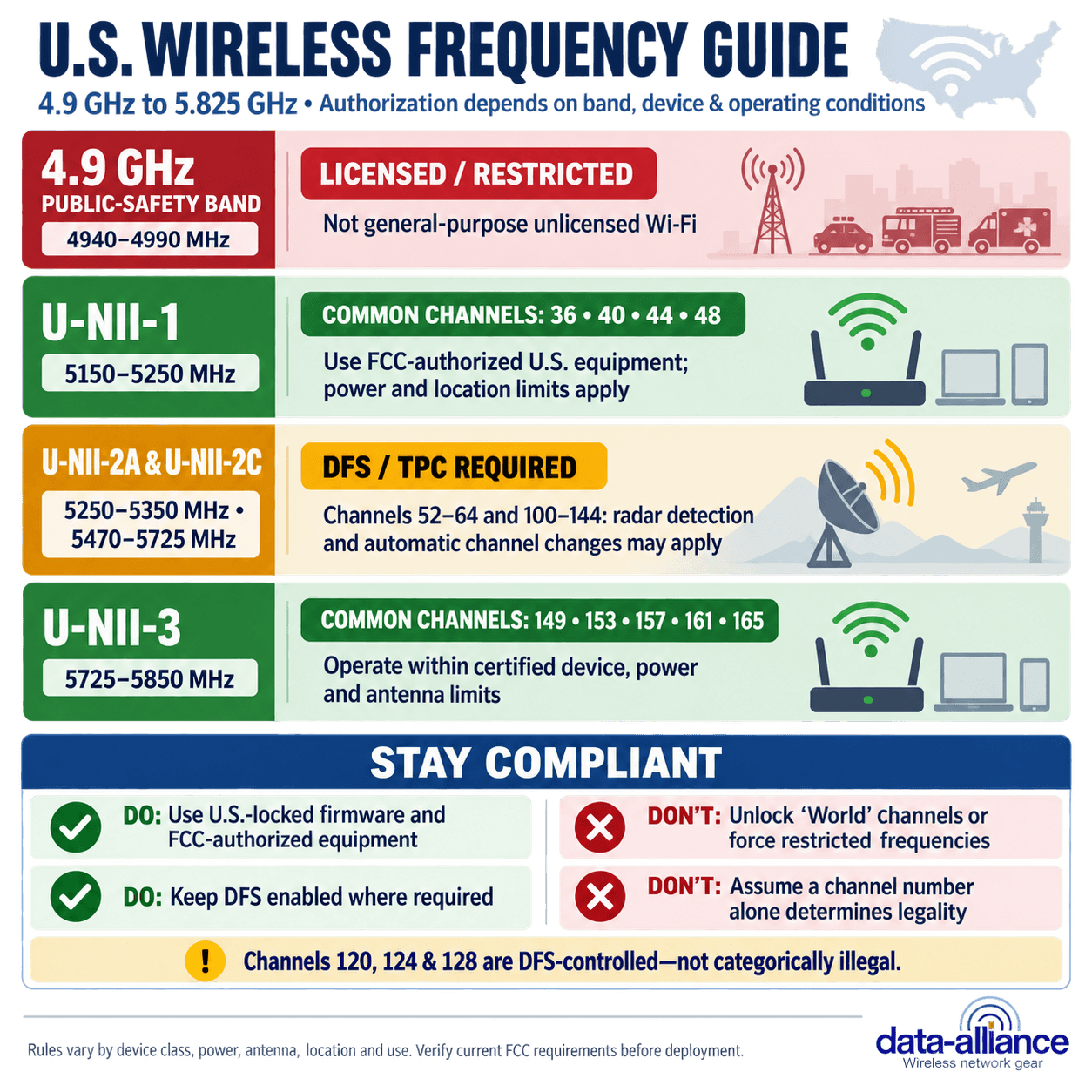
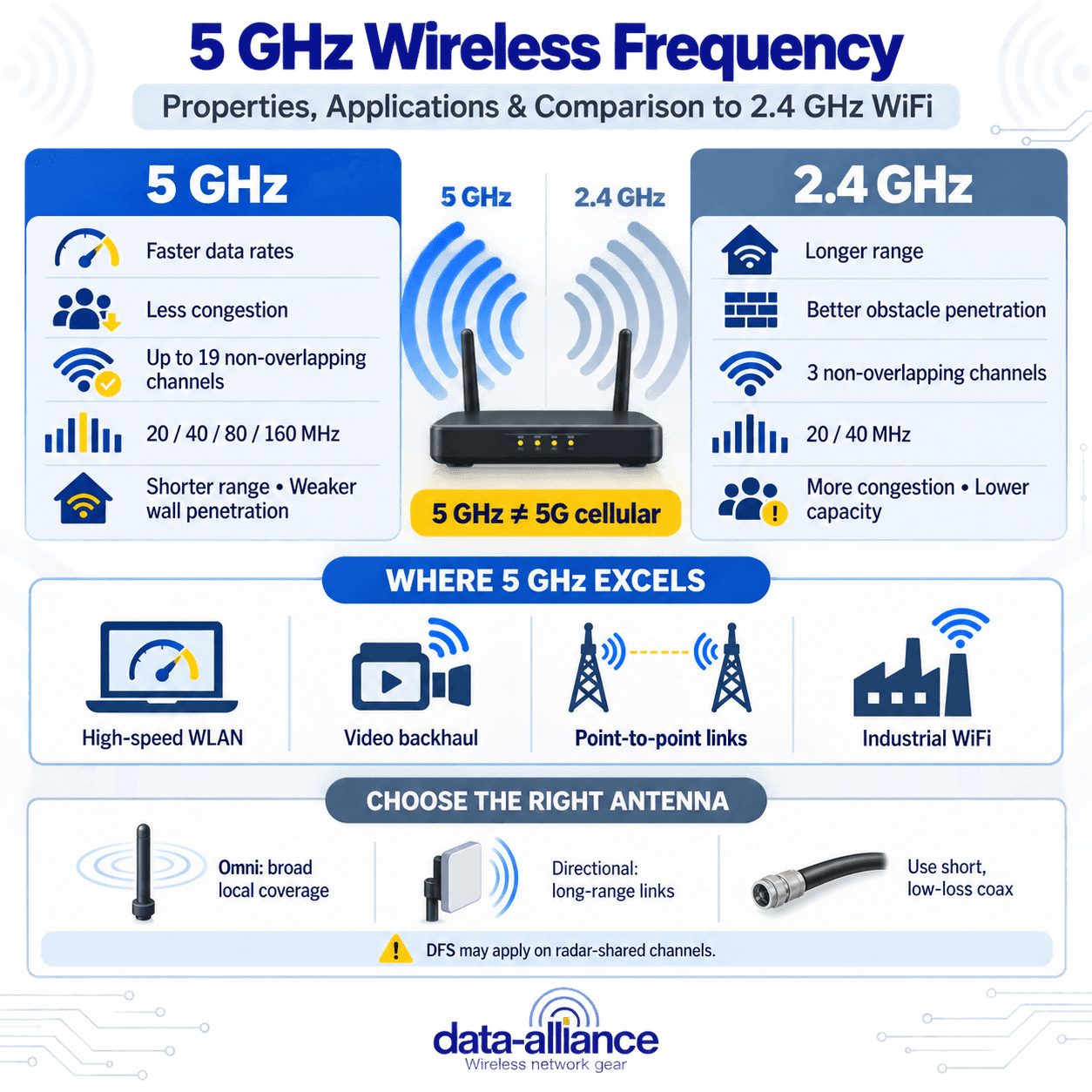
ISM (Industrial, Scientific and Medical) bands are unlicensed radio ranges originally reserved for non-telecom equipment so that industrial and medical devices would not interfere with licensed services. Common ISM bands include 433 MHz, 915 MHz, 2.4 GHz and 5.8 GHz — the frequencies used by Wi-Fi, Bluetooth, LoRa, Zigbee and proprietary IoT systems.
ISM-band technologies are widely used in IoT devices that need short-range or low-power wireless communication.
5G, 4G & 3G Standards Comparison Table
Technology | Generation | Access Method | Typical Speed | Primary Use Cases |
GSM | 2G / 3G | TDMA | 64–120 kbps | Legacy voice, low-data M2M |
CDMA | 2G / 3G | CDMA (spread spectrum) | kbps–Mbps | Legacy cellular |
WCDMA / HSPA | 3G | Wideband CDMA | Up to tens of Mbps | 3G mobile data, legacy M2M |
LTE | 4G | OFDMA | 100 Mbps–1 Gbps | Mobile broadband, IoT |
5G | 5G | OFDMA + mmWave | 1–20 Gbps | Ultra-fast data, low latency |
ISM | N/A | Various | Application dependent | Wi-Fi, IoT, industrial |
Choosing the Right Wireless Technology
The right wireless technology depends on data-rate requirements, latency sensitivity, coverage area and device power budget. LTE remains a strong default for most IoT applications; 5G is the choice for ultra-low latency and high-throughput use cases; and ISM bands suit short-range, low-power deployments. Whichever you choose, match the antenna's frequency range and gain to the band, and keep cable loss low with the correct coax and connectors.
Wireless Solutions from Data Alliance
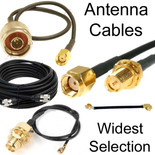
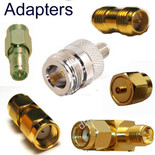
Data Alliance supplies antennas, custom-manufactured cables and RF accessories for LTE, 5G and ISM-band applications across IoT, industrial and commercial deployments. Browse multiband cellular antennas and antenna cables and adapters, or request a custom quote for a build matched to your bands and connectors.
FAQs
What are the main differences between GSM, CDMA, LTE, and 5G?
GSM and CDMA are older 2G/3G cellular technologies designed primarily for voice and low-speed data. LTE (4G) introduced high-speed, IP-based data transmission with lower latency, while 5G further expands capacity, speed and responsiveness, enabling ultra-low latency and massive IoT connectivity.
What is the difference between WCDMA and HSPA?
WCDMA is the 3G air interface that spreads each user's signal across a wide 5 MHz channel. HSPA (and HSPA+) is a set of upgrades layered on top of WCDMA that raised 3G data rates to tens of Mbps. In short, WCDMA is the underlying 3G technology and HSPA is the speed enhancement built on it.
Is LTE still relevant with the rollout of 5G?
Yes. LTE remains widely used and highly relevant, especially for IoT, industrial devices, routers and gateways. It offers an excellent balance of coverage, reliability, speed and cost, making it suitable for many applications where 5G is not yet required or available.
Why are GSM and CDMA networks being phased out?
GSM and CDMA networks are being retired because they cannot efficiently support modern data demands. Carriers are reallocating that spectrum to LTE and 5G, which deliver higher speeds, lower latency and better scalability for smartphones and IoT devices.
What are ISM frequency bands and how are they used?
ISM (Industrial, Scientific and Medical) bands are unlicensed frequency ranges such as 433 MHz, 915 MHz, 2.4 GHz and 5.8 GHz. They are commonly used for Wi-Fi, Bluetooth, LoRa, Zigbee and other short-range or low-power IoT and industrial wireless systems.
How does 5G differ from 4G LTE in terms of frequency bands?
4G LTE primarily uses sub-6 GHz frequencies for wide coverage. 5G operates across low-band, mid-band and millimeter-wave (mmWave) frequencies, enabling much higher speeds (up to 20 Gbps), lower latency and greater device density depending on deployment.
Which wireless technology is best for IoT applications?
It depends on the application. LTE is ideal for most IoT deployments that need reliable wide-area coverage. 5G suits ultra-low latency and high-throughput use cases, while ISM-band technologies are best for short-range, low-power and private IoT networks.