


Antennas, Antenna Cables, Wireless Products: Technical Articles
Torque Ratings of SMA and RP-SMA Antenna Cable Connectors & Adapters
Table of Contents
Torque Ratings of SMA and RP-SMA
When it comes to ensuring a reliable RF (Radio Frequency) connection, the devil is truly in the details. Whether you're connecting an SMA cable to a radio module, attaching an SMA antenna to a gateway, or integrating an SMA adapter into an IoT, cellular, WiFi, or GPS system, one vital aspect that should never be overlooked is the torque rating of the antenna connector.
Connectors may appear small and simple, but they play a critical role in overall RF system performance. Applying the correct torque ensures proper electrical contact, mechanical stability, and long-term reliability. Applying too little or too much torque, on the other hand, can lead to performance degradation, connector damage, or costly equipment replacement.
This article explains the recommended torque specifications for both SMA and RP-SMA cable connectors and adapters, why torque ratings matter, and best practices for proper installation.
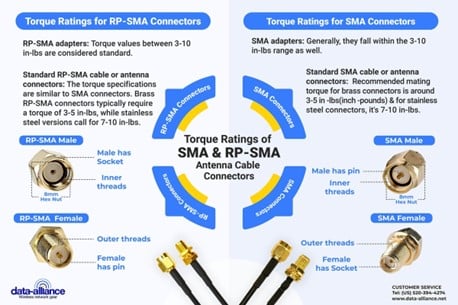
Torque Ratings for SMA Connectors
SMA connectors are precision RF components designed to operate up to 18 GHz (and in some cases higher). Because they are precision-threaded connectors, proper torque application is essential.
Standard SMA Cable or Antenna Connectors
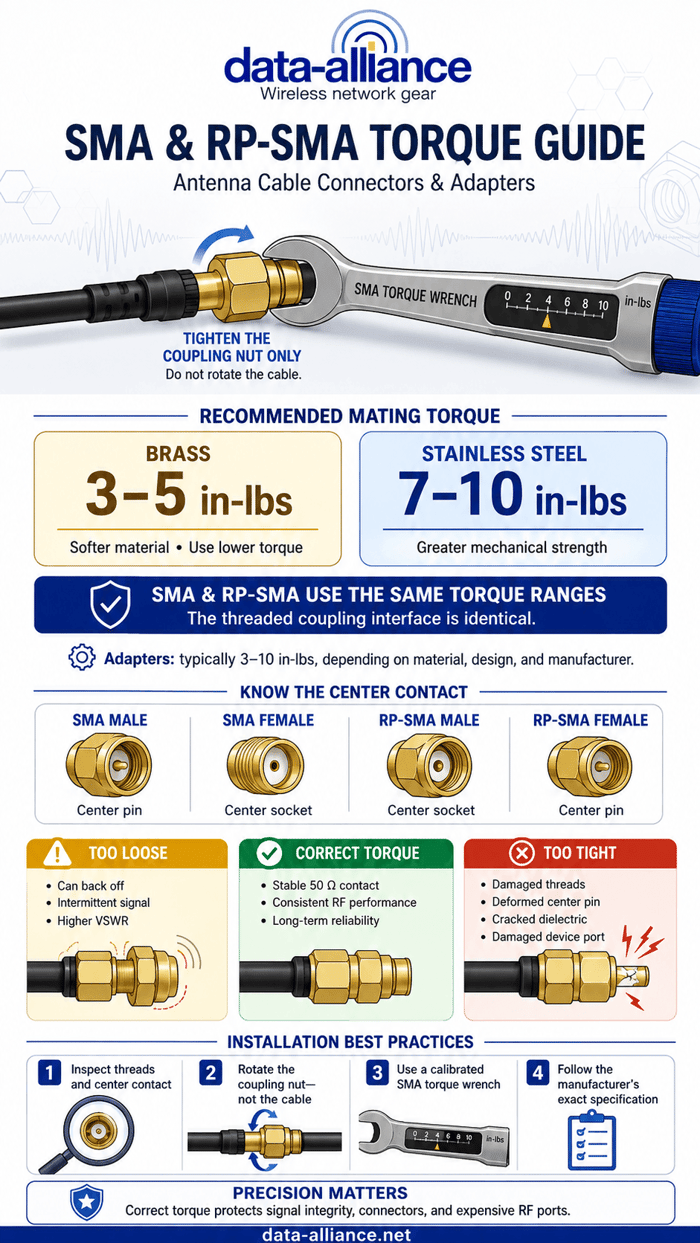
For standard SMA connectors, recommended mating torque depends on the connector material:
- Brass SMA connectors:
Typically require 3–5 in-lbs (inch-pounds) of torque. - Stainless steel SMA connectors:
Typically require 7–10 in-lbs (inch-pounds) of torque.
The higher torque rating for stainless steel connectors reflects their increased mechanical strength compared to brass. Stainless steel connectors are often used in rugged, industrial, or outdoor applications where additional durability is required.
SMA Adapters
SMA adapters (such as SMA male-to-male, female-to-female, or right-angle adapters) may have slightly different torque recommendations depending on their internal construction and plating. However, in most cases, they fall within the same general range of:
3–10 in-lbs, depending on material and manufacturer specifications.
Always confirm the torque rating if the adapter is part of a high-frequency or mission-critical system.
Torque Ratings for RP-SMA Connectors
RP-SMA (Reverse Polarity SMA) connectors share the same mechanical threading and body dimensions as standard SMA connectors. Therefore, torque specifications are generally the same.
Standard RP-SMA Cable or Antenna Connectors
- Brass RP-SMA connectors:
Recommended torque of 3–5 in-lbs. - Stainless steel RP-SMA connectors:
Recommended torque of 7–10 in-lbs.
Because RP-SMA uses the same threaded interface as SMA, torque values remain consistent across both connector types.
RP-SMA Adapters
As with SMA adapters, torque values for RP-SMA adapters generally fall within:
3–10 in-lbs, depending on material and design.
Even though torque values are similar between SMA and RP-SMA, it is critical not to confuse the two connector types, as their center pin configurations differ.
Why Torque Ratings Matter
The torque rating of an SMA or RP-SMA connector refers to the amount of rotational force that should be applied during installation to ensure proper mating without causing damage.
Torque is defined as the force applied to rotate an object around an axis. In the context of RF connectors, torque ensures:
- Proper mechanical engagement of threads
- Stable electrical contact between center conductors
- Consistent impedance matching
- Long-term reliability under vibration or movement
Consequences of Under-Tightening
Applying insufficient torque can result in:
- Loose mechanical connection
A loose connector can back off over time due to vibration or thermal cycling. - Intermittent signal loss
Poor center pin contact may cause intermittent performance issues. - Increased return loss
An improperly seated connector can introduce impedance mismatch, increasing signal reflections (VSWR). - Reduced data throughput
In wireless systems, poor RF integrity can directly affect link stability and speed.
Consequences of Over-Tightening
Exceeding recommended torque ratings can cause serious problems:
- Thread damage
Over-tightening can strip or gall threads, especially on brass connectors. - Center pin deformation
Excess torque may compress or misalign the center conductor, permanently damaging the connector. - Impedance mismatch
Mechanical deformation can alter the 50-ohm impedance interface. - Cracked dielectric
The PTFE insulator inside the connector may crack under excessive pressure. - Device port damage
In many cases, the equipment port (router, modem, gateway) is more expensive than the cable. Over-torqueing can damage the device’s RF port, leading to costly replacement.
In high-frequency applications, even small mechanical distortions can significantly affect performance.
Best Practices for Adhering to Specifications
To ensure optimal performance and connector longevity, follow these guidelines:
1. Use a Calibrated Torque Wrench
A precision torque wrench designed for SMA connectors is strongly recommended. These tools are typically pre-set to 5 in-lbs or 8 in-lbs and ensure consistent, repeatable installation.
Hand-tightening alone is not reliable, especially in professional or production environments.
2. Tighten the Coupling Nut Only
When installing SMA connectors:
- Always rotate the coupling nut, not the cable body.
- Avoid twisting the cable, which can stress the internal conductor.
This prevents internal damage and preserves cable performance.
3. Check Manufacturer Guidelines
Although general torque ranges apply, specific manufacturers may publish precise torque recommendations for their connectors. Always consult documentation when available.
4. Inspect Before Mating
Before connecting:
- Check threads for debris or damage.
- Verify that the center pin is straight.
- Ensure no foreign particles are present.
Clean, undamaged threads ensure proper torque application.
5. Avoid Repeated Excessive Mating Cycles
SMA connectors are rated for a limited number of mating cycles (often around 500). Excessive connecting and disconnecting can wear threads and degrade performance.
About SMA and RP-SMA Connectors
What is an SMA Connector?
SMA (SubMiniature version A) connectors are coaxial RF connectors developed in the 1960s. They are compact, threaded connectors designed for 50-ohm impedance systems and are widely used in:
- WiFi systems
- Cellular antennas
- GPS modules
- IoT gateways
- RF test equipment
- Satellite communication
- Industrial wireless systems
Their threaded design provides a secure connection compared to push-on connectors.
What is RP-SMA?
RP-SMA stands for Reverse Polarity SMA.
While the threaded interface remains the same:
- Standard SMA male: Inner threads with center pin
- Standard SMA female: Outer threads with center socket
In RP-SMA, the center pin genders are reversed:
- RP-SMA male has a center socket
- RP-SMA female has a center pin
This design was originally introduced to comply with regulatory requirements intended to prevent consumers from easily attaching unauthorized antennas to wireless devices.
Despite the reversed polarity of the center pin, torque specifications remain the same because the threaded coupling mechanism is identical.
Material Considerations and Plating
Connector material and plating affect torque behavior:
- Brass with gold plating offers good conductivity but is softer.
- Stainless steel provides superior mechanical durability.
- Nickel plating offers corrosion resistance but slightly higher insertion force.
Environmental factors such as moisture, vibration, and temperature cycling also influence long-term performance, making proper torque even more important in outdoor installations.
Conclusion
Whether you're working with an SMA extension cable, SMA antenna, SMA adapter, RP-SMA adapter, or integrated RF module, understanding and respecting torque ratings is essential for maintaining signal integrity and protecting your equipment.
Proper torque:
- Ensures consistent 50-ohm impedance
- Prevents connector damage
- Protects device RF ports
- Minimizes signal reflections
- Extends the lifespan of your RF components
In RF systems, small mechanical details have large electrical consequences. By following recommended torque specifications and using proper installation techniques, you safeguard performance, reliability, and long-term durability.
When it comes to RF connectivity, precision matters — and proper torque is one of the simplest yet most important steps you can take to ensure optimal results.
FAQs
What is the recommended torque for SMA connectors?
The recommended torque for SMA connectors depends on the connector material. Brass SMA connectors typically require 3–5 inch-pounds (in-lbs) of torque, while stainless steel SMA connectors generally require 7–10 in-lbs. Using the correct torque ensures proper electrical contact, stable impedance, and prevents damage to the connector threads or center pin.
Is the torque specification the same for RP-SMA connectors?
Yes. RP-SMA connectors use the same threaded coupling mechanism as standard SMA connectors, so their torque specifications are generally identical. Brass RP-SMA connectors typically require 3–5 in-lbs, while stainless steel versions require 7–10 in-lbs. The difference between SMA and RP-SMA lies in the center pin configuration—not the torque requirement.
What happens if you over-tighten an SMA or RP-SMA connector?
Over-tightening can cause serious damage, including stripped threads, deformed center pins, cracked dielectric insulators, and impedance mismatch. In some cases, excessive torque can damage the RF port on the connected device, such as a router or modem, leading to costly repairs or replacement. Always use a calibrated torque wrench to avoid over-tightening.
What problems can occur if an SMA connector is under-tightened?
Under-tightening can result in a loose mechanical connection, intermittent signal loss, increased return loss (VSWR), and reduced data throughput. In environments with vibration or temperature changes, a loosely connected SMA or RP-SMA connector may gradually back off, further degrading RF performance.
Should I use a torque wrench when installing SMA connectors?
Yes. A calibrated torque wrench designed for SMA connectors is strongly recommended, especially in professional, industrial, or high-frequency applications. Torque wrenches—often preset to 5 in-lbs or 8 in-lbs—ensure consistent and repeatable installation. Hand-tightening alone may lead to inconsistent performance or accidental over-tightening.
Does connector material affect torque requirements?
Yes. Connector material plays an important role in torque ratings. Brass connectors, which are softer, require lower torque (3–5 in-lbs), while stainless steel connectors, which are mechanically stronger, require higher torque (7–10 in-lbs). Plating types such as gold or nickel may also slightly affect insertion feel, but the manufacturer’s specified torque range should always be followed.