


Antennas, Antenna Cables, Wireless Products: Technical Articles
Senet LPWAN: Largest LoRaWAN Managed IoT Network
Table of Contents
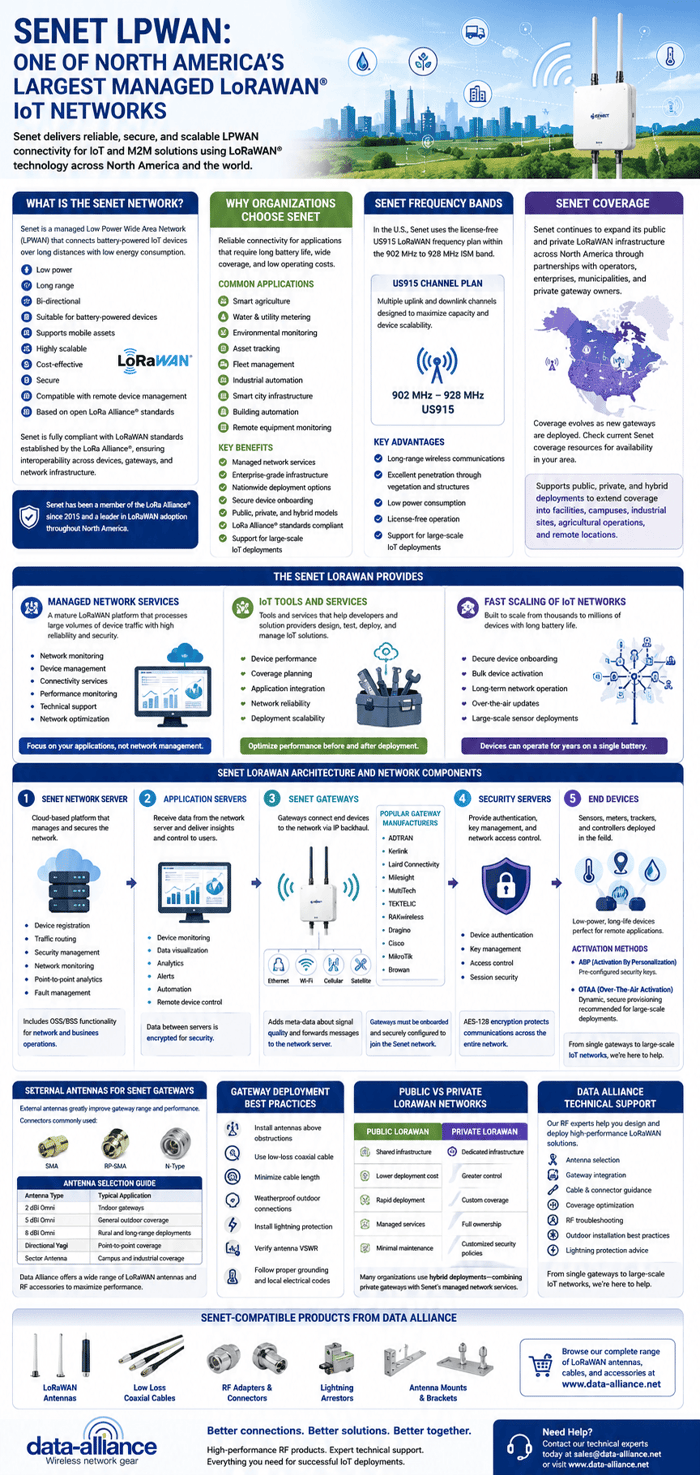
Senet LPWAN: One of North America's Largest Managed LoRaWAN IoT Networks
What is the Senet Network?
The Senet Network is a managed Low Power Wide Area Network (LPWAN) that supports Internet of Things (IoT) and Machine-to-Machine (M2M) applications using LoRaWAN® technology. Senet operates one of the largest managed LoRaWAN infrastructures in North America and provides connectivity services for a wide variety of sensors, meters, trackers, industrial monitoring systems, and smart city applications.
LoRaWAN is specifically designed for long-range, low-power communications, enabling battery-powered devices to transmit data over several miles while consuming minimal energy. Data collected by IoT devices is transmitted through LoRaWAN gateways to cloud-based network servers where it can be monitored, analyzed, and used for automation and control.
The Senet network is:
- Low power
- Long range
- Bi-directional
- Suitable for battery-powered devices
- Capable of supporting mobile assets
- Highly scalable
- Cost-effective
- Secure
- Compatible with remote device management
- Based on open LoRa Alliance® standards
Unlike some proprietary LPWAN implementations, Senet is fully compliant with LoRaWAN standards established by the LoRa Alliance, helping ensure interoperability among devices, gateways, and network infrastructure from multiple manufacturers.
Senet has been a member of the LoRa Alliance since 2015 and has played an important role in the growth of LoRaWAN adoption throughout North America.
Why Organizations Choose Senet
Organizations deploy Senet-powered LoRaWAN solutions because they provide reliable connectivity for applications that require long battery life, wide coverage areas, and low operating costs.
Common applications include:
- Smart agriculture
- Water and utility metering
- Environmental monitoring
- Asset tracking
- Fleet management
- Industrial automation
- Smart city infrastructure
- Building automation
- Remote equipment monitoring
Benefits of the Senet ecosystem include:
- Managed network services
- Enterprise-grade infrastructure
- Nationwide deployment options
- Secure device onboarding
- Public, private, and hybrid deployment models
- LoRa Alliance standards compliance
- Support for large-scale IoT deployments
Senet Frequency Bands
In the United States, Senet operates using the license-free US915 LoRaWAN frequency plan within the 902 MHz to 928 MHz Industrial, Scientific, and Medical (ISM) band.
The US915 channel plan supports multiple uplink and downlink channels designed to maximize network capacity and device scalability.
Key advantages of the US915 frequency band include:
- Long-range wireless communications
- Excellent penetration through vegetation and structures
- Low power consumption
- License-free operation
- Support for large-scale IoT deployments
Senet Coverage
Senet continues to expand its public and private LoRaWAN infrastructure throughout North America through partnerships with network operators, enterprises, municipalities, and private gateway owners.
Coverage availability evolves as new gateways are deployed and integrated into the network. Organizations considering a deployment should consult current Senet coverage resources to determine network availability in their target area.
In addition to public network coverage, Senet also supports private and hybrid LoRaWAN deployments that allow organizations to extend coverage into facilities, campuses, industrial sites, agricultural operations, and remote locations.
The Senet LoRaWAN Provides
Managed Network Services
Senet provides a mature LoRaWAN platform capable of supporting enterprise and industrial IoT applications. The network processes large volumes of device traffic while maintaining high reliability and security.
Managed services include:
- Network monitoring
- Device management
- Connectivity services
- Performance monitoring
- Technical support
- Network optimization
This allows organizations to focus on application development rather than network management.
IoT Tools and Services
Senet offers a variety of tools and services that assist developers and solution providers in designing, testing, deploying, and managing IoT solutions.
These services help optimize:
- Device performance
- Coverage planning
- Application integration
- Network reliability
- Deployment scalability
Fast Scaling of IoT Networks
LoRaWAN networks are designed for large-scale deployments consisting of thousands or even millions of connected devices.
Senet supports:
- Secure device onboarding
- Bulk device activation
- Long-term network operation
- Over-the-air updates
- Large-scale sensor deployments
Many LoRaWAN devices can operate for years on a single battery, making them ideal for remote monitoring applications.
Senet LoRaWAN Architecture and Network Components
The Senet LoRaWAN architecture integrates multiple technologies to provide secure, scalable IoT communications.
1. The Senet Network Server
Like all LoRaWAN networks, Senet uses a cloud-based network server that serves as the central management platform.
Key functions include:
- Device registration
- Traffic routing
- Security management
- Network monitoring
- Performance analytics
- Fault management
The network server also provides Operations Support System (OSS) and Business Support System (BSS) functionality for network administration and customer services.
2. Application Servers
Application servers receive data from the network server and provide the interface through which users access, analyze, and manage IoT information.
Application servers support:
- Device monitoring
- Data visualization
- Analytics
- Alerts
- Automation
- Remote device control
Communications between network servers and application servers remain encrypted to maintain data security.
3. Senet Gateways
LoRaWAN gateways serve as the bridge between end devices and the network server.
Gateways receive wireless transmissions from IoT devices and forward them to the network server through an IP-based backhaul connection such as:
- Ethernet
- Wi-Fi
- Cellular
- Satellite
Gateways can be deployed indoors or outdoors depending on coverage requirements.
Popular LoRaWAN gateway manufacturers include:
- ADTRAN
- Kerlink
- Laird Connectivity
- Milesight
- MultiTech
- TEKTELIC
- RAKwireless
- Dragino
- Cisco
- MikroTik
- Browan
New gateways must be onboarded and configured to communicate securely with the Senet network.
External Antennas for Senet Gateways
The performance of any LoRaWAN deployment depends heavily on antenna selection and installation.
Many Senet-compatible gateways support external antennas through RF connectors such as:
Indoor gateways commonly use SMA connectors, while outdoor industrial gateways frequently utilize weather-resistant N-Type connectors.
How Antenna Selection Impacts Coverage
Several factors affect LoRaWAN coverage:
- Antenna gain
- Antenna height
- Terrain
- Building density
- Cable losses
- Gateway transmit power
- Environmental conditions
Typical antenna applications include:
Antenna Type | Typical Application |
2 dBi Omni | Indoor gateways |
5 dBi Omni | General outdoor coverage |
8 dBi Omni | Rural and long-range deployments |
Directional Yagi | Point-to-point coverage |
Sector Antenna | Campus and industrial coverage |
Senet Network Antennas by Data Alliance
Data Alliance offers a complete range of LoRaWAN-compatible antennas and RF accessories designed to maximize gateway performance and coverage.
Available products include:
- Indoor LoRa antennas
- Outdoor LoRaWAN antennas
- Omnidirectional antennas
- Directional antennas
- Fiberglass base station antennas
- Magnetic mount antennas
- N-Type antennas
- SMA antennas
- Low-loss coaxial cable assemblies
- Lightning arrestors
- RF adapters
- Antenna mounts and brackets
Proper antenna selection and installation can significantly improve network reliability, range, and overall system performance.
Gateway Deployment Best Practices
For maximum LoRaWAN coverage and performance:
- Install antennas above nearby obstructions.
- Use low-loss coaxial cable.
- Minimize cable length whenever possible.
- Properly weatherproof outdoor connections.
- Install lightning protection where required.
- Verify antenna VSWR performance.
- Follow local grounding and electrical codes.
These best practices help maximize link budget and improve overall network reliability.
4. Security Servers
Security is a fundamental component of the Senet architecture.
Security servers perform:
- Device authentication
- Key management
- Access control
- Session security
Senet utilizes AES-128 encryption throughout the network to protect communications between:
- End devices
- Gateways
- Network servers
- Application servers
Additional security solutions can also be integrated to meet specific enterprise requirements.
5. End Devices
End devices are the sensors, meters, trackers, controllers, and monitoring equipment that communicate through the LoRaWAN network.
Examples include:
- Water meters
- Soil moisture sensors
- Temperature sensors
- GPS trackers
- Industrial monitoring equipment
- Smart city sensors
Many LoRaWAN devices are battery-powered and benefit from the technology's low power consumption.
Device activation methods include:
Activation By Personalization (ABP)
ABP devices are provisioned using preconfigured security credentials.
Over-The-Air Activation (OTAA)
OTAA enables secure dynamic provisioning and is generally recommended for large-scale deployments due to its enhanced security and flexibility.
Public vs Private LoRaWAN Networks
Organizations can choose between public, private, or hybrid LoRaWAN deployments.
Public LoRaWAN | Private LoRaWAN |
Shared infrastructure | Dedicated infrastructure |
Lower deployment cost | Greater control |
Rapid deployment | Custom coverage |
Managed services | Full ownership |
Minimal maintenance | Customized security policies |
Many organizations combine private gateways with Senet's managed network services to create hybrid deployments.
Data Alliance Technical Support
Successful LoRaWAN deployments depend on more than simply selecting a gateway.
Data Alliance technical support assists customers with:
- Antenna selection
- Gateway integration
- Cable assembly recommendations
- Connector compatibility
- Coverage optimization
- RF troubleshooting
- Outdoor installation best practices
- Lightning protection recommendations
Whether deploying a single gateway or a large-scale IoT network, selecting the proper antenna and RF infrastructure can significantly improve performance and reliability.
Rounding Up
Senet remains one of the most recognized managed LoRaWAN network providers in North America, supporting a wide range of IoT applications across agriculture, utilities, environmental monitoring, asset tracking, industrial automation, and smart city deployments.
Its adherence to LoRa Alliance standards, combined with support for public, private, and hybrid networks, makes it a flexible solution for organizations seeking scalable IoT connectivity.
When combined with properly selected antennas, low-loss coaxial cables, lightning protection, and professionally installed RF infrastructure, Senet-compatible LoRaWAN deployments can achieve exceptional coverage, reliability, and long-term performance.
Data Alliance offers a complete range of LoRaWAN antennas, RF cables, adapters, mounts, lightning protection products, and technical support resources to help maximize the performance of Senet-compatible deployments.
FAQs
What is the Senet Network?
Senet is a managed LoRaWAN® Low Power Wide Area Network (LPWAN) that provides wireless connectivity for Internet of Things (IoT) devices throughout North America. It supports long-range, low-power communications for applications such as smart agriculture, utility metering, asset tracking, environmental monitoring, and industrial automation.
What frequency does the Senet Network use?
In the United States, Senet operates using the US915 LoRaWAN frequency plan within the license-free 902 MHz to 928 MHz ISM band. This frequency range provides excellent long-range performance, low power consumption, and strong signal penetration through vegetation and structures.
What types of devices can connect to the Senet Network?
A wide variety of LoRaWAN-compatible devices can connect to the Senet Network, including:
- Water meters
- Soil moisture sensors
- Temperature and environmental sensors
- GPS asset trackers
- Industrial monitoring equipment
- Smart city sensors
- Building automation devices
Most devices are battery-powered and designed for years of operation with minimal maintenance.
Can I use my own LoRaWAN gateway with Senet?
Yes. Many LoRaWAN gateways from manufacturers such as Kerlink, Milesight, TEKTELIC, MultiTech, RAKwireless, Dragino, Cisco, and MikroTik can be configured to operate on the Senet Network. Gateways must be properly onboarded and configured according to Senet requirements.
How can I improve LoRaWAN gateway coverage?
Coverage can often be improved by:
- Installing the antenna at a higher elevation
- Using a higher-gain LoRaWAN antenna
- Selecting low-loss coaxial cable
- Minimizing cable length
- Using lightning protection and proper grounding
- Optimizing gateway placement
Data Alliance offers LoRaWAN antennas, cables, adapters, mounts, and technical support to help maximize gateway performance.
What is the difference between a public and private LoRaWAN network?
A public LoRaWAN network uses shared infrastructure operated by a network provider such as Senet. A private LoRaWAN network uses dedicated gateways and infrastructure owned by an organization.
Public networks provide lower deployment costs and rapid implementation, while private networks offer greater control, customized coverage, and enhanced security management. Many organizations use hybrid deployments that combine both approaches.
What antennas are recommended for Senet-compatible gateways?
The best antenna depends on the deployment environment.
- 2 dBi omnidirectional antennas are commonly used indoors.
- 5 dBi omnidirectional antennas are popular for general outdoor coverage.
- 8 dBi omnidirectional antennas are often used for rural and long-range deployments.
- Directional Yagi antennas are ideal for point-to-point applications.
Data Alliance provides indoor and outdoor LoRaWAN antennas, fiberglass base station antennas, magnetic mount antennas, low-loss coaxial cables, lightning arrestors, and mounting hardware compatible with Senet deployments.