



Antennas, Antenna Cables, Wireless Products: Technical Articles
Nickel and Gold-Plated Brass Compared as Platings for Antenna Cable Connectors and Adapters
Table of Contents
- Rust Proofing and Corrosion-Protection: Best Options Among Nickel, Gold-Plated Brass & Brass Alloys
- For Outdoor Applications: Nickel-Plated Brass is the Best Option
- Durability and Corrosion Resistance of Nickel-Plated Brass
- Nickel Plating Process and Benefits
- For Indoor Applications: Gold-Plated Brass is the Best Option
- Appearance and Cost Considerations
- Rust Proofing and Corrosion Protection in Brass Alloys
- Gold-Plated Brass vs Nickel-Plated Brass: Key Comparison
- Additional Notes and Product-Specific Information
- Nickel-Plated Antenna Cable Connectors in IoT and RF Systems
- In Conclusion
- FAQs
Rust Proofing and Corrosion-Protection: Best Options Among Nickel, Gold-Plated Brass & Brass Alloys
When selecting antenna cable connectors and adapters, especially for RF and IoT wireless systems, plating material plays a critical role in long-term performance, corrosion resistance, and signal reliability. At Data Alliance, we work extensively with connector types such as U.FL, MHF4, SMA, RP-SMA, MMCX and RP-TNC, and plating selection is a key factor in ensuring durability across different environments.
Understanding the differences between nickel-plated brass and gold-plated brass helps ensure the correct choice is made for both outdoor and indoor deployments, balancing corrosion resistance, electrical performance, and cost.
For Outdoor Applications: Nickel-Plated Brass is the Best Option
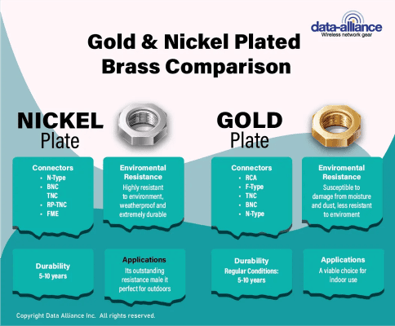
For outdoor and harsh-environment applications, nickel-plated brass is the preferred solution. These connectors are commonly used with antenna cable types and RF adapters exposed to moisture, temperature fluctuations, UV exposure, and airborne contaminants.
Nickel plating offers superior corrosion resistance, making it ideal for long-term outdoor installations such as:
- External IoT antennas
- Cellular and LTE/5G antenna systems
- Outdoor WiFi bridges
- Industrial wireless deployments
Nickel-plated brass connectors are significantly more durable than gold-plated connectors when it comes to weatherproofing. While gold provides excellent conductivity, it is softer and can wear more quickly in exposed environments.
Durability and Corrosion Resistance of Nickel-Plated Brass
Nickel-plated brass is widely regarded as the most corrosion-resistant option among common RF connector platings. In typical outdoor applications, nickel plating can last 5–10 years depending on environmental conditions such as humidity, salt exposure, and temperature cycling.
At Data Alliance, while long-term lab testing over decades has not been formally conducted, our real-world experience over 17+ years shows a strong reliability record. We have not received customer complaints related to corrosion failure on nickel-plated brass connectors, which reinforces their suitability for demanding environments.
One of the key advantages of nickel is its oxidation behavior. Nickel does not degrade in the same way as many metals. Instead, it forms a stable nickel-oxide layer on the surface, which acts as a protective barrier and prevents further corrosion. This self-limiting oxidation process is a major reason for its long service life outdoors.
Nickel Plating Process and Benefits
Nickel plating is achieved through an electroplating process, where a thin, uniform layer of nickel is applied over brass connectors, nuts, and washers. This process enhances both mechanical durability and environmental resistance.
Key benefits include:
- High resistance to rust and oxidation
- Protection against verdigris (green corrosion typical of untreated brass)
- Improved hardness and wear resistance
- Long-term performance in outdoor and industrial environments
This makes nickel-plated connectors especially suitable for installations where maintenance access is limited or costly.
For Indoor Applications: Gold-Plated Brass is the Best Option
For indoor applications, gold-plated brass connectors are typically the preferred choice. These environments are generally controlled, with minimal exposure to moisture and contaminants, allowing gold plating to deliver its primary advantages: excellent conductivity and stable electrical performance.
Gold-plated connectors are commonly used in:
- Indoor RF systems
- Test equipment and lab setups
- Low-power signal connections (U.FL, MHF4, MMCX)
- High-frequency applications where signal integrity is critical
Gold plating provides a highly conductive, non-oxidizing surface that ensures consistent signal transmission. It is especially valuable in applications requiring low contact resistance and minimal signal loss.
Appearance and Cost Considerations
Gold-plated connectors are visually more appealing and are often associated with premium products. However, they are significantly more expensive than nickel-plated options due to the cost of gold and the plating process.
While gold plating enhances electrical performance, it does not provide the same level of mechanical durability or environmental resistance as nickel in outdoor conditions. Therefore, the selection should be based on application requirements rather than appearance alone.
Rust Proofing and Corrosion Protection in Brass Alloys
At Data Alliance, rust proofing and corrosion protection are further enhanced through careful control of brass alloy composition used in connectors, adapters, nuts, and washers.
This includes:
- Maintaining zinc content below 15% to reduce corrosion susceptibility
- Adding trace elements such as arsenic, phosphorus, antimony, and tin to improve corrosion resistance and mechanical strength
These alloy optimizations ensure that even before plating is applied, the base material contributes to long-term durability and performance.
When combined with high-quality plating (nickel or gold), this results in connectors that perform reliably across a wide range of environments.
Gold-Plated Brass vs Nickel-Plated Brass: Key Comparison
- Nickel-Plated Brass:
- Best for outdoor and harsh environments
- Superior corrosion resistance
- Longer lifespan in exposed conditions
- More durable mechanically
- Gold-Plated Brass:
- Best for indoor and controlled environments
- High conductivity and low contact resistance
- Better for high-frequency and low-signal applications
- Higher cost and softer surface
Additional Notes and Product-Specific Information
- Gold-plated nickel (nickel base with gold overlay) is generally more durable than gold-plated brass alone, combining strength with conductivity.
- Data Alliance’s standard RP-SMA and SMA connectors, nuts, and washers are gold-plated brass, optimized for signal performance in typical indoor and semi-protected environments.
- The washers included with RP-SMA female connectors are gold-plated to maintain consistent electrical contact.
- All RP-TNC connectors offered by Data Alliance are nickel-plated brass, reflecting their common use in more rugged or outdoor applications.
Nickel-Plated Antenna Cable Connectors in IoT and RF Systems
Nickel-plated connectors play a critical role in modern IoT and wireless infrastructure. As antennas are increasingly deployed outdoors for cellular, LoRa, WiFi, and telemetry systems, connector durability becomes essential.
Reliable connectors ensure:
- Stable antenna performance
- Reduced maintenance and replacement costs
- Consistent signal quality over time
- Protection against environmental degradation
At Data Alliance, selecting the appropriate plating is part of our technical support approach—helping customers match the right connector and cable assembly to their specific use case.
In Conclusion
Both nickel-plated brass and gold-plated brass connectors have important roles in RF and antenna systems. The best choice depends on the environment and application requirements.
Nickel-plated brass is the clear choice for outdoor, rugged, and long-term deployments where corrosion resistance is critical. Gold-plated brass excels in indoor environments where signal integrity and conductivity are the primary concerns.
By combining high-quality materials, optimized brass alloys, and proven plating techniques, Data Alliance ensures that its antenna cable connectors and adapters deliver reliable performance across a wide range of applications—from legacy RF systems to modern IoT wireless networks.
FAQs
What is the main difference between nickel-plated and gold-plated brass connectors?
Nickel-plated brass connectors are designed for durability and corrosion resistance, making them ideal for outdoor use. Gold-plated brass connectors provide superior conductivity and low contact resistance, making them better suited for indoor and high-frequency applications.
Which plating is best for outdoor antenna cable connectors?
Nickel-plated brass is the best option for outdoor environments. It offers strong resistance to moisture, oxidation, and environmental exposure, making it suitable for long-term use in harsh conditions such as IoT, cellular, and industrial wireless systems.
Why is gold plating used on RF connectors?
Gold plating is used because it provides excellent conductivity and does not oxidize, ensuring stable signal transmission. It is especially beneficial in indoor RF systems and high-frequency applications where signal integrity is critical.
How long do nickel-plated connectors last outdoors?
Nickel-plated connectors typically last between 5 to 10 years in outdoor environments, depending on factors such as humidity, salt exposure, and temperature variations. The nickel oxide layer formed on the surface helps prevent further corrosion.
Are gold-plated connectors more durable than nickel-plated connectors?
No, gold-plated connectors are generally less durable in outdoor conditions. While gold offers excellent electrical performance, it is softer and can wear faster, making nickel-plated connectors the better choice for mechanical durability and weather resistance.
What factors should be considered when choosing connector plating?
Key factors include the installation environment (indoor vs outdoor), exposure to moisture or contaminants, required signal performance, and budget. Nickel plating is preferred for durability, while gold plating is preferred for conductivity and signal quality.
Does the base material of the connector affect corrosion resistance?
Yes, the brass alloy composition plays an important role. Controlling zinc content and adding elements like tin or phosphorus improves corrosion resistance. When combined with proper plating, this ensures long-term performance and reliability.