



Antennas, Antenna Cables, Wireless Products: Technical Articles
LoRa: Long Range Wireless for Internet of Things (IOT): Frequency Bands, Antennas
Table of Contents
Long Range Wireless (LoRa)
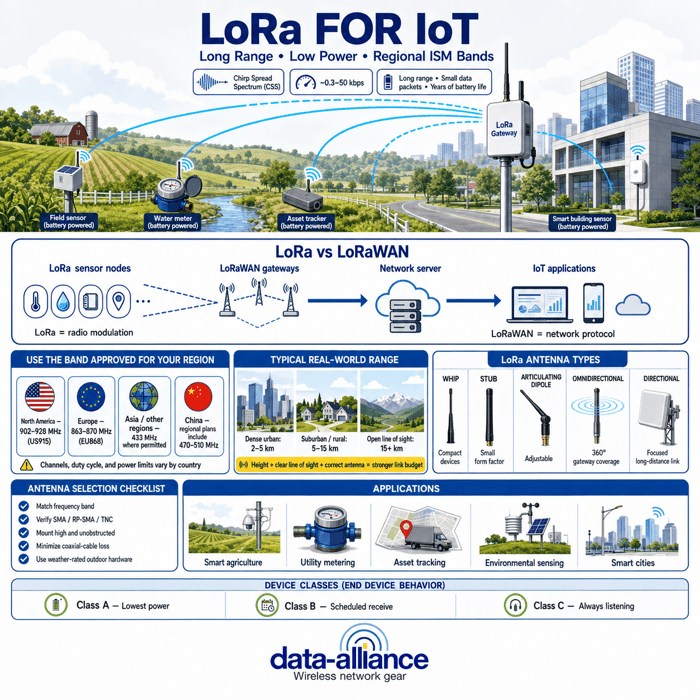
LoRa (Long Range) is a low-power wireless modulation technology originally developed in France and now owned and licensed by Semtech (USA). It forms the physical (PHY) layer of many Low Power Wide Area Network (LPWAN) systems and is governed by the LoRa Alliance, a global consortium of technology providers, network operators, and device manufacturers.
LoRa is designed to support long-range communication with extremely low power consumption, making it well suited for Internet of Things (IoT) and machine-to-machine (M2M) applications. It uses Chirp Spread Spectrum (CSS) modulation to achieve high link budgets and robust performance in noisy RF environments. Depending on the selected bandwidth and spreading factor, LoRa supports data rates ranging from approximately 0.3 kbps up to 50 kbps when using Chirp Spread Spectrum (CSS) modulation. Higher bit rates are achieved by reducing range and increasing power consumption.
LoRa Frequency Bands
The exact frequency band used by LoRa depends on regional spectrum regulations. While LoRa operates exclusively in unlicensed ISM bands, the permitted channels, duty cycles, and transmit power limits vary by country and region.
LoRa uses these unlicensed frequency bands:
- 915 MHz (902–928 MHz) – North America (FCC Part 15)
- 868 MHz – Europe (ETSI)
- 433 MHz – Asia and some regions outside North America
- 470 MHz – China (regulated allocation)
The 915 frequency band
915 MHz is the center frequency of what is known as the 33-centimeter band, which is named after the wavelength at this frequency. It is also known as the 900 MHz band and spans 902 MHz to 928 MHz. The 915 MHz frequency band is designated by the International Telecommunications Union (ITU) as an unlicensed Industrial Scientific and Medical (ISM) frequency band which means that it can be used globally for LoRa networking with minimal restriction. Its ability to support long-range transmissions efficiently is advantageous. Other notable uses of this frequency band include amateur radio, as discussed further on.
Why are LoRa antennas important?
The 915 MHz antenna that is used for LoRa networking supports long-range connectivity that is comparable to lower frequencies like the 433 MHz band (though the 915 MHz antennas are higher gain). In the US, the use of the 433 MHz band is restricted by FCC regulations so this higher frequency band is the only sub gigahertz band available to support LoRa connectivity.
Antenna performance is often the single most critical factor determining real-world LoRa range and reliability. Antenna gain, radiation pattern, ground plane quality, mounting height, and cable losses all directly affect link budget and network capacity. Selecting the correct antenna is therefore as important as choosing the LoRa chipset itself.
Signal propagation at 915 MHz
Line of sight is the predominant means of signal transmission meaning 915 MHz antennas and repeaters are often installed at a height beyond obstructions like buildings or hills. With equivalent transmitting power, a 915 MHz LoRa antenna's signal can travel approximately 75 percent of the distance of a 433 MHz antenna. The penetration of buildings and windows is effective, especially when compared to higher frequencies like 2.4 GHz.
In real-world deployments, typical LoRa ranges at 915 MHz are:
- 2–5 km in dense urban environments
- 5–15 km in suburban or rural areas
- 15+ km in open line-of-sight conditions
915 MHz antennas for LoRa Wireless Area Networking
LoRa's use of 33-centimeter band antennas relies on spread spectrum modulation to achieve competitive data rates with efficient use of bandwidth and energy consumption.
The key features for LoRa connectivity:
- Bandwidth and frequency scalability
- Low output power of transmitters
- Resistance to in-band and out-band interference
- Resilience of signal transmission against fading and Doppler shift
- Support for long-range connectivity
- Ability to support high capacity networks
- Ability to support localization via networked nodes
The modulation technique used is derived from Chirp Spread Spectrum (CSS). This involves increasing the bandwidth of the transmitted signal to compensate for degradation in signal to noise ratio and varying the data rate to improve coverage or the rate of power consumption as needed. This also makes transmissions resilient against multipath fading without increasing transmission power. To achieve low power, wide-area performance, data is the key trade-off. Data is broken up and encoded into multiple 'chirps' which are transmitted or 'spread' at varying rates (using changes in frequency), according to airtime availability. Chirp rate is known as Spreading Factor (SF). This scalable bit rate facilitates the most efficient use of the network. Forward error correction is also used to further prevent interference.
The LoRa WAN network protocol
This networking protocol is developed for LoRa and specifies the system architecture (point to multipoint), control (frequencies used and data rates), and communication within deployed LoRa networks. Individual networked devices will transmit only where they have data to send. Transmitter data is related through multiple upstream nodes to the network's central server in a star topology. LoRa networking can be limited in that there is no provision for acknowledgments of data receipt to be transmitted to downstream nodes. Coverage can be anything up to 15 kilometers (10 miles). There are three classes of node communication:
- Class A involves the asynchronous broadcasting of nodes (whenever they need to). When they have no data, they remain dormant.
- Class B involves central communication to nodes via beacon messages broadcast at regular intervals. The receiving nodes are battery powered and therefore capable of listening at scheduled intervals for the transmitted signal.
- Class C are continuously powered, 'active' nodes that can receive signals at any time. This is not a low energy endeavor and usually needs AC power.
915 MHz IoT Antennas
LoRa is one of the key technologies expected to underpin the imminently anticipated expansion of the Internet of Things (IoT). IoT networked devices often use high throughput networking like WiFi or the cellular network, but LoRa offers the opportunity to develop connectivity that is better tailored to the requirements of sensor-based systems which may only be sending minute data packets at irregular intervals. LoRa also allows IoT devices to be operable in remote locations where power is inconsistent and there is a reliance on batteries which can last up to 10 years in the field.
To integrate LoRa connectivity in a device a LoRa compliant chipset which is licensed by Semtech. LoRa Alliance includes over 500 companies who have developed solutions with LoRa interoperability and contribute to its global ecosystem of solutions in a multi-billion dollar marketplace. Slowly LoRa enabled chips are becoming integrated into a range of wireless devices like laptops and domestic appliances.
LoRa applications span the breadth of the global industry and deployment of this technology is so widespread that it is setting the standard for LP-WAN connectivity and IoT/ M2M and eclipsing competitor technologies like NB-IOT or SigFox. Sectors with active LoRa networking deployments include:
- Ecological surveillance
- Agriculture
- Utility metering
- Inventory tracking
- Automotive
Long-range low energy connectivity alternatives to LoRa
SigFox 915 MHz antennas
915 MHz antennas can also be used for SigFox connectivity which uses the same frequency as LoRa. SigFox is an LP-WAN technology that uses differential binary phase-shift keying (DBPSK) and the Gaussian frequency-shift keying (GFSK) for sub gigahertz connectivity between networked objects. It uses a one-hop star topology which is highly reliant on high quality 915 Mhz antennas for optimal functioning. It has a data rate of 100 bps with limited bi-directional communication and is deployed in over 60 countries.
Other applications that use the 915 MHz frequency band
The 33-centimeter band is also allocated to amateur radio use, with the caveat that there may be vulnerability to interference from devices using it as an ISM band. A range of amateur endeavors like Amateur Television (ATV), and radio communications like FM, CW, and SSB calling using a range of self-built or modified hardware. Enthusiasts find that propagation at this frequency is similar to propagation in the 70-centimeter band. External 915 MHz antennas can be used with radios, repeaters, and amplifiers.
Key types of 915 MHz LoRa antenna
Antennas for LoRa networking come in a variety of types with a good range of characteristics that will support the effective coverage and functioning of a LoRa network. These antennas can also be used for the 915 MHz / 33-centimeter applications as discussed further on. Many of these antennas are fitted with SMA, RP-SMA, or TNC connectors but connector type should carefully be checked to ensure compatibility.
[A] Quarter wave whip 915 MHz antenna
These antennas have a conducting element that is a quarter of the wavelength at 915 MHz. Some are encased in molded housing, but whip antennas are highly flexible and resilient against impacts. Some units may have a flying lead for greater ease in mounting.
[B] 915 MHz Stub antenna
Stub antennas are essentially helical antennas that are compressed into a compact and portable unit which may be advantageous in some applications. Helical antennas have a coiled radiating element which also reduces the length of the antenna, but not as much as a stub antenna.
[C] Swivel or articulating 915 MHz dipole antenna
Articulating or rotating antennas are highly adjustable and usually lock into position when their optimal coverage has been achieved. Their flexibility also increases potential mounting options. Many are half-wave dipole antennas.
[D] Omnidirectional 915 MHz antenna
Omnidirectional antennas are dipole antennas and can be used to create 360 degrees indoor or outdoor coverage. They tend to have lower gains than directional antennas as their beam is not focused. This means that reliance on a single Omni antenna may not produce the coverage desired and a combination of antenna types will be needed to achieve the best results. Outdoor omnidirectional antennas are robust with a well-sealed waterproof radome and a range of mounting options. Some designs are through-hole mounting antennas, others come pre-mounted on a metal bracket with jumper cable supplied.
[E] 915 MHz Directional antenna
Directional antennas focus their transmission or receiving power in a specific direction, making them capable of providing high gain and long-distance performance.
[F] 915 MHz Co-linear antenna
These powerful omnidirectional antennas provide extensive outdoor coverage. They should ideally be mounted at height and be unobstructed for line of sight visibility. They are typically made from quarter, half-wave or dipole elements phased to deliver optimal horizontal plane coverage. They are housed in a protective fiberglass radome.
What You Should Know
What are the differences between LoRa versus SigFox?
SigFox is positioned more as a network operator than LoRa, which provides the technology for companies to use to create their networks. SigFox will deploy its network for subscribers to use.
- SigFox networks tend to be simpler than LoRa networks.
- The coverage of SigFox is greater than that of LoRa.
- LoRa with CSS uses much more bandwidth than SigFox.
- SigFox is designed for infrequent transmission and has longer battery life.
- It has only very limited bidirectional communication between participating nodes. LoRa is marginally more sophisticated.
- The radio modules and chipsets are cheaper than those for LoRa.
- It is effective where sensors transmit data infrequently.
- SigFox currently shows better efficacy at preventing 'replay' and 'man in the middle' attacks./li>
What are the differences between LoRa versus NB-IoT?
- Narrow Band Internet of Things (NB-IoT) is a licensed LTE technology created by the Third Generation Partnership Project (3GPP).
- It uses cellular technology for its networking.
- LoRa uses unlicensed ISM bands whereas NB-IoT uses a licensed portion of the spectrum.
- NB-IoT is more expensive than LoRa.
- LoRa uses less bandwidth.
- LoRa has greater battery life.
- LoRa has lower latency.
NB-IoT benefits from cellular-grade security mechanisms inherent to licensed LTE networks. LoRaWAN, however, implements end-to-end AES-128 encryption at both the network and application layers, providing strong security when correctly deployed.
LoRa vs LoRaWAN
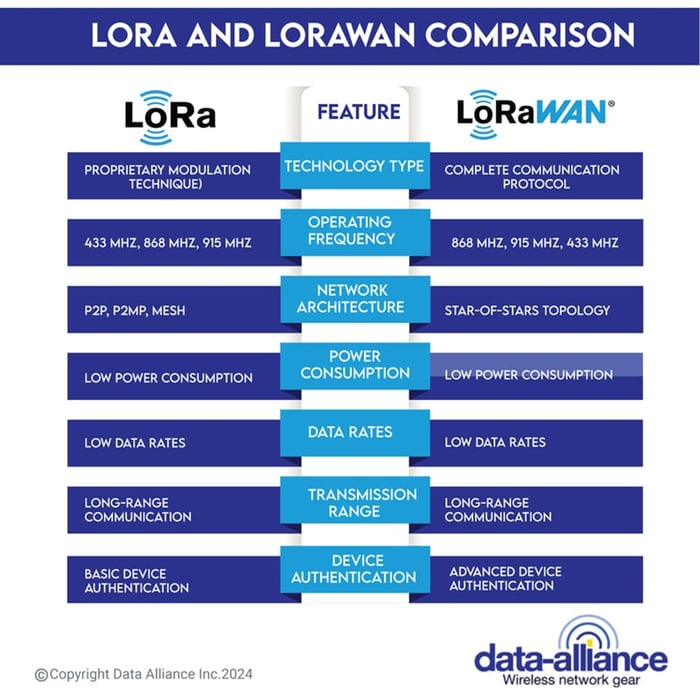
LoRa refers to the radio modulation technology, while LoRaWAN is the network protocol that defines how devices communicate with gateways and servers. LoRaWAN specifies device classes, security mechanisms, adaptive data rates, and network architecture. In practice, most LoRa-based IoT deployments use the LoRaWAN protocol.
What are the differences between 915 MHz versus 433 MHz?
Bothe the 915 MHZ and the 433 MHz frequency bands are used for low power, wide-area networking. The 433 MHz band is subject to FCC restrictions in the US, meaning that the 915 MHz band is preferentially used for this type of connectivity in North America. The 433 MHz band may be subject to less interference as cordless phones and other appliances use the 915 MHz band as well as amateur radio. Interestingly, their performance is almost equivalent, though the 915 Mhz band has less coverage and smaller antennas, due to the shorter wavelength.
LoRa antenna: A Long Range or LoRa-antenna is an antenna that is resonant at frequencies that makes it suitable for operating in accordance with the proprietary LoRa networking protocol. These sub gigahertz frequency antennas facilitate low bitrate long-distance transmissions, that can exceed 10 kilometers (6.21 miles). In North America, the 915 MHz frequency is specified for use by this technology, meaning that 915 MHz antennas are typically associated with LoRa in the US market.
In conclusion
The 915 MHz ISM band has proven to be a robust and efficient foundation for low-power, wide-area networking. LoRa technology, in particular, enables scalable IoT deployments that balance range, energy efficiency, and cost. When paired with properly designed and installed antennas, LoRa networks can deliver reliable long-distance connectivity for years on a single battery, making them a cornerstone technology for modern IoT systems.
FAQs
What is LoRa and how does it work?
LoRa (Long Range) is a low-power, wide-area wireless networking technology that enables long-distance communication between IoT devices using minimal energy. It uses Chirp Spread Spectrum (CSS) modulation to send data over unlicensed frequency bands (such as 915 MHz in North America). This allows devices to transmit small data packets efficiently over distances of up to 10–15 km (6–10 miles) with excellent power efficiency.
What frequency bands does LoRa use worldwide?
LoRa operates in unlicensed Industrial, Scientific, and Medical (ISM) frequency bands, which vary by region:
- 915 MHz – North America
- 868 MHz – Europe
- 433 MHz – Asia
The 915 MHz band (902–928 MHz) is the standard in the U.S., offering strong long-range performance without licensing requirements.
Why are antennas important for LoRa connectivity?
The antenna is a critical component in any LoRa network because it determines signal range, stability, and efficiency. For example, a 915 MHz LoRa antenna enables long-range connectivity and helps maintain a reliable signal despite environmental obstacles. Since the 433 MHz band is restricted in the U.S., 915 MHz antennas are the primary option for LoRa communications in North America.
What are the main types of 915 MHz antennas used for LoRa?
Common types of LoRa antennas include:
- Quarter-wave whip antennas: Flexible, impact-resistant, and easy to mount.
- Stub and helical antennas: Compact and suited for space-limited devices.
- Swivel dipole antennas: Adjustable for optimal signal coverage.
- Omnidirectional antennas: Provide 360° coverage for broad area networks.
- Directional antennas: Focus energy in one direction for long-distance links.
- Co-linear antennas: High-gain omnidirectional antennas ideal for outdoor installations.
How does LoRa compare to other LP-WAN technologies like SigFox or NB-IoT?
- SigFox: Simpler network structure, lower data rate (100 bps), limited two-way communication, and slightly better security for specific use cases.
- NB-IoT: Operates on licensed LTE networks, offering higher security and cost, but with greater power consumption.
- LoRa: Uses unlicensed bands, provides longer battery life, lower costs, and flexible deployment for private networks.
What are the advantages of using the 915 MHz frequency band for IoT?
The 915 MHz band offers a balance between range, data rate, and obstacle penetration. It allows for reliable long-range communication even in non-line-of-sight environments. Its unlicensed status simplifies deployment, and it supports diverse applications such as agriculture, utility metering, environmental monitoring, and inventory tracking.
What makes LoRa ideal for IoT applications?
LoRa’s low power consumption, long range, and robust signal resilience make it an excellent choice for IoT networks, particularly where devices transmit small, infrequent packets of data. Battery-powered sensors can operate for up to 10 years, even in remote areas. LoRa’s scalability also allows thousands of devices to communicate efficiently within a single network.