


Antennas, Antenna Cables, Wireless Products: Technical Articles
Drones: The Wireless Technologies That Enable Operation and Control
Table of Contents
- Wireless technologies in the operation of drones
- Radio Control (RC) Transmitters:
- Telemetry Systems:
- GPS (Global Positioning System):
- Wi-Fi:
- FPV(First-Person View) Systems:
- Remote Data Links:
- LTE / 4G / 5G Connectivity:
- Bluetooth:
- Mesh Networking:
- Drone Antenna Systems and RF Components
- RF Optimization Best Practices for Drone Systems
- Drones as an Aspect of the Internet of Things
- Conclusion
- FAQs
Wireless technologies in the operation of drones
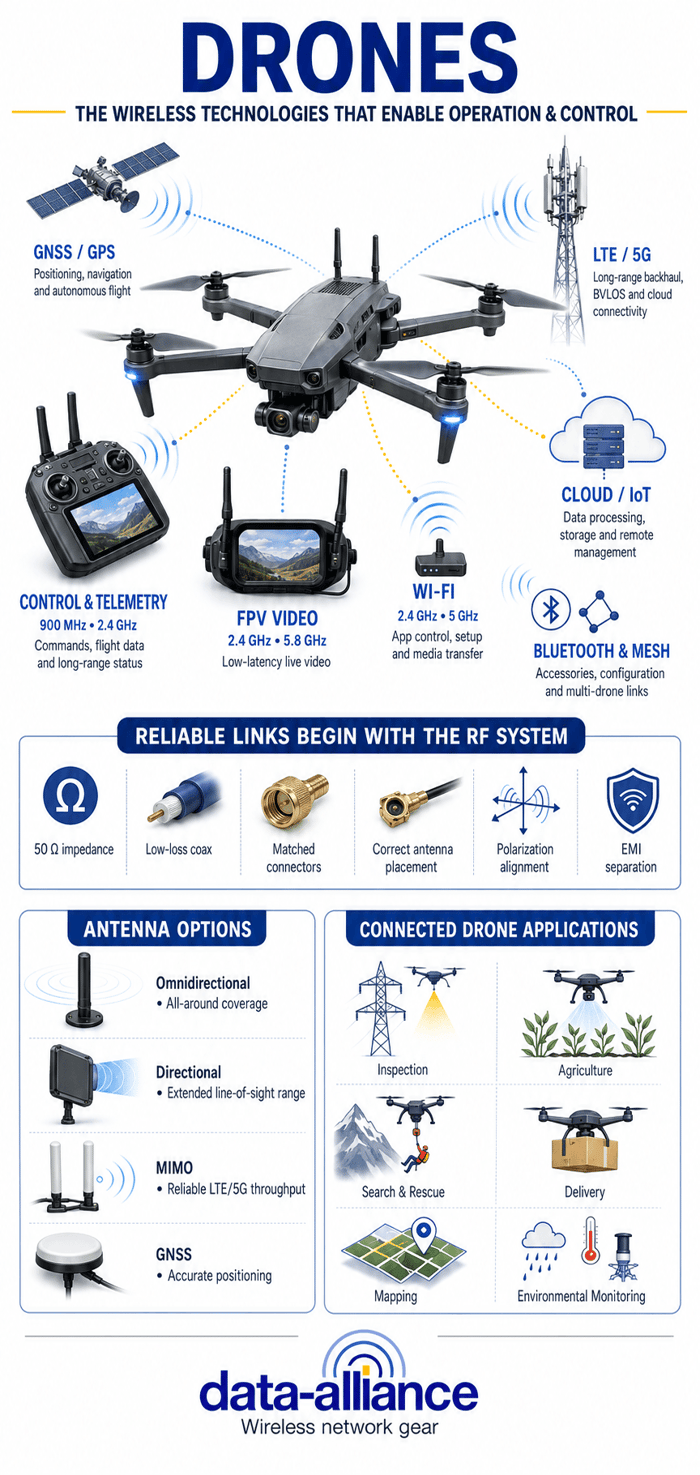
Reliable drone communication does not depend solely on the wireless protocol used. The performance of RF antennas, coaxial cables, connectors, impedance matching (50 ohm systems), and proper antenna placement plays a critical role in maximizing range, minimizing latency, and ensuring stable data transmission. Poor RF design often limits performance more than the wireless technology itself.

Wireless technologies play a crucial role in the operation and control of drones (unmanned aerial vehicles or UAVs). These technologies enable communication between various components of the drone system and facilitate remote control, data transmission, and real-time monitoring. Here are some of the key wireless technologies commonly used in drones:
Radio Control (RC) Transmitters:
RC transmitters use radio frequencies to send control signals from the operator (pilot) to the drone's flight controller. These signals control the drone's movements, including throttle, pitch, roll, and yaw. 2.4 GHz is a typical frequency band for RC communication due to its reliability and range.
Antenna selection significantly affects RC link stability. Many drone controllers use 2.4 GHz monopole or dipole antennas with SMA or RP-SMA connectors. Upgrading to a higher-gain directional antenna (such as a patch or Yagi) can increase control range in line-of-sight applications. Proper polarization alignment between transmitter and receiver antennas is also essential for maximum signal strength.
Telemetry Systems:
Telemetry systems provide real-time data from the drone to the operator. This data includes altitude, GPS coordinates, battery voltage, and other essential flight parameters. Telemetry data is transmitted over a wireless link using frequency bands, such as 900 MHz or 2.4 GHz.
900 MHz telemetry links are often preferred for long-range UAV applications due to better propagation characteristics and improved obstacle penetration compared to 2.4 GHz. Using low-loss coaxial cables (such as LMR-type cables) and minimizing connector transitions helps preserve signal integrity, especially in extended-range drone systems.
GPS (Global Positioning System):
GPS is essential for drones to accurately determine their location and navigate. Drones use GPS signals from satellites to calculate their position in three dimensions. This information is crucial for autonomous flight and waypoint navigation.
Wi-Fi:
Many consumer drones are equipped with Wi-Fi for communication between the drone and a smartphone or tablet, which serves as a remote control interface or a display for live video streaming. Wi-Fi is also used to transfer captured photos and videos from the drone's camera to the operator's device.
FPV(First-Person View) Systems:
FPV systems allow the operator to view live video feeds from the drone's onboard camera in real time. These systems often use analog or digital video transmission technologies in the 5.8 GHz or 2.4 GHz frequency bands, providing low-latency video feeds to the operator's goggles or screen.
Digital FPV systems benefit from high-efficiency 5.8 GHz antennas with circular polarization (RHCP or LHCP) to reduce multipath interference. Antenna placement away from high-current ESC wires helps minimize RF noise and video interference.
Remote Data Links:
Beyond visual line of sight (BVLOS), operations require long-range data links for controlling and monitoring the drone. These links often use specialized radio communication equipment operating in frequency bands such as 900 MHz or 2.4 GHz.
LTE / 4G / 5G Connectivity:
Some advanced drones have cellular connectivity ( LTE, 4G, or 5G) to enable remote control and data transfer over cellular networks. This allows for extended range and more reliable communication in areas with cellular coverage.
Cellular-enabled drones rely on embedded LTE/4G or 5G modules with MIMO antenna configurations to maintain reliable connectivity. Proper antenna selection is critical to optimize:
- Signal strength (measured in dBm)
- SINR (Signal-to-Interference-plus-Noise Ratio)
- Data throughput
- Network stability during mobility
Many LTE drone modules use U.FL or MHF4 internal connectors that require precision external antenna integration. Selecting a multiband LTE antenna covering major cellular bands ensures compatibility across different carriers.
For industrial and BVLOS drone operations, external high-efficiency LTE antennas mounted outside carbon fiber airframes can significantly improve cellular performance.
Bluetooth:
Bluetooth technology is used in some drones for short-range communication with accessories like remote controllers, smartphones, or tablets. It may be used for tasks like firmware updates or configuring the drone.
Radio Frequency Identification (RFID): RFID technology can be used for identification and tracking purposes in drone applications. It allows drones to read RFID tags on objects or locations for various industrial and logistical applications.
Mesh Networking:
In some cases, drones can be equipped with mesh networking capabilities, allowing them to form ad-hoc wireless networks with other drones or ground stations. This can be useful for collaborative missions or search and rescue operations.
The choice of wireless technologies for a drone depends on its intended use, range requirements, and regulatory considerations. To operate drones safely and effectively, it's essential to comply with local regulations and ensure secure and reliable communication.
Drone Antenna Systems and RF Components
Provide 360° horizontal coverage. Ideal for:
- General flight operations
- Short-to-medium range missions
- LTE and telemetry applications
Common types:
- Dipole antennas
- Whip antennas
- Rubber duck antennas
Concentrate RF energy in a focused beam for extended range.
Examples:
- Patch antennas
- Yagi antennas
- Panel antennas
Best for:
- Long-range RC control
- BVLOS operations
- Fixed ground control stations
MIMO Antennas for LTE/5G Drones
Modern LTE and 5G drones use:
- 2x2 MIMO
- 4x4 MIMO
Proper antenna spacing and orientation are required to avoid signal correlation and performance degradation.
Common Drone RF Connector Types
- U.FL (IPEX) – Ultra-miniature connector used on compact LTE/GPS modules
- MHF4 – Smaller alternative to U.FL for newer cellular modules
- SMA – Threaded RF connector commonly used on external antennas
- RP-SMA – Reverse polarity SMA used in WiFi systems
- MMCX – Snap-on connector for compact RF systems
Ensuring connector compatibility prevents signal loss and mechanical stress.
Coaxial Cables for Drone Applications
Coaxial cable selection affects insertion loss, especially at higher frequencies (2.4 GHz, 5.8 GHz, LTE bands). Shorter cable runs reduce attenuation. For external antenna mounting, low-loss coax types are recommended to preserve link budget performance.
Extension Cables & Adapters
Each adapter introduces small insertion loss. For optimal performance, minimize the number of adapters in the RF chain and use high-quality 50-ohm impedance-matched components.
RF Optimization Best Practices for Drone Systems
- Maintain 50-ohm impedance across antennas, cables, and modules
- Minimize cable length to reduce signal attenuation
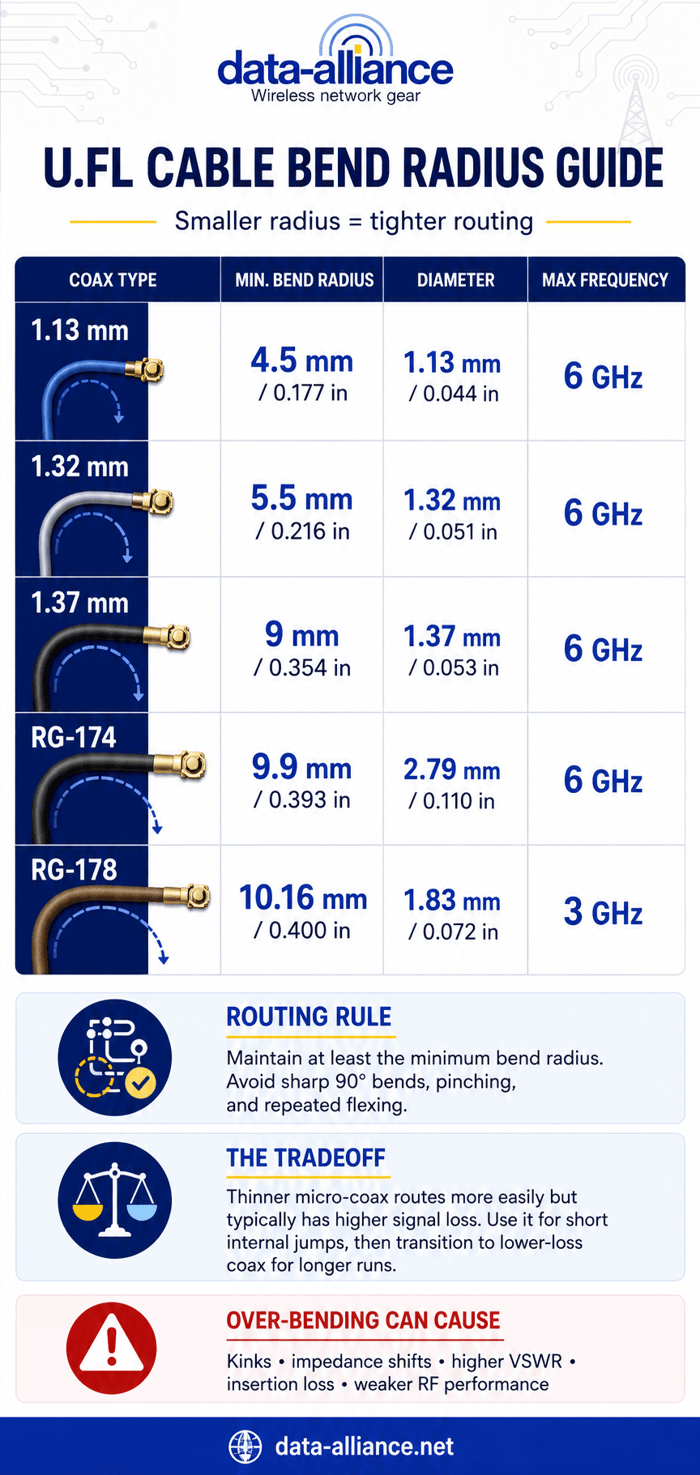
- Avoid sharp cable bends to prevent impedance discontinuities
- Mount antennas away from carbon fiber frames when possible
- Separate GPS and LTE antennas to reduce interference
- Ensure proper grounding and shielding
Drones as an Aspect of the Internet of Things
Drones are increasingly becoming an integral aspect of the Internet of Things (IoT) ecosystem, contributing to the growing network of interconnected devices and sensors. They play a unique role in extending IoT capabilities to the skies and have various applications across various industries. Here's how drones are integrated into the IoT landscape:
- Data Collection and Sensing: Drones are equipped with various sensors, such as cameras, LiDAR, thermal imaging, and environmental sensors. These sensors collect data from the physical world and transmit it in real time to a central IoT platform. This data can be used for monitoring environmental conditions, gathering agricultural data, conducting infrastructure inspections, and more.
- Remote Monitoring and Surveillance: Drones are employed for remote monitoring and surveillance in industries like security, agriculture, and forestry. They capture live video feeds and other sensor data, enabling real-time monitoring of assets, facilities, or areas. This data can be analyzed and processed within the IoT ecosystem to detect anomalies or security threats.
- Search and Rescue Operations: Drones equipped with cameras and thermal imaging sensors are used in search and rescue missions. They can locate missing persons, monitor disaster-stricken areas, and relay critical information to rescue teams through the IoT network, aiding in more efficient and effective operations.
- Precision Agriculture: In precision agriculture, IoT-enabled drones are used for crop monitoring, soil analysis, and pesticide application. They collect data on soil moisture, nutrient levels, and crop health, which is then integrated with other IoT devices like weather stations and automated irrigation systems to optimize farming practices.
- Infrastructure Inspection: Drones with cameras and sensors are employed to inspect critical infrastructure, such as bridges, power lines, and pipelines. These inspections are often part of predictive maintenance programs within the broader IoT framework, helping to identify maintenance needs before they lead to failures.
- Delivery and Logistics: Companies are exploring drone delivery services as part of their IoT-driven logistics operations. Drones can transport packages and goods from one location to another, using IoT technology to communicate with centralized control systems and navigation aids to ensure safe and efficient delivery routes.
- Environmental Monitoring: Drones play a role in environmental conservation and monitoring. They collect data on wildlife, vegetation, and ecosystems, which is then integrated into broader environmental monitoring networks to assess and manage the impact of human activities.
- Emergency Response: During natural disasters or emergencies, drones can be rapidly deployed to assess damage, locate survivors, and assess the condition of infrastructure. The data collected is shared with emergency response teams via IoT networks to coordinate rescue and relief efforts.
- Fleet Management: When multiple drones are involved in operations, fleet management systems integrated with IoT can track each drone's status, location, and maintenance needs. This ensures efficient deployment and maintenance of the drone fleet.
- Traffic Management: Drones can be used for traffic management and monitoring, providing real-time traffic data to IoT-based systems that optimize traffic flow, reduce congestion, and enhance road safety.
As an aspect of the Internet of Things, drones bring new capabilities for data acquisition, remote monitoring, and automation across various industries. They enhance the IoT ecosystem by extending connectivity and data collection to previously inaccessible or hard-to-reach areas, contributing to more informed decision-making and improved operational efficiency.
As IoT edge devices, drones rely on secure and reliable wireless backhaul connections. LTE and 5G connectivity allows drones to transmit real-time sensor data to cloud-based IoT platforms. High-efficiency antennas improve uplink reliability, particularly in remote or weak-signal environments.
Drones operating in smart agriculture, smart cities, infrastructure monitoring, and industrial IoT applications require ruggedized antennas designed for vibration resistance, weather exposure, and wide temperature ranges.
Conclusion
Wireless technologies are fundamental to drone operation, but true performance depends on optimized RF infrastructure. Proper antenna selection, correct connector matching, low-loss coaxial cables, and strategic antenna placement significantly enhance range, signal reliability, and data throughput.
Whether operating via RC, telemetry, WiFi, or LTE/5G cellular networks, integrating high-quality RF components ensures stable communication and improved operational efficiency in both consumer and industrial drone applications.
For IoT-enabled UAV systems, professional-grade antennas and RF accessories remain one of the most effective ways to maximize wireless performance.
FAQs
What wireless technologies are used to control drones?
Drones use multiple wireless technologies depending on their application. These include 2.4 GHz Radio Control (RC) systems, 900 MHz or 2.4 GHz telemetry links, GPS for positioning, Wi-Fi for short-range communication, FPV video transmission (2.4 GHz or 5.8 GHz), and LTE/4G/5G cellular connectivity for long-range and BVLOS operations. The performance of these systems depends heavily on antenna quality, proper impedance matching (50 ohm systems), and correct RF component integration.
Why is antenna selection important for drone performance?
Antenna selection directly affects signal range, link stability, latency, and data throughput. Using the correct omnidirectional or directional antenna, ensuring proper polarization alignment, and minimizing cable loss can significantly improve control reliability and video transmission quality. In many cases, poor antenna configuration limits performance more than the wireless protocol itself.
What is the advantage of 900 MHz telemetry compared to 2.4 GHz?
900 MHz telemetry systems typically provide better range and obstacle penetration than 2.4 GHz links. Lower frequencies propagate more effectively through vegetation and structures, making them ideal for long-range UAV applications. However, antenna efficiency, cable quality, and minimizing connector transitions remain critical for preserving signal integrity.
How do LTE and 5G improve drone connectivity?
LTE/4G and 5G connectivity allow drones to communicate over cellular networks, enabling extended-range operations beyond visual line of sight (BVLOS). These systems use MIMO antenna configurations (2x2 or 4x4) to improve signal strength, SINR, throughput, and network stability. Proper integration of multiband LTE antennas and compatible connectors such as U.FL or MHF4 is essential for optimal performance.
What are the most common RF connectors used in drones?
Common drone RF connectors include:
- U.FL (IPEX) – Ultra-miniature connector used on LTE and GPS modules
- MHF4 – Smaller alternative used in newer cellular modules
- SMA – Threaded connector for external antennas
- RP-SMA – Reverse polarity connector often used in Wi-Fi systems
- MMCX – Compact snap-on connector
Ensuring connector compatibility prevents signal loss, impedance mismatch, and mechanical damage.
How do coaxial cables affect drone signal performance?
Coaxial cables introduce insertion loss, especially at higher frequencies such as 2.4 GHz, 5.8 GHz, and LTE bands. Using shorter cable runs and low-loss coaxial cables helps preserve signal strength and improve link budget performance. Each adapter or connector transition adds additional loss, so minimizing RF chain complexity is recommended.
How are drones integrated into the Internet of Things (IoT)?
Drones function as mobile IoT edge devices that collect and transmit real-time sensor data to cloud-based platforms via Wi-Fi, telemetry, or LTE/5G networks. They are widely used in precision agriculture, infrastructure inspection, environmental monitoring, logistics, and smart city applications. Reliable RF infrastructure, ruggedized antennas, and secure wireless backhaul connections are essential for maintaining consistent IoT data transmission.