


Antennas, Antenna Cables, Wireless Products: Technical Articles
5GHz Wireless Frequency: Properties, Applications & Comparison to 2.4GHz WiFi
Table of Contents
- What Is the 5GHz Wireless Frequency?
- Properties of 5GHz
- How Is Data Transmitted at 5GHz?
- Pros and Cons of 5GHz Wireless Communication
- Key 5GHz Applications
- More Things to Know
- Rounding Up
- FAQs
- What is the 5GHz wireless frequency?
- Is 5GHz the same as 5G?
- How many channels does the 5GHz band have?
- What are the main differences between 2.4GHz and 5GHz WiFi?
- How is data transmitted over 5GHz WiFi?
- What is the maximum speed of 5GHz WiFi?
- What types of antennas are used with 5GHz WiFi?
- Can 2.4GHz and 5GHz use the same SSID?
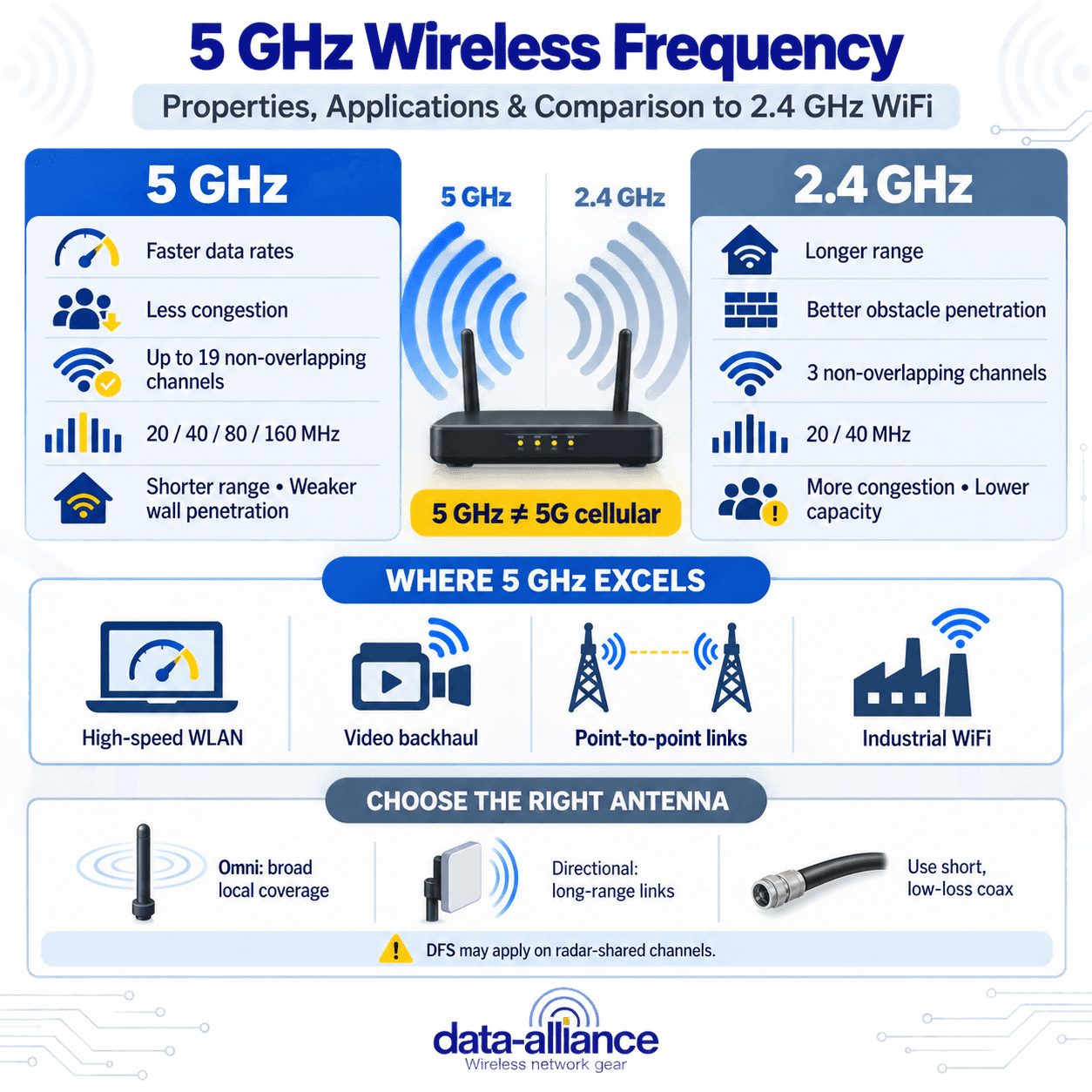
The 5GHz wireless frequency is a super-high-frequency (SHF) band used for high-throughput WiFi, fixed wireless links, and local networking. If you are choosing hardware, the practical questions are: how many channels does 5GHz have, how does it compare to 2.4GHz for range and speed, and which 5GHz antenna and connector type you need. This guide answers all three with verifiable specifications. One gigahertz equals one billion Hertz (cycles per second); at 5GHz the wavelength is measured in centimeters, which is why 5GHz radio waves are easily focused into narrow beams by conveniently sized antennas.
Is 5GHz the same as 5G? No. 5GHz is a radio frequency band; 5G is the fifth generation of cellular technology. Some 5G deployments use frequencies near or above 5 GHz, but the terms describe entirely different concepts — frequency versus cellular generation.
What Is the 5GHz Wireless Frequency?
The 5GHz wireless frequency range spans roughly 5.15 GHz to 5.85 GHz and is primarily composed of unlicensed UNII bands, whereas 900 MHz and 2.4 GHz are traditional ISM frequency bands. ISM and UNII bands are license-exempt in many regions but differ in regulatory origin and power rules, and specific limits vary by country. Because 5GHz is license-exempt, it is an accessible, lower-cost way to build local area networks — which is why the WiFi Alliance specified it in the 802.11 protocols discussed below.
Properties of 5GHz
The wavelength at 5 GHz is shorter than at the lower ISM frequencies and propagates best by line of sight in point-to-point communications. 5GHz has some penetration through walls, but signal attenuation by obstructions is greater than at lower ISM-band frequencies, and it reflects readily off metal and solid surfaces. Because of these propagation characteristics, 5 GHz networks depend heavily on correct antenna selection, placement, and polarization — especially in dense indoor or long-range outdoor deployments.
5GHz Channel Width
Individual 5 GHz WiFi channels are 20 MHz wide, with the option to bond channels together (40, 80, or 160 MHz) for higher data rates. Wider bonded channels raise peak throughput but reduce the number of non-overlapping channels available and increase susceptibility to interference — a key trade-off in dense deployments.
How Many Channels Does 5GHz Have?
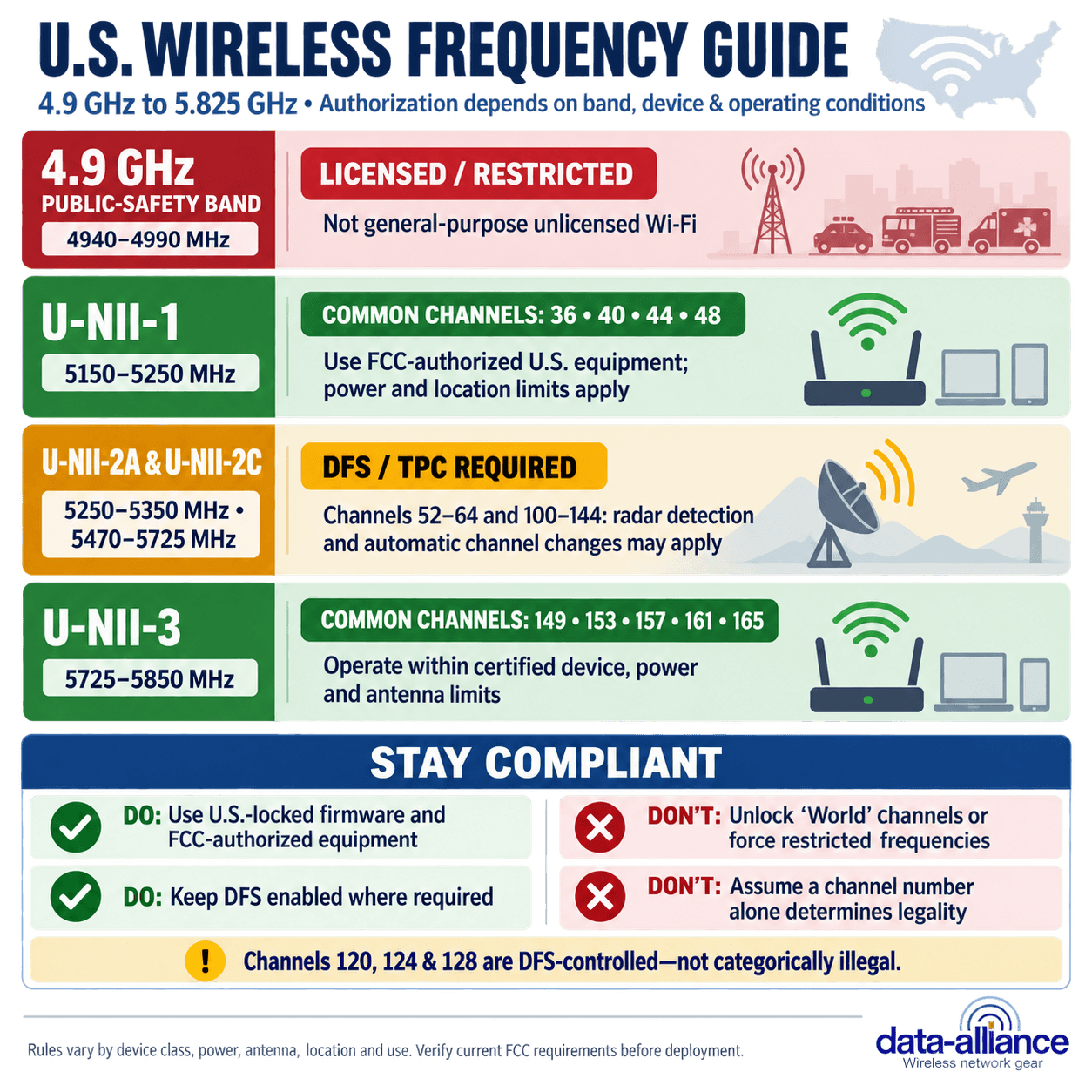
There are up to nineteen non-overlapping 5 GHz channels contained within four 20 MHz band groups:
- A-Lower (5.150–5.250 GHz): channels 36, 40, 44, 48 — specified for indoor use.
- A-Upper (5.250–5.350 GHz): channels 52, 56, 60, 64 — specified for indoor use.
- B band (5.470–5.725 GHz): eleven channels numbered 100 through 140 — indoor or outdoor use.
- C band (5.735–5.850 GHz): channels 149, 153, 157, 161, 165 — outdoor point-to-point use; portions are licensed.
The A-Upper and B bands are subject to Dynamic Frequency Selection (DFS) in many regions because they are shared with radar systems.
5GHz vs 2.4GHz
Knowing the difference between the 5 GHz and 2.4 GHz wireless frequencies lets you deploy each one optimally. The table below summarizes the main differences.
| 2.4GHz | 5GHz | |
| Band groups | 1 band | 4 band groups (UNII-1/2/2e/3) |
| Channel width | 20 MHz (up to 40) | 20 MHz, bondable to 40/80/160 MHz |
| Non-overlapping channels | 3 of 14 | Up to 19 |
| Modulation | DSSS / OFDM (802.11b/g/n/ax) | OFDM / OFDMA (802.11a/n/ac/ax) |
| Speed | Slower | Faster data rates than 2.4 GHz |
| Penetration | Greater through obstacles | Less penetration |
| Coverage | Greater range | More attenuation where obstacles are present |
| Signal quality | More congested; quality degrades under load | Less congested; higher signal quality |
How Is Data Transmitted at 5GHz?
The broad 5 GHz bandwidth and multiple channels drive the achievable link speed. Several techniques protect the band from the interference that affects 2.4 GHz:
- Dynamic Frequency Selection (DFS) is required on certain shared 5 GHz bands to avoid interfering with radar or military systems. DFS scans for traffic-free channels before transmitting — a Channel Availability Check (CAC) — and re-checks periodically while a channel is in use.
- OFDM makes 5GHz resilient against multipath interference from reflected and refracted signals by using dozens of orthogonal sub-carriers for parallel transmission, reducing inter-symbol interference.
- Transmission Power Control (TPC) reduces device output on the A-Upper, B, and C bands to the minimum needed for a reliable link, minimizing electromagnetic interference.
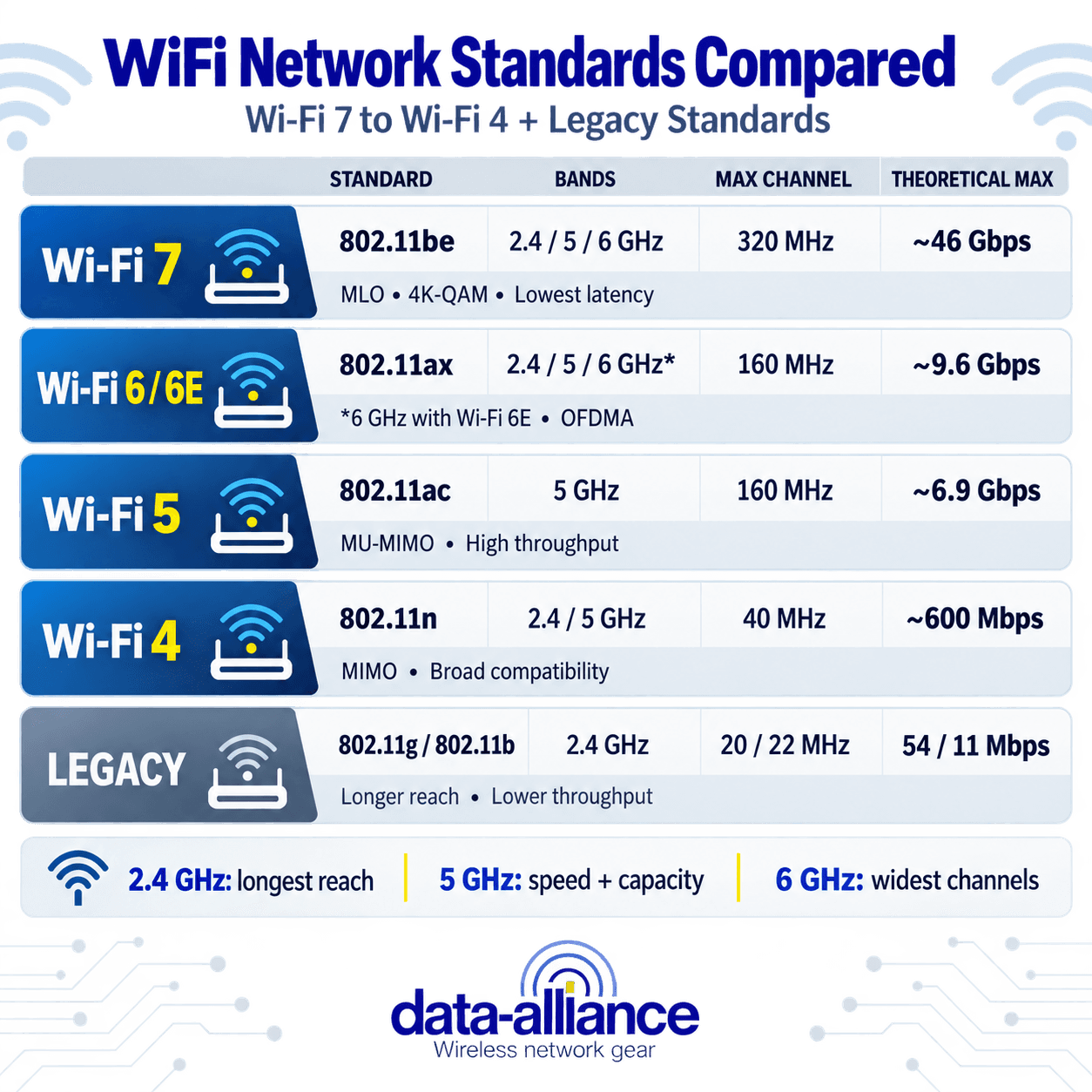
Newer standards such as Wi-Fi 6 (802.11ax) further improve efficiency through OFDMA, MU-MIMO, and better spatial reuse, letting 5 GHz networks support more devices simultaneously with lower latency. For a standard-by-standard breakdown, see our guide to WiFi network standards (802.11ax/ac/n/g/b).
Pros and Cons of 5GHz Wireless Communication
Certain 5 GHz sub-bands permit higher effective isotropic radiated power (EIRP) than 2.4 GHz — particularly for outdoor point-to-point links — subject to regional regulations. Higher permitted output power can help penetrate buildings and extend 5 GHz range to several kilometers on a clear path. Compared with 2.4 GHz, 5GHz has better scatter performance and is minimally absorbed by water, giving it better penetration of damp structures.
The trade-off: penetration of solid objects is still poorer than 2.4 GHz, which limits range and often requires more power. As 5GHz adoption has grown, the cost of 5GHz antennas, access points, and compatible wireless-frequency equipment has fallen, though it typically remains higher than comparable 2.4 GHz gear.
Key 5GHz Applications
5 GHz is favored for wireless LANs (WLANs) because of its speed and signal quality. Common indoor and outdoor uses include:
- 5 GHz internet access and modem/routers
- 5 GHz security cameras and video-surveillance backhaul
- Wireless printers, cordless phones, and baby monitors
- Fixed wireless backhaul and point-to-point links
- IoT gateways (high-throughput edge aggregation)
- Industrial Wi-Fi
5GHz is well suited to fixed wireless data links, some covering significant distances when high-gain directional antennas are used — often saving the cost of cabled connections.
What Is 5GHz WiFi?
WiFi as specified by the WiFi Alliance's 802.11 protocols can be delivered on the 5 GHz band. Early 5 GHz Wi-Fi (802.11a) delivered up to 54 Mbps, while modern 802.11ac and 802.11ax implementations reach hundreds of Mbps to multi-gigabit speeds, depending on channel width, spatial streams, and signal quality. The 802.11 variants that use 5 GHz include 802.11a, 802.11n, 802.11ac, and 802.11ax. Many routers and antennas are dual-band and use whichever of 2.4 GHz or 5 GHz gives the best connection.
5GHz Antennas
The antenna is a mission-critical part of getting the best performance out of 5GHz networking. Match the antenna to your deployment environment, available access points, and range goals. Broad categories:
- Directional 5 GHz antennas concentrate RF energy in one direction for maximum range.
- Omnidirectional 5 GHz antennas (omni dipoles) radiate over the full horizontal plane.
Also weigh polarization (vertical vs dual-pol), MIMO compatibility, and connector/cable losses when specifying an antenna.
Indoor 5GHz Antennas
5 GHz suits indoor connectivity; with adequate antenna gain the signal penetrates interior walls. If a router has replaceable antennas, a lower-frequency antenna can be swapped for a 5 GHz one, and a 5 GHz WiFi dongle can upgrade a laptop's connectivity.
Outdoor 5GHz Antennas
Outdoor 5GHz antennas are effective for point-to-point links because certain bands permit output up to 4 watts EIRP. High-gain directional antennas harness this for long-distance transmission, and 5GHz copes with scatter and reflection better than 2.4 GHz in near-line-of-sight paths.
Notable Types of 5GHz Antenna
Horn: a horn-shaped waveguide directs the radio waves; popular above 1 GHz for moderate directivity, broad bandwidth, and low SWR. Browse 5 GHz antennas.
Yagi: a classic multi-element dipole design and an ideal directional 5 GHz Wi-Fi extender for long-range, high-speed links; outdoor units are often housed in a protective radome.
Sector: provides long-distance coverage over a wide arc; combining multiple sectors approximates 360-degree coverage, useful for ranches, RV parks, and campuses.
Patch/panel: horizontally or vertically polarized, a discreet option for indoor or outdoor coverage.
More Things to Know
Why Can't I Connect to 5GHz WiFi?
- Your device or router may not be 5GHz-capable — common with older or budget hardware configured only for 2.4 GHz.
- Restart the device and re-check for the 5 GHz SSID.
- If it still doesn't appear, reset the network settings.
- Inspect for physical damage; antennas can be replaced if faulty.
Cables and Adapters for 5GHz WiFi Antennas
A 5GHz antenna must be connected to your radio with compatible cables and adapters. The most common 5GHz connector types are SMA and RP-SMA and U.FL. Connectors come in male and female genders and may require a specific cable or adapter depending on your antenna and device. For minimum insertion loss, match the connector genders and cable type to your hardware — and use the lowest-loss coax practical for the run length. If you're unsure which cable or adapter you need, contact our technical support or request a custom quote.
Rounding Up
As demand grows for faster, cleaner, more reliable wireless links, the 5GHz wireless frequency remains a cornerstone for Wi-Fi, fixed wireless, and industrial networking. Selecting the right antenna, cabling, and deployment strategy is essential to unlocking its full performance in both indoor and outdoor environments. Data Alliance manufactures custom antenna cables and stocks 5GHz antennas, adapters, and connectors with same-day shipping on orders placed before 4pm MST.
FAQs
What is the 5GHz wireless frequency?
The 5GHz wireless frequency is part of the super-high-frequency (SHF) band used to transmit electromagnetic energy as radio waves at roughly five billion cycles per second. It is widely used for high-speed WiFi, fixed wireless links, and local area networks.
Is 5GHz the same as 5G?
No. 5GHz refers to a radio frequency band, while 5G is the fifth generation of mobile network technology. Both are used for wireless communication but serve different purposes.
How many channels does the 5GHz band have?
Up to 19 non-overlapping channels across four 20 MHz band groups — A-Lower, A-Upper, B, and C — each designated for specific indoor or outdoor use. Channels can be bonded to 40, 80, or 160 MHz for higher throughput.
What are the main differences between 2.4GHz and 5GHz WiFi?
5GHz WiFi offers faster speeds and less interference but has shorter range and weaker wall penetration than 2.4 GHz, which covers larger areas at slower speeds.
How is data transmitted over 5GHz WiFi?
Data at 5GHz is transmitted using technologies such as Dynamic Frequency Selection (DFS), Orthogonal Frequency Division Multiplexing (OFDM/OFDMA), and Transmission Power Control (TPC), which reduce interference and optimize signal quality.
What is the maximum speed of 5GHz WiFi?
Early 5 GHz Wi-Fi (802.11a) reached 54 Mbps; modern 802.11ac and 802.11ax implementations reach hundreds of Mbps to multi-gigabit speeds. Actual throughput depends on the Wi-Fi standard, channel width, antenna gain, interference, and client capability — not frequency alone.
What types of antennas are used with 5GHz WiFi?
5GHz antennas include directional, omnidirectional, horn, yagi, sector, and patch/panel types. The right choice depends on indoor vs outdoor use, range requirements, and coverage needs.
Can 2.4GHz and 5GHz use the same SSID?
Yes. The same network name (SSID) can be used for both 2.4 GHz and 2.4/5 GHz dual-band networking. Devices that support only 2.4 GHz will simply use that band and won't "see" the 5 GHz radio.