


Antennas, Antenna Cables, Wireless Products: Technical Articles
LTE antennas: Reduce Digital Noise to Improve Signal Quality
Table of Contents
LTE Antennas: How to Reduce Digital Noise and Improve Signal Quality (4G, 5G, IoT)
If the amount of digital noise picked up by your cellular antennas (LTE 4G or 5G) is causing a severe degradation of signal quality in specific areas. This article explains how to filter out signal noise.
At Data Alliance, we specialize in LTE, 4G, and 5G antenna solutions including bandpass filters, low-noise amplifiers (LNAs), and high-performance antenna systems designed to improve signal-to-noise ratio (SNR) in real-world deployments.
To address the issue of digital noise in cellular (LTE) antennas and improve signal quality, there are several approaches you might consider:
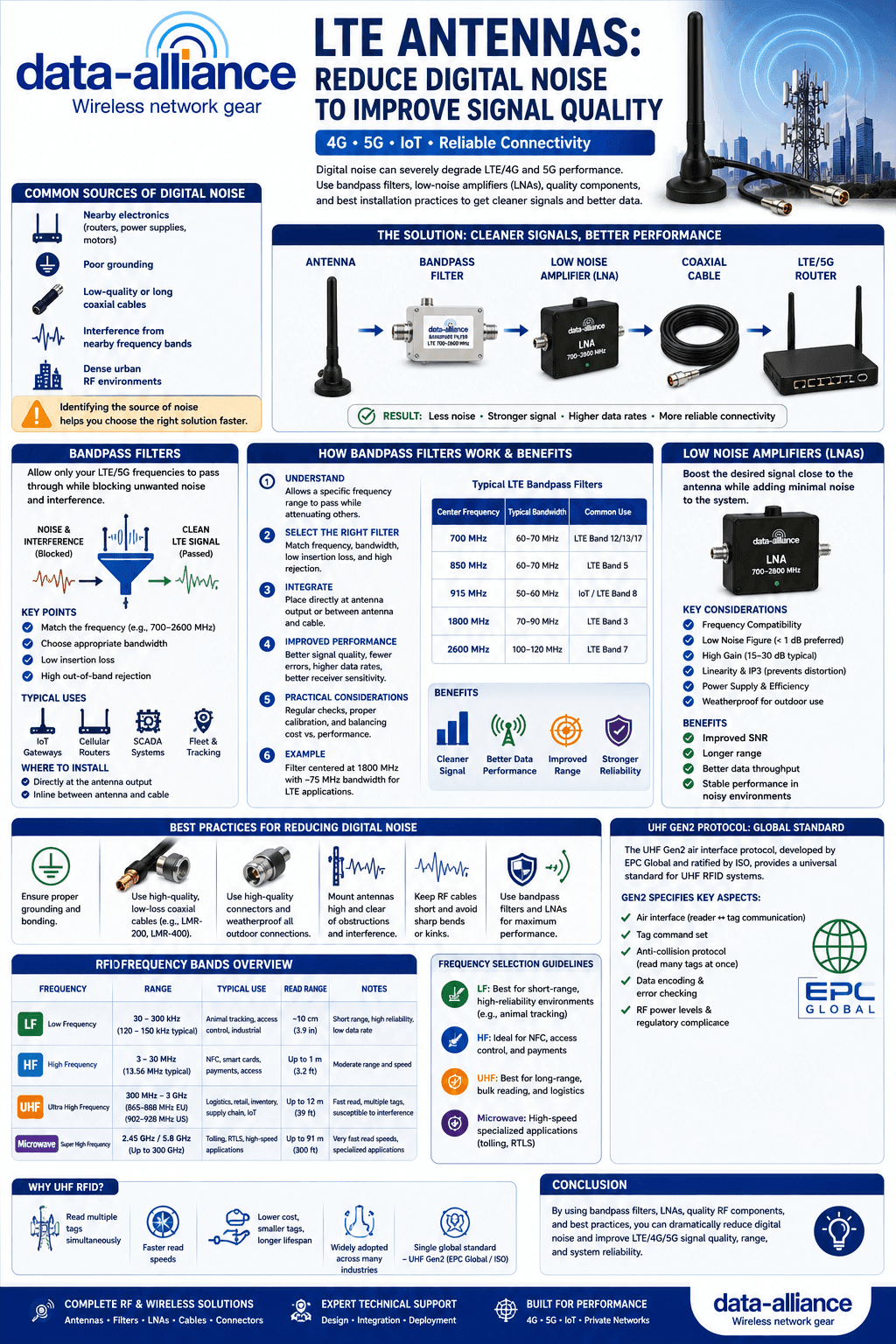
Common Sources of Digital Noise in LTE Systems
- Nearby electronics (routers, power supplies, motors)
- Poor grounding
- Low-quality or long coaxial cables
- Interference from nearby frequency bands
- Dense urban RF environments
Note: Identifying the source of noise helps you choose the right solution faster.
Use of Bandpass Filters
Bandpass filters are one of the most effective ways to reduce unwanted noise. They allow only your LTE frequencies to pass through while blocking interference from other signals.
Key Points:
What They Do
A bandpass filter isolates the frequencies your antenna needs and removes everything else.
How to Choose One
- Match the frequency (e.g., 700–2600 MHz for LTE)
- Choose appropriate bandwidth
- Look for low insertion loss
- Ensure strong out-of-band rejection
Data Alliance offers bandpass filters for common LTE bands such as 700 MHz, 850 MHz, 915 MHz, 1800 MHz, and 2600 MHz.
Typical uses:
- IoT gateways
- Cellular routers
- SCADA systems
Where to Install
- Directly at the antenna output
- Inline between antenna and cable
Benefits
- Cleaner signal
- Better data performance
- Improved receiver sensitivity
Here's a detailed look at how bandpass filters work and how they can be implemented:
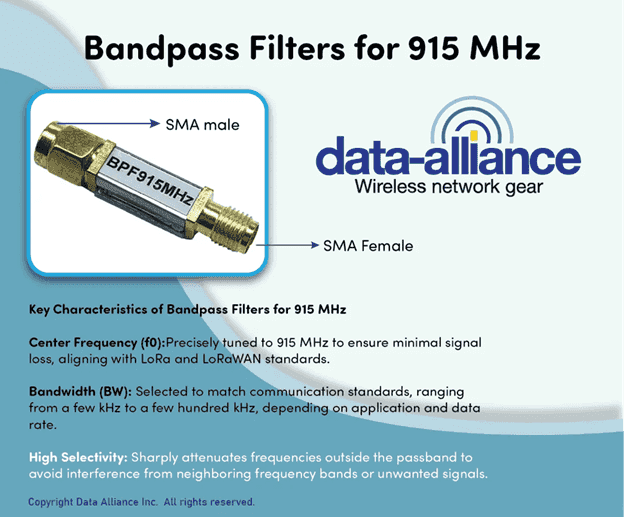
1. Understanding Bandpass Filters
A bandpass filter allows frequencies within a specific range to pass through while attenuating frequencies outside that range. This helps isolate the desired signal from unwanted noise or interference. These filters are crucial for LTE, 5G, and 4G antennas because they help ensure the antenna receives only the frequencies relevant to its operation.
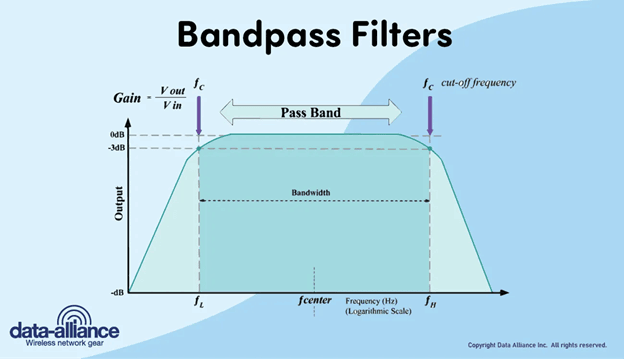
2. Selection of Bandpass Filters
The selection of the right bandpass filter depends on several factors:
- Frequency Range: The filter must match the operating frequency range of the antenna. For example, 4G LTE frequencies might range from 700 to 2600 MHz, depending on the band.
- Bandwidth: The filter's bandwidth should be wide enough to allow the necessary signals through but not so wide that it lets in too much noise.
- Insertion Loss: Lower insertion loss is preferable as it implies less signal is lost as it passes through the filter.
- Rejection: High rejection outside the passband ensures that unwanted signals are effectively blocked.
3. Integration with Antenna System
Integrating bandpass filters in antenna systems involves placing them in the signal path between the antenna and the receiver. This can be done in several ways:
- Direct Integration: The filter is directly connected to the antenna's output, filtering the signal before it reaches any other component.
- System-Level Integration: Filters can be placed between the antenna and the antenna cable or integrated at other stages of the signal processing chain—not just at the antenna output.
4. Impact on Antenna Performance
The use of bandpass filters can greatly enhance antenna performance:
- Improved Signal Quality: By filtering out noise and interference, the quality of the received signal improves, which is crucial for maintaining high data rates and stable connections in LTE, 5G, and 4G networks.
- Increased System Capacity: Cleaner signals mean less error correction and retransmission, effectively increasing the system’s capacity.
- Enhanced Receiver Sensitivity: With less noise, the receiver can better detect weaker signals, particularly in environments with poor signal conditions.
5. Practical Considerations
- Maintenance and Calibration: Filters need regular checks and calibration to ensure they operate at their optimal specifications.
- Cost vs. Benefit: The cost of implementing high-quality filters needs to be balanced against the performance improvement they offer.
6. Examples of Use
An LTE system might use a bandpass filter centered around 1800 MHz with a bandwidth of about 75 MHz to ensure that only the signals within this band are amplified and processed further. Similarly, for 5G systems operating at higher frequencies, such as 28 GHz, precise and high-quality filters are essential to cope with the broader range of frequency bands.
By strategically using bandpass filters, the performance of LTE, 5G, and 4G antennas can be significantly enhanced, leading to better overall network performance and user satisfaction.
Low Noise Amplifiers (LNAs)
Adding a low-noise amplifier close to the antenna can boost the desired signal while adding minimal noise to the system, improving the signal-to-noise ratio (SNR).
LNAs are used to amplify the received signals while minimizing the addition of noise, thus improving the overall performance of the antenna system. Here’s a detailed guide on how to effectively use LNAs for reducing signal noise and enhancing antenna performance:
1. Selection of the LNA
- Frequency Compatibility: Choose an LNA compatible with the frequency bands of your LTE, 5G, or 4G network. The LNA should support the specific frequencies used by the cellular service to ensure effective amplification.
- Noise Figure: Select an LNA with a low noise figure. The noise figure indicates how much noise the amplifier adds to the signal. A lower noise figure (typically less than 1 dB) is preferable as it means less additional noise.
- Gain: Ensure the LNA provides sufficient gain to improve the signal-to-noise ratio (SNR) without causing signal distortion. The gain needed depends on your specific setup and signal conditions.
2. Installation
- Proximity to Antenna: Install the LNA as close to the antenna. The longer the cable between the antenna and the LNA, the greater the potential for signal loss and noise introduction before amplification.
- Shielding and Isolation: Use shielded cables and enclosures to prevent external electromagnetic interference. Proper isolation from other electronic devices is crucial to avoid cross-talk and interference.
3. Integration with Existing Systems
- Impedance Matching: Ensure the LNA is impedance-matched to both the antenna and the subsequent system components to maximize power transfer and minimize reflections.
- Avoid Overloading: Be mindful of the LNA's output power to avoid overloading the receiver, which can lead to signal distortion and degradation.
4. Testing and Optimization
- Test Under Various Conditions: After installation, test the system performance under various environmental conditions and signal strengths. Based on these tests, adjust the LNA's placement or settings.
- Use of Filters: Consider integrating band-pass or low-pass filters before or after the LNA to reduce out-of-band noise and prevent interference from nearby frequency bands.
5. Maintenance
- Regular Checks: Regularly check the physical and operational integrity of the LNA and associated cabling. Look for signs of wear, loose connections, or corrosion, which can affect performance.
- System Updates: Keep the system firmware and software updated to ensure compatibility and optimal performance with the evolving cellular network standards.
6. Advanced Techniques
- Digital Signal Processing (DSP): DSP techniques are used with the LNA to improve signal quality through digital filtering and noise reduction algorithms.
- Adaptive Gain Control: Implement adaptive gain control systems that dynamically adjust the LNA's gain based on the incoming signal strength to maintain optimal performance without saturation.
By carefully selecting, installing, and maintaining an LNA, you can significantly enhance the performance of LTE, 5G, and 4G antenna systems, leading to better signal quality and more reliable communication.
Digital Signal Processing (DSP)
Advanced DSP techniques can filter out noise at the receiver end. Using Digital Signal Processing (DSP) to reduce signal noise in LTE, 5G, and 4G antennas involves sophisticated techniques that enhance signal integrity and improve overall performance. DSP can be particularly effective in environments with high interference or multipath propagation.
Techniques like adaptive filtering, which dynamically adjusts according to the interference patterns, can be particularly effective.
Here are key strategies to leverage DSP in improving cellular antenna performance:
1. Noise Reduction Techniques
- Adaptive Filtering: This technique dynamically adjusts the filter coefficients based on the changing characteristics of the signal and noise. Adaptive filters are excellent for environments where interference characteristics vary, such as in urban settings with dynamic signal conditions.
- Spectral Subtraction: This method involves estimating and subtracting the noise spectrum from the signal spectrum. It is commonly used to clean up audio signals but can be adapted for signal processing for data communications to reduce background noise.
2. Interference Cancellation
- Active Noise Cancellation: DSP algorithms can generate a signal that is the exact opposite (anti-phase) of the noise component in the received signal, effectively canceling it out. This technique requires accurate noise estimation and fast processing speeds.
- Beamforming: Used extensively in 5G systems, beamforming involves using multiple antennas with DSP to direct the reception or transmission of signals in specific directions. This spatial filtering significantly improves the signal-to-noise ratio by focusing the antenna's gain toward the desired signal source and away from sources of interference.
3. Error Correction
- Forward Error Correction (FEC): This method adds redundancy to the transmitted data, allowing the receiver to detect and correct errors without retransmission. DSP algorithms decode these error-correcting codes to improve the reliability of data transmission over noisy channels.
4. Signal Modulation and Demodulation
- Complex Modulation Schemes: DSP is used to implement advanced modulation schemes, such as Quadrature Amplitude Modulation (QAM), in LTE and 5G systems. These schemes are more sensitive to noise, and DSP helps accurately demodulate the received signals despite the noise.
5. Equalization
- Channel Equalization: To combat the effects of channel fading and intersymbol interference, DSP algorithms can dynamically adjust equalizer settings based on the estimated channel conditions. This compensates for distortions and can significantly clear up the received signal.
6. Implementation Considerations
- Hardware and Software: Implementing DSP techniques requires powerful processors that can handle complex calculations at high speeds. This might involve dedicated DSP chips or using software-defined radio (SDR) platforms where the DSP algorithms run on a general-purpose processor or a field-programmable gate array (FPGA).
- Real-Time Processing: Ensure that the DSP algorithms are optimized for real-time processing to avoid latency, which is critical in communication systems.
7. Testing and Optimization
- Simulation and Testing: Before deploying DSP techniques in live environments, simulate the conditions and DSP algorithms to fine-tune the system. This helps in identifying the optimal settings for filters, equalizers, and other parameters.
- Continuous Monitoring and Adjustment: Regular monitoring and adjustment of the DSP settings are necessary to adapt to changes in the operating environment and maintain optimal performance.
By integrating these DSP techniques, you can significantly enhance the performance of LTE, 5G, and 4G antennas, resulting in better signal clarity, higher data rates, and improved reliability of wireless communications.
Additional Ways to Reduce Signal Noise for 5G & 4G Antennas
1. Antenna Design and Placement
Directional Antennas: Use directional antennas that focus their reception and transmission in a specific direction rather than omnidirectional antennas. This can help in reducing the noise from unwanted directions.
Antenna Placement: Sometimes, simply relocating the antenna can significantly reduce noise. Avoid placing antennas near other electronic devices or in areas where obstacles can reflect signals and create multipath interference.
2. Shielding and Grounding
Shielding: Ensuring that the antenna and associated cabling are well-shielded can prevent external electromagnetic interference from degrading the signal.
Grounding: Proper grounding of antenna systems can reduce the pickup of electrical noise.
3. Regular Maintenance
Periodic checks and maintenance of the antenna system, including connectors and cabling, can help in identifying and resolving issues that may lead to increased noise.
4. System Updates and Configuration
Ensure that all firmware and software associated with your cellular system are up-to-date. Sometimes, updating the system or tweaking configuration settings can optimize performance and reduce noise.
Coaxial Cables and Connectors
Poor cables and connectors can introduce both noise and signal loss.
Best practices:
- Use low-loss cable (LMR-400 or better for long runs)
- Match SMA connectors correctly
- Minimize adapters
- Avoid unnecessary cable length
High-quality RF cables and connectors are critical for stable LTE performance.
Troubleshooting Checklist
If signal quality is poor:
- Move or elevate the antenna
- Try a directional antenna
- Add a bandpass filter
- Install an LNA near the antenna
- Check cables and connectors
- Verify grounding
For more complex setups, Data Alliance technical support can help recommend the right solution.
Conclusion
Reducing digital noise in LTE systems usually requires a combination of the right components and proper installation.
Using bandpass filters, LNAs, correct antenna types, and quality cabling can significantly improve signal quality and reliability.
Data Alliance offers antennas, filters, cables, and RF accessories designed for LTE, 4G, 5G, and IoT applications.
FAQs
What causes digital noise in LTE antennas?
Digital noise in LTE antennas is commonly caused by nearby electronic devices, poor grounding, low-quality or long coaxial cables, interference from adjacent frequency bands, and high RF congestion in urban environments.
How do bandpass filters improve LTE signal quality?
Bandpass filters improve signal quality by allowing only the desired LTE frequency range to pass through while blocking unwanted frequencies, reducing interference and enhancing the signal-to-noise ratio (SNR).
What is the role of a Low Noise Amplifier (LNA) in LTE systems?
An LNA boosts weak incoming signals while adding minimal noise, helping improve overall signal clarity and receiver sensitivity, especially in low-signal environments.
Where should an LNA be installed for best performance?
For optimal performance, an LNA should be installed as close to the antenna as possible to minimize signal loss and noise before amplification.
How does Digital Signal Processing (DSP) reduce noise in LTE systems?
DSP reduces noise using techniques such as adaptive filtering, interference cancellation, and error correction, which help clean and stabilize signals in high-interference environments.
Does antenna placement affect digital noise levels?
Yes, proper antenna placement is critical. Positioning antennas away from interference sources and using directional antennas can significantly reduce noise and improve signal quality.
What are simple ways to reduce LTE antenna noise without major upgrades?
Basic steps include improving grounding, using shielded cables, relocating the antenna, performing regular maintenance, and ensuring system firmware is up to date.